

Covering an off-color brow tattoo adds darker ink and can make removal longer. Learn when to fade first, which inks darken with laser, and what to expect.
Published
Updated

Author
Wi Young-jin · Chief director
Seoul National University College of Medicine · Seoul National University Hospital Specialist
→
If your eyebrow tattoo has shifted to a cool blue-gray, healed uneven, or simply doesn't match your face anymore, your first instinct might be to book a touch-up and draw a better brow right over it. It's an understandable plan. You want it fixed, and covering it feels faster than removing it.
Here's the catch: every layer you add to a brow tattoo that's already gone off-color usually means more ink to deal with later. To hide what's underneath, the new layer has to be darker, and darker, denser ink tends to take more laser sessions to fade. So even if you fully intend to get your brows redone, fading the old pigment first is often the shorter road in the long run. One more wrinkle: some brown and flesh-toned brow inks can turn darker the moment a laser hits them, so the order of steps depends on what's actually in your skin.
In this article, we'll cover why cover-ups tend to make removal harder, three quick questions that help you decide between covering and fading first, which pigments need a test spot before treatment, what to watch for during removal, and how a cautious removal plan is usually built.
Why Do Cover-Ups Make Eyebrow Tattoo Removal Harder?
Short answer: covering requires darker ink, and darker ink adds to the removal workload. Tattoo ink is translucent, so you can't simply paint a lighter shade on top and expect the old color to disappear. The new layer has to be dark enough to block what's beneath it.
Dermatologists even account for this when estimating how many laser sessions a tattoo will need. The Kirby-Desai scale, a scoring system built to predict removal sessions, notes that covering an older tattoo calls for darker tones and assigns 2 extra points when a tattoo has been layered or covered up. On that scale, a higher total score points to more sessions.
Brows are especially prone to this. Cosmetic brow tattoos fade over time, so many people get regular touch-ups. A brow that turned blue-gray gets a fresh layer of brown, then a slightly wider outline because the shape still looks off, and so on. From the outside it may look like one color. In the skin, there can be several overlapping layers of different pigments, each of which may respond to the laser a little differently.
That's why a cover-up can feel like a fix today and turn into a longer project later. It isn't that covering never works. It's that each additional layer makes the eventual removal less predictable.
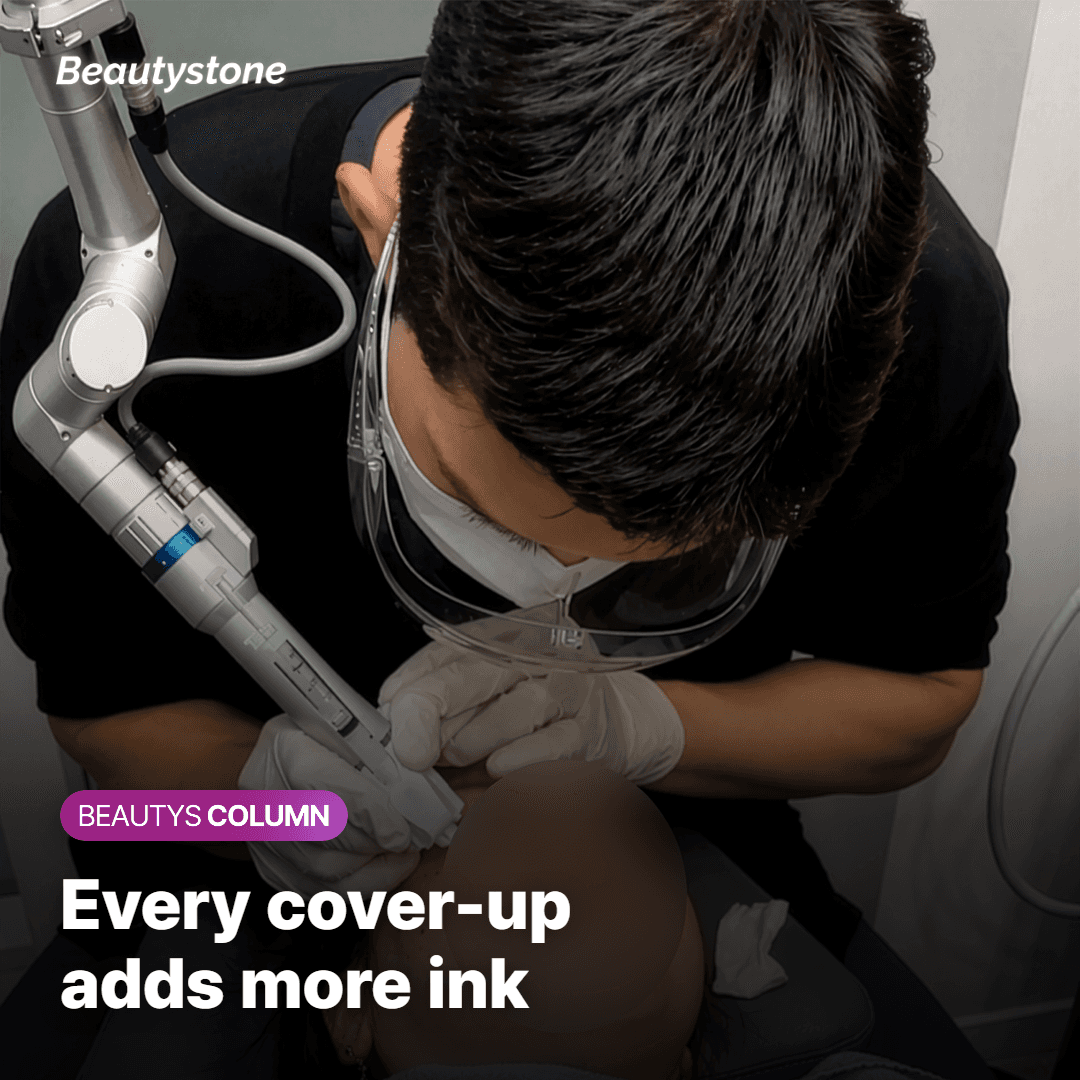
Cover Up or Fade First? Three Questions to Ask in the Mirror
Before you book a touch-up, take a good look in natural light and ask yourself three things. If any answer lands in the right-hand column, it's worth talking about fading first.
What to check | Covering may be reasonable | Consider fading first |
|---|---|---|
Current color | Close to the brown you want, just lighter | Shifted to blue-gray, red, or orange |
Shape and position | You only need to fill in density within the current outline | It sits outside your natural brow line, or the two sides are at different heights |
Number of layers | This was your first session and you've had it done once | You've already covered it two or three times and the color keeps drifting |
Putting a similar shade over a brow that's already drifted in color often looks fine at first. A few months later, though, the old tone can start showing through again, and you're back where you started, with more ink in the skin than before.
Shape matters as much as color. If the existing outline sits too high, too low, or too far toward the temple, a cover-up has to stay inside that outline or extend beyond it. Neither option gives your brow artist a clean canvas. Fading the misplaced section first can give them room to redraw where your brows naturally sit.
Can Brown or Flesh-Toned Brow Ink Turn Darker With Laser?
Yes, it can, and it's one of the main reasons brow tattoo removal starts with a test spot. Many brown, tan, and flesh-toned cosmetic pigments contain iron oxide*, which is used to create warm reddish-brown shades.
*Iron oxide: a metal oxide pigment that gives a reddish-brown tone. It's common in cosmetic tattoo inks for brows and lips.
A 1993 report described five cases in which white, flesh-toned, and pink-red cosmetic tattoos darkened immediately after laser treatment, and red-brown iron oxide also turned black in laboratory testing. The authors recommended treating a small test site before going ahead with the full area. In some cases the darkened pigment later faded with more sessions, but not in every case.
The type of laser seems to matter too. In an animal study comparing devices on mouse skin tattooed with white and flesh-colored ink, a picosecond laser caused significantly less of this paradoxical darkening than a Q-switched laser. Mouse skin isn't human skin, so the result can't be applied directly to people. Still, the principle holds: the device and energy settings should be chosen around the colors actually present in your brows.
This is also why covering a problem brow with white or flesh-toned ink, a common attempt to "erase" an unwanted line, can make later laser removal trickier rather than easier.
Side Effects and Risks: Watch Your Brow Hairs Too
Brow tattoo removal isn't only about the ink. The hairs growing through that area deserve attention as well. In a 2026 case report, a blue-tinted eyebrow tattoo was lightened with a Q-switched ruby laser over five sessions spaced four weeks apart, and the patient's eyebrow hair density decreased. The authors noted the change wasn't consistent with scarring, but they described it as an adverse effect patients should hear about before treatment starts.
That's a single case, so it doesn't tell you how often this happens. It does tell you why it's worth tracking two things at every visit: how much the color has faded and how the brow hairs look.
After each session, you may notice:
Redness and swelling: Common right after treatment, and they usually settle within a few days.
Crusting: Small scabs can form. Let them fall off on their own and never pick at them.
Temporary color changes: The treated area may look uneven while it heals.
If redness spreads, the area becomes increasingly painful or warm, you see pus, or you develop a fever, seek medical care right away.
It's also wise to postpone removal if any of these apply:
You're pregnant or breastfeeding
There's inflammation, a cold sore, or a wound near your brows
You had a touch-up in the same area within the past few weeks
You've had keloids or raised, thick scars before

How a Test-Spot-First Removal Plan Works
There's no single schedule that fits every brow, because the plan depends on when the tattoo was done, how many times it was touched up, and which colors were used. A cautious approach usually looks like this:
Test spot: A small, less visible area, such as the outer tail of the brow, is treated first.
Check the response: Your provider looks at whether the pigment darkened and how the brow hairs are doing before planning the full area.
Spacing: For tattoo removal in general, sessions are often spaced six to eight weeks apart. For brows, that interval may be adjusted based on how your skin and hair respond.
Redraw timing: A new brow is usually planned once the skin has fully settled and the remaining pigment has been assessed, ideally together with your brow artist.
At Beautystone, a dermatology clinic in Seoul's Hapjeong area, brow tattoo removal with PicoWay starts the same way: a small test area first, a check for darkening and hair changes, and then a full plan. If you're planning to have your brows redrawn, let us know your timeline. In some cases it's possible to fade only the lines you won't keep and leave the ones that already work, which may reduce the number of sessions you need.
What to bring to your consultation: Jot down roughly when you got your first brow tattoo and how many touch-ups you've had since. If you have a photo from right after the first session, bring it along. It gives a useful clue about which colors may be sitting underneath, which makes it easier to choose where to test. Individual results vary, and the number of sessions you'll need can only be estimated after your brows have been examined in person.

The Bottom Line
Covering an off-color brow tattoo usually means darker ink, which tends to make later removal longer.
If you plan to redraw your brows, fading the old pigment first is often the shorter path overall.
Brown, flesh-toned, and white cosmetic inks can darken with laser, so a small test spot comes first.
During removal, it's worth tracking your brow hairs as well as the fading color.
Like any procedure, laser removal comes with trade-offs, and changes in brow hair are one of them. Ultimately, the choice depends on your skin, your goals, and your plans for your brows.
If you're stuck deciding whether to cover your brows or fade them first, a consultation is the best way to find out what fits you. Beautystone is a dermatology clinic in Seoul's Hapjeong area. A current photo of your brows and the date of your last touch-up are a great place to start, and you can see current offers at our promotions page.


Tattoo removal
Bad Brow Tattoo: Cover It Up or Fade It First?

Lifting
Shurink Cost: Why Do 300-Shot Quotes Differ?

Lifting
XERF vs. Thermage FLX: How Do You Choose?

Lifting
How Long Do XERF Results Take to Show?

skin
Why Is My Butt Dark? Causes and What Fades It

skin
Why Does Fractional CO2 Take Longer to Heal?