

Wondering how many Sculptra sessions hollow temples need and how long to wait between them? Here's how the plan gets built, and when filler makes more sense.
Published -
Updated -

Author
Wi Young-jin · Chief director
Seoul National University College of Medicine · Seoul National University Hospital Specialist
→
Most people notice it in a side-angle photo rather than in the mirror: the area just above the outer corner of the eye looks a little more sunken than it used to. Temple change tends to announce itself that quietly, and once you've seen it, it's hard to unsee.
Two questions usually follow. How many sessions will this take, and when will it actually show? They sound like separate concerns, but they're really the same one asked twice.
Sculptra isn't a product that fills space. It's one that prompts your body to build collagen, so the number of sessions and the waiting in between aren't scheduling details — they're what produces the result. In this article we'll walk through how a temple session plan gets built, what happens during the gaps, and where hyaluronic acid filler is the better answer instead.
What's actually happening when a temple looks hollow
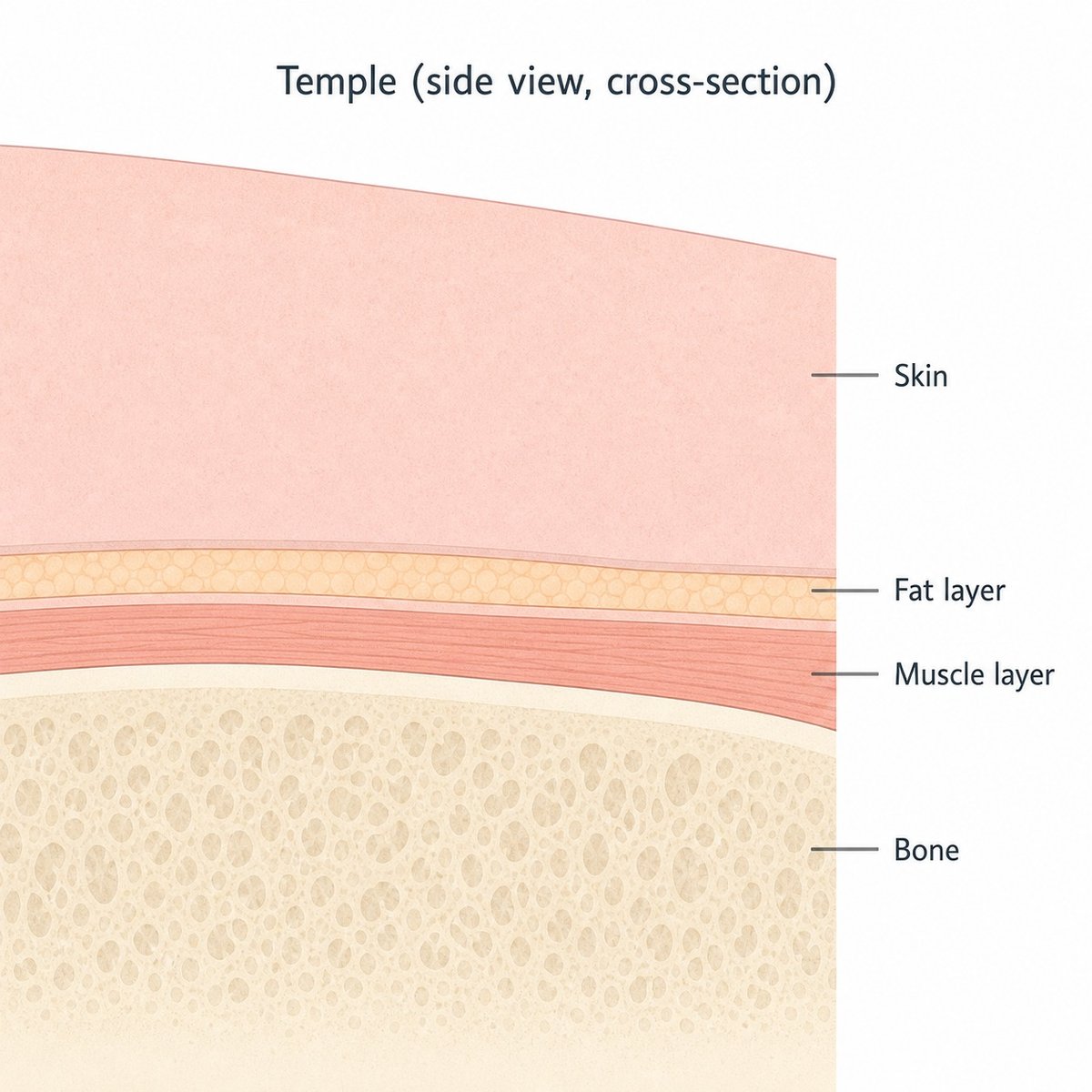
The temple runs from just outside the corner of the eye back toward the front of the ear. When it starts to look sunken, weight loss is rarely the whole story. The fat in that region thins, the muscle underneath loses bulk, and the bone itself gives up some volume with age. Those changes stack, and what surfaces is a shadow.
That's also why the same temple reads differently depending on the angle. From the front, the line between the forehead and the cheekbone looks squared off. From the side, the area above the outer eye corner appears to drop away. People often describe it as looking fine in one photo and tired in the next, and the explanation is usually lighting hitting a contour that changed shape.
There's one more thing worth knowing before any injection is planned here. Blood vessels and nerves run through this region, and an anatomical study mapping the course of the superficial temporal artery found meaningful variation from person to person. That variation is the reason a temple plan starts with assessment rather than with a set volume.

Why Sculptra doesn't fill anything on the day
The active component is poly-L-lactic acid, and it belongs to a different category than the fillers most people are familiar with. Hyaluronic acid creates volume at the moment it's placed, because the material itself takes up space. Sculptra works as a biostimulator instead: it triggers the body to lay down its own collagen over time.
A comparison that tends to land: hyaluronic acid is like setting a cushion into a dip, while Sculptra is closer to sowing seed and waiting for something to grow. Nothing has changed on the day you sow it. That's expected, not a sign that it didn't work.
Which is why looking in the mirror right after a session can be genuinely deflating. Volume builds over the following weeks to months, and longer-term follow-up of collagen-stimulated volume change keeps repeating the same point: judging the outcome takes months, and how quickly a person responds varies. Treating that delay as a flaw usually leads to adding more, sooner, than the face needed.
Choosing between hyaluronic acid filler and Sculptra
Two things decide it. The character of the hollow, and how much time you're willing to give it. If there's an event on the calendar in a few weeks, the answer is different from the one you'd get with no deadline at all.
Hyaluronic acid shows you the volume immediately and often finishes in a single visit, which makes it a reasonable choice when you want a defined endpoint. Sculptra moves in the other direction: sessions are split up, the change accumulates gradually, and it suits people who'd rather the shift not be noticeable as an event. The number of sessions that fits a given face isn't something to lock in beforehand — it's a clinical judgment made after the temple is assessed in person.
The safety profile of poly-L-lactic acid itself is reasonably well characterized in the literature, including a review of its safety and response patterns. What comes bundled with it is the pacing: because the response appears slowly, the next session gets decided by looking at what's already come up rather than by a schedule set in advance.

How the session plan gets built, and why the gaps matter
Putting the full intended amount in at once sounds efficient. The problem is that nobody can predict how much collagen a particular person will build. Committing to a total volume up front means deciding on behalf of a result that hasn't happened yet, so the plan starts with how sessions will be divided instead.
In practice, a common approach is to space sessions roughly four to six weeks apart and use that window to see how much has come up. Working in staged sessions and reassessing between them is the shared pattern across published clinical experience with divided treatment courses. The exact interval still gets adjusted based on what the assessment shows.
The reasoning behind the gap is simple enough. Collagen needs time to form. Stacking sessions close together means adding volume on top of volume that's still on its way up, and the usual outcome is a temple that ends up fuller than anyone intended. Waiting isn't a delay in the process — it's the part where you find out how much more, if any, is actually needed.
Side effects and what to watch for afterward
Because the temple has vessels and nerves running through it, the injection itself calls for anatomical caution. The sequence isn't rushed. It starts by working out whether the hollow leans more toward fat loss or toward bone volume change, and the layer and the injection points get planned before anything begins.
Afterward, swelling, bruising, and a tender or tight feeling on pressure are common, and they generally settle over the following days. Less often, a firm nodule can be felt under the skin, and that's worth reporting before the next session rather than waiting to see. If you experience severe pain, skin color change, or any visual disturbance after an injection, contact the clinic immediately instead of waiting for your scheduled visit.
Poly-L-lactic acid gradually breaks down and is absorbed, so the result isn't permanent and how long it lasts differs from person to person. Anyone who is pregnant or breastfeeding, has active inflammation or infection at the injection site, or has an autoimmune condition should mention it in advance so suitability can be assessed properly.

The bottom line when you're still deciding
A hollow temple is where changes in fat, muscle, and bone surface together. Sculptra doesn't fill that space directly; it builds collagen and lifts the area gradually, which is why how the sessions are divided and how long you wait become the quality of the result.
So go back to the photo that started this. The first question to answer isn't how many vials you'll need. It's whether you want the change quickly or you're fine letting it arrive slowly. If you're not sure which one you are, message us on LINE and we'll tell you what's worth checking when you come in.
Frequently asked questions
Q. How many Sculptra sessions do hollow temples usually need?
A. It's difficult to fix a number in advance, because both the degree of hollowing and how quickly a person responds vary. The usual approach is to divide it into several sessions and decide on the next one after seeing how much volume has come up.
Q. Why is there a gap between sessions?
A. Collagen takes time to form. Stacking sessions without a gap means adding on top of volume that's still developing, which tends to overshoot what the face actually needed.
Q. How long before I can see a difference?
A. Not on the day. The change builds over several weeks to a few months, so it's better not to judge right after the first session and instead reassess closer to the next one.
Q. Can Sculptra be combined with hyaluronic acid filler?
A. Sometimes, yes. If one area needs volume quickly and another can be built up slowly, the two can be planned together — but what goes where depends on how the hollow is assessed in person.
Content

![[Wi Young-jin] Sculptra nodules? Why '5-5-5 massage' matters](https://framerusercontent.com/images/s1UCjSsM9psyNPMJmVnU0h0.jpg?width=1080&height=1080)

![[Wi Young-jin Column] Sculptra 2-Year Truth Explained](https://framerusercontent.com/images/rR92Lkh6VVQ30n1H4E7oLEUG4.jpg?width=1080&height=1080)


skin
Why Does Fractional CO2 Take Longer to Heal?

Contouring & Volume
How Many cc Does Forehead Filler Need?

skin
Why Is My Skin Oily but Tight in the Fall?

Hair Removal
Underarm Laser Hair Removal Cost: Do the Math

Tattoo removal
Laser Before a Cover-Up: How Many Sessions?

skin
큐어젯 다운타임, 다음 날 출근과 화장은 언제부터 될까요?