

Per-session price is half the math. See how sessions, wavelength, and records set the total.
Published -
Updated -

Author
Wi Young-jin · Chief director
Seoul National University College of Medicine · Seoul National University Hospital Specialist
→
If you've been comparing underarm laser hair removal prices, you've probably noticed how small the per-session number looks. The underarm is a small area, so one visit rarely costs much on its own. But the number that actually matters is the one at the end: the per-session price multiplied by the number of sessions it takes to get where you want to be. The American Academy of Dermatology (AAD) notes that most people need somewhere between two and six sessions, typically spaced four to six weeks apart.
That's why two quotes with the same per-session price can end in very different totals. What the price is based on, which wavelength is used, and whether anyone keeps track of your settings from one visit to the next all shape the final bill. In this article, we'll cover why underarm hair doesn't respond all at once, what research on the underarm specifically says about hair left after three sessions, how wavelength is matched to your skin, and what to ask before you book.
Why Underarm Hair Doesn't Clear in One Session
Here's the short answer: laser hair removal only works well on hair that's actively growing. The laser's light is absorbed by the pigment in the hair root and turned into heat, which weakens the follicle. The catch is that your follicles don't all run on the same schedule. At any given moment, some hairs are in the anagen* phase and others are resting.
*Anagen: the active growth phase of a hair. The root holds the most pigment during this stage, so it absorbs laser light most efficiently.
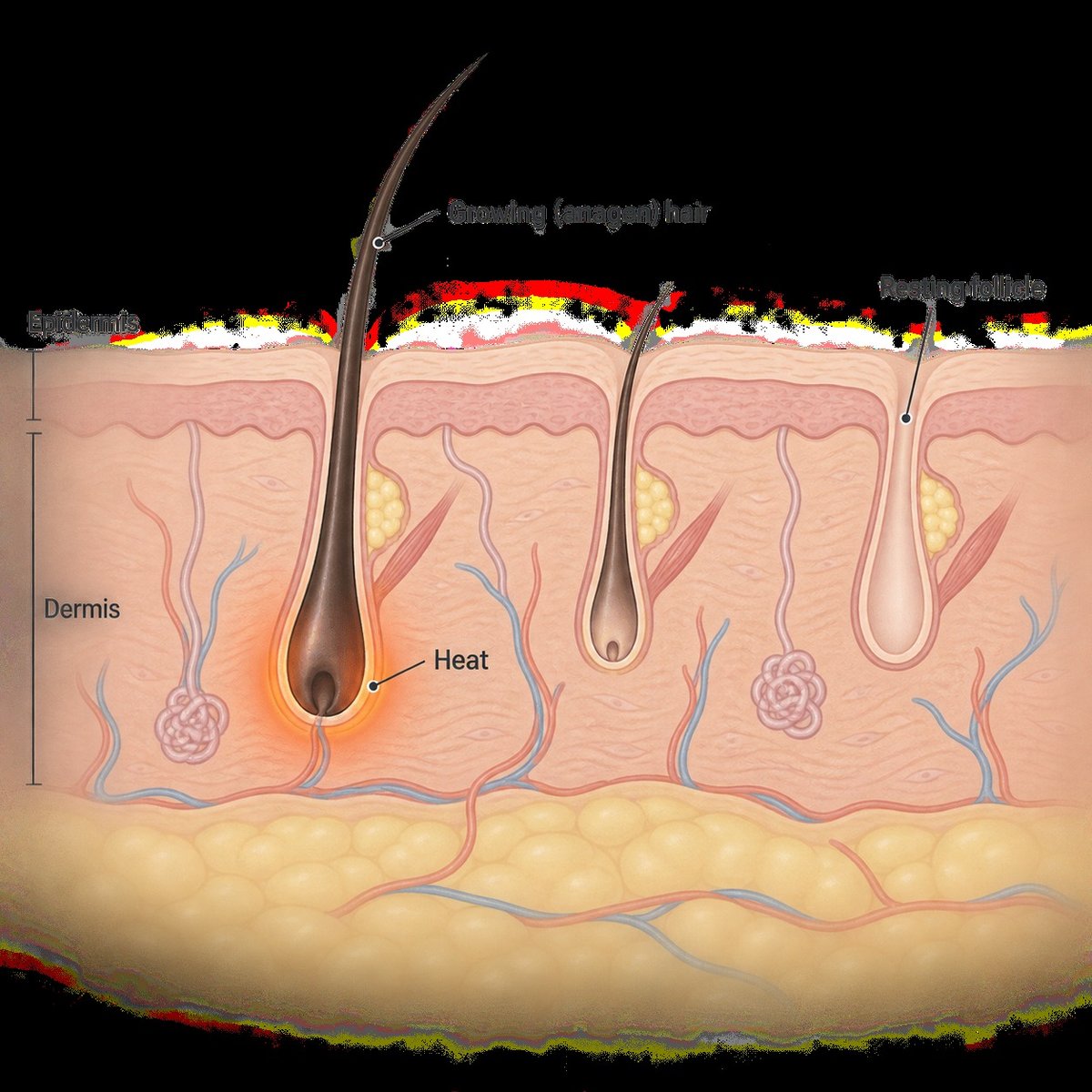
A 2025 paper in Lasers in Medical Science describes scheduling the first three treatments about a month apart to line up with the growth phase, when hair is most responsive to the laser. In practice, each session reduces the hairs that happened to be growing that day. The resting ones come up later and need a session of their own.
So, what does this mean for your wallet? The per-session price is only one piece of the total. Before you compare quotes, it's worth asking how many sessions that price assumes, not just what a single visit costs.

How Much Hair Is Left After Three Sessions?
More than most people expect. One study split the underarm into four zones and treated each with a different laser. Among the 18 people who completed three sessions spaced four to six weeks apart, hair reduction was 70.3% with an alexandrite laser, 67.1% with alexandrite and Nd:YAG combined, 59.7% with a diode laser, and 47.4% with Nd:YAG alone.
Laser used on the underarm | Hair reduction after 3 sessions |
|---|---|
Alexandrite | 70.3% |
Alexandrite + Nd:YAG | 67.1% |
Diode | 59.7% |
Nd:YAG alone | 47.4% |
Put another way, even the best-performing zone still had close to 30% of its hair after three sessions. A three-session package can look like a bargain, but depending on how smooth you want your underarms to be, you may need to add sessions on top of it. We can't promise that three will be enough for you, and individual results vary.
The AAD also notes that maintenance treatments may be needed to keep the area hair-free. When you get a quote, ask about the price of additional sessions and maintenance visits too. That's the only way to estimate what you'll actually spend by the time you're done.

How Wavelength Is Matched to Your Skin and Hair
Wavelength is chosen by looking at your skin tone and your hair thickness, and that choice affects both how many sessions you'll need and how safe each one is. A review of laser hair removal complications in Canadian Family Physician points out that darker skin is more challenging to treat, but it can be treated. Melanin in the skin absorbs light too, so the darker your skin, the more the settings need to keep heat away from the surface.
This matters on the underarm in particular, because darkening in that area is common. In a split-side study of 30 women with skin types IV to VI, one underarm was treated with 755nm and the other with 1064nm, five times at monthly intervals. Hair density dropped significantly on both sides, the reduction was greater on the 755nm side, and both wavelengths were used safely in darker skin.
GentleMax Pro Plus is a laser platform that offers both a 755nm alexandrite and a 1064nm Nd:YAG wavelength in one device. In a 2024 study where both wavelengths were used on the same underarm, 10 people received three sessions six weeks apart, and hair reduction was 46.70% with alexandrite, 27.74% with Nd:YAG, and 70.12% when the two were used together. The sample is small, so it's too early to draw firm conclusions. Still, it points in the same direction as the other studies: the wavelength choice can shape how many sessions it takes.

Four Things That Change Your Total Cost
Even when two quotes show the same per-session price, these four factors can push your final total in very different directions.
What to check | Pushes the total up | Helps keep the total down |
|---|---|---|
Session basis | Only the single-session price is quoted; extra sessions are priced separately | You know how many sessions the price assumes, plus the cost of extra sessions |
Wavelength | The same settings for everyone, regardless of skin tone | Wavelength chosen after checking your skin tone and hair thickness |
Interval | Sessions rushed to fit a calendar, or left far too long | Timed within four to six weeks, based on when hair grows back |
Session records | Every visit is set up as if it were your first | Last session's wavelength, energy, and skin reaction are recorded and used next time |
That last row is the one that most often gets skipped. If no one knows which wavelength and energy were used last time, or how your skin reacted, the next session has to start again from cautious settings. At Beautystone, we record your settings and skin reaction at every session and use them to plan the next one. In our view, cutting out unnecessary sessions is the most reliable way to bring the total cost down.
For current Seoul clinic pricing, see our price page. Prices can change, so it's worth confirming the details, including how many sessions a package covers, during your consultation.
Side Effects and Risks to Know Before You Book
Like any laser treatment, underarm hair removal comes with trade-offs. Redness and slight swelling around the follicles are common right after a session and usually settle within a few days. The Canadian review also notes that darker or tanned skin is harder to treat, because the skin's own pigment competes with the hair for the laser's energy. That's where burns and pigment changes become more of a concern, and it's why settings need to match your skin rather than a one-size-fits-all default.
Common and short-lived: Redness, warmth, and bumps around the follicles that fade over the next few days.
Worth mentioning at your next visit: Areas that look darker or lighter than the surrounding skin after the redness fades.
Call your clinic promptly: Blisters, crusting, or pain that's getting worse instead of better.
If you notice spreading redness, fever, oozing, or worsening pain, seek medical care right away. Everyone's skin is different, so it's also important to tell your provider if you've had pigment changes after a laser before.

What to Tell Your Provider Before Your First Session
At the first consultation, your skin type and hair thickness are noted before any wavelength is chosen. The more you share up front, the more accurately your provider can estimate how many sessions you'll need.
If you've waxed or plucked your underarms in the past month, make sure to mention it. The Canadian review advises against plucking or waxing before treatment, because the laser targets the pigment in the hair root, while shaving is fine. If the root has been pulled out, there's nothing for the laser to hit, and that session may not do much.
Underarm darkening: It doesn't rule you out, but it changes how the wavelength and energy are set.
Recent tanning: Sun-darkened skin absorbs more of the laser's light.
Past pigment after a laser: A reason to start more conservatively.
Your treatment history: How many sessions you've already had, and the date of the last one.
That last point is especially useful if you're switching clinics. It lets your provider start by estimating how many sessions you have left, rather than treating you as a brand-new patient.
The Bottom Line
Your total cost is the per-session price multiplied by the sessions you need, so a three-session package may not be the finish line.
In an underarm study, three sessions reduced hair by 47% to 70% depending on the laser, which means some hair usually remains.
Wavelength should be chosen based on your skin tone and hair thickness, especially if your underarms are darker.
Records of each session's settings and skin reaction help your provider avoid sessions you don't need.
Like any procedure, laser hair removal comes with trade-offs, and results vary from person to person. Ultimately, the choice depends on your skin, your goals, and your budget.
If you're considering underarm laser hair removal, a consultation is the best way to find out what fits you. Beautystone is a dermatology clinic in Seoul's Hapjeong area. Bring your treatment history and let us know about any darkening or recent tanning, and we can start by estimating the total rather than just the first visit. You can see current offers at /en/promotion.
Content


Contouring & Volume
How Many cc Does Forehead Filler Need?

skin
Why Is My Skin Oily but Tight in the Fall?

Hair Removal
Underarm Laser Hair Removal Cost: Do the Math

Tattoo removal
Laser Before a Cover-Up: How Many Sessions?

skin
큐어젯 다운타임, 다음 날 출근과 화장은 언제부터 될까요?

Lifting
Titanium Lifting Side Effects: When to Worry