

Why Secret RF needle depth changes across the cheek, forehead, jawline, and eye area.
Published -
Updated -

Author
Wi Young-jin · Chief director
Seoul National University College of Medicine · Seoul National University Hospital Specialist
→
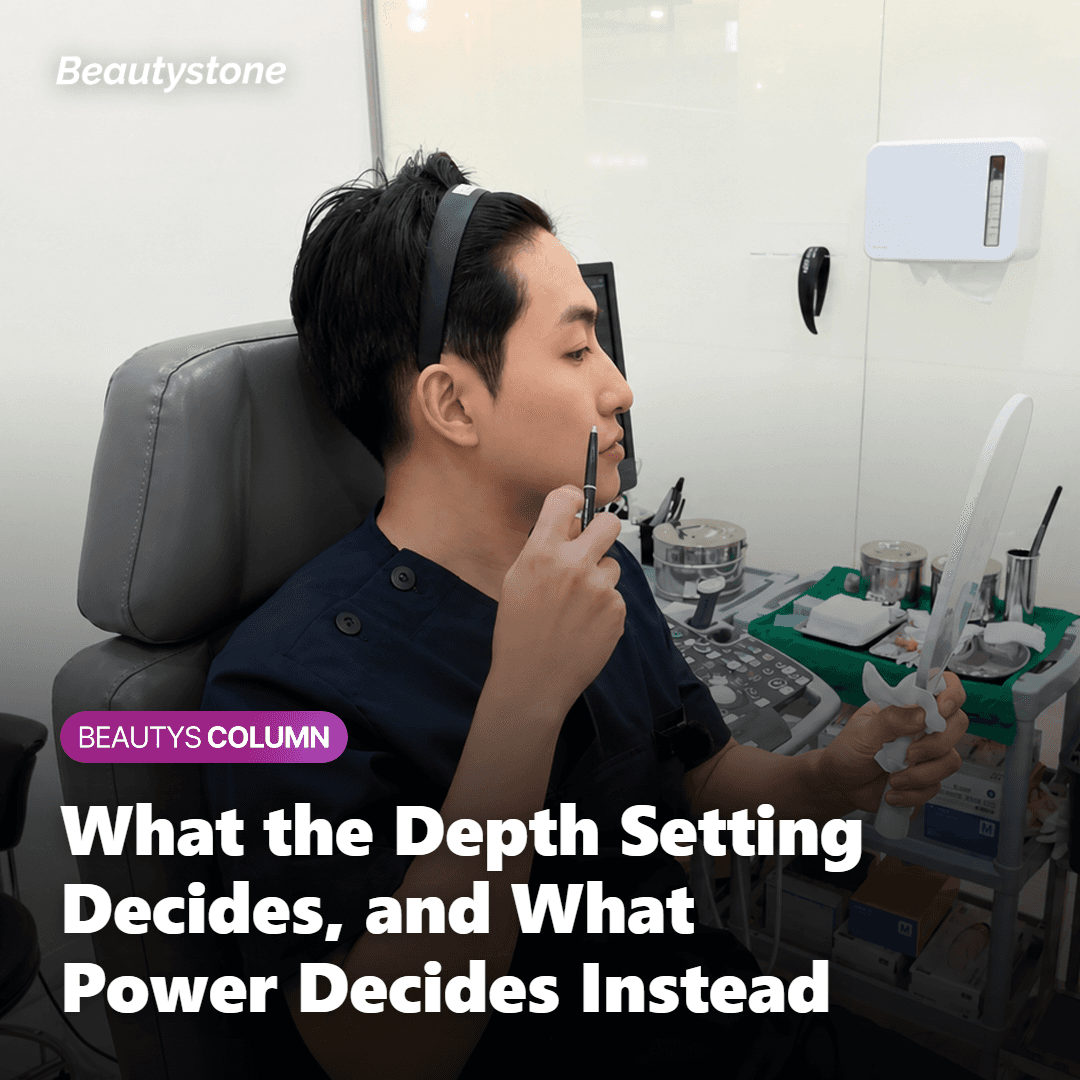
If you've had radiofrequency microneedling before, you may have noticed your provider changing a number on the screen partway through the session. That number is usually needle depth, and it's one of the few settings that gets adjusted several times across a single face.
It can feel arbitrary from the treatment chair. It isn't. Facial skin is not one uniform sheet, and the layer a provider is aiming for sits at a different distance from the surface on your cheek than it does under your eye. Using one depth everywhere would mean overshooting in some places and never reaching the target in others.
In this article, we'll cover what needle depth actually controls, how much facial skin thickness varies from spot to spot, how the cheek, forehead, jawline, and eye area typically get handled differently, and which questions are worth asking before you agree to a plan.
What Does Needle Depth Actually Control?
Secret RF, made by Cutera, is a radiofrequency microneedling device. Fine needles pass through the skin surface, and radiofrequency energy is released once they're in place. The needles are insulated along their shaft, so the energy comes out at the tip rather than along the whole length. That insulation is the reason depth matters so much: it decides which layer receives the heat and which layers get passed over.
A histologic study of radiofrequency microneedling dosing looked at what happens in tissue at different settings. Two findings are worth carrying into a consultation. First, insulated needles limited damage at the surface, because the heat was concentrated where the tip sat. Second, results were strongest when the needle length was long enough to reach the reticular dermis, the deeper and more fibrous part of the dermis where remodeling happens.
It helps to separate two settings that often get blurred together:
Depth decides where the energy lands. It's a matter of anatomy, not intensity.
Power and pulse duration decide how much heat is delivered once the tip is there.
So a shallow setting isn't a weaker treatment in any general sense. It's a different target. Turning depth up on thin skin doesn't make the session more effective; it just moves the heat somewhere it wasn't meant to go.
Why Facial Skin Thickness Changes the Math
The reason a single number can't cover the whole face is that facial skin thickness varies more than most people expect. A measurement study covering 39 facial sites found the dermis at its thickest, roughly 1,969 micrometers, in the area beside the lower nose, and at its thinnest, roughly 759 micrometers, on the inner upper eyelid. That's more than a twofold difference inside one face.
Put that next to the first study and the logic becomes concrete. If the goal is to reach the reticular dermis, and the dermis in one spot is more than twice as thick as in another, then the depth that reaches the target on the cheek will sail straight past it near the eye. Same device, same session, same goal, different number.
Thickness isn't the only variable either. What sits underneath matters as much as what sits on top. Over the forehead, bone is close to the surface. Along the jawline, nerve and vessel paths run through the region. Under the eye, there's very little cushioning tissue at all. Providers factor in both the layer they want to hit and the structures they'd rather stay clear of.

Cheek, Forehead, Jawline, and Eye Area
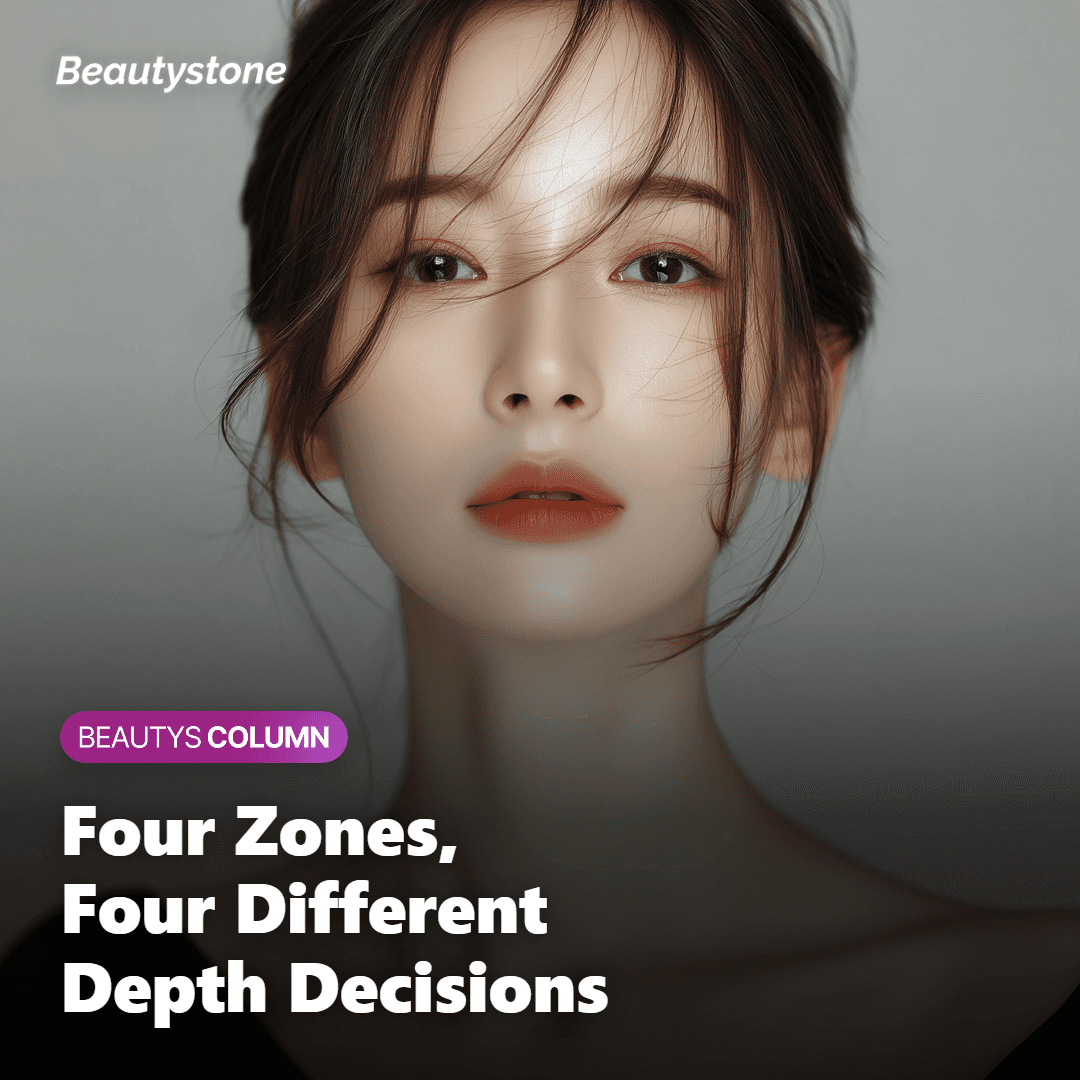
Here's how those four regions usually differ in practice. Treat the millimeter figures below as illustrative of the pattern rather than as a prescription, since the exact numbers depend on your skin and the specific concern being treated.
Area | What the anatomy looks like | Typical direction of the setting |
|---|---|---|
Cheek | Thick dermis with fat support underneath | Deepest of the four, often around 2.0 mm |
Forehead | Moderate thickness, bone close beneath | Shallower and kept fairly uniform, often near 1.2 mm |
Jawline | Medium thickness, nerve and vessel paths nearby | Mid-range and approached conservatively |
Eye area | The thinnest skin on the face, little cushioning | Shallowest, often around 0.8 mm, with lower power |
Notice that the eye area gets both a shallower depth and a lower energy setting. Those two adjustments do different jobs. The depth change keeps the tip inside the correct layer, and the power change keeps the amount of heat proportional to how little tissue is there to absorb it.
Does Deeper Always Mean Better?
No, and this is where a lot of consultation confusion starts. Depth follows the concern, not just the region.
Enlarged pores and shallow acne scarring sit in the upper dermis. Treating them means staying deliberately shallow, even on a cheek that could physically take a deeper setting. Meanwhile, laxity on that exact same cheek calls for going deeper, because the structural support being targeted sits further down. Two people can be treated on the same square inch of face at very different depths and both plans can be correct.
One more thing worth knowing: millimeter numbers aren't reliably comparable between devices. Manufacturers measure needle length from different reference points, and the length of the insulated segment differs too. A 2.0 mm setting on one platform doesn't necessarily place energy where 2.0 mm places it on another. If you're comparing clinics or comparing Secret RF against something like Potenza, asking which layer is being targeted will tell you more than comparing the numbers.
Side Effects, Downtime, and What Depth Changes
Radiofrequency microneedling is a controlled injury to the skin, so a reaction afterward is expected rather than a sign that something went wrong. Common effects include redness, mild swelling, a warm or sunburn-like sensation, small pinpoint marks where the needles entered, and some roughness or dryness for a few days. Bruising is possible, particularly around thinner or more vascular areas.
Depth influences how that recovery feels. Deeper settings on the cheek tend to bring more of a deep, dull ache and slightly longer-lasting swelling. Shallower work near the eyes usually reads as sharper on the surface but settles faster. Neither pattern is a problem on its own, though your provider should tell you which to expect for your plan so you can schedule around it.
Some things do warrant a call back to your clinic rather than waiting it out: swelling that keeps increasing after the second day, spreading redness with warmth or discharge, unusual pain that isn't improving, or any numbness or muscle weakness that persists. These are uncommon, but they're worth flagging early rather than late.
What to Ask at Your Consultation
A good depth plan comes out of a conversation, not a default preset. These questions tend to be the useful ones:
Which layer are you targeting for my main concern? This is more informative than asking for a number.
Will the setting change across different parts of my face? If the answer is no, ask why not.
How are you accounting for my eye area and jawline? These are the two regions where caution matters most.
How will the plan change between sessions? Depth is often adjusted based on how your skin responded to the previous round.
If you have a history of keloid scarring, an active skin infection in the treatment area, or you're pregnant or breastfeeding, mention it early. The same goes for isotretinoin use, recent procedures in the same area, and any implanted electronic device, since radiofrequency treatment needs specific consideration in that case. Your provider may adjust the plan or suggest waiting.
The Bottom Line
Different needle depths across your face aren't inconsistency. They're the treatment adapting to skin that genuinely differs in thickness from one spot to the next, with a dermis that can be more than twice as thick beside the nose as it is on the inner eyelid. The point of changing the number is to keep hitting the same target layer everywhere.
Results vary from person to person, and depth is only one part of a plan that also includes energy, pulse duration, session count, and how your skin recovers in between. If you're weighing whether radiofrequency microneedling suits your concern, it's worth having that mapped out in person before you book. You're welcome to check our current consultation options, and our team at Beautystone Clinic in the Hapjeong district of Seoul is happy to walk you through what would apply to your skin.
Frequently asked questions
Q. Does a deeper needle setting mean better results?
A. Not by itself. Depth decides which layer of skin receives the energy, so the right depth is the one that reaches the layer your concern actually lives in. Pores and shallow scarring sit in the upper dermis and are treated deliberately shallow, while laxity is addressed deeper. Going deeper than the target doesn't add benefit, and on thin skin it mainly adds risk. If you want a stronger effect at the correct layer, that's usually a question about energy settings rather than depth.
Q. Why is the eye area treated so much more shallowly?
A. Because the skin there is the thinnest on the face. Measurements across the face have put the inner upper eyelid at roughly 759 micrometers of dermis, against roughly 1,969 micrometers beside the lower nose. There's also very little cushioning tissue underneath. A depth that lands correctly on your cheek would pass well beyond the intended layer near your eye, so providers reduce both the depth and the energy in that zone.
Q. Can I compare Secret RF millimeter settings with another device?
A. Not directly, and it's a common source of confusion. Manufacturers measure needle length from different reference points, and the insulated portion of the needle varies in length too. That means the same number on two platforms doesn't necessarily place the energy in the same place. A more useful question when comparing clinics or devices is which skin layer they're aiming for and why, rather than which number is bigger.
Q. How much downtime should I plan for after a session?
A. Most people see redness and mild swelling that eases over a few days, along with small pinpoint marks and some dryness or roughness while the skin settles. Deeper work on the cheeks often brings slightly more swelling and a dull ache, while shallower work near the eyes tends to feel sharper but calm down sooner. Bruising is possible. Ask your provider what to expect for your specific plan, and contact the clinic if swelling keeps increasing after the second day or redness starts spreading.





skin
Fraxel CO2: Why Prices Vary & What to Check

skin
How to Choose an Acne Dermatologist: 5 Signs

Contouring & Volume
Nasolabial Folds: When Lifting Isn't Enough

skin
Sculptra Cost: Why Sessions and Vials Matter

Lifting
After Shurink Universe: Wash, Work Out & Drink

skin
Sofwave Before a Wedding: Timing Guide