

PicoWay reviews claim clean color removal — we break down what the actual session count looks like.
Published
Updated

Author
Wi Young-jin · Chief director
Seoul National University College of Medicine · Seoul National University Hospital Specialist
→
When you are researching consultations to remove an old color tattoo, you might often see reviews saying, "If you use PicoWay, it will be completely cleared." Looking at black tattoo reviews together, you might think that as long as you complete the same number of sessions, color tattoos would fade similarly. However, when you listen to a doctor's explanation in the consultation room, you learn that the number of sessions for color tattoos is much longer than for black ones, and that's when you start to get confused.
To put it briefly, color tattoos do not fade as much as black ones within the same number of sessions. Each color absorbs a different wavelength, and the wavelength needed to treat certain colors may not exist or may be weak on commercially available devices. On top of that, color-specific variables like darkening are also involved, meaning the sessions, risks, and costs are of a different nature than those for black tattoos.
Wavelength*: The unit of length of light emitted by a laser (nanometer, nm). Because each color absorbs different wavelengths well, ink reacts differently even with the same device.
Darkening (paradoxical darkening)*: A phenomenon where color ink temporarily becomes darker after a laser treatment. This is often seen in skin-toned, brown, and red inks.
Different colors react to different wavelengths
Laser tattoo removal works on the principle of breaking ink particles into fine pieces by emitting light at wavelengths absorbed by the ink color. Black ink absorbs all wavelengths evenly, so it fades relatively well with any device. However, for color tattoos, the absorption wavelength is different for each color: red is near 532nm, blue and green are near 1064nm, and yellow and light green have almost no well-absorbed wavelengths available on commercial devices.
Multi-wavelength devices like PicoWay use three wavelengths—532nm, 785nm, and 1064nm—making them versatile for handling colors. Even so, for colors with weak absorption like yellow and skin-tone, you may need to increase the number of sessions, or a faint residue may remain until the end.

1.5 to 2 times more sessions than black tattoos is common
Black tattoos often fade in about 6 to 10 sessions on average, though this can increase depending on the depth. A color tattoo of the same area can take 8 to 15 sessions even with just one color, and color tattoos with a mix of red, green, and blue can take up to 12 to 20 sessions.
The interval between sessions is 6 to 8 weeks, similar to black tattoos, but because the percentage of fading per session is smaller, it can take a year to a year and a half to achieve the same result. If you start with the expectation that "it will all fade at once," it is easy to get exhausted halfway through, so it is highly recommended to discuss estimated sessions accurately with your doctor before starting.

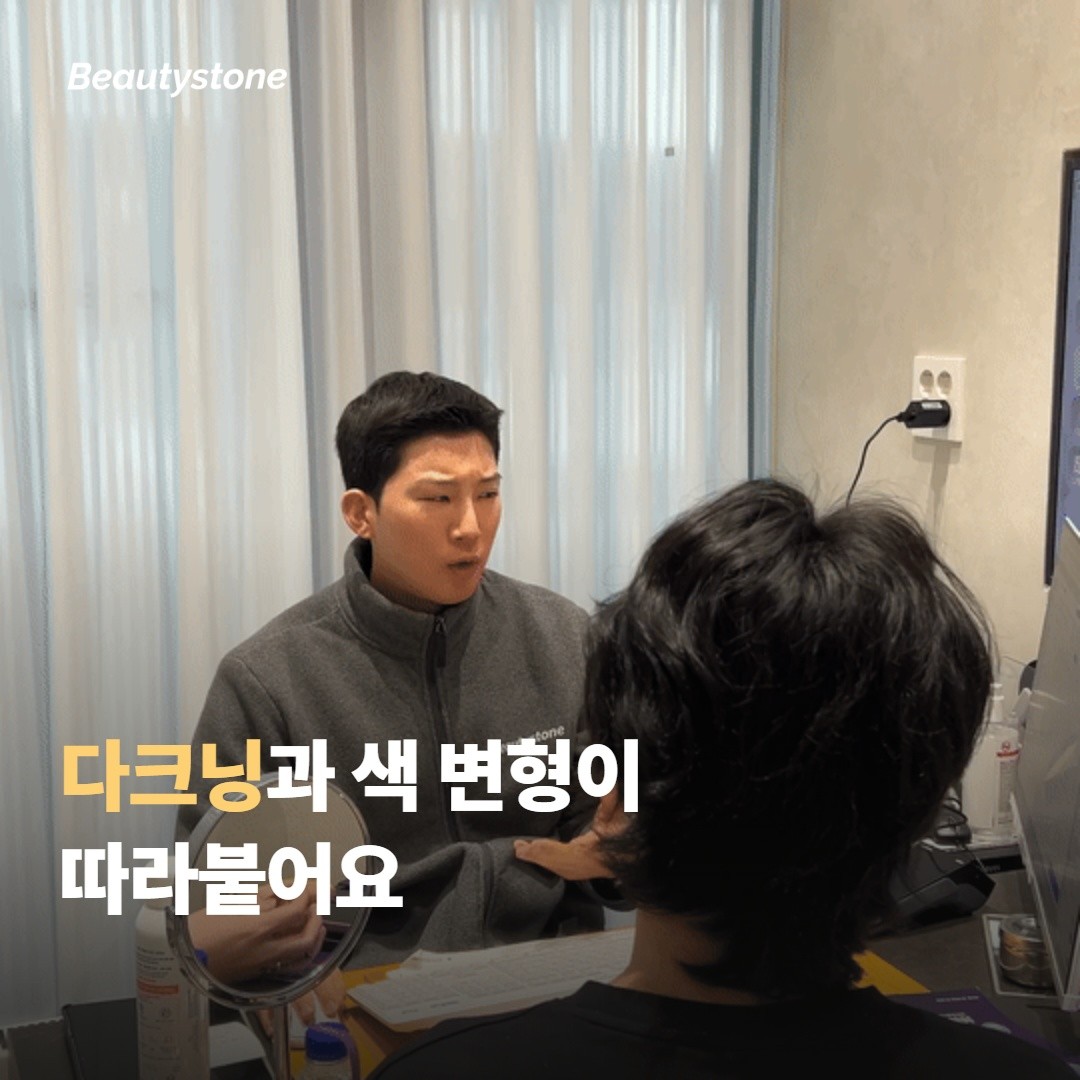
Darkening and color alteration may occur
Red, skin-tone, and brown inks may experience darkening, where the color temporarily becomes darker after laser treatment. This phenomenon occurs when the iron oxide component in the ink is reduced by the laser heat, causing the color to darken. Although it often fades over time, it can occasionally increase the number of sessions or remain permanently.
For colors with a high risk of darkening, it is safer to perform a test shot on a small area before your first session. Additionally, white and yellow inks frequently experience alteration where the color turns gray or black, regardless of darkening, so a treatment plan where the doctor addresses these risks in advance is crucial.
Please decide by looking at the sessions, cost, and risks together
Color tattoo removal cannot be cleared like black tattoos with the same cost and timeframe. While the cost per session is similar to black tattoos, the total cost is commonly 1.5 to 2 times higher because there are simply more sessions. On top of that, you must keep the possibilities of darkening, color alteration, and faint residual pigment in mind.
This article is for general informational purposes; please consult with a doctor who can personally examine your tattoo ink and depth to determine your actual removal potential, number of sessions, and risks.

Frequently Asked Questions
Q. Can color tattoos be completely removed with just one device like PicoWay?
A. Red, blue, and green can be treated to some extent, but yellow, skin-tone, and white often leave residual pigment even with increased sessions. Depending on the color combination, some clinics use other wavelength devices as a supplement.
Q. Is darkening permanent if it occurs?
A. It often fades over time, but it can also increase the number of sessions or remain permanently. This is more common in skin-toned and red inks that contain a lot of iron oxide.
Q. Can colors layered over a black tattoo be removed together?
A. If the black and the color are at a similar depth, they can be treated together, but if the depths are different, the session plan will vary. We will check the ink depth together during the diagnosis stage.
Colour is one of the six items in the Kirby–Desai assessment that Beautystone uses in consultation, together with skin type, location, ink amount, layering and scarring. That is how we arrive at an expected session range for a coloured piece instead of applying a general multiplier. It is an estimate, and we reassess it as each colour responds, which helps if you are budgeting a long course from abroad.
See how we estimate sessions for colour work
Further Reading





Lifting
XERF for a Thin Face: Depth vs. Hollowing?

Lifting
Thread Lift Swelling: What's Normal in 5 Days?

Lifting
Thermage Cost: 4 Lines to Check on a Quote

Contouring & Volume
Xeomin Cost: Why Do 50-Unit Quotes Differ?

skin
Back Acne That Won't Clear? It Might Be Fungal

Tattoo removal
Bad Brow Tattoo: Cover It Up or Fade It First?