

Wondering if hip filler hurts? Here's where the pain comes from and how numbing is layered.
Published
Updated

Author
Wi Young-jin · Chief director
Seoul National University College of Medicine · Seoul National University Hospital Specialist
→
If you're considering hip filler but the first thing on your mind is "how much is this going to hurt," you're not alone. The buttocks cover a large area, and the volume injected tends to be higher than with facial filler, so it's natural to wonder whether a bigger treatment means bigger discomfort.
Here's the reassuring part: how much you feel depends heavily on the numbing approach, the injection tool, and your provider's technique. In this article, we'll cover where hip-filler pain actually comes from, how anesthesia is layered step by step, how a cannula compares with a needle, and what the recovery timeline usually looks like.
Where Does Hip Filler Pain Come From?
Hip-filler discomfort tends to show up at three moments. First is the quick sting as a needle or blunt cannula* passes through the skin. Second is a pressure sensation as filler spreads between tissue layers. Third is a dull, heavy ache while the area swells and recovers in the days afterward.
The buttocks have a thick layer of subcutaneous fat, with large muscles and nerves running deeper below. Filler is typically placed in the fat layer and just above the fascia, so keeping the injection at the right depth — away from deeper nerves — matters for both comfort and safety.
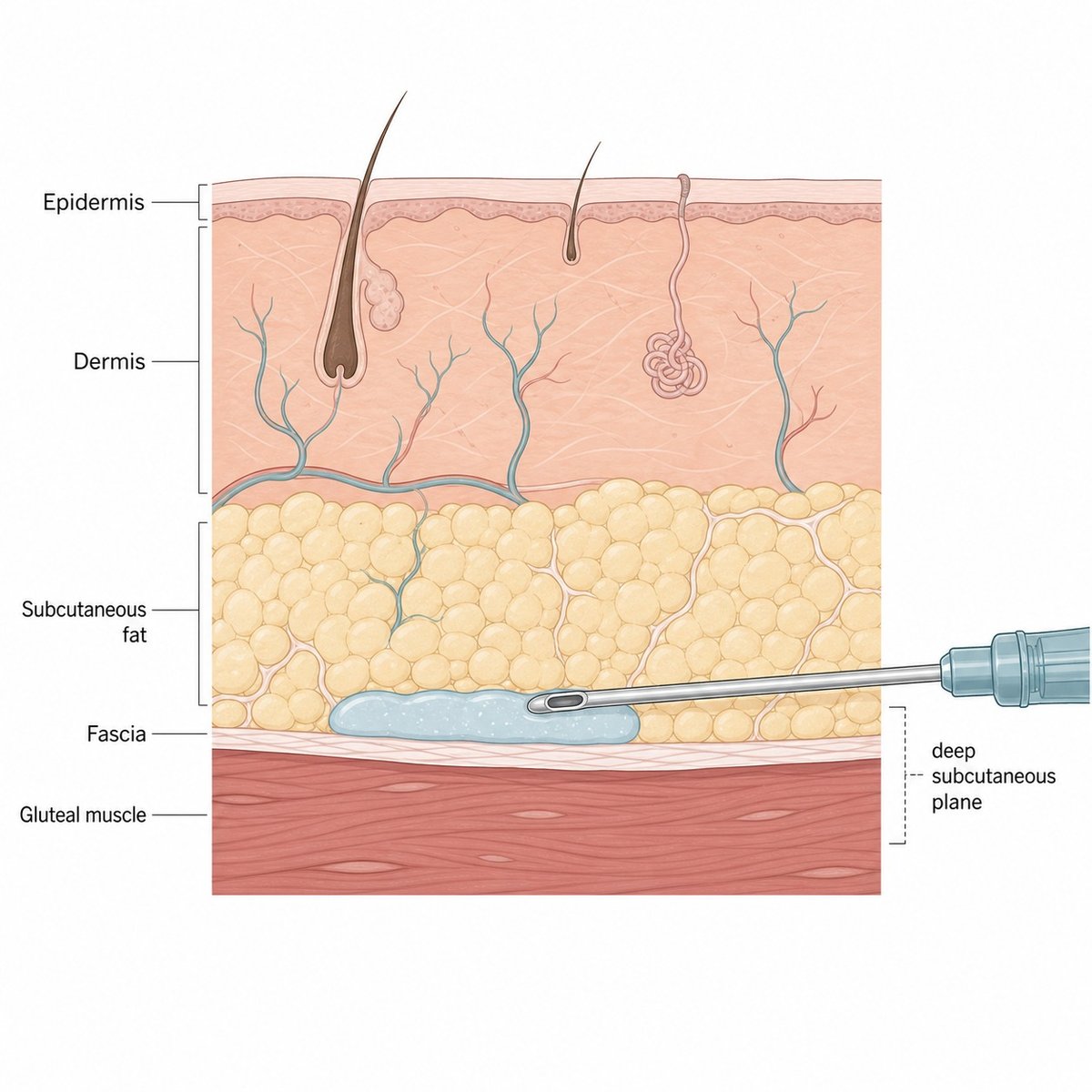
Too shallow: the surface can look uneven. Too deep: the injection sits closer to nerves and blood vessels, which raises both discomfort and risk. That's why a steady, consistent injection depth is at the heart of managing pain.
How Is Anesthesia Handled, Step by Step?
For hip filler, providers usually combine a topical numbing cream with local anesthesia. First, numbing cream is applied to dull the surface of the skin, and after roughly 30 minutes, a shallow local anesthetic may be injected if needed. On top of that, filler products that contain lidocaine* keep the area numb while the product goes in.
Because the treatment area is wide, the numbing zone is broader than it would be for the face. Here's a quick look at how each layer feels:
Numbing step | Method | What it feels like |
|---|---|---|
Topical cream | Applied, then wait | Softens the sting as the needle enters |
Local anesthetic | Shallow injection | A small pinch on the first injection |
Lidocaine-containing filler | Numbs as it's injected | Eases the pressure feeling during injection |
Topical numbing alone already makes a big difference, but for a wide area or a more sensitive patient, adding local anesthesia can bring the discomfort down another notch. Your provider will tailor the approach to your pain sensitivity and the volume being placed during your consultation.
It's worth remembering that pain tolerance is personal. Some people describe the sting as barely noticeable, while others feel it more sharply — and that's completely normal. The point of layering numbing methods is to meet you where you are rather than assuming everyone experiences it the same way. If you've had a rough experience with injections before, that's exactly the kind of thing your provider wants to hear about beforehand.
Cannula vs. Needle: How Different Is the Pain?
The injection tool has a real impact on comfort. A sharp needle punctures tissue repeatedly, while a blunt-tipped cannula enters once and then fans out to distribute filler over a wider area. Fewer entry points and less tissue trauma tend to mean less bruising and less discomfort.
After the treatment, you'll usually feel a heavy ache as the numbing wears off. For most people this settles noticeably within about three days and eases to a level that doesn't interfere with daily life by around a week. While swelling lingers, sitting can feel uncomfortable, so a donut cushion or similar support can help you get through recovery more easily. Individual results vary, and if the ache worsens or spreads, contact your provider right away.
Side Effects and Risks to Keep in Mind
Hip filler is generally considered manageable, but swelling, bruising, mild asymmetry, and small firm lumps can occur. These are usually short-lived and settle within a few days to a week. If symptoms drag on or intensify, don't tough it out — talk to your provider.
Rarely, issues involving blood flow can happen and need prompt attention, so if you notice severe pain, fever, spreading redness, or a change in skin color, seek medical care right away. If pain worries you, mention it during your consultation so the numbing plan can be adjusted. Research suggests injection discomfort from filler can be reduced when a lidocaine-containing product is paired with appropriate anesthesia (report on filler injection pain). Cost depends on the area and the volume placed, so it's best to confirm details during your visit.
The Bottom Line
Here's what to take away:
Hip-filler pain shows up at three points: the needle or cannula entry, the pressure as filler spreads, and the dull ache during recovery.
Topical numbing, local anesthesia, and lidocaine-containing filler each lower the discomfort in a different way.
A blunt cannula usually means fewer entry points, less bruising, and less pain than a sharp needle.
Most soreness settles within a few days and eases toward normal by about a week.
Like any procedure, it comes with trade-offs, and comfort and recovery vary from person to person. Ultimately, the choice depends on your body, your goals, and your budget. If you're considering hip filler, a consultation is the best way to find out what fits you. Beautystone is a dermatology clinic in Seoul's Hapjeong area — see current offers at /en/promotion.
Frequently asked questions
Q. Does hip filler really not hurt if I get anesthesia?
A. With topical numbing cream plus local anesthesia, most people feel only a mild sting and some pressure. If you're sensitive to pain, mention it at your consultation so the numbing area can be widened.
Q. When should the numbing cream go on?
A. It's usually applied about 30 minutes to an hour before treatment so it can fully absorb. Most clinics apply it for you and have you wait, so you don't need to prepare anything yourself.
Q. How many days does the pain last?
A. There's a dull ache right after, but it typically eases a lot within about three days and settles to a level that doesn't interfere with daily life by around a week. Sitting can feel uncomfortable while swelling lingers.
Q. When does sitting or lying down get comfortable again?
A. For the first two to three days, sitting for a long time can feel like pressure. A donut cushion or changing position often helps you get through recovery more comfortably.




Contouring & Volume
Glabella Botox Side Effects: Droopy Eyelids

Contouring & Volume
Juvelook Volume Not Working After 3 Sessions?

Contouring & Volume
Hip Dip Filler Before and After: 4 Checks

Body
Potenza Treatment Interval: Why 4 Weeks?

Lifting
Ultherapy Before and After: Why Wait 90 Days?

Contouring & Volume
Belotero Revive Cost: 2cc Price vs. 3 Sessions