

Why little shows for a few days after InMode, when results peak, and how long they last.
Published -
Updated -

Author
Wi Young-jin · Chief director
Seoul National University College of Medicine · Seoul National University Hospital Specialist
→
After finished with InMode, many as they walk out look in the mirror and ponder, "It feels a bit tighter today, but will it still be like this tomorrow?" or "Is this it, or will it get even better?" While the treatment itself takes only a few minutes, what you're actually curious about is how the following days and weeks will transpire.
The short answer is that the immediate sensation right after InMode and the actual results a few months later unfold a bit differently. Immediately after, you feel an instant tightening from the heat which eventually settles down, while the real change in elasticity tends to fill in slowly over time. That is why those who feel "it wasn't that great a few days after" have usually not yet passed the phase of the most significant transformation.
If it is your first time, it is easy to get disappointed too quickly without knowing this time lag, or conversely, to expect too much based solely on how it feels right after. Therefore, having a clear understanding of what changes are common at each stage will put your mind at ease.
This content compiles treatment information from Beautystone Hapjeong.
By reading this post, you will
Learn when the effects of InMode are most noticeable: immediately after, a few weeks, or a few months down the road.
Understand why the immediate post-treatment tightness differs from the actual change in elasticity.
Discover how long the results typically last and when it is ideal to consider your next session.
Learn daily habits to help sustain your results for as long as possible.
The immediate tightening and the real results follow different timelines
The "pulled tight" feeling you experience immediately after InMode and the change in elasticity that settles in months later are actually two different stages. It is easy to confuse the two at first, leaving you feeling disappointed thinking, "It felt great today, but it went back to normal tomorrow."
The immediate tightness occurs as the radiofrequency (RF)* heat temporarily contracts the collagen fibers in the dermis. This is an instant but temporary change that will eventually subside, and from there, the real game begins as the skin slowly produces new collagen. Observing how the radiofrequency heat denatures the collagen triple helix to cause immediate contraction, followed by fibroblast stimulation to produce new collagen makes it clearer why the immediate aftermath feels so different from a few months later.
Radiofrequency (RF)*: Electromagnetic energy that delivers heat deep into the skin layers. In treatments like InMode, it is used to apply heat to the dermis, inducing collagen contraction and regeneration.
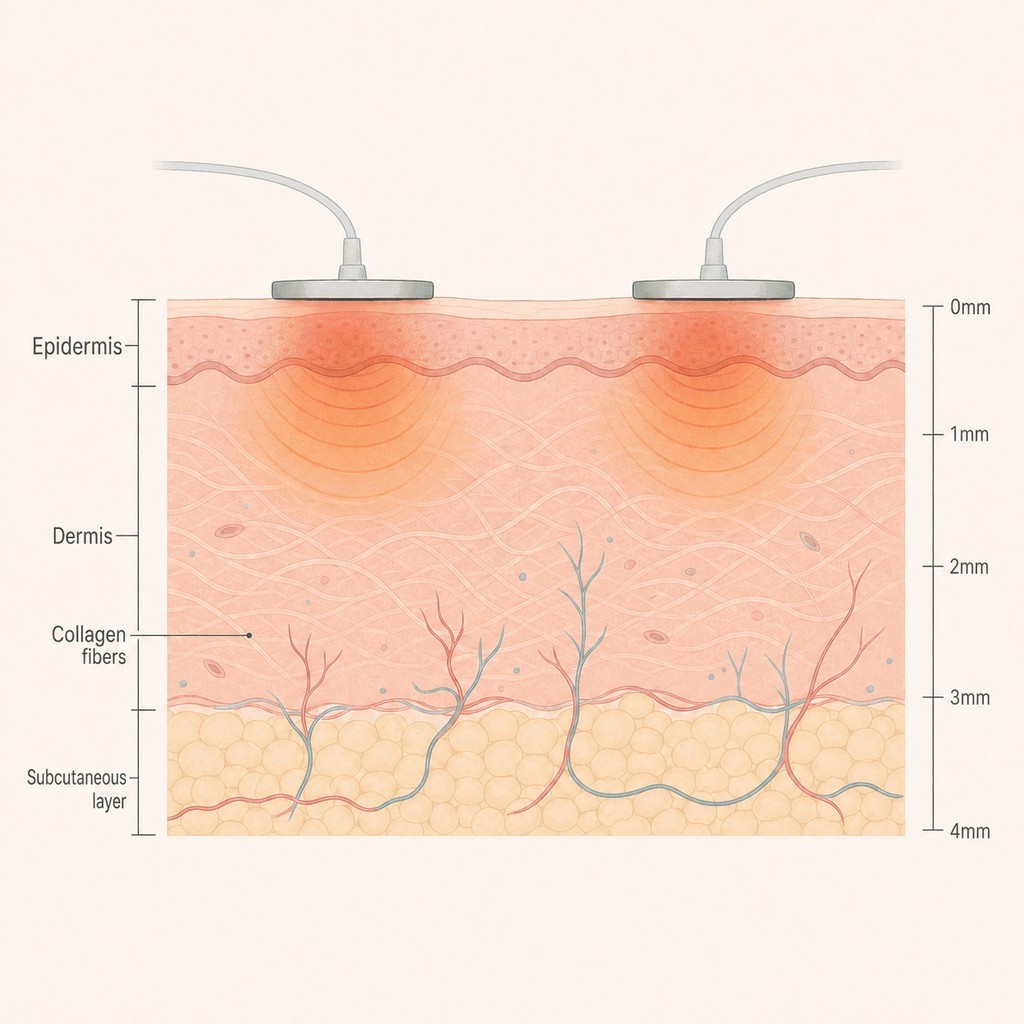
So even if you look in the mirror on the day of or the day after your treatment and think, "It's not as dramatic as I thought," it is best not to judge too quickly. This treatment aligns with a gradual process of filling in over several weeks rather than an instant, one-time fix.
Your experience will vary depending on the timeframe: immediately after, weeks, or months
With InMode, the type of changes you feel varies depending on the time that has passed since your treatment. When you are feeling unsure if "what you are experiencing is normal," comparing it with a chart of common responses at each stage can be very helpful.
Timeframe | Common Sensation | Quick Note |
|---|---|---|
Immediately after | Mild tightening and flushing | Immediate contraction due to heat, which soon subsides |
2–4 weeks | Gradual improvement in elasticity | This is the phase where new collagen begins to form |
2–3 months | Most visible changes | Collagen regeneration accumulates and settles in |
Maintenance after | Gradual fading | The duration varies depending on individual skin and aftercare |
As shown in the table, the most visible changes typically appear about two to three months after the treatment. Just as neocollagenesis progresses over the following 3 to 4 months after RF treatment, making clinical changes distinct only after a few months, the skin requires time to produce and reorganize new collagen. Here is a curve showing how the visible results build up over time and then slowly fade.
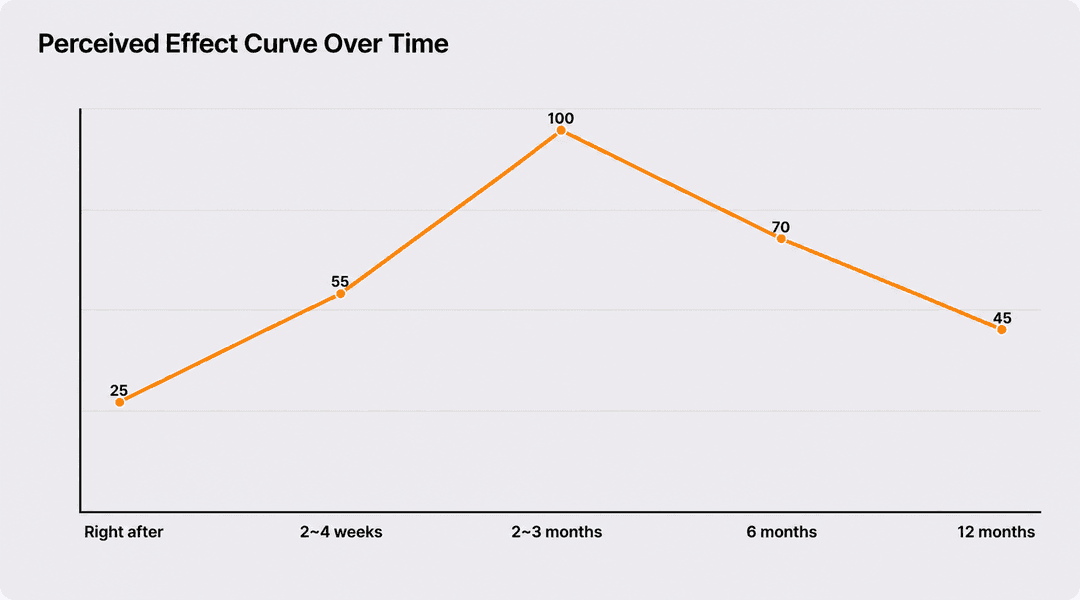
It is also good to know that this curve varies slightly from person to person. Depending on skin thickness, age, and daily skincare routines, the peak may be higher or lower, and the fading speed will differ as well. Therefore, rather than making simple comparisons like "My friend's results look much better," it is much more accurate to observe the natural flow of your own skin.
How long do the results last, and when should you consider another treatment?
The duration of InMode's effects varies greatly depending on the individual and how they manage their skin. Generally, after reaching its peak, the change slowly fades, with the visible results lasting from several months up to about a year.
However, the elasticity improved by collagen regeneration will also gradually diminish with the natural process of aging. Rather than stopping at a single session, it is common to undergo a series of treatments or to plan another session around the time the peak begins to fade. Scheduling the next treatment too early can be a burden, while waiting too long might feel disappointing as much of the gained elasticity may have declined. It is best to decide based on how quickly your own skin's results fade.
First noticeable change — Usually felt gradually starting from 2 to 4 weeks
Peak period — Typically around 2 to 3 months
When to reconsider — Decide in consultation with your medical team, observing when your peak results begin to fade
Helper habits for maintenance — Consistently applying sunscreen and keeping the skin well-hydrated helps maintain results
To make the results last as long as possible, it is helpful to consistently block UV rays and prevent the skin from drying out. Even after putting in the effort to generate new collagen, accumulation of UV exposure can easily break it down again.

Why Beautystone Hapjeong?
At Beautystone Hapjeong, we prioritize guiding you through the recovery and maintenance process that follows, rather than focusing solely on the treatment itself. For treatments like InMode, where the effects build up over time, knowing beforehand what sensations are normal immediately after and what changes are natural over the coming weeks helps reduce unnecessary worry. As a cozy clinic located just a short walk from Hapjeong Station, we offer the attentive care needed to monitor each individual's skin response and fading rate, allowing us to plan your next session together naturally.
The process and mindset to keep in mind before your treatment
If you are considering InMode for the first time, it helps to visualize the overall journey. Understanding how the process flows will allow you to go through the treatment and post-care with a much calmer mind.
Consultation & Diagnosis — We assess your skin condition and align on the changes you hope to achieve
The Treatment — Depending on the target areas, it typically takes about 30 to 45 minutes
Immediate Aftercare — Any redness or mild heat sensation usually subsides within a day
Progress Monitoring — We check the progress of changes around the 2–4 week and 2–3 month marks
While you can return to your daily routine right after InMode, it is highly recommended to avoid excessive heat exposure (such as saunas or hot baths) for the first 1 to 2 days, and to pay close attention to moisturizing and sun protection. Results generally start to become noticeable around 2 to 4 weeks, peak at 2 to 3 months, and then slowly fade depending on individual characteristics and habits. Since this guide provides general information, it is always safest to consult with a medical professional who has examined your skin to determine if you are a good candidate and how to manage your recovery.

Frequently Asked Questions
Q. Is it normal that I don't see much of a difference on the day of the treatment?
A. Yes, this is completely normal. The tightness immediately after the procedure is a temporary reaction to the heat and will settle down. The real improvement in elasticity will gradually appear from 2 to 4 weeks as new collagen is produced. Therefore, it is best to observe the changes over several weeks rather than judging by how it looks on day one.
Q. When are the results typically most prominent?
A. Usually around 2 to 3 months after the treatment. Because it takes time for the skin to produce and reorganize new collagen, the changes are often most visible two to three months later rather than immediately after. However, the exact peak time may vary from person to person.
Q. Will I still see lasting results from just one session?
A. While you can experience visible improvements from a single session, the effects naturally fade over time. Because of this, many people choose to receive a series of treatments or schedule another session when the peak results begin to fade. It is best to decide on the timing with your medical provider based on how quickly your skin's results decline.
Q. What is the best way to prolong the results?
A. Consistent sun protection and deep hydration are key. Since accumulated UV damage can easily break down the newly generated collagen, making daily sunscreen a habit is incredibly beneficial in preserving your results.
Recommended Reads


Hair Removal
레이저 제모 1회에도 남는 몫이 있어요 — 밀도를 모자이크로 보는 법

Tattoo removal
Why Extremity Tattoos Are Slower to Remove

Tattoo removal
Tattoo Removal Cost: Why Quotes Vary by Area

Tattoo removal
Unused Tattoo Removal Sessions: What Happens?

Lifting
Forehead Thread Lifting: How Far Can It Go?

skin
Skin Booster Prices: What to Check in a Quote