

One handpiece warms the shallow dermis to a set temperature, the other reaches near the fat layer. Which you need follows the concern you name first.
Published
Updated

Author
Wi Young-jin · Chief director
Seoul National University College of Medicine · Seoul National University Hospital Specialist
→
When you look into InMode, you'll often see specific mode names pop up, like "get the FX" or "go with Forma." Since they are both InMode, it is easy to get confused about why they are divided and which one is right for your skin texture concerns.
In short, InMode houses multiple modes within a single device, and FX and Forma deliver radiofrequency (RF)* to different depths for different purposes. Forma evenly warms the layers closer to the skin's surface, while FX delivers heat to deeper layers to help contour and address sagging.
Radiofrequency (RF)*: This is electrical energy that generates heat inside the skin to stimulate collagen. The target changes depending on the depth at which the heat is delivered.
This content is a compilation of treatment information from Beautystone Hapjeong. It is always best to consult with a medical professional before your treatment to find the mode that fits your unique skin.
In this article, you will learn:
Why InMode is divided into different modes
How Forma works and which layer of the skin it targets
Which layer FX targets and how it differs from Forma
How to choose the right mode based on your personal skin concerns
InMode features modes with different purposes in one device
InMode is a device that utilizes radiofrequency energy, but it contains multiple handpieces (modes) within a single machine. This is why you hear different names like FX, Forma, and Diol. Simply hearing "get InMode" doesn't tell you exactly what the treatment entails; you need to look at the specific mode to understand the approach.
The key distinction between the modes is "at which depth the heat is delivered." Even with the same RF energy, the targeted changes differ between the shallow and deep layers. Consequently, the ideal mode varies depending on whether your concern is skin texture or contour sagging.

Forma and FX: Two modes with different depths of action and purposes
Forma is a mode that warms the dermis*, which is close to the skin's surface, to a specific temperature to stimulate collagen. It involves rolling the handpiece over the skin to maintain a target temperature, aiming for improvements in skin texture and elasticity. On the other hand, FX targets a deeper layer than Forma, delivering heat deep into the skin and close to the subcutaneous fat layer to help contour sagging areas.
Dermis*: The layer of skin located below the epidermis. It is primarily where collagen and elastin fibers reside, providing skin elasticity.
We have summarized the differences between the two modes in the table below.
Collagen*: A protein fiber that creates skin elasticity. When stimulated by RF heat, damaged collagen is rearranged, and the production of new collagen is promoted.
Clinical studies on bipolar RF facial devices have also reported that temperature-controlled RF reaches its target temperature within 1 to 2 minutes, increasing collagen and elastic fibers in the upper dermis. This clinically confirms that the approaches targeting shallower and deeper layers are distinct.

Looking at the cross-section of depth makes your choice clear
Understanding where Forma and FX actually work becomes much clearer when you look at the cross-sectional structure of the skin. The core difference between the two modes lies in which layer—epidermis, dermis, or subcutaneous fat*—the heat is focused on.
Subcutaneous fat layer*: The layer located beneath the dermis. When deep RF delivers heat close to this layer, it targets a tightening effect on the supporting structures.
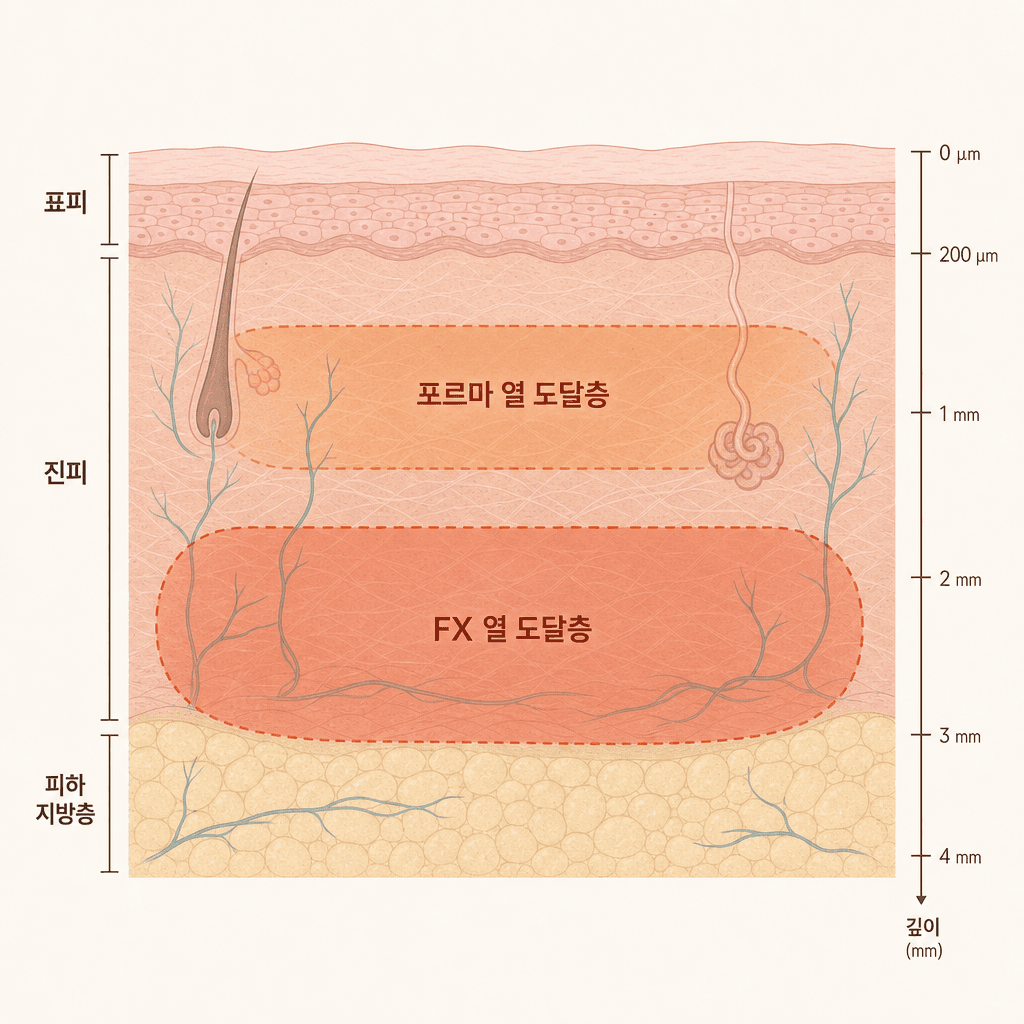
Academic data on RF action by depth also explains that deep RF delivers heat to the connective structures of the subcutaneous tissue and deep dermis, working to lift sagging areas. This is why the layer reached by the heat varies depending on the handpiece, even with the same InMode device.

Why Beautystone Hapjeong?
At Beautystone Hapjeong, we believe in going beyond just recommending "InMode." We make sure to explain which mode targets which layer first. This is because the right mode can be completely different for someone worried about skin texture versus someone concerned about contour sagging. With our focus on customized 1:1 consultations, we help you identify your skin condition and concerns first before deciding on the right mode. Located just a 4-minute walk from Hapjeong Station, Mecenatpolis, stopping by for a quick pre-treatment consultation is convenient and easy.

The choice of mode depends on your skin concerns
Rather than one being superior to the other, FX and Forma simply target different layers for different purposes. The right mode is determined by your specific concerns.
Here is a guide based on your goals:
If you are concerned about skin texture and elasticity, Forma—which evenly warms the shallow dermis—is generally a good fit. If your main concern is sagging contours, FX—which targets the deeper layers—is more suitable. When both concerns overlap, we often recommend combining both modes. Because RF stimulation requires time for collagen to rebuild, results are best evaluated over several weeks to months rather than immediately after the procedure. We recommend consulting with our medical team before your treatment to choose the mode that is perfect for you.

Frequently Asked Questions
Q. Which is more effective, FX or Forma?
A. It is not a matter of one being better than the other; they simply target different layers. Forma works on the texture and elasticity of the shallow-to-mid dermis, while FX targets sagging contours in the deeper layers near the subcutaneous fat. The ideal mode depends on your personal skin concerns.
Q. Will I get better results if I receive both?
A. You do not necessarily have to get both. If you are concerned about both skin texture and sagging contours, combining the modes can be highly beneficial. However, if you only have one specific concern, focusing on just one suitable mode is also very common. We recommend discussing your goals with our medical staff to determine the best path.
Q. How soon can I see the effects of RF treatment?
A. Since collagen takes time to rebuild and settle, the changes typically become more noticeable over several weeks to months rather than immediately after the procedure. It is cooperative to observe the gradual progress rather than expecting instant results.
Q. Can I return to my daily life immediately after the treatment?
A. You may experience slight redness or a warm sensation right after the procedure, but it generally does not interfere with daily activities. However, individual experiences can vary, so it is best to follow the post-treatment care guidelines provided by your medical practitioner.


Contouring & Volume
Hip Dip Filler Before and After: 4 Checks

Body
Potenza Treatment Interval: Why 4 Weeks?

Lifting
Ultherapy Before and After: Why Wait 90 Days?

Contouring & Volume
Belotero Revive Cost: 2cc Price vs. 3 Sessions

skin
Lip Hyperpigmentation Laser: Does It Work?

Contouring & Volume
Men's Forehead Filler: Hollow or Just Lines?