

Swelling peaks the day after InMode FX and eases within days. Here's what to expect.
Published -
Updated -

Author
Wi Young-jin · Chief director
Seoul National University College of Medicine · Seoul National University Hospital Specialist
→
If you've booked InMode FX and then opened your calendar to find a wedding, a photo shoot, and a client dinner stacked into the next two weeks, you're not alone. One of the most common questions we hear isn't about results at all. It's this: how long will I look swollen, and am I going to bruise?
Here's the short answer. Most people see warmth and mild redness on the day of treatment, the most noticeable puffiness the following morning, and a face that looks close to normal within about a week. Bruising isn't a given, but when it shows up it usually takes a few days to two weeks to fade.
In this article, we'll cover why swelling and bruising happen after a radiofrequency treatment, a day-by-day recovery timeline you can plan around, who tends to bruise more easily, the side effects worth watching for, and how far ahead to book when you have an event you can't move.
What Causes Swelling and Bruising After InMode FX?
Heat, mostly — and it's a normal tissue response rather than a sign that something went wrong. InMode FX delivers radiofrequency energy into the dermis and the subcutaneous fat layer to stimulate collagen and firm up the tissue that gives your lower face its shape. When tissue is heated, blood flow to the area increases temporarily and fluid collects between the fibers. What you see in the mirror that evening is the result: skin that feels warm, looks slightly flushed, and feels tight.
Think of a sponge that's just soaked up water. The sponge itself hasn't changed size — it only looks fuller while it's holding fluid, and it settles back once that fluid drains. Early post-treatment swelling behaves much the same way.
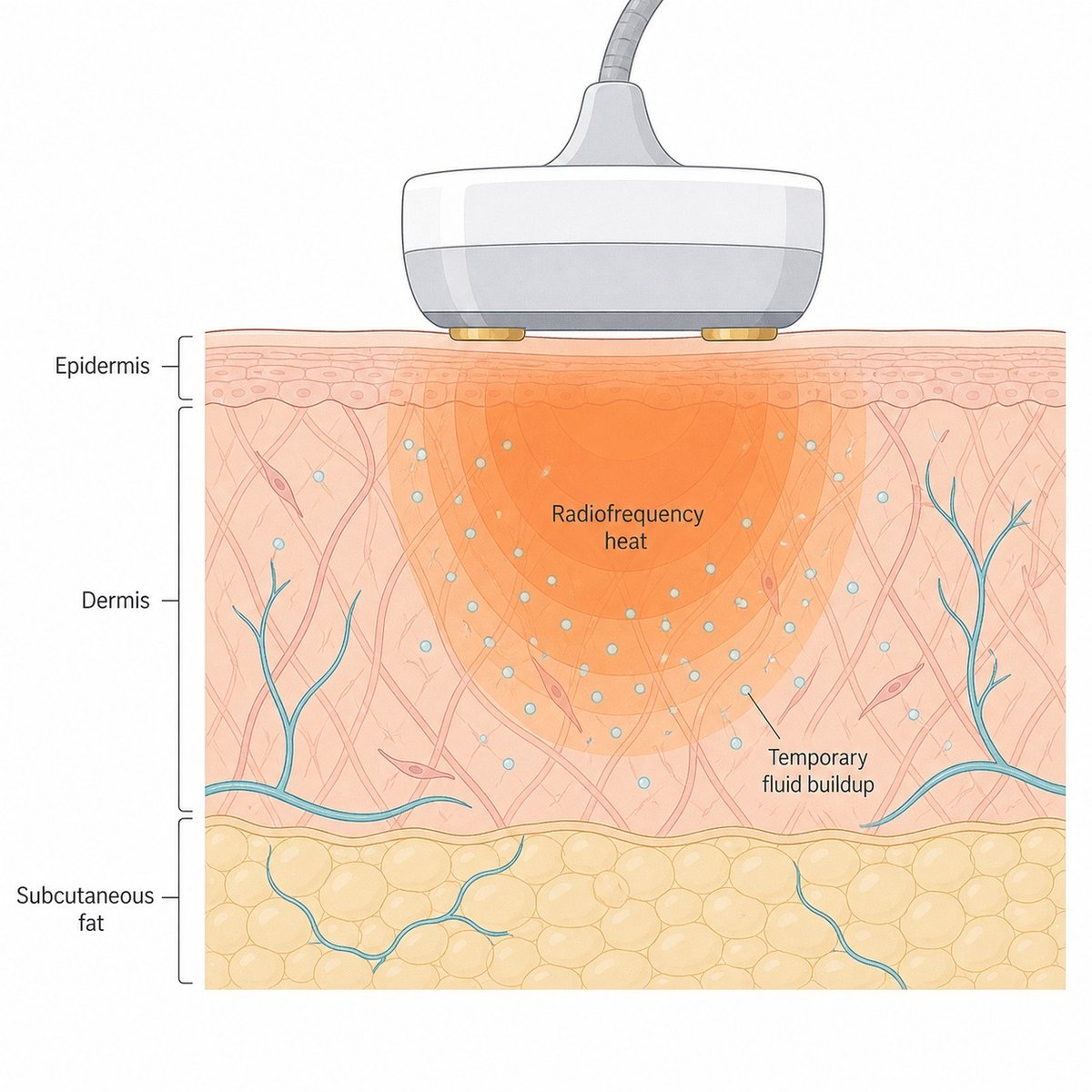
The temperatures at which different layers respond aren't the same, either. Research on radiofrequency tissue tightening reported that in testing, fat began to contract at roughly 69°C, fascia at roughly 61°C, and skin at roughly 82°C. That work looked at body areas using different equipment, so those numbers aren't a facial protocol — but they do explain why facial treatments are delivered at lower energy across several passes instead of one aggressive session.
Bruising has a different mechanism. It happens when small vessels under the skin leak a little blood into the surrounding tissue, which is why it tends to appear where skin is thin and vessels sit close to the surface: around the eyes and along the jawline. Not everyone bruises. If you do, it isn't a sign that something has gone wrong.
InMode FX Recovery Timeline, Day by Day
Before the table, one set of numbers worth anchoring to. A systematic review of the safety of facial radiofrequency pooled 15 studies covering 1,230 participants and found no severe or lasting complications. The effect reported most often was erythema — redness — described in anywhere from 17.6 to 100 percent of patients depending on the protocol used, along with edema, or swelling, in roughly 5.3 to 26.5 percent. In most cases both settled on their own within 24 to 72 hours.
That same review is candid about a gap in the evidence: not one of those 15 studies measured recovery time systematically. So the timeline below reflects what we see in clinic rather than a figure the literature has confirmed. Treat it as a planning tool, not a promise.
When | What you'll usually see | What helps |
|---|---|---|
Day of treatment | Warmth, mild flushing, a tight feeling | Short cold compresses; skip the sauna |
Next morning | Puffiness at its most noticeable | Go easy on salt; sleep slightly elevated |
Days 2 to 3 | Redness and swelling starting to ease | Light makeup is usually fine by now |
Days 4 to 7 | Face looking close to baseline | Back to your normal skincare routine |
If a bruise appears | Color shifting from purple to green-yellow, then fading | Avoid firm massage and direct heat there |
Individual results vary. How long you stay puffy depends on your skin thickness, the energy your provider selects, the area treated, and how you look after yourself in the first 48 hours.
Who Bruises More Easily and How to Fade It Faster
Because InMode FX doesn't involve needles passing through the skin, bruising is less common here than it is with injectables. A few things do raise the odds.
Blood-thinning medications and supplements: Aspirin, fish oil, and high-dose vitamin E all make small vessels more likely to leak. Don't stop a prescription on your own — tell your provider instead.
Alcohol or a short night's sleep: Either one in the 24 hours before your appointment.
Where you are in your cycle: Many people swell more easily in the days just before and after a period.
Recent injectables: Filler or skin boosters placed in the same area not long ago.
Naturally thin skin: Particularly around the eyes.
Aftercare isn't complicated. On day one, use a cold compress in short sessions rather than one long one, and skip the sauna, the steam room, and hard workouts for the first day or two. Heat and a raised heart rate both make swelling look worse in the short term.
If a bruise does appear, it typically shifts color from purple to green-yellow before fading over a few days to about two weeks. Avoid firm massage and direct heat on that spot while it clears. If the color hasn't started to lighten after two weeks, have your provider take a look.
As for makeup, wait until the skin isn't flushed or irritated, then pat concealer on gently instead of rubbing it in. Hold off on gritty scrubs, strong exfoliating acids, and retinol for at least a week, or until your provider tells you your skin is ready.

Side Effects and Risks: What's Normal and What Isn't
Most of what happens after InMode FX is mild and settles without intervention. Here's what sits inside the expected range.
Redness and warmth: Common on the day of treatment, typically easing within 24 to 72 hours.
Mild swelling: Usually most noticeable the next morning.
Dryness or light flaking: Sometimes for several days afterward.
Numbness or intermittent tightness: Generally temporary.
And here's the line where you stop waiting it out. If you notice blistering, an open wound, pain that keeps getting worse, redness that spreads, fever, or a dark mark showing no sign of lightening, seek medical care right away. Those aren't normal settling signs.
On comfort, the same systematic review reported an average pain score of 1.94 out of 10 — tolerable for most people, though an average tells you nothing about how you personally will feel. Areas where bone sits close to the surface, like the jawline, tend to feel hotter than the rest. Say so during the session, because energy can be dialed down.
Some people should postpone treatment, or at least talk it through in detail first.
Pregnancy or breastfeeding.
A pacemaker or implanted metal in the area being treated.
Active infection, rash, or inflamed acne where the handpiece would pass.
A bleeding disorder or ongoing anticoagulant therapy.
A history of raised or keloid scarring.
Your medication list, your medical history, and any treatment you've had recently can all change the plan, so bring them up at the consultation rather than deciding for yourself that they don't matter.
How Far Ahead Should You Book Before a Big Event?
Count backward from the event rather than forward from today. Three rough guidelines cover most situations.
A wedding, a shoot, or anything on stage: Leave about three weeks.
A dinner or a meeting where you'll be seen up close: About a week is usually enough.
A week you can work from home: Treat before a weekend and you'll likely be fine.
Three weeks before a major event isn't because swelling lasts that long — it doesn't. It's insurance against a bruise landing somewhere makeup can't easily cover, plus time for skin to settle before a day of heavy makeup. If you have less than a week and still want to go ahead, ask your provider whether lower energy or splitting the treatment across sessions makes more sense.
Cost depends on the area treated, the number of pulses, and how your provider designs the plan, so a single figure would be misleading. Current pricing is on our price page and seasonal offers are on our promotions page. These are Seoul clinic prices and are subject to change.
The Bottom Line
Swelling peaks early: Warmth and flushing on the day of treatment, the most noticeable puffiness the next morning, easing from day two or three.
The literature supports that short arc: A systematic review found redness and swelling resolved on their own within 24 to 72 hours in most cases, with no severe complications across 15 studies.
Bruising is possible, not inevitable: When it does appear it usually fades within a few days to about two weeks, most often in thin-skinned areas.
Plan backward from your calendar: Roughly three weeks for a major event, roughly a week for ordinary social plans.
Like any energy-based procedure, InMode FX comes with trade-offs, and individual results vary with skin thickness, settings, and aftercare. Ultimately the choice depends on your skin, your schedule, and what you're hoping to change — and if something looks off afterward, talk to your provider instead of waiting to see.
Beautystone is a dermatology clinic in Seoul's Hapjeong neighborhood. If you're trying to fit a treatment around a date you can't move, a consultation is the best way to map the timing. For more detail, see InMode FX Side Effects and when you can wash your face and wear makeup again.
Frequently asked questions
Q. How long does swelling last after InMode FX?
A. For most people, swelling is at its most noticeable the morning after treatment and starts easing from day two or three. A systematic review of facial radiofrequency reported that redness and swelling resolved on their own within 24 to 72 hours in most cases, though not one of the studies it pooled measured recovery time systematically. Individual results vary with skin thickness, the energy used, and how much heat or salt you're exposed to in the first couple of days, so it's worth leaving more room in your calendar than you think you'll need.
Q. Does InMode FX cause bruising?
A. Sometimes, but it's far from a given. Because the treatment doesn't pass needles through the skin, bruising is less common than it is with injectables. When it happens, it usually shows up where skin is thin and small vessels sit near the surface — around the eyes and along the jawline. A bruise typically shifts color from purple to green-yellow and fades within a few days to about two weeks. If the color hasn't begun to lighten after two weeks, have your provider look at it.
Q. How far in advance should I book before a wedding or photo shoot?
A. About three weeks is a comfortable buffer for an event you can't reschedule. That isn't because swelling lasts three weeks — it usually doesn't. It's margin in case a bruise lands somewhere concealer can't easily cover, plus time for skin to settle before a day of heavy makeup. For an ordinary dinner or meeting, a week is generally enough. With less than a week, ask your provider whether lower energy or splitting the treatment across sessions is the smarter call.
Q. When can I wear makeup or work out again?
A. Light makeup is usually fine from day two or three, once skin is no longer flushed or irritated — pat it on rather than rubbing. Skip the sauna, the steam room, and hard workouts for the first day or two, since heat and a raised heart rate both make swelling look worse temporarily. Gritty scrubs, strong exfoliating acids, and retinol are best held off for at least a week, or until your provider says your skin is ready.
Content


skin
Why Does Fractional CO2 Take Longer to Heal?

Contouring & Volume
How Many cc Does Forehead Filler Need?

skin
Why Is My Skin Oily but Tight in the Fall?

Hair Removal
Underarm Laser Hair Removal Cost: Do the Math

Tattoo removal
Laser Before a Cover-Up: How Many Sessions?

skin
큐어젯 다운타임, 다음 날 출근과 화장은 언제부터 될까요?