

Beard Hair Removal: Single vs Multi-Wavelength
Beard Hair Removal: Single vs Multi-Wavelength
Beard Hair Removal: Single vs Multi-Wavelength
Beard hair removal hinges on wavelength choice. Single vs multi-wavelength lasers by follicle depth.
Published -
Updated -

Author
Wi Young-jin · Chief director
Seoul National University College of Medicine · Seoul National University Hospital Specialist
→
Male Beard Hair Removal, Single Wavelength vs Multi-Wavelength — The Real Reason Results Differ
As the weather starts to warm up a bit, more men start coming into the clinic.
Because they’re bothered by the dark shadow showing through under the chin,
or because they feel awkward taking off a mask with razor stubble.
"I had 8 sessions somewhere else, so why is it growing back like this?"
I really hear that three or four times a week.
Today, I’ll explain the reason step by step.

They all look like hair-removal lasers, right? But actually
Hair-removal lasers are procedures that burn the melanin in the follicle using a specific wavelength of light.
But there’s one important thing here.
Depending on the wavelength, the depth the light penetrates is completely different.
The commonly used Alexandrite (755nm) penetrates relatively shallowly,
Diode (808nm) reaches mid-depth,
and Nd:YAG (1064nm) reaches the deepest follicles.
Unlike women’s fine hair or leg hair, men’s beard hair often has
follicles embedded as deep as 4 to 5 mm.
So if you use only one wavelength, you’re bound to miss one layer.
Why does the same beard respond well for some people but not for others?
Director Wi Young-jin’s key insight
Thick men’s beards need more than one wavelength,
and multiple wavelengths must be combined to effectively reach each follicle depth.
Cases like this are really common, so I’m writing this down separately.
Last week, a 26-year-old man came in,
and he had received 10 sessions with a single Alexandrite wavelength at another clinic.
But when we compared photos, only the fine surface hairs had become a bit lighter,
and the thick beard along the jawline was almost unchanged.
The reason is this:
The 755nm wavelength responds well to shallow follicles close to the epidermis,
but in areas like under the chin and the upper lip, where the follicles are deep and thick,
the energy that reaches them drops to less than half.
On the other hand, if you use only 1064nm by itself,
it’s inefficient for treating fine hairs near the surface,
and the pain per session is no joke either.

So for male beard hair, I usually
use two or three wavelengths mixed within one session.
The shallow layer gets 755nm or 808nm,
and the deep layer gets 1064nm.
After doing that, that 26-year-old patient said at the third session
that "the time between shaves got longer for the first time."
A change he hadn’t seen even after the previous 10 sessions.
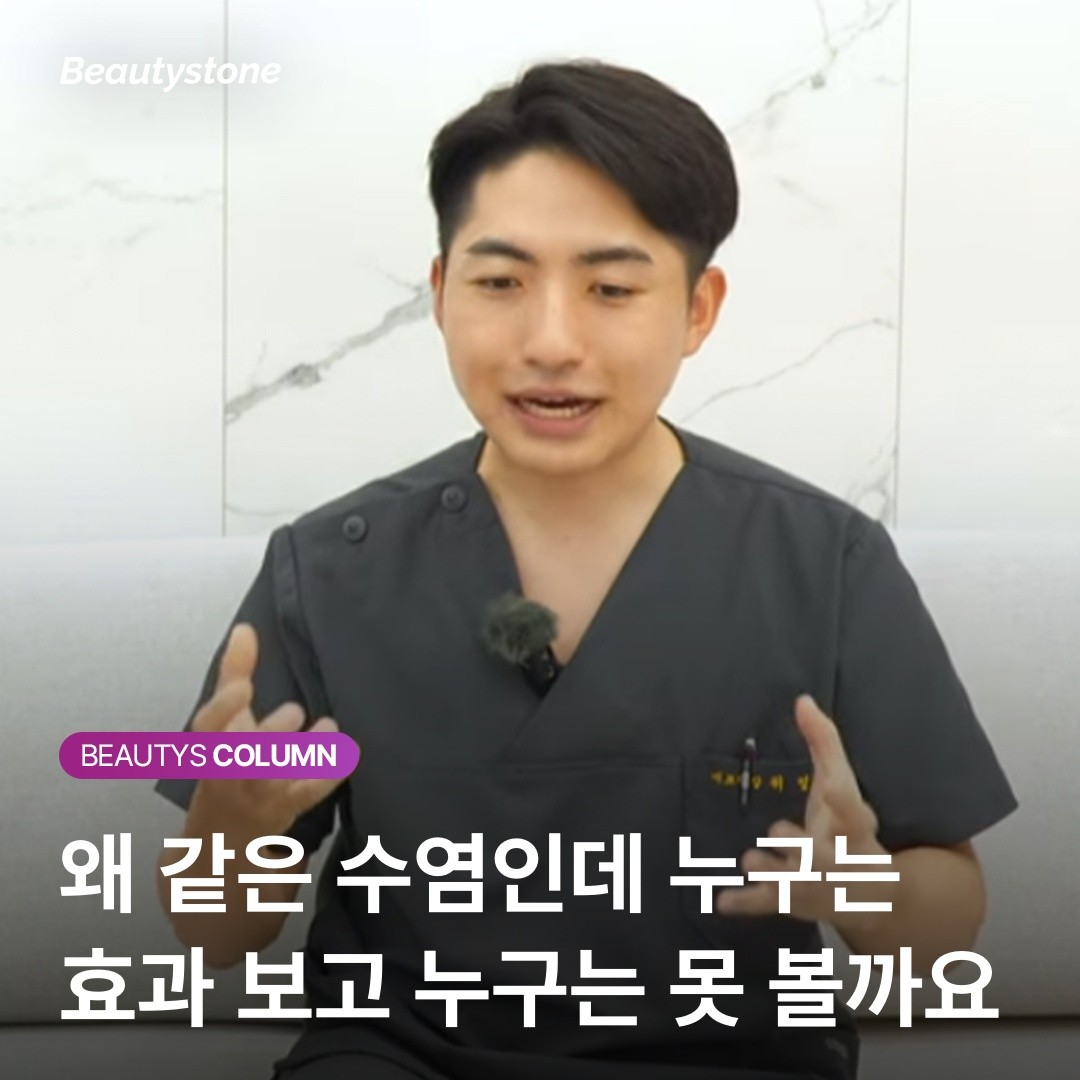
Director Wi Young-jin’s key summary
Men’s beards have varying follicle depths,
so using only one wavelength will inevitably miss some layers.
The real variable that determines results is not "how many sessions you had," but "which wavelengths were combined and how."
So should I get single-wavelength or multi-wavelength treatment?
If we organize it in a table, it looks like this.
Category | Single wavelength | Multi-wavelength combination |
|---|---|---|
Best suited for | Fine hair / light beard | Thick, deep beard |
Average sessions | 8–12+ sessions | 5–8 sessions |
Pain | Moderate | Moderate to slightly strong |
Cost per session | Relatively inexpensive | 10–20% higher |
Residual rate | Deep follicles are likely to remain | Uniform reduction across all layers |
But that doesn’t mean multi-wavelength is always the answer.
If your beard is naturally light and you’re mainly bothered by pigment,
single wavelength may be enough.
However, if your beard still looks dark even after shaving,
the so-called "blue beard" type is better treated with multi-wavelength.

If you’ve read this far, you’re probably wondering this
Q1. How much more painful is multi-wavelength treatment?
1064 is seriously painful..
When the 1064nm is delivered, the feeling of it “popping”
is a bit heavier than with a single wavelength.
But when I’m actually in the treatment room,
more people say, "It’s more tolerable than I expected."
If we apply a topical anesthetic cream, the perceived pain
drops by about one level.
And this is something I get asked a lot too.
Q2. How many sessions does it take before the time between shaves gets longer?
Less than half of patients say, "Oh, it’s already gone down," after just 1–2 sessions.
Usually around the third session, the interval between shaves increases by a day or two,
and after 5–6 sessions, it starts to fade in earnest.
The standard recommendation is 5–8 sessions at 2–4 week intervals.
However, because of hormonally driven new beard growth,
many people continue with "maintenance" rather than complete treatment completion.
Lastly, let me address this part as well.
Q3. Won’t folliculitis or hyperpigmentation happen after the procedure?
This is something many people misunderstand,
but folliculitis is more often caused by
shaving and cleansing care right after the procedure than by the procedure itself.
For 24 hours after treatment, don’t use a razor,
and it’s best to cleanse only with lukewarm water.
Hyperpigmentation can occasionally occur if you have a darker skin tone
or if you’re exposed to a lot of sunlight right after treatment.
So in summer, I always tell patients getting treated
to make sure they use sunscreen with SPF 50 or higher.
In the next post, I’ll go over "Male beard hair removal, what really changes in the clinic at the 5th session."
Even with the same multi-wavelength treatment,
why the point at which people feel results differs
I’ll compare two cases, ages 33 and 26.
This has been Wi Young-jin.
WhatsApp consultation is available before visiting the clinic.
Read together
Beard hair removal: Don’t believe claims of permanent removal unless it’s GentleMax Pro Plus
GentleMax beard hair removal: Why increasing the number of sessions alone doesn’t help
Ulthera 300-shot effect, do it only on the cheekbones [Seoul National University specialist]
GentleMax Pro Plus hair removal treatment details
This month: GentleMax Pro Plus
Frequently asked questions
Q. Q1. How much more painful is it with multi-wavelength treatment?
A. When using 1064 nm, the "popping" sensation does feel a bit heavier than with a single wavelength.
Q. Q2. How many sessions are needed for the shaving interval to get longer?
A. The standard recommendation is 5 to 8 sessions at intervals of 2 to 4 weeks.
Q. Q3. Does folliculitis or hyperpigmentation occur after the procedure?
A. Hyperpigmentation only develops when folliculitis occurs first—so preventing folliculitis is the key. For 24 hours after the procedure, avoid using a razor and stick to face cleansing with lukewarm water only.
Q. Will using multiple wavelengths completely stop beard growth?
A. It is often viewed as maintenance rather than a permanent cure. Since new beard hair can grow due to hormonal influences, the treatment aims to extend the shaving intervals, and results may vary from person to person.
Male Beard Hair Removal, Single Wavelength vs Multi-Wavelength — The Real Reason Results Differ
As the weather starts to warm up a bit, more men start coming into the clinic.
Because they’re bothered by the dark shadow showing through under the chin,
or because they feel awkward taking off a mask with razor stubble.
"I had 8 sessions somewhere else, so why is it growing back like this?"
I really hear that three or four times a week.
Today, I’ll explain the reason step by step.
They all look like hair-removal lasers, right? But actually
Hair-removal lasers are procedures that burn the melanin in the follicle using a specific wavelength of light.
But there’s one important thing here.
Depending on the wavelength, the depth the light penetrates is completely different.
The commonly used Alexandrite (755nm) penetrates relatively shallowly,
Diode (808nm) reaches mid-depth,
and Nd:YAG (1064nm) reaches the deepest follicles.
Unlike women’s fine hair or leg hair, men’s beard hair often has
follicles embedded as deep as 4 to 5 mm.
So if you use only one wavelength, you’re bound to miss one layer.
Why does the same beard respond well for some people but not for others?
Director Wi Young-jin’s key insight
Thick men’s beards need more than one wavelength,
and multiple wavelengths must be combined to effectively reach each follicle depth.
Cases like this are really common, so I’m writing this down separately.
Last week, a 26-year-old man came in,
and he had received 10 sessions with a single Alexandrite wavelength at another clinic.
But when we compared photos, only the fine surface hairs had become a bit lighter,
and the thick beard along the jawline was almost unchanged.
The reason is this:
The 755nm wavelength responds well to shallow follicles close to the epidermis,
but in areas like under the chin and the upper lip, where the follicles are deep and thick,
the energy that reaches them drops to less than half.
On the other hand, if you use only 1064nm by itself,
it’s inefficient for treating fine hairs near the surface,
and the pain per session is no joke either.
So for male beard hair, I usually
use two or three wavelengths mixed within one session.
The shallow layer gets 755nm or 808nm,
and the deep layer gets 1064nm.
After doing that, that 26-year-old patient said at the third session
that "the time between shaves got longer for the first time."
A change he hadn’t seen even after the previous 10 sessions.
Director Wi Young-jin’s key summary
Men’s beards have varying follicle depths,
so using only one wavelength will inevitably miss some layers.
The real variable that determines results is not "how many sessions you had," but "which wavelengths were combined and how."
So should I get single-wavelength or multi-wavelength treatment?
If we organize it in a table, it looks like this.
Category | Single wavelength | Multi-wavelength combination |
|---|---|---|
Best suited for | Fine hair / light beard | Thick, deep beard |
Average sessions | 8–12+ sessions | 5–8 sessions |
Pain | Moderate | Moderate to slightly strong |
Cost per session | Relatively inexpensive | 10–20% higher |
Residual rate | Deep follicles are likely to remain | Uniform reduction across all layers |
But that doesn’t mean multi-wavelength is always the answer.
If your beard is naturally light and you’re mainly bothered by pigment,
single wavelength may be enough.
However, if your beard still looks dark even after shaving,
the so-called "blue beard" type is better treated with multi-wavelength.
If you’ve read this far, you’re probably wondering this
Q1. How much more painful is multi-wavelength treatment?
1064 is seriously painful..
When the 1064nm is delivered, the feeling of it “popping”
is a bit heavier than with a single wavelength.
But when I’m actually in the treatment room,
more people say, "It’s more tolerable than I expected."
If we apply a topical anesthetic cream, the perceived pain
drops by about one level.
And this is something I get asked a lot too.
Q2. How many sessions does it take before the time between shaves gets longer?
Less than half of patients say, "Oh, it’s already gone down," after just 1–2 sessions.
Usually around the third session, the interval between shaves increases by a day or two,
and after 5–6 sessions, it starts to fade in earnest.
The standard recommendation is 5–8 sessions at 2–4 week intervals.
However, because of hormonally driven new beard growth,
many people continue with "maintenance" rather than complete treatment completion.
Lastly, let me address this part as well.
Q3. Won’t folliculitis or hyperpigmentation happen after the procedure?
This is something many people misunderstand,
but folliculitis is more often caused by
shaving and cleansing care right after the procedure than by the procedure itself.
For 24 hours after treatment, don’t use a razor,
and it’s best to cleanse only with lukewarm water.
Hyperpigmentation can occasionally occur if you have a darker skin tone
or if you’re exposed to a lot of sunlight right after treatment.
So in summer, I always tell patients getting treated
to make sure they use sunscreen with SPF 50 or higher.
In the next post, I’ll go over "Male beard hair removal, what really changes in the clinic at the 5th session."
Even with the same multi-wavelength treatment,
why the point at which people feel results differs
I’ll compare two cases, ages 33 and 26.
This has been Wi Young-jin.
WhatsApp consultation is available before visiting the clinic.
Read together
Beard hair removal: Don’t believe claims of permanent removal unless it’s GentleMax Pro Plus
GentleMax beard hair removal: Why increasing the number of sessions alone doesn’t help
Ulthera 300-shot effect, do it only on the cheekbones [Seoul National University specialist]
GentleMax Pro Plus hair removal treatment details
This month: GentleMax Pro Plus
Frequently asked questions
Q. Q1. How much more painful is it with multi-wavelength treatment?
A. When using 1064 nm, the "popping" sensation does feel a bit heavier than with a single wavelength.
Q. Q2. How many sessions are needed for the shaving interval to get longer?
A. The standard recommendation is 5 to 8 sessions at intervals of 2 to 4 weeks.
Q. Q3. Does folliculitis or hyperpigmentation occur after the procedure?
A. Hyperpigmentation only develops when folliculitis occurs first—so preventing folliculitis is the key. For 24 hours after the procedure, avoid using a razor and stick to face cleansing with lukewarm water only.
Q. Will using multiple wavelengths completely stop beard growth?
A. It is often viewed as maintenance rather than a permanent cure. Since new beard hair can grow due to hormonal influences, the treatment aims to extend the shaving intervals, and results may vary from person to person.


Latest post
Latest post

Hair Removal
레이저 제모 1회에도 남는 몫이 있어요 — 밀도를 모자이크로 보는 법

Tattoo removal
Why Extremity Tattoos Are Slower to Remove

Tattoo removal
Tattoo Removal Cost: Why Quotes Vary by Area

Tattoo removal
Unused Tattoo Removal Sessions: What Happens?

Lifting
Forehead Thread Lifting: How Far Can It Go?

skin
Skin Booster Prices: What to Check in a Quote
1:1 Custom Approach
1:1 Consultation Whatsapp
🌸 Beautystone Clinic attends the Meditox Bangkok Cadaver Workshop 🌸
1:1 Custom Approach