

Can you get Ultherapy while breastfeeding? How to think about timing and safety postpartum.
Published
Updated
Author
Wi Young-jin · Chief director
Seoul National University College of Medicine · Seoul National University Hospital Specialist
→
If you've caught your reflection lately and noticed your cheeks or jawline looking a little softer since giving birth, you're not alone. Postpartum skin changes are one of the most common concerns new parents mention, and they can feel discouraging when you're already running on very little sleep.
One of the most common questions we hear from new moms is whether it's okay to jump straight into a lifting treatment like Ultherapy, especially while still breastfeeding. It's a fair question, and the honest answer is more nuanced than a simple yes or no.
In this article, we'll cover why the face tends to sag after pregnancy, how Ultherapy actually works, what the timing and safety considerations look like while you're nursing, and the side effects worth knowing about before you book anything.
Why Does the Face Sag After Pregnancy?
Pregnancy and the postpartum period bring big hormonal shifts, and those shifts don't just affect your mood and energy. Estrogen influences how much collagen and water your skin holds, so as levels fluctuate after birth, your skin can temporarily lose some of its bounce and firmness.
Add in months of interrupted sleep, the physical demands of feeding, and rapid weight changes, and it's easy to see why the mirror might look different than it did a year ago. The good news: a lot of this is temporary. Pregnancy-related laxity often recovers at least partly on its own over the months that follow, as your body and hormones settle back toward baseline.
The takeaway here: before assuming you need a procedure, it's often worth giving your skin a little time. Individual results vary, but many people notice gradual improvement without doing anything at all.
How Does Ultherapy Actually Work?
Ultherapy is a type of HIFU, or high-intensity focused ultrasound. Instead of treating the surface of your skin, it sends focused ultrasound energy past the outer layers to a deeper support layer called the SMAS.
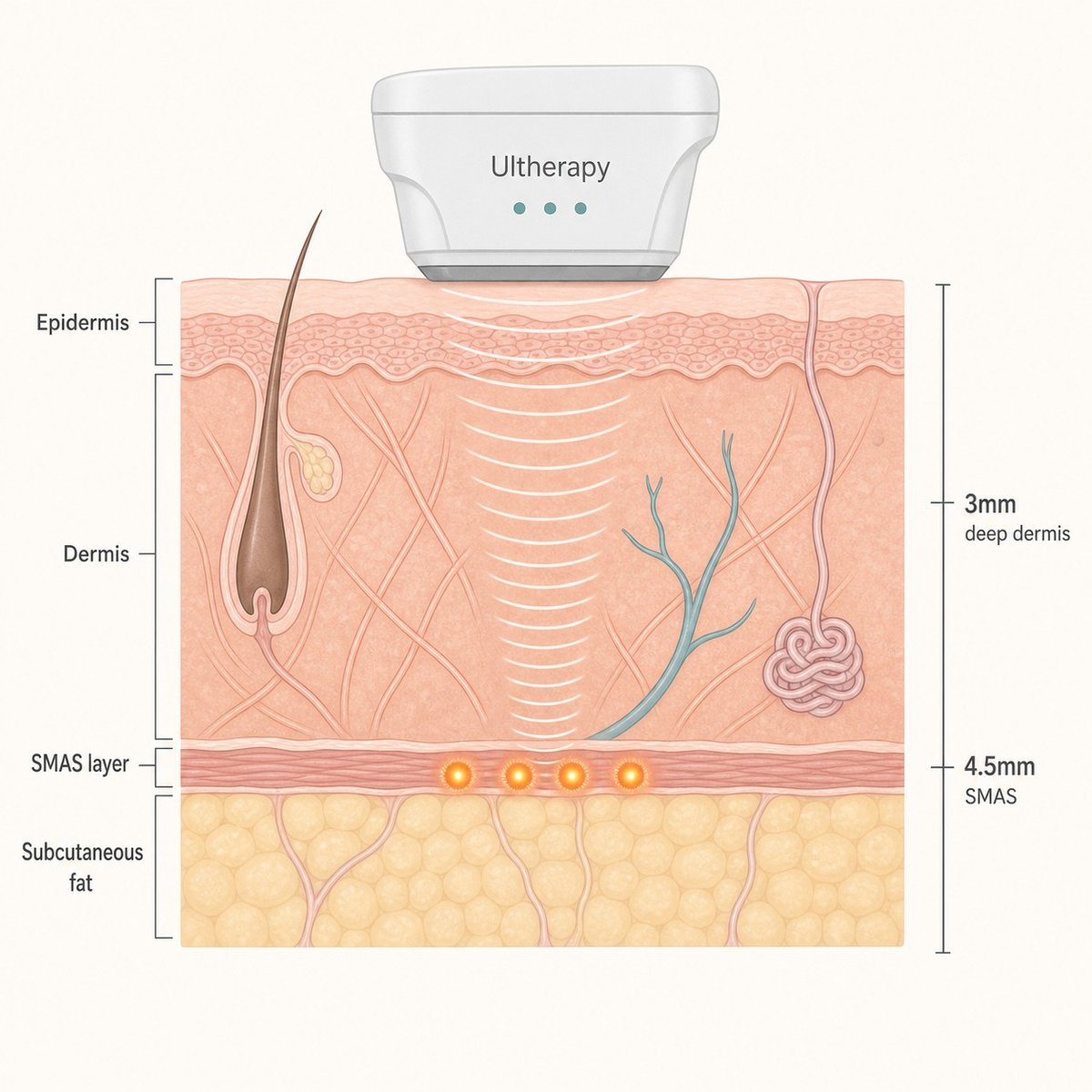
The SMAS is the same foundational layer that surgeons lift during a facelift. By creating tiny points of controlled heat at that depth, Ultherapy prompts the skin to contract slightly and, over the following weeks, to build new collagen.
Timeline: This isn't an instant fix. Most people see gradual changes rather than an overnight difference, and collagen remodeling typically continues for two to three months after a session. Studies suggest results can keep developing over that window, though how much you see depends on your skin, your age, and the degree of laxity you started with.
Can You Get Ultherapy While Breastfeeding?
Here's the reassuring part first: Ultherapy doesn't inject a drug or medication into your body. It's ultrasound energy delivered to the skin's deeper layers, so there's no systemic absorption that would pass into breast milk the way an oral medication might. That's a meaningful difference from treatments that rely on injectables or drugs.
That said, most providers still recommend waiting. The reason isn't a proven danger, it's that research specifically in pregnant and breastfeeding populations is limited, and standard clinical caution favors holding off on elective cosmetic procedures until your postpartum recovery and hormones have stabilized. Because so much of postpartum laxity improves on its own, waiting also means you won't pay for a treatment your body might have partly handled for free.
Skin and tissue go through real changes during this period, and our understanding of them is still developing (research on skin care during breastfeeding). The bottom line for timing: don't decide alone. Tell your provider you're breastfeeding, and let them weigh your specific situation before scheduling anything.

Side Effects and Safety
Because Ultherapy is non-surgical, downtime tends to be minimal. Still, it's a treatment that delivers heat below the surface, so it's worth knowing what's normal and what isn't.
Common and temporary: Redness, mild swelling, tingling, or tenderness. These are common and usually settle within a few days.
Less common: Small areas of bruising or temporary numbness along the treated area.
Seek medical care right away: If you develop a fever, spreading redness, or worsening pain in the days after treatment, contact your provider promptly rather than waiting it out.
Postpartum skin can also be more sensitive than usual, which is one more reason a pre-treatment consultation matters. Ongoing research continues to look at the safety profile of focused ultrasound lifting (research on ultrasound-based lifting). A qualified provider can flag whether the timing is right for you and rule out reasons to hold off.
How Much Does Ultherapy Cost?
Pricing for Ultherapy varies quite a bit depending on how many shots you need and how large an area you're treating. Since it's an elective cosmetic treatment, it isn't covered by insurance, and clinics typically quote by shot count or by zone rather than a single flat fee.
Because prices at a Seoul clinic are subject to change, the most reliable move is to ask for a current quote during your consultation rather than relying on a number you saw online. Individual results vary, and so does what each person actually needs, so a personalized estimate will always be more accurate than a ballpark figure.
The Bottom Line
Here's what to keep in mind:
Postpartum sagging is common, largely hormone-driven, and often improves on its own over several months.
Ultherapy works by heating the deep SMAS layer to stimulate collagen, with results building gradually.
It doesn't introduce a drug into your system, but the standard advice is still to wait until you're past breastfeeding and your recovery has stabilized.
Redness and swelling are typical and short-lived, while fever or spreading redness means you should seek care.
Like any procedure, Ultherapy comes with trade-offs, and the right timing is personal. Ultimately, the choice depends on your skin, your recovery, and a conversation with someone who knows your history. If you're considering Ultherapy after pregnancy, a consultation is the best way to find out what fits you. Beautystone is a dermatology clinic in Seoul's Hapjeong area, and you can talk through your timing there before making any decisions.
Frequently asked questions
Q. Is Ultherapy safe while breastfeeding?
A. Ultherapy uses focused ultrasound rather than an injected drug, so there's no systemic absorption that would pass into breast milk. Even so, most providers recommend waiting, because research in breastfeeding populations is limited and standard caution favors holding off on elective cosmetic treatments until you've recovered. Tell your provider you're nursing and let them advise on timing.
Q. How long after giving birth should I wait for Ultherapy?
A. There's no fixed rule, but a lot of postpartum laxity improves on its own as your hormones settle over several months. Many providers suggest waiting until you've finished breastfeeding and your skin and body feel stable. Because individual results vary, the safest approach is to confirm your specific timing with a provider.
Q. Does Ultherapy hurt?
A. You may feel brief warmth or a tingling sensation as the energy reaches the deeper layers, and comfort levels vary from person to person. Numbing options can help. Postpartum skin can be more sensitive, so mention that during your consultation so your provider can adjust accordingly.
Q. Will postpartum sagging go away without treatment?
A. Often, at least partly. Pregnancy-related skin laxity frequently recovers on its own over the months after birth as your body returns toward its baseline. It's usually worth giving it some time before deciding on a procedure, and considering treatment only if you're still bothered once things have settled.



Contouring & Volume
Hip Dip Filler Before and After: 4 Checks

Body
Potenza Treatment Interval: Why 4 Weeks?

Lifting
Ultherapy Before and After: Why Wait 90 Days?

Contouring & Volume
Belotero Revive Cost: 2cc Price vs. 3 Sessions

skin
Lip Hyperpigmentation Laser: Does It Work?

Contouring & Volume
Men's Forehead Filler: Hollow or Just Lines?