Ultherapy regrows collagen; thread lifts give an instant pull. Which suits your skin.
Published
Updated

Author
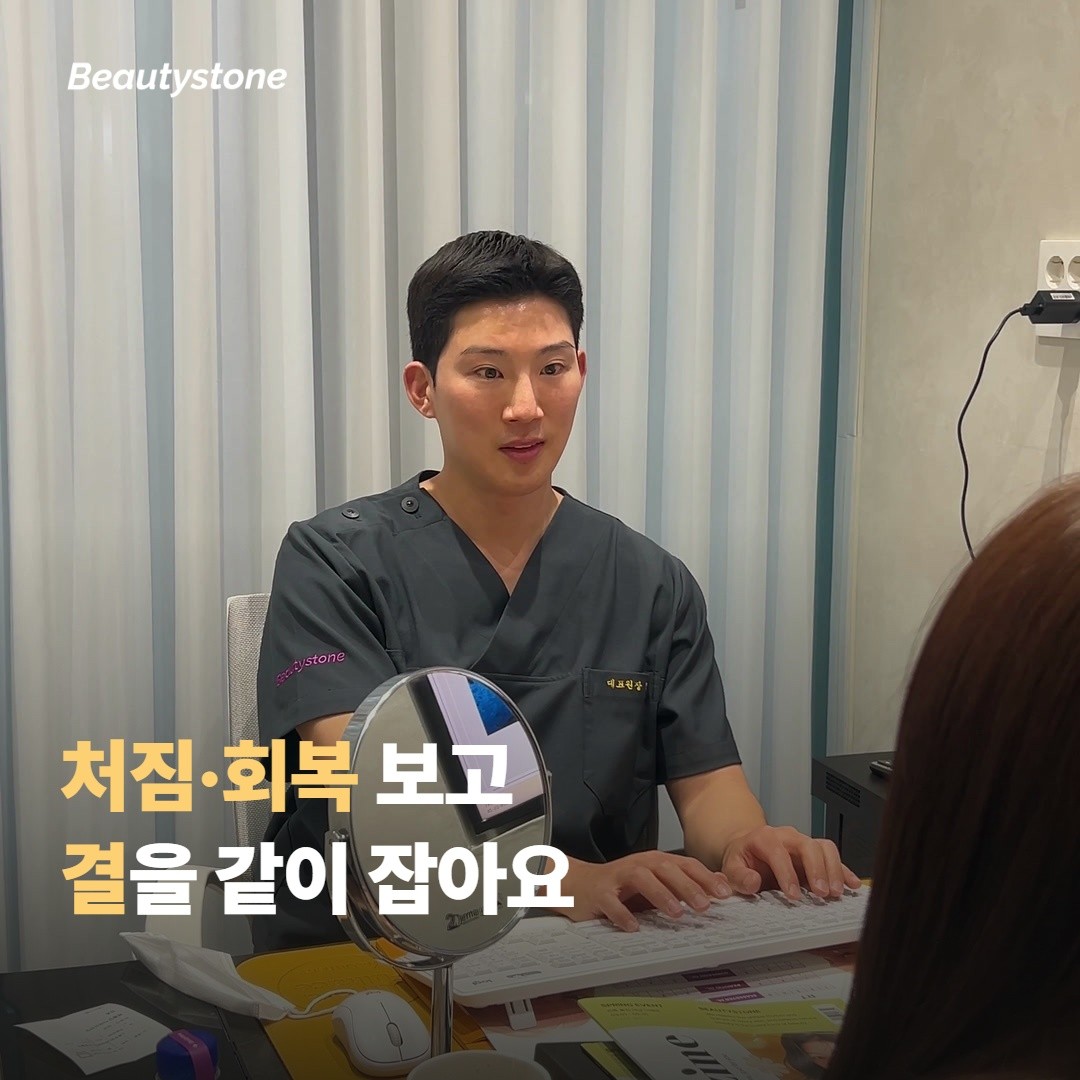
Wi Young-jin · Chief director
Seoul National University College of Medicine · Seoul National University Hospital Specialist
→
When working in Yeouido, many people find themselves stopping by during lunch or after work to look into lifting treatments. It often starts with a subtle sign in the mirror—a softening jawline or a slight sagging under the cheekbones. However, when they actually begin researching, many find themselves stuck at a crossroads: "Should I get Ultherapy or a thread lift?" The short answer is that the right choice depends on your degree of sagging, recovery time, and when you expect to see results, as the two treatments work on entirely different principles and suit different needs.
It's not a simple choice. Although Ultherapy and thread lifting are often grouped together as "lifting" treatments, one works by signaling your body to produce its own collagen, while the other physically pulls the skin up using threads. Understanding the differences between these two pathways beforehand makes it much easier to find the perfect fit during your consultation.
This content is a summary of treatment information from Beautystone Hapjeong.
In This Article, You Will Learn
The difference in how Ultherapy and thread lifting work
Who is a good candidate for Ultherapy
Who is a good candidate for thread lifting
How these two treatments can be combined at different times
How They Work: Ultherapy vs. Thread Lifting
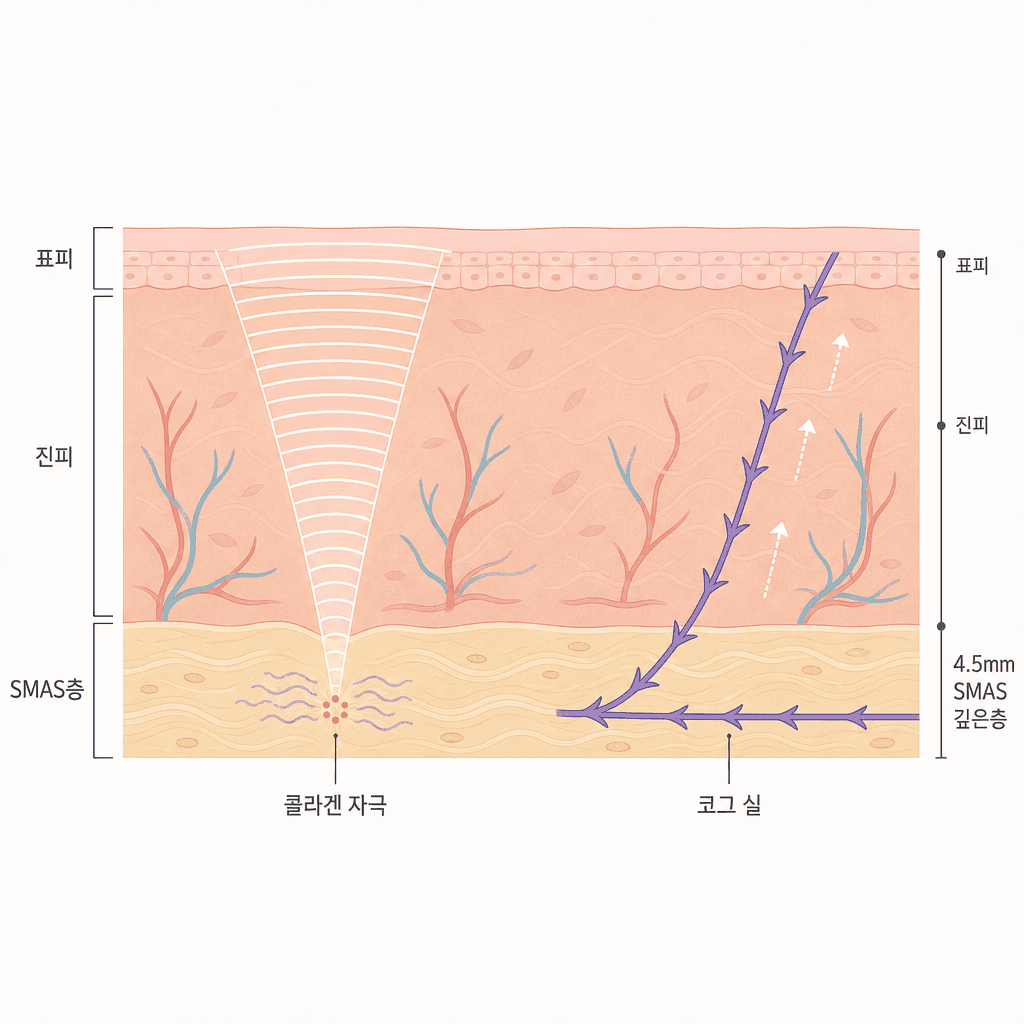
Ultherapy uses HIFU* ultrasound focused on a single point to stimulate the deep layers of the skin. By signaling the body to generate its own collagen, it doesn't physically lift the skin itself, but rather coaxes your body into doing the lifting. Micro-focused ultrasound is reported to induce collagen and elastin remodeling within target layers, including the SMAS depth.
HIFU*: High-Intensity Focused Ultrasound. It concentrates ultrasound energy onto a single point to create thermal coagulation zones in the deep skin layer (SMAS). This stimulus triggers natural collagen production, gradually revealing a lifted effect.
Thread lifting works in the exact opposite way. It physically anchors and pulls sagging tissue by inserting absorbable threads with tiny barbs into the dermis and SMAS layers for an immediate lift. The treatment itself does the lifting, and as the threads are absorbed over time, they also stimulate collagen. SMAS repositioning using cog threads is designed to secure sagging soft tissue back onto firmer underlying structures to prevent it from dropping again. In short, this contrast between biology (Ultherapy) and physics (thread lift) determines the differences in immediate results, longevity, downtime, and who each treatment suits best.

Who is Ultherapy Best For?
Ultherapy is perfect for those with mild to moderate sagging, or anyone looking to discreetly rebuild their natural collagen foundation. You should be comfortable with results that develop gradually over several months rather than seeing an instant change. In Yeouido, we often recommend it to those who:
Have no severe sagging, but are starting to notice softening lines in the mirror
Need virtually zero downtime—ideal for those who must head straight back to the office
Feel hesitant about the invasive nature of inserting threads under the skin
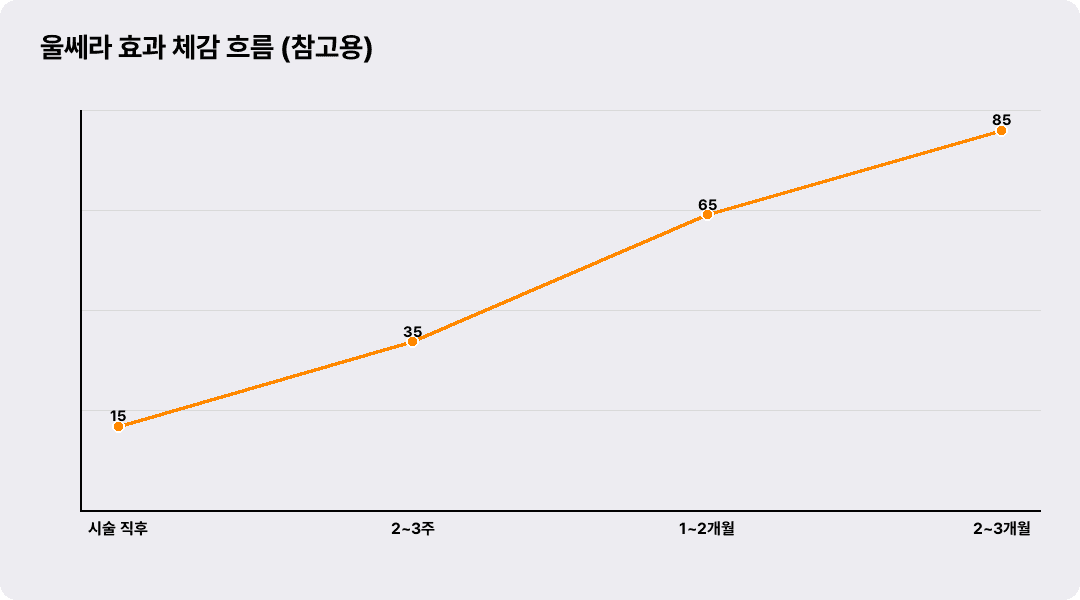
After Ultherapy, you may experience mild swelling or redness for just 1 to 2 days. You can apply makeup the next day and go about your daily life without much trouble, which is why getting a quick treatment during lunch and heading into an afternoon meeting is quite common. However, because collagen regeneration takes time, it's best to judge the results over a few weeks rather than immediately after the procedure. The diagram below illustrates how the visible effects of Ultherapy build up over time for your reference.
Who is Thread Lifting Best For?
Thread lifting is highly suited for those with distinct sagging who want to see immediate, visible improvement. The jawline and cheeks look instantly redefined right after the treatment, with results typically lasting between 6 months to 2 years. We frequently recommend this to patients who:
Have noticeable sagging below the cheekbones and along the jawline
Have a scheduled event, meeting, or wedding—ideal for those who need results by a specific date
Can manage a few days of downtime (a tight sensation or slight bruising)
Conversely, it is safer to postpone treatment or look into other options if:
You are pregnant, breastfeeding, or have active inflammation in the treatment area—recovery and safety must come first
You have a history of keloids—it is best to consult with our medical team regarding skin reactions at the thread entry points
For a few days after a thread lift, you may experience a tight sensation or mild bruising. This usually resolves and looks completely natural within 3 to 5 days, making it highly satisfying for those looking for instant rejuvenation.

Comparing Your Options
Putting Ultherapy and thread lifting side-by-side helps clarify which path aligns best with your goals. Weighing downtime, the onset of results, and longevity against your personal schedule and level of sagging is the most natural way to decide.
Non-surgical anti-aging is a process where a board-certified dermatologist guides you to the best options based on your unique skin condition and goals. Rather than making a self-diagnosis using a chart, it is safest to decide in consultation with your doctor. Neither treatment is inherently superior; the key is simply finding which one aligns with your needs.

How Beautystone Hapjeong Approaches Both Methods
Deciding between Ultherapy and thread lifting isn't about choosing the "better" treatment, but rather determining which approach matches your specific skin profile. Even for the same individual, these two treatments can be performed at different times in a synergistic plan. For pronounced sagging, we might first lift the tissue immediately with a thread lift, and then follow up about 6 months later with Ultherapy to reinforce the collagen foundation. It is generally safer to separate these treatments rather than performing them together on the same day. At Beautystone Hapjeong, we never push a single pre-determined treatment. Instead, we prioritize evaluating your degree of sagging, lifestyle recovery time, and expected timeline together to design a tailored path. A specialized dermatologist will carefully assess your skin's natural lines and plan a schedule with you.
Frequently Asked Questions
Q. Can I get treated during lunchtime and go right back to work?
A. This is very doable with Ultherapy. The procedure takes about 30 to 60 minutes, fitting easily between lunch and your return to work, and any mild redness or swelling can usually be concealed with makeup. However, it is difficult to go right back to work after a thread lift. You may experience a tight sensation or minor bruising for 3 to 5 days, so it is safest to schedule it ahead of a weekend or a short break.
Q. Is one session enough?
A. Both treatments have a set maintenance period. For Ultherapy, patients typically follow up every 6 to 12 months, allowing your natural collagen cycle to fully complete before retreatment to build a cumulative effect. Thread lifts last between 6 months and 2 years, depending on the type of thread, the cog shape, and each individual's skin tissue. The precise timing for a touch-up is best decided in consultation with your medical team.
Q. Will getting both treatments yield a better result?
A. We generally do not recommend getting both on the same day. For areas with clear sagging, a common approach is to first lift the tissue with a thread lift, and then follow up around 6 months later with Ultherapy to fortify the collagen structure. The order is highly customized, so it is best to plan this during your consultation.
Q. When will I start seeing results?
A. The timing for each is very different. A thread lift shows an instantly redefined line right after the procedure, while Ultherapy results appear gradually over 2 to 3 months as collagen regenerates. Therefore, if you need results by a specific date, a thread lift is often the better fit; if you prefer a subtle, natural transition, Ultherapy is usually ideal. Please note that individual results may vary.

![[Wi Young-jin] Thread Lifting: SMAS Layer + Scalp Fixation](https://framerusercontent.com/images/oatUlH5EVV3ka4Clw3CSQE62c.jpg?width=1080&height=1080)