

Darker by afternoon? Likely vascular. Treatments either target vessels or fill with collagen.
Published
Updated

Author
Wi Young-jin · Chief director
Seoul National University College of Medicine · Seoul National University Hospital Specialist
→
Have you ever noticed your under-eyes looking much darker late in the afternoon compared to when you looked in the mirror in the morning? Or perhaps the difference between a tired day and a well-rested day is exceptionally clear for you. If your under-eye color fluctuates like this throughout the day, the primary cause of your dark circles is highly likely related to blood vessels.
However, even if you are diagnosed with the vascular type, the treatment path is not set in stone. The approach branches into two directions: directly reducing the visible veins, or thickening the skin above them to cover the transparency. Which path is more suitable for you depends entirely on the condition of your under-eyes.
This content compiles treatment information from Beautystone Hapjeong.
In This Article
Why dark circles that change color throughout the day are a sign of the vascular type
How to estimate your type with a simple at-home "skin-stretch" self-test
The difference between treatments that target blood vessels versus those that thicken the skin
The standards to help you determine which approach fits your under-eye condition better
If the Color Changes Throughout the Day, It Could Be a Vascular Sign
The quickest self-observation is to look in the mirror at different times of the day. If it is light in the morning but darkens in the afternoon or evening, or if it looks exceptionally dark on tired days—this kind of daily fluctuation points to the vascular type. This daily variation rarely occurs in pigment-type or shadow-type (sunken) dark circles.
There is one more thing you can try. Gently pull your under-eye skin upward with your finger. If the color fades when stretched, it is likely the vascular type, meaning the veins are showing through thin skin. If the color remains brown, it points to the pigment type; if the shadow disappears simply by stretching, it leans toward the shadow type. Since dark circles are often classified as an overlapping combination of shadows, vessels, and pigment, it is best to look at multiple factors together rather than making a definitive conclusion with just one self-test.

Why Does the Under-Eye Color Change Throughout the Day?
The key lies in the oxygen levels of the blood flowing through the veins. Deoxygenated venous hemoglobin* appears darker when it lacks oxygen. When you are tired, lack sleep, or sit for long periods, venous blood flow congests, causing deoxygenated blood to linger there longer. Consequently, the under-eyes look bluer and darker in the afternoon and evening.
Venous hemoglobin*: An oxygen-carrying protein in the blood flowing through the veins. When deoxygenated, it changes to a darker hue, showing through the thin under-eye skin.
The under-eye area has the thinnest skin on the face. Therefore, even the same veins show through more easily, and the color varies depending on your condition that day. A review on dark circles also notes that thin, translucent skin and the blood vessels situated close to the skin surface contribute to the dark appearance. This indicates that skin thickness is an incredibly significant variable.
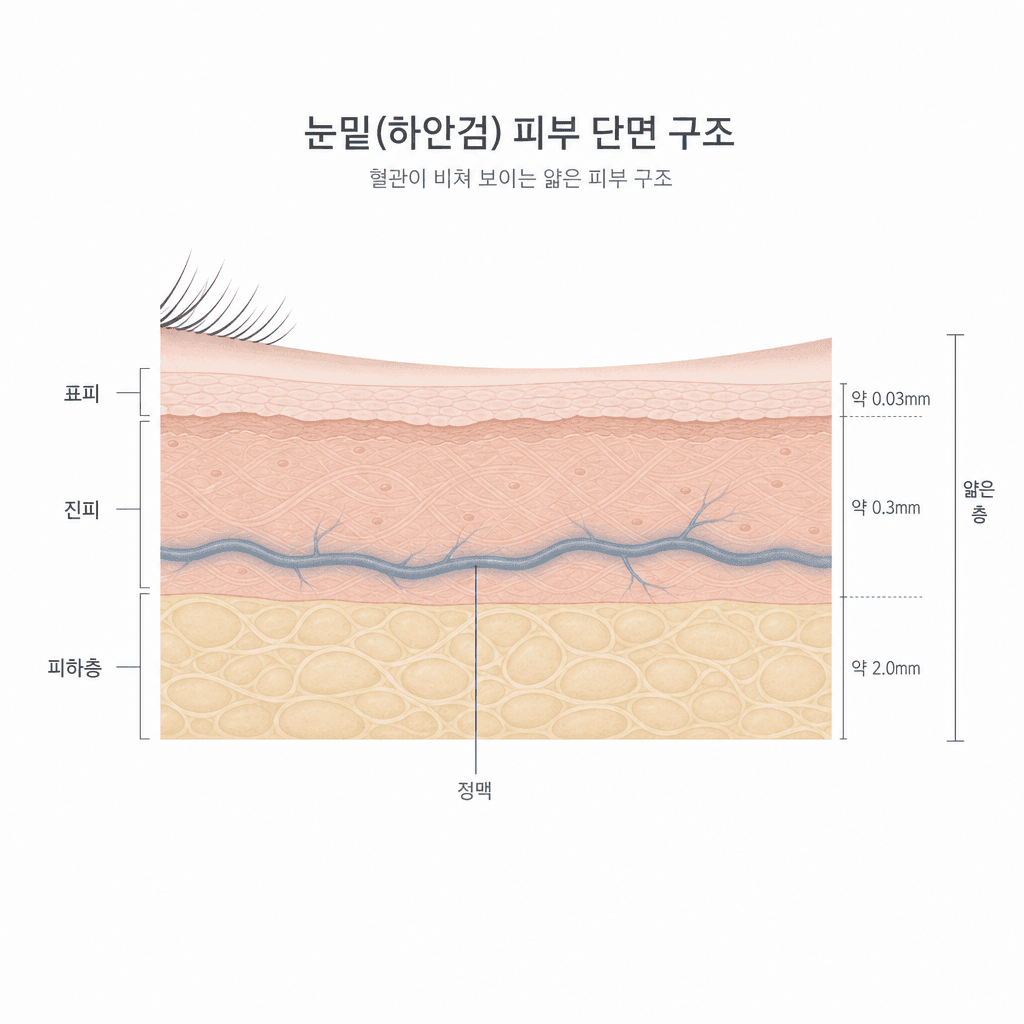

Approach 1: Directly Reducing the Blood Vessels
This direction focuses on shrinking the visible veins themselves. Vascular lasers* target wavelengths absorbed by the hemoglobin inside the veins to coagulate the vessels, reducing their visibility over time. A review on vascular dark circles also concludes that lasers targeting blood vessels are suitable for vascular dark circles. Pulsed dye lasers (585–595nm) or 1064nm long-pulsed lasers are frequently mentioned.
Vascular laser*: A laser that shoots wavelengths specifically absorbed by hemoglobin in the veins. The same review explains that longer wavelengths, such as 1064nm, have less interaction with melanin and are relatively safer for darker skin.
This treatment is typically performed over several sessions spaced a few weeks apart. We often recommend this as the first step for those with highly visible, distinct veins. Although it is not a one-stop treatment, the visibility is step-by-step cleaned up as the sessions accumulate. Because mild bruising or marks may remain for a few days, it is best to schedule this in line with your personal itinerary.

Approach 2: Thickening the Skin to Cover Visibility
Instead of directly touching the blood vessels, this direction focuses on thickening the overlying skin. When a collagen booster* plumps up the dermis layer, the same veins will show through much less. Because the under-eye area is highly delicate, boosters with fine particles and low irritation are carefully selected and used.
Collagen booster*: A treatment that injects ingredients into the dermis to stimulate collagen production, gradually building up thickness and elasticity over time. A representative example includes PDLLA-based boosters like Juvelook.
This is typically done in two to three sessions spaced a few weeks apart. We primarily recommend this to individuals whose main concern is thin skin, where the color fades significantly upon stretching. Since collagen boosters take time to build up, changes are barely visible immediately after, but the dermis thickens and the transparency slowly fades over the following weeks. When tracking transparency over time, it gradually decreases like the curve below.
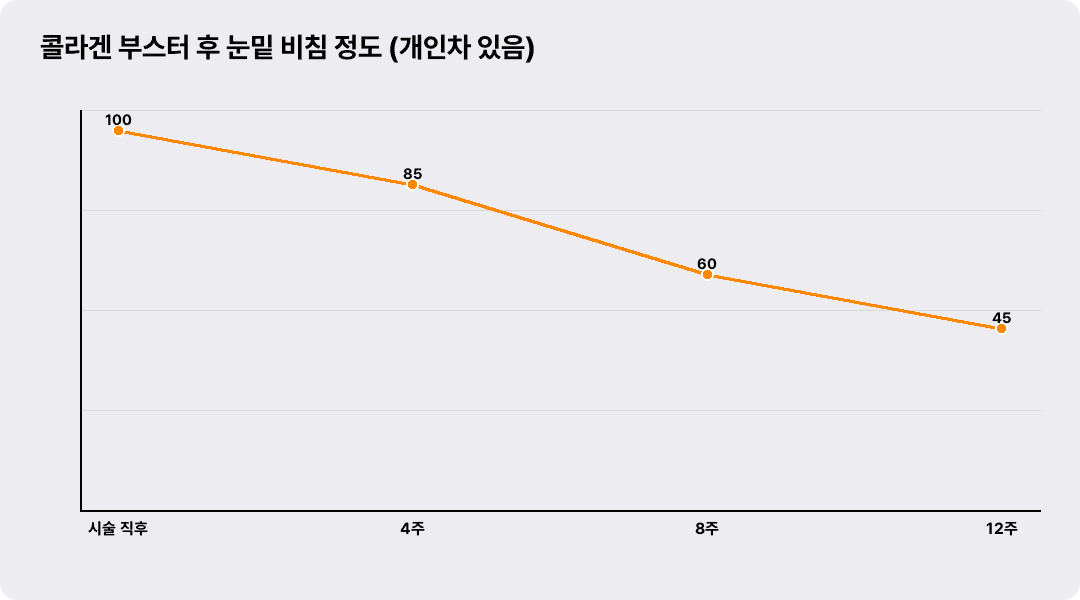
The values in the curve are for illustrative purposes to show the progression and may vary from person to person. Let's summarize the two approaches at a glance in the table below.
It is recommended to postpone the procedure in the following cases:
Pregnant or breastfeeding
Active inflammation or infection around the eyes
History of keloids (experience with raised, puffy scars)
Taking photosensitizing medications (depending on the type of treatment)
Immediately after receiving other recent treatments around the eyes
If any of these apply to you, please consult with our medical staff regarding the appropriate timing for your next procedure.

At Beautystone Hapjeong, We Start by Assessing the Self-Test Together
As mentioned earlier, even within the same vascular type, the first step depends on whether visible veins or thin skin is the primary cause. That is why at Beautystone Hapjeong, before deciding on a treatment, we review your self-observation results together—such as the skin-stretch test and color changes by time of day.
For those with distinct vein lines, we prioritize laser treatments; for those where thin skin is the main issue, we prioritize boosters; and if it is both, we guide you through a step-by-step combination. Rather than rushing a decision, assessing your under-eye condition first to map out the direction results in a much more natural outcome.

Frequently Asked Questions
Q. Can I go to work the day after the treatment?
A. Usually, you can return to your daily routine the next day. Vascular lasers may leave slight bruising or marks for a few days, so many people choose to cover them with makeup. Collagen boosters may cause slight swelling immediately after, but it typically subsides within 1 to 2 days.
Q. Is it a one-time treatment?
A. Both approaches require multiple sessions. Vascular lasers usually require several sessions, and collagen boosters typically take two to three sessions. Rather than forcing immediate results in a single session, it is much more natural to evaluate the progress at each step and adjust the next dosage.
Q. Can I receive both treatments together?
A. If you present both visible veins and thin skin, a combination indeed makes more sense. Usually, we start with vascular lasers to reduce visibility first, followed by collagen boosters to reinforce skin thickness. However, it is safer to space them out rather than receiving both on the exact same day.
Q. If I have the pigment or shadow type, will these treatments not work?
A. The answer depends on your type. For the pigment type, an approach targeting melanin is more suitable, while for the shadow type, an approach that fills the sunken area works better. Therefore, it is best to first estimate your type through a self-test and then determine the exact direction during your consultation. Since multiple causes can overlap under a single person's eyes, a definitive conclusion requires professional assessment.




Lifting
Ultherapy Before and After: Why Wait 90 Days?

Contouring & Volume
Belotero Revive Cost: 2cc Price vs. 3 Sessions

skin
Lip Hyperpigmentation Laser: Does It Work?

Contouring & Volume
Men's Forehead Filler: Hollow or Just Lines?

Contouring & Volume
Calf Botox Timeline: When to Book Session 2?

Contouring & Volume
Thread Lift Cost: Smile Lines vs. Full Face?