

Hip dips can lengthen legs, but too much looks off. Sizing a first Sculptra dose, split sessions.
Published
Updated

Author
Wi Young-jin · Chief director
Seoul National University College of Medicine · Seoul National University Hospital Specialist
→
Have you ever looked at your profile in the mirror and noticed a subtle indentation on the side of your hips? If you have searched online, you have likely come across the term "hip dip Sculptra." Many of our guests visit us asking, "Can't we just fill it all up in one go?" However, we prefer not to inject a large volume into this area from the very beginning. Starting with a conservative amount and filling it gradually over two to three sessions naturally leads to much more beautiful, seamless results.
Many people also seek this treatment because it makes the legs look longer. However, that lengthening effect depends more on how we design and shape the line rather than just how much volume we inject. This is the very first point I always like to emphasize to those who are looking into this for the first time.
This content is an informative guide on treatments compiled by Hapjeong Beautystone.
By reading this article, you will learn:
That hip dips are a natural contour variation originating from your bone structure.
The anatomical principle behind why filling this area makes your legs look longer.
Why we use Sculptra for this area and prefer starting with a conservative amount.
What the multi-session process feels like, and how to care for yourself post-treatment.
Why do hip dips form?
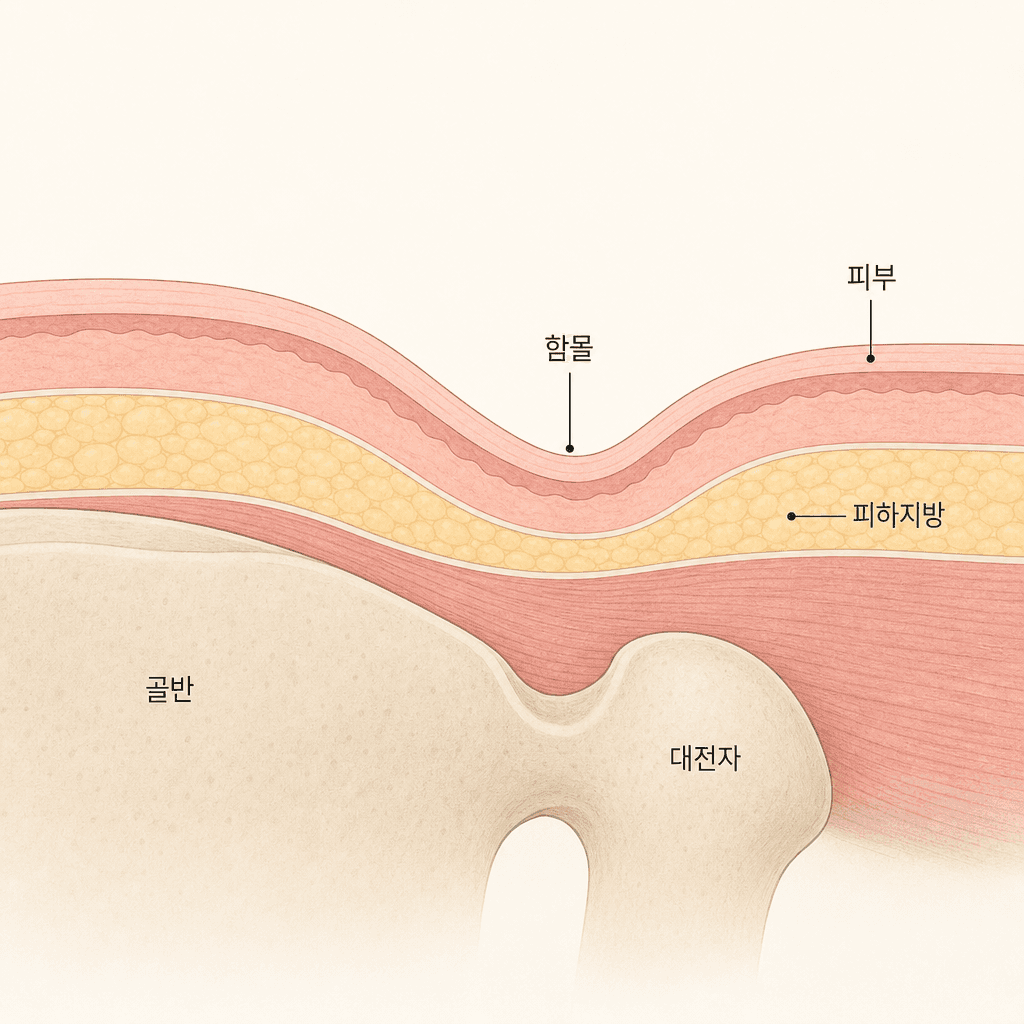
The slight indentation on the side of your hips is a natural depression between the iliac crest and the greater trochanter of the femur. Anatomically, it is referred to as the trochanteric depression*. As the lower curve of the pelvis dips inward and then curves back out at the outer projection of the thigh bone, the space between them naturally looks like a dip.
*Trochanteric Depression: A natural lateral indentation that forms between the lower pelvic crest and the outer bony prominence of the thigh bone. It is commonly known as a "hip dip."
It is important to understand that your skeletal structure plays a major role here. An anatomical study on hip dips explains that this indentation is a structural feature made up of the greater trochanter and the attachment points of various thigh and gluteal muscles, representing a normal shape that everyone has to some degree. While muscle and fat distribution do play a part, it is an area that is very difficult to completely fill out through exercise alone. The degree to which it is visible simply varies from person to person, so saying "having hip dips is abnormal" is medically incorrect.

Why does filling them make your legs look longer?
When hip dips are filled, the silhouette running from your pelvis down to your thighs flows smoothly without interruption. This visually shifts the perceived starting point of your legs higher up, creating the illusion of longer legs even at the exact same height. It does not make your hips look bulkier; rather, it beautifully refines and clean up your overall silhouette.
Because the line connecting your pelvis and thighs flows continuously when viewed from the side, your overall proportions look elegantly elongated. Many of our guests share that their clothes fit completely differently after the treatment. This is why the continuity of the side profile is far more crucial than your actual leg length.

Why Sculptra, and why start with a small amount?
If we inject a large volume of immediate dermal fillers or implants all at once into an area that requires significant volume like hip dips, the results can easily look unnatural. That is why we frequently use collagen biostimulators like Sculptra, which is composed of PLLA* (Poly-L-Lactic Acid). This treatment encourages your body to naturally generate its own collagen over time, smoothly filling in the hollows. A clinical review on the body applications of PLLA also highlights that for areas like the buttocks, a step-by-step approach of up to three sessions scheduled 4 to 6 weeks apart is highly recommended.
*PLLA (Poly-L-Lactic Acid): A lactic acid-based substance that stimulates natural collagen production deep within the skin. It safely biodegrades over time, leaving behind newly generated collagen. Sculptra is the representative treatment using this ingredient.
However, there is a catch. You will see almost no change immediately after the procedure. Because PLLA is a stimulatory treatment that takes time to produce new collagen, it is easy to look at the immediate result and ask for "more." But if too much is injected at the start, the area can become over-corrected and look bumpy once the collagen fully volumes up. This is why we recommend starting conservatively with less than the standard amount for your first session and carefully touch up after assessing how your natural collagen has grown. The progression of volume building up over time resembles the gradual curve shown below.
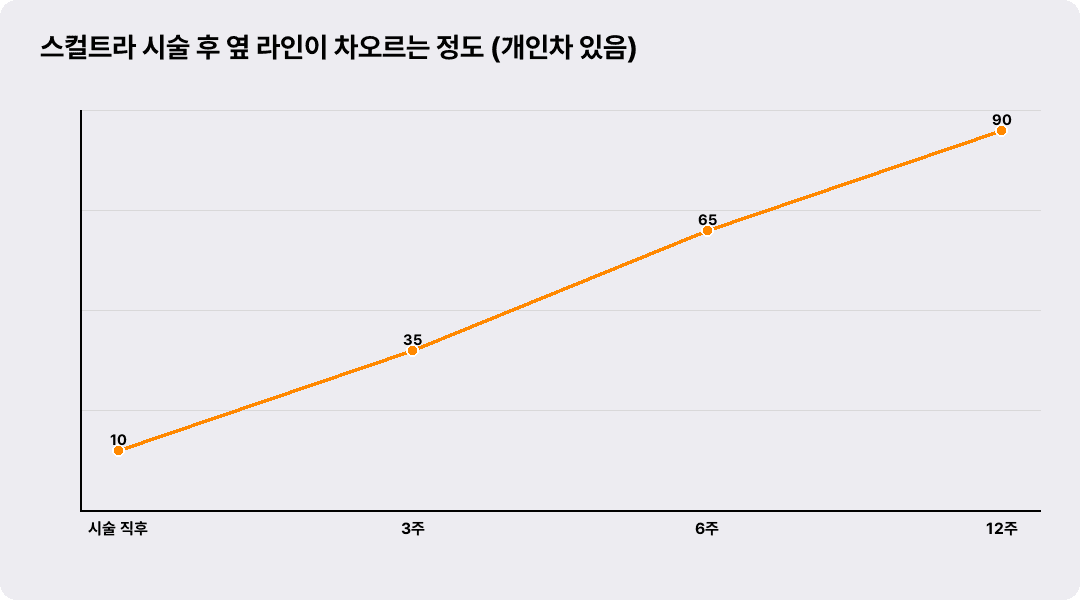
The values on this graph are for illustrative purposes to help you understand the collagen generation process, and the actual timeline varies from person to person. Another key reason to split the treatment into multiple sessions is volume control. Rather than deciding on a fixed amount from day one, assessing the newly generated collagen in your skin and adding touch-ups only where needed guarantees a beautifully natural contour.
What is daily life like after the treatment?
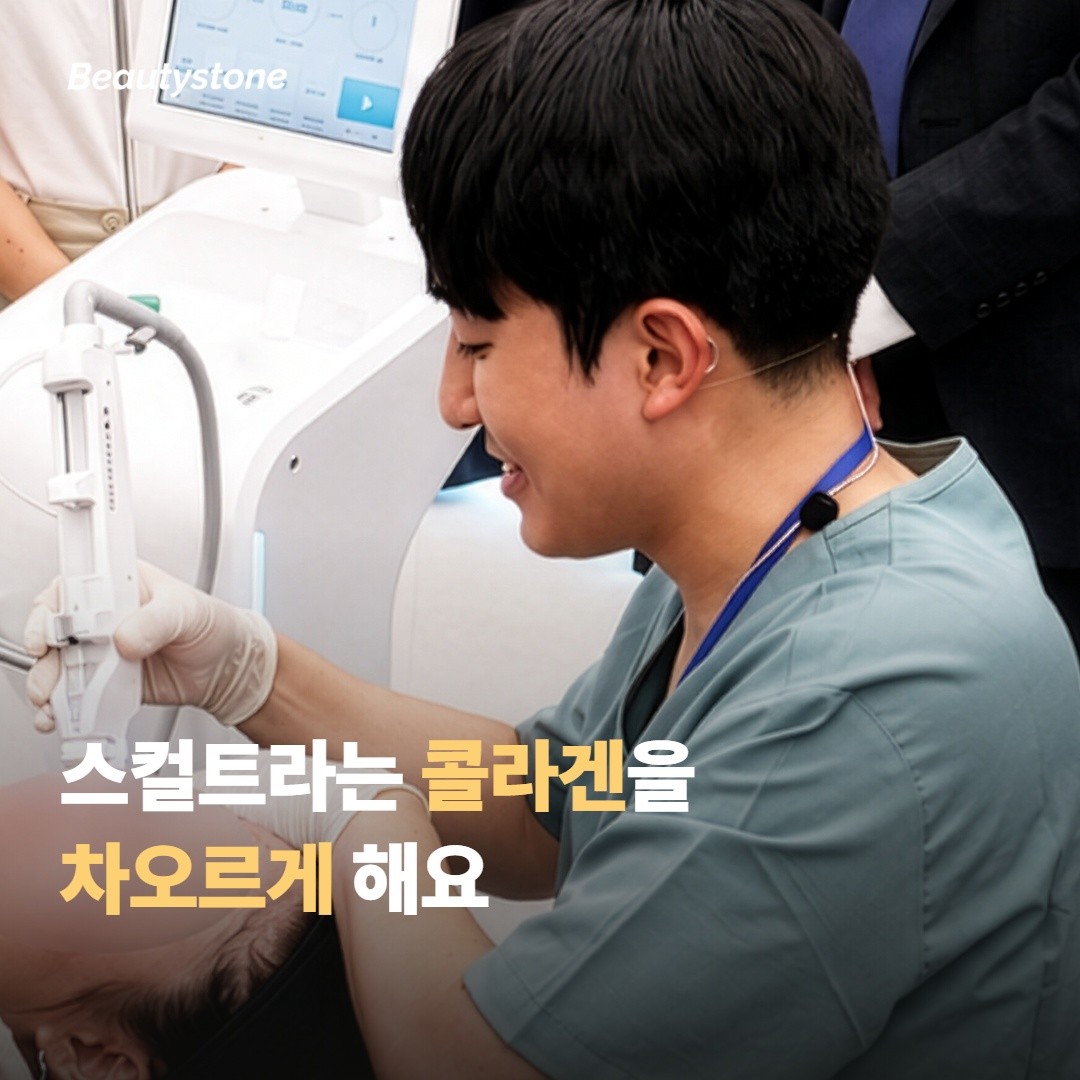
The questions our first-time guests ask most frequently concern discomfort and returning to daily routines. Before the treatment, we apply a numbing cream and perform local anesthesia, and then gently administer the product using a blunt-tipped cannula. This minimizes bruising and swelling, resulting in a gentle experience that feels like a minor pinching sensation.
You might notice mild swelling right after the session, but this typically resolves within 1 to 2 days. You can comfortably return to work and your daily activities the very next day. While you might experience a slightly heavy or tender sensation for a few days when sitting or walking, it will not interfere with your day-to-day life.
Starting the day after your session, it is highly beneficial to gently massage the treated area several times a day for a few days. This simple step ensures that the product is evenly distributed. However, please refrain from saunas, hot baths, intense workouts, and alcohol for about a week to minimize any irritation while the collagen begins to settle.
We recommend postponing the treatment if you:
Are pregnant or breastfeeding
Have an active skin inflammation or infection in the treatment area
Have a history of keloid scarring (past scars that healed raised and puffy)
Have an active autoimmune disease (depending on the specific condition)
Have recently undergone a different treatment in the same area
If any of these apply to you, please consult with our medical team to plan the best timing for your treatment.

At Hapjeong Beautystone, we start conservatively and refine gently
As mentioned earlier, hip dips are primarily structural, making them very difficult to resolve through exercise alone. While volume restoration is an excellent answer, rushing to inject a massive amount on day one can lead to an unnatural look once your body's collagen fully develops.
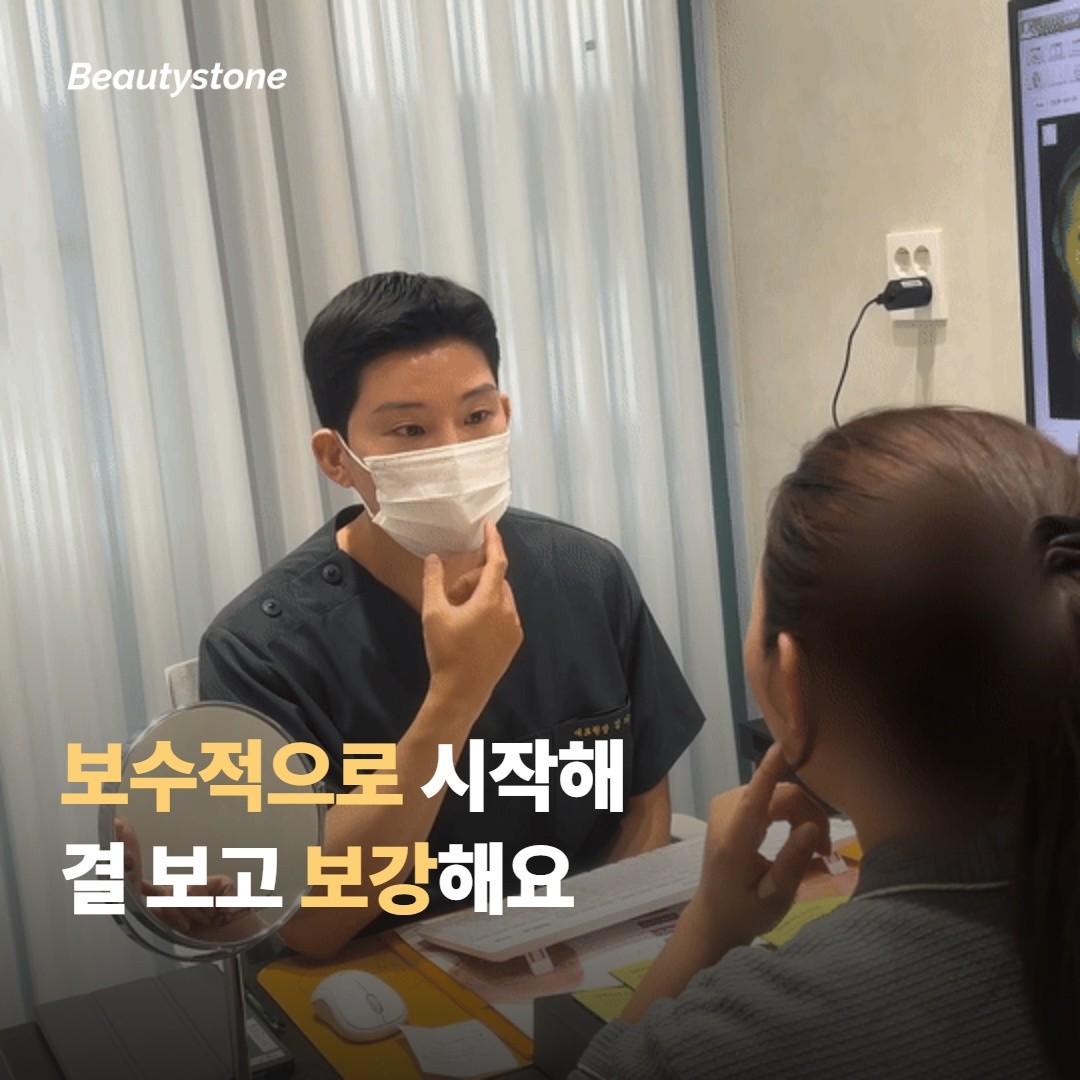
At Hapjeong Beautystone, we guide you through a thoughtful plan: starting with a conservative amount in the first session, letting your natural collagen build, and then adding precise touch-ups only where needed. Starting small and evaluating your silhouette session by session is always the safest way to achieve the most elegant, seamless leg line. Rather than trying to complete everything in a single visit, pacing the treatment based on your biological response is the most reliable path to beautiful results.
Frequently Asked Questions
Q. Can I go to work the day after the treatment?
A. Yes, you can absolutely return to your normal routine the next day. Any minor swelling or redness immediately after the session typically subsides within 1 to 2 days, and sitting or walking will not be an issue. We simply ask that you avoid heated saunas, intense workouts, and alcohol for about one week.
Q. Is it really not possible to finish it in just one session?
A. While injecting a massive amount at once might seem quick, monitoring how your skin responds and styling the silhouette across multiple sessions yields a much more natural, beautiful result. We generally design a course of two to three sessions spaced a few weeks apart. Overfilling at once can lead to unnatural over-correction once the collagen fully develops.
Q. How painful is it?
A. We apply topical numbing cream and local anesthesia before using a round, blunt cannula to administer the treatment, keeping discomfort to a mild pinching sensation. While sitting might feel slightly heavy for a few days afterward, it won't disrupt your daily routine. Pacing the volume over multiple sessions also reduces the physical burden of each visit.
Q. Can I really not fill hip dips with exercise?
A. Because hip dips are largely determined by your bone structure, they are very difficult to completely fill out through exercise alone. However, strengthening your gluteal muscles can sometimes make the indentation less prominent. Since everyone's bone structure and muscle distribution are unique, we would love to discuss what is achievable for you during your personal consultation.


![[Wi Young-jin Column] Strategy Over Ingredients: Collagen by Face](https://framerusercontent.com/images/XCKH3mrnb8l7BT5u4FDcUQerwQ.jpg?width=1080&height=1080)


Contouring & Volume
Hip Dip Filler Before and After: 4 Checks

Body
Potenza Treatment Interval: Why 4 Weeks?

Lifting
Ultherapy Before and After: Why Wait 90 Days?

Contouring & Volume
Belotero Revive Cost: 2cc Price vs. 3 Sessions

skin
Lip Hyperpigmentation Laser: Does It Work?

Contouring & Volume
Men's Forehead Filler: Hollow or Just Lines?