

Will InMode FX dissolve your fat graft? Learn how transplanted fat survives RF heat, when engraftment finishes, and how long to wait before RF is safe.
Published
Updated

Author
Wi Young-jin · Chief director
Seoul National University College of Medicine · Seoul National University Hospital Specialist
→
If you've recently had a fat graft — or you're planning one — and you're wondering whether RF treatments like InMode FX will dissolve those carefully placed fat cells, you're not alone. It's one of the most common questions we hear from patients navigating their post-procedure timeline. In this article, we'll cover how InMode FX works, what actually happens to transplanted fat under RF heat, and — most importantly — when it's safe to move forward.
What Is InMode FX?
InMode FX is a radiofrequency (RF) device that delivers controlled thermal energy deep into the skin and underlying soft tissue. It's cleared by the FDA for skin tightening and body contouring, and it's become popular for improving jawline definition, jowl laxity, and submental fullness — what most people call a 'double chin.'
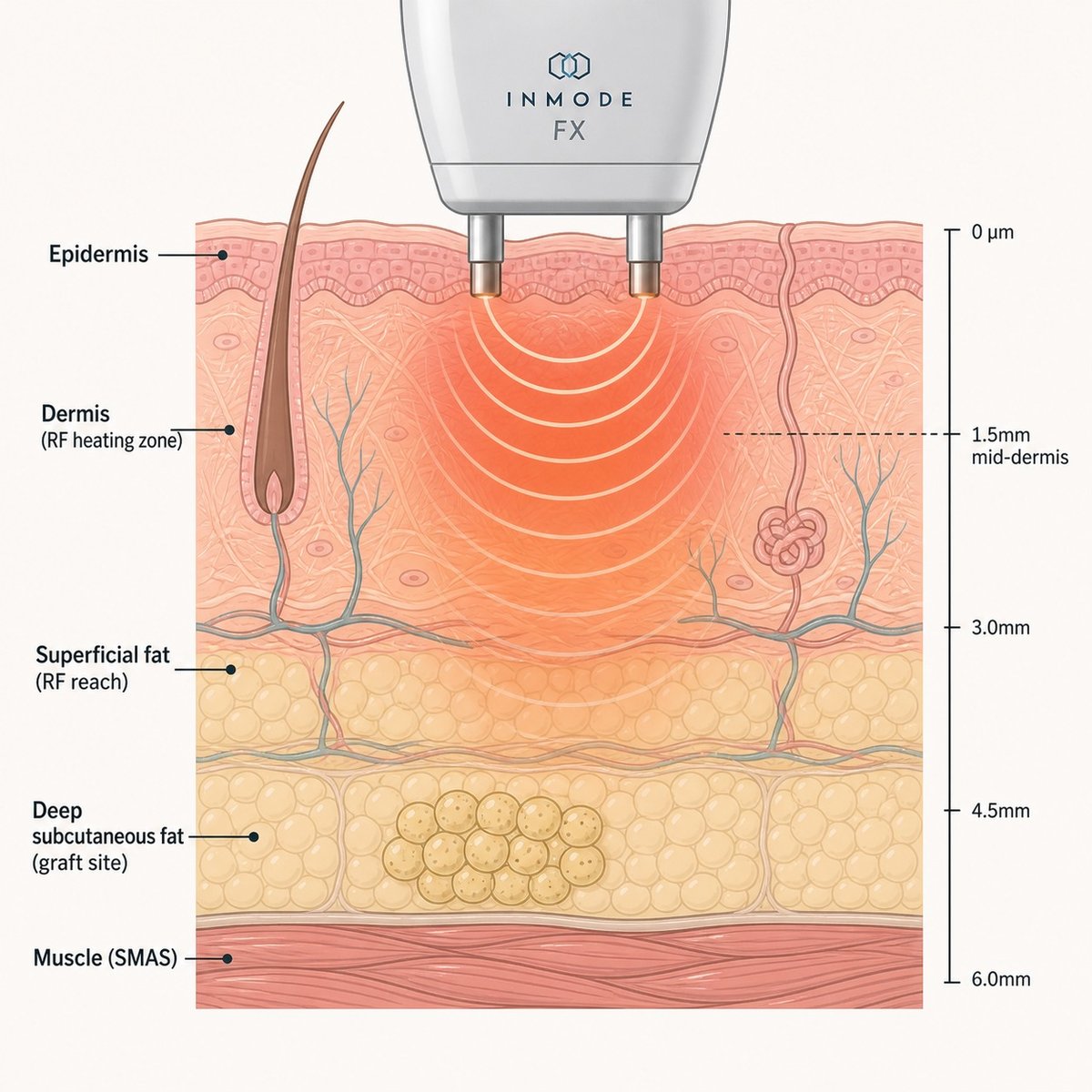
Unlike high-intensity focused ultrasound (HIFU) devices that target a specific focal depth, InMode FX uses bipolar RF energy that heats tissue across a broader zone, including the dermis and the superficial fat layer directly beneath it. That's where things get nuanced when there's transplanted fat in the picture.
How Does InMode FX Work?
The short answer? It heats tissue to remodel collagen and stimulate new collagen production — which is what creates the tightening effect.
Here's how it actually works. Bipolar RF energy from the InMode FX handpiece travels between two electrodes and converts to heat in the tissue between them. The target temperature for collagen remodeling sits around 40–45°C. At this range, existing collagen fibers contract and fibroblasts are prompted to lay down new collagen over the following weeks to months.
The important nuance is depth. InMode FX is designed to work primarily in the dermis and the most superficial subcutaneous fat layer — roughly 1–4 mm beneath the skin surface, depending on the handpiece and energy settings used. Fat grafts placed during facial fat transfer surgery are typically deposited at multiple depths, including the deeper subcutaneous and periosteal planes, which are largely outside InMode FX's primary heating zone.
That said, the boundary isn't perfectly clean, and early-stage grafts — those still building a blood supply and establishing connections to surrounding tissue — are more vulnerable to thermal disruption than grafts that have fully integrated.
Does RF Heat Dissolve Transplanted Fat?
This is the heart of the question, and research suggests it's more complicated than a simple yes or no.
Transplanted fat cells go through a process called engraftment — the period during which the grafted fat establishes a new blood supply (neovascularization) and the surviving fat cells stabilize in their new location. Studies on fat graft survival indicate that a significant portion of the initial graft volume is absorbed or reabsorbed in the weeks following the procedure, with volume stabilization typically occurring between three and six months post-graft, though some research points to the process continuing up to a year in some patients. The PMC-indexed literature on fat graft outcomes supports this range as the general consensus window for graft stabilization (PMC11282510).
Before engraftment is complete, the fat cells are metabolically stressed and rely on diffusion for their nutrition — they don't yet have a robust blood supply to help them tolerate or recover from additional thermal stress. Applying RF heat during this window introduces real risk:
Additional cell death: Marginally surviving fat cells that are still establishing their blood supply can be pushed past viability by thermal exposure.
Volume loss: If a meaningful portion of the graft is still in flux, RF heat can contribute to accelerated reabsorption, shrinking the final result.
Unpredictable outcomes: Because the graft is healing unevenly across different depth planes, the thermal effect won't be uniform — some areas may be fine, others may lose more volume than expected.
Once the graft is fully engrafted — meaning the fat cells have a stable blood supply and have survived the initial reabsorption phase — they behave more like native fat. At that point, RF energy at InMode FX's typical settings is unlikely to selectively dissolve the transplanted fat, since the temperatures used for collagen remodeling are well below the threshold needed to destroy adipocytes outright. Individual results vary, and your provider's specific energy settings and the graft depth in your case will both factor in.
When Is It Safe to Try InMode FX After a Fat Graft?
Here's the key claim you need to keep in mind: the waiting window isn't the same for everyone, because engraftment completion varies depending on the individual, the graft volume, the placement technique, and the treatment area.
That said, the general guidance that most clinicians follow is:
Minimum 3 months: This is rarely recommended as a start point. At three months, early engraftment is underway but volume is often still settling.
6 months — the more common recommendation: Most providers suggest waiting until at least six months post-fat graft before introducing RF energy to the face. By this point, the graft has reached a more stable state, and residual reabsorption is much less likely to be meaningfully accelerated by RF.
12 months for conservative patients: If you had a large-volume graft, multiple areas treated, or if your provider notes that your volume has continued to change past the six-month mark, waiting a full year is a reasonable and often advised approach.
The decision isn't purely time-based, though. A clinical assessment of whether the graft has stabilized — typically by evaluating whether your facial volume has stayed consistent for at least four to six weeks — is just as important as the calendar date. If you're still noticing visible changes in volume, more waiting is warranted.
Side Effects, Risks, and What to Watch For
Even after the recommended waiting window, there are a few things to keep in mind.
InMode FX's side effects on their own are well-documented and generally mild: temporary redness, swelling, and a warm or tingling sensation in the treated area are common and usually resolve within a few days to a week. If they worsen or you develop spreading redness, fever, or signs of skin breakdown, seek medical care right away.
In the context of post-fat graft skin, a few additional considerations apply:
Heat sensitivity: Areas with recent grafting may have subtly altered nerve sensitivity. Some patients report that the treated area feels more tender than expected, particularly in the first few sessions after long-term RF resumption.
Volume asymmetry: If RF is introduced before full stabilization, asymmetry between sides can occur if one area's graft has engrafted more completely than the other. This is one of the reasons providers are cautious about timing.
Energy settings matter: A provider experienced with post-graft patients will typically start with conservative energy levels and increase gradually across sessions, rather than starting at the standard settings used for non-grafted patients.
Like any procedure, it comes with trade-offs. Being honest with your provider about your fat graft history — including when it was done and what volume was used — is non-negotiable before any RF treatment.
How to Plan the Sequence: Fat Graft and RF Lifting
If you're planning both procedures and haven't had either yet, the sequencing options are worth thinking through carefully.
Option A — RF first, then fat graft: This is generally the lower-risk path. Doing InMode FX (or another RF treatment) before a fat graft means the RF's collagen-remodeling effects are already underway, and the subsequent fat graft lands into tissue that's not acutely inflamed from RF. The main caveat is that RF tightening may alter the skin envelope slightly before the graft, so your provider will factor that into volume planning.
Option B — Fat graft first, then RF: This is the path most patients end up on, often because their primary concern is volume restoration and they add RF later for tightening. It works well — but it requires patience. The waiting window exists for good reason, and rushing it can compromise your graft results.
Same-day sequencing is not recommended. Combining RF energy with a fresh fat graft on the same visit introduces compounding thermal and inflammatory stress that most providers consider unnecessary risk.

The Bottom Line
Here's a quick recap of what we've covered:
InMode FX uses RF heat that primarily targets the dermis and superficial fat layer — the same zone where early-stage grafted fat is most vulnerable.
Transplanted fat cells don't fully stabilize until roughly three to six months post-graft, and in some cases up to a year — so waiting matters.
Most providers recommend a minimum of six months before RF lifting after a fat graft, with a year being the conservative standard for larger or multi-area grafts.
Once engraftment is confirmed stable, InMode FX is considered a reasonable option — but start with lower energy settings and disclose your graft history fully.
Like any procedure, it comes with trade-offs. The best way to figure out your own timeline is a consultation with a provider who has experience with both fat grafting and RF devices — they can assess your graft stability and advise on the right entry point for you. If you're considering InMode FX or planning a fat graft procedure, Beautystone is a dermatology clinic in Seoul's Hapjeong area — you can see current offers at /en/promotion.
Frequently asked questions
Q. Will InMode FX melt my transplanted fat?
A. Not once the graft has fully stabilized — but timing matters. InMode FX's RF heat works at temperatures used for collagen remodeling, which aren't high enough to selectively destroy mature, engrafted fat cells. The risk comes during the engraftment window (roughly the first three to six months), when the fat cells are still building their blood supply and are more vulnerable to thermal stress. After that window closes and your graft volume has been stable, RF is generally considered acceptable with appropriate energy settings.
Q. How long should I wait after a fat graft before getting InMode FX?
A. The general clinical consensus is a minimum of six months, with twelve months recommended for larger-volume or multi-area grafts. The key isn't just the calendar date — it's whether your graft volume has stopped visibly changing. If you're still seeing fluctuation, more waiting is warranted. Your provider should assess graft stability before scheduling any RF treatment.
Q. Can I get a fat graft and InMode FX at the same visit?
A. No — this isn't recommended. Combining RF energy with a fresh fat graft on the same day introduces compounding thermal and inflammatory stress that could harm graft survival. If you're interested in both procedures, the safer path is to do InMode FX first and then have the fat graft, or to wait the full recovery window after the graft before adding RF.
Q. Does InMode FX have any special risks for skin that's had fat grafting?
A. After the graft has stabilized, the main additional considerations are that grafted areas may have subtly altered sensitivity (some patients find the area feels more tender than expected) and that energy settings should be conservative, particularly in early sessions. Providers experienced with post-graft patients will typically start lower and adjust. The standard InMode FX side effects — temporary redness, warmth, mild swelling — still apply and usually resolve within days.


Lifting
Ultherapy Before and After: Why Wait 90 Days?

Contouring & Volume
Belotero Revive Cost: 2cc Price vs. 3 Sessions

skin
Lip Hyperpigmentation Laser: Does It Work?

Contouring & Volume
Men's Forehead Filler: Hollow or Just Lines?

Contouring & Volume
Calf Botox Timeline: When to Book Session 2?

Contouring & Volume
Thread Lift Cost: Smile Lines vs. Full Face?