

Your face looks fine an hour later, but the dermis is still busy. Here's how to stage walking, workouts, and the sauna after Thermage, plus 5 ready signs.
Published
Updated

Author
Wi Young-jin · Chief director
Seoul National University College of Medicine · Seoul National University Hospital Specialist
→
If you've ever walked out of a Thermage session, checked the mirror an hour later, and thought 'this looks fine, can I just go to the gym tomorrow?', you're not alone. It's one of the questions we hear most, and it comes up hardest from people with the most structured routines: the three-workouts-a-week crowd and the weekend sauna regulars.
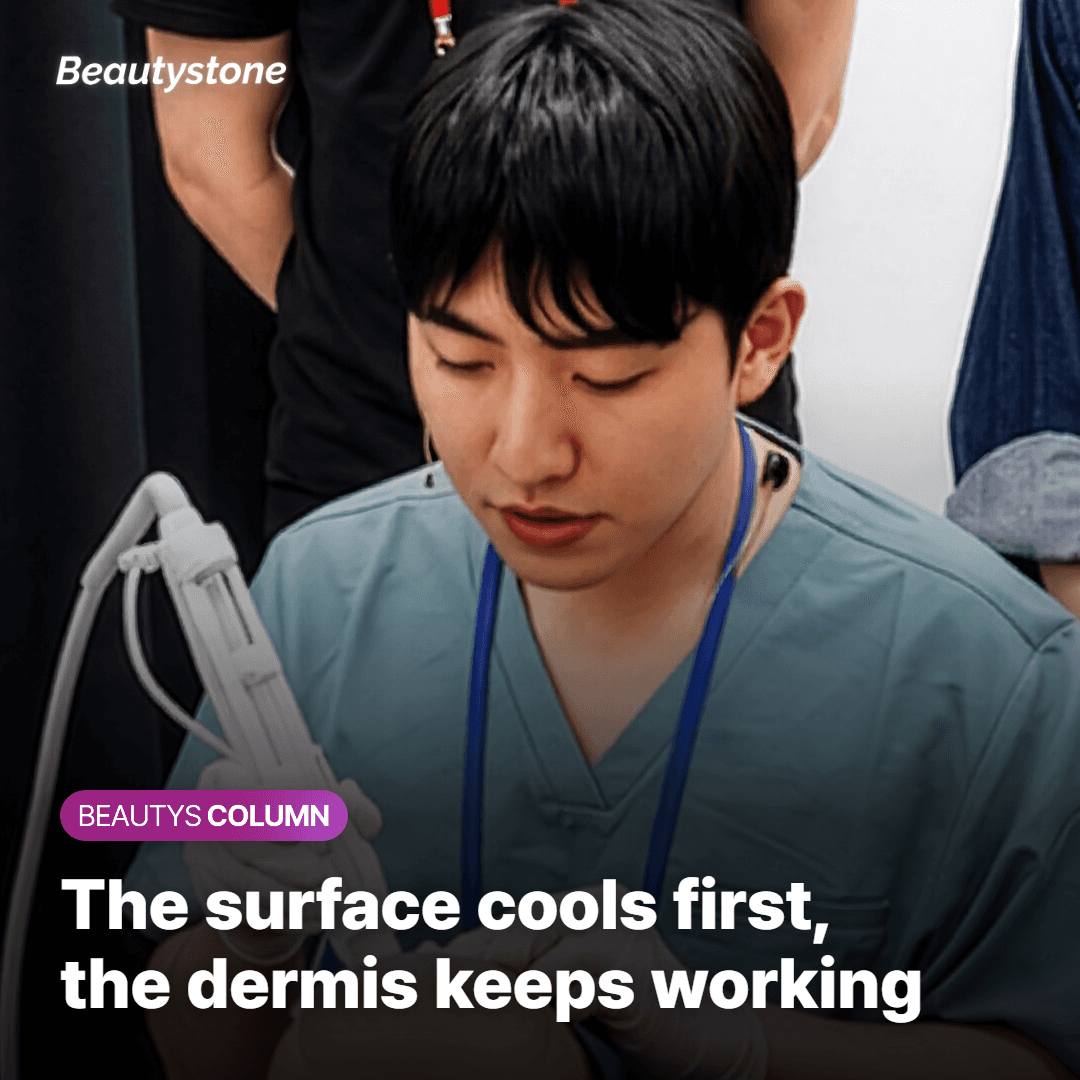
The short answer? Judge it by what's still happening under the surface, not by how your face looks in the mirror. In a review of dermal temperature control in monopolar radiofrequency, the collagen-remodeling response is described in a dermal temperature window of roughly 42°C to 65°C, while the skin surface itself is held below about 42°C to 45°C. In other words, your outside cools off well before your inside is finished.
In this article, we'll cover what's going on in your skin right after treatment, why sauna heat and hard workouts pull on the same lever, when to restart each activity, and the signs that tell you you're ready to move up a level.
Beautystone is a dermatology clinic in the Hapjeong area of Seoul, and what follows is how we walk through aftercare with our own patients.
What Happens Under Your Skin Right After Thermage
Thermage delivers radiofrequency energy deep into the dermis, where the heat builds up. That's the whole point of the treatment, and it's also why the mirror is a poor judge of your recovery.
By the time you're back in your car, the surface temperature has already dropped. The heated tissue underneath, though, is just getting started on its repair response, including new collagen formation (neocollagenesis). That's a quiet process. It doesn't announce itself with pain or scabs, which is exactly why people assume they're back to normal on day one.
So there's a gap: your face reads 'done' while the dermis reads 'in progress.' Nearly every timing mistake after a radiofrequency treatment lives inside that gap.
Side Effects and Downtime: What's Actually Normal
The two things most people notice are redness and puffiness. A systematic review of safety in radiofrequency facial treatments gives a sense of the range across published studies:
Erythema (redness): reported in as few as 17.6% of patients and in as many as all of them, depending on the study.
Edema (swelling): reported from 5.3% to 26.5%.
Severity: mostly described as mild and temporary, and in one study the redness settled within a day.
Read that spread carefully, because it cuts both ways. Redness is common enough that seeing it doesn't mean something went wrong. It's also short-lived enough that days of throbbing pain or crusting isn't the baseline you should be planning around. Individual results vary, and so does how long the flush hangs on.
That last part is the piece you have some control over. How quickly mild redness clears has a lot to do with how you spend the next few days. And if redness spreads, gets worse instead of better, stays in one specific spot, or comes with pain, contact the clinic that treated you right away rather than waiting it out.

Why Heat and Sweat Both Slow You Down
Sauna sessions and hard training feel like completely different activities, but they press on the same button: both raise your body temperature and push more blood through your skin.
On the heat side, a systematic review of dry sauna use describes short, intense heat exposure raising skin temperature and core temperature together, with heart rate, skin blood flow, cardiac output, and sweating all climbing in response. That's heat stacked onto vessels that are already dilated from your treatment.
Exercise adds two extra variables. Sweat sits on the skin and creates a warm, humid environment that can clog pores, and there's friction from towels, hands, and equipment landing on a face that's more reactive than usual. So it isn't only about temperature — it's temperature plus moisture plus rubbing.
Activity | What it mainly does | Why it matters while you're healing |
|---|---|---|
Sauna or jjimjilbang | Raises core temperature and skin blood flow | Redness and that warm, flushed feeling can linger longer |
Hard workouts | Raises blood flow, and adds sweat and friction | Swelling and irritation tend to climb together |
Easy walking | Barely moves your body temperature | Usually has little effect in either direction |

When to Restart: Walking, Workouts, and the Sauna
Here's the reframe that makes this simple: the ladder isn't built out of dates on a calendar. It's built out of how hot you get and how flushed your face gets.
Easy walking and stretching: usually fine the same day. Your heart rate stays low, you barely sweat, and your skin hardly notices.
Light exercise where you start to sweat: easier to pick back up once the redness has visibly settled, rather than on a fixed day.
Hard training: weights, running, anything that turns your face red — give it about a week of breathing room.
Sauna, jjimjilbang, and long hot soaks: the longest wait of the group, and the one worth being strictest about.
Why does the sauna sit at the bottom of the list? Because it points in the same direction as the energy your treatment already delivered. Stack the two before the repair response has settled and you can stretch out the redness and the warm, flushed feeling instead of letting them fade.
Treat all of this as an average rather than a deadline. Treatment intensity and personal recovery speed both shift the line forward or back, and your provider knows how much energy went in on your particular day.

Five Signs Your Skin Is Ready for More
Instead of counting days, run this quick check before you level up:
No visible flush in the mirror: the simplest signal that the redness has resolved.
No warmth when you rest the back of your hand on your face: leftover heat means the vessels are still dilated.
No puffiness after lying down and getting back up: when morning swelling stops showing up, the edema has largely settled.
No stinging when you wash your face: this tells you the reactive, easily irritated phase is over.
No flushing that comes back after light activity: the most useful test, because it's a live rehearsal of the next step up.
If four or more are true, move up one rung. If the flush comes back, drop down for a day or two and try again. That's a more honest read than any number someone hands you at checkout.

How We Handle This at Beautystone
When someone comes in for a Thermage consultation with us, one of the first things we ask about is their workout routine and their sauna habits. It sounds like small talk. It isn't.
Handing identical aftercare instructions to someone who trains five days a week and someone who never sets foot in a gym means one of them gets a plan they can't realistically follow. And a plan nobody follows is worse than no plan at all.
A board-certified dermatologist performs the treatment and sets your restart timing against the energy level actually used that day. Because it's a small, one-to-one practice, it's also easy to come back and show us your face if the redness feels like it's overstaying its welcome. Current offers are listed on our /en/promotion page.
The Bottom Line
Your face is a lagging indicator: the surface cools first while the dermis keeps working.
Redness and swelling are common and usually brief, but heat and sweat can stretch them out.
Stage your return: walking right away, sweaty sessions once the flush clears, hard training after about a week, sauna last.
Let your skin vote: if light activity brings the redness back, you moved up too soon.
Like any procedure, Thermage comes with trade-offs, and a few low-key days are part of the deal. Skipping the gym for a stretch won't cost you your result — the response in the dermis unfolds over weeks, not hours.
Ultimately, the timing depends on your skin, the energy level used in your session, and how your own recovery tends to go. If you're considering Thermage, a consultation is the best way to map that out against the routine you actually keep.
Frequently asked questions
Q. Can I shower the same day as my Thermage session?
A. A short, lukewarm shower is generally fine. What's worth postponing for a few days is anything that piles on more heat: long hot showers, or aiming a strong stream directly at your face.
Q. Is it a problem if redness lasts longer than a week?
A. That runs longer than what the published reports describe, so it's worth having someone look at it. Tell the clinic that treated you, especially if the redness is limited to one spot or arrives alongside pain.
Q. Do hot baths and hot springs count the same as a sauna?
A. Treat them the same way, since they also raise your core temperature. The hotter the water and the longer you soak, the closer it gets to a sauna — so applying one rule to all of them keeps things simple.
Q. Will skipping my workouts make my Thermage results weaker?
A. No. The response in the dermis plays out over a matter of weeks, so dialing down the intensity for the first few days doesn't shrink what you get out of the treatment.



Contouring & Volume
Hip Dip Filler Before and After: 4 Checks

Body
Potenza Treatment Interval: Why 4 Weeks?

Lifting
Ultherapy Before and After: Why Wait 90 Days?

Contouring & Volume
Belotero Revive Cost: 2cc Price vs. 3 Sessions

skin
Lip Hyperpigmentation Laser: Does It Work?

Contouring & Volume
Men's Forehead Filler: Hollow or Just Lines?