

Tingling and numbness after Thermage: what is normal, when to call, how to recover.
Published -
Updated -

Author
Wi Young-jin · Chief director
Seoul National University College of Medicine · Seoul National University Hospital Specialist
→
You get home after Thermage, touch your face, and it feels a little tingly, with some spots stinging or oddly numb. If it is your first time, it is natural to worry, "Is this a side effect?"
The short answer: in the first few days after the procedure, tingling and stinging are usually a temporary change in sensation caused by heat reaching the deeper skin (dermis), and it tends to settle on its own over time. That said, not every sensation is automatically fine, so knowing which signals fall within the normal range and which ones you should report to the clinic can put your mind at ease.
This article pulls together treatment information from Beautystone in Hapjeong.
In this article
Why tingling and stinging happen after Thermage
How to tell what still counts as the normal range
When it tends to settle and how to care for your skin
Which signs you should report to the clinic right away
Why your face feels tingly after Thermage
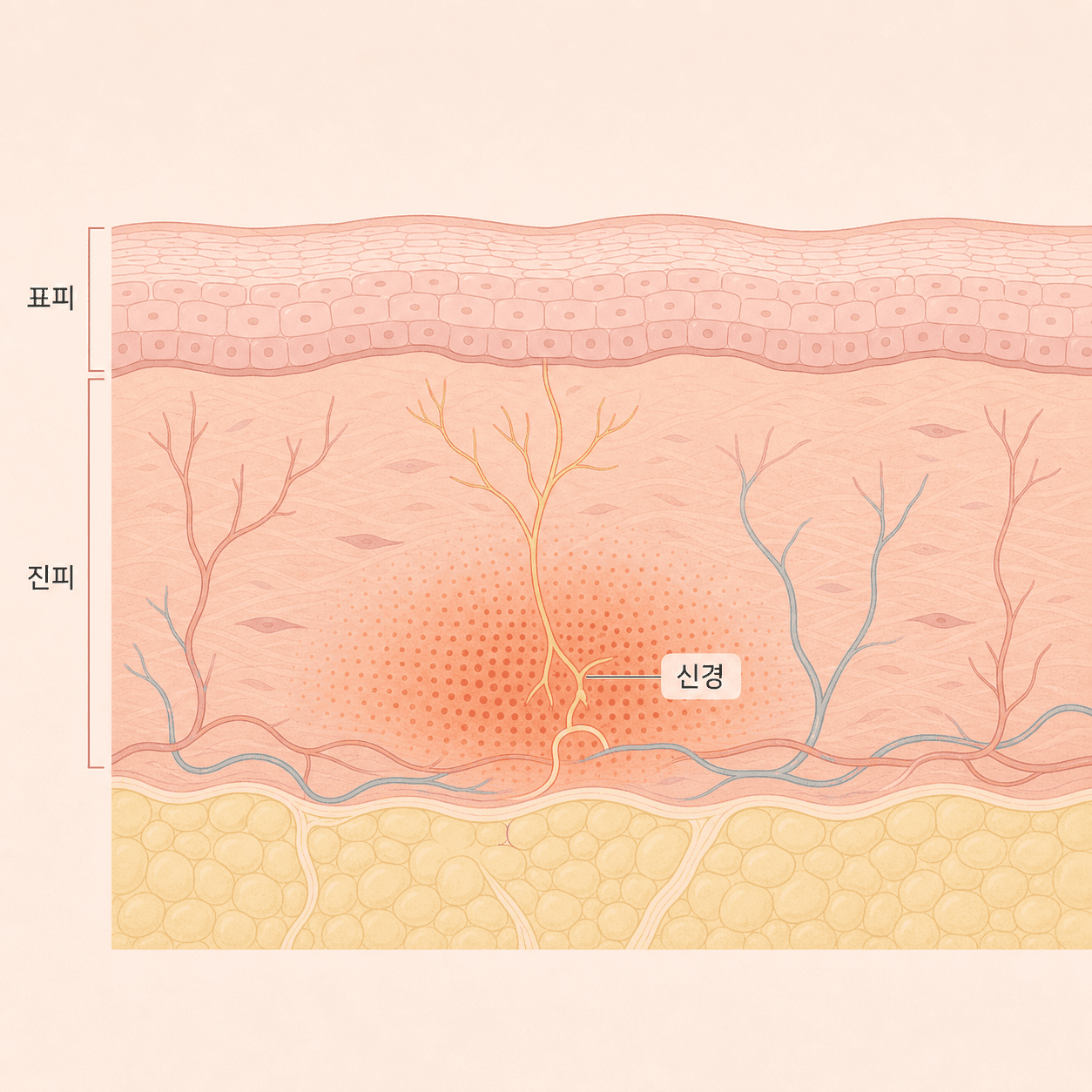
Thermage delivers radiofrequency energy deep into the skin to build up heat, and that heat contracts collagen and prompts it to rebuild over time. As this happens, the dermis and the nerves beneath it warm up together, so a brief change in sensation* shows up right after the procedure. Tingling, stinging, and even a slightly numb feeling in certain spots all show up differently from person to person. This explanation of how radiofrequency energy heats the deep dermis to cause immediate tissue contraction and later collagen renewal helps make sense of why these sensation changes occur at the depth the heat reaches.
change in sensation*: a reaction in which the skin's nerves briefly become more sensitive or duller after the procedure, felt as tingling or stinging. It usually fades as time passes.
This sensation is not because your skin is damaged. It is closer to nerves becoming temporarily sensitive in response to the heat. That is why it usually fades over a few days, or at most a week or two. Because the intensity and duration vary from person to person, it helps to get a sense of where your own recovery sits.
How to tell what still counts as normal
Even the same tingling feels different when it is "fading over time" versus "getting steadily worse." A sensation that stays faint for a few days right after the procedure and gradually eases off is generally normal. On the other hand, if the pain sharpens as time goes on, or one spot burns, swells, and changes color, that is closer to a signal worth looking into separately.
Sensation | Closer to the normal range | Worth reporting to the clinic |
|---|---|---|
Tingling and stinging | Faint for a few days, gradually fading | Getting sharper and worse over time |
Numb feeling | Slight in spots, recovers within 1–2 weeks | Clearly lingers past 2 weeks |
Burning | Mild for the first 1–2 days | One spot keeps burning |
Swelling | Light and overall | Swollen on one side with color change |
Pain | A little when you touch it | Throbbing even at rest |
As the table shows, what normal recovery has in common is an "overall, gradually fading" pattern. By contrast, a sensation that is sharp in just one spot and worsens over time is safer to flag with your medical team than to leave alone.
How long it lasts and how to care for it
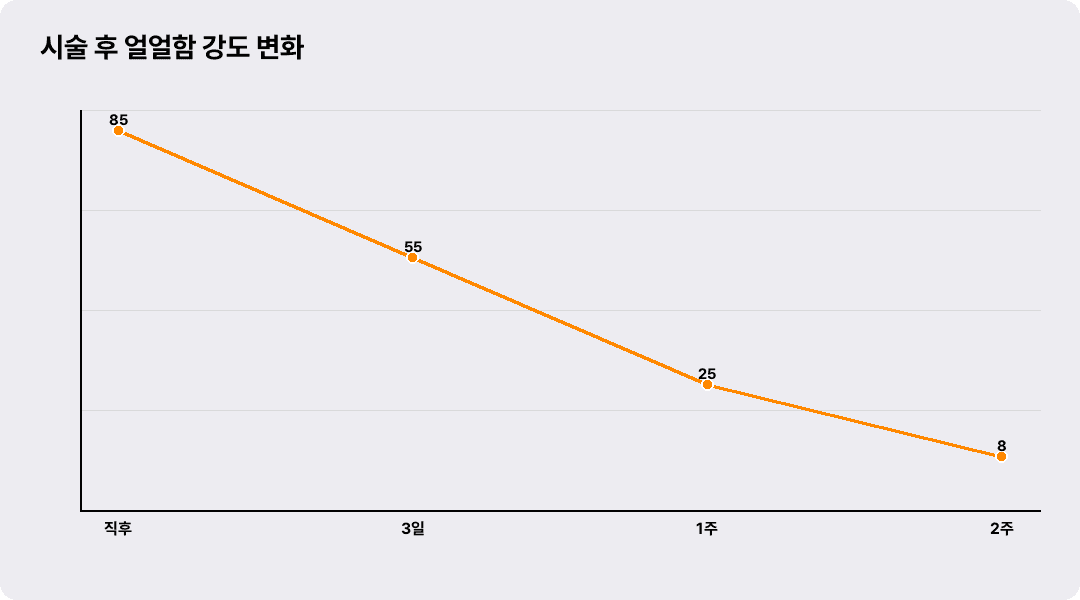
Most tingling and stinging noticeably eases within a few days, and even if a numb feeling lingers, it tends to recover slowly over 1–2 weeks. During this time, the best care is to leave your skin alone without irritating it. It is best to put off heat-and-irritation habits like hot saunas or strong massages until the sensation settles.
Recovery is most noticeable right after the procedure and fades as time goes on, so looking at it day by day, you can clearly feel it getting better. If you moisturize well, avoid sun exposure, and give your skin time to calm down, the sensation settles right along with it.

Why Beautystone in Hapjeong
Rather than waving it off with "Thermage is just like that," Beautystone in Hapjeong walks you through ahead of time which sensations are normal and to what degree right after the procedure, and helps you check whether a sensation that shows up during recovery is part of the normal pattern. Even with the same radiofrequency, how recovery feels varies with the energy level and the depth it reaches, so matching the intensity to your skin before the procedure cuts down on unnecessary worry. As a small clinic within walking distance of Hapjeong Station, it can watch each person's recovery pace and set the next check-in point together with you.
Signs worth reporting to the clinic right away
For most people, time does the healing, but a few signs are better flagged quickly than simply waited out. Knowing them ahead of time lets you respond without panicking.
Pain getting worse in just one spot — unlike the overall-fading pattern, one area sharpening needs a check
A clear numb feeling past 2 weeks — if sensation is slow to return, it is worth looking into
Blisters, oozing, or distinct color change — surface reactions on the skin are safest reported right away
Swelling on one side with heat that will not go away — if the two sides differ and it persists, it needs a check
High fever with severe swelling — if whole-body symptoms come along, it is best to get in touch without delay
This article pulls together general information, so the call on your own recovery and symptoms is safest made in consultation with the medical team who treated you.
Frequently asked questions
Q. The tingling has lasted more than a week. Is that okay?
A. A numb feeling or mild tingling often recovers slowly over 1–2 weeks, so if it is steadily fading, it is generally within the normal range. But if it sharpens over time or turns into pain, it is safer to flag it with your medical team than to leave it alone.
Q. Can I use an ointment or painkiller when it stings?
A. Rather than applying an ointment on your own, it is best to follow the guidance you got from the clinic where you had the procedure. Your skin is sensitive right now, so a product that does not suit it can be irritating. If the discomfort is significant, it is safest to ask first which products are okay to use.
Q. One area feels numb. Could it be permanent?
A. A temporarily numb feeling after the procedure usually recovers as time passes. That said, if an area stays clearly numb past 2 weeks, it is worth getting checked, and sharing your progress with your medical team helps them judge it more accurately.
Q. Should I wait until all sensation returns before the next procedure?
A. It is usually natural to look at the next step once your skin and sensation have calmed down enough. Recovery pace varies from person to person, so it is best to decide the timing together with your medical team based on your own progress.
Content




skin
Why Does Fractional CO2 Take Longer to Heal?

Contouring & Volume
How Many cc Does Forehead Filler Need?

skin
Why Is My Skin Oily but Tight in the Fall?

Hair Removal
Underarm Laser Hair Removal Cost: Do the Math

Tattoo removal
Laser Before a Cover-Up: How Many Sessions?

skin
큐어젯 다운타임, 다음 날 출근과 화장은 언제부터 될까요?