

Hand or injector for a skin booster? How pain, bruising, and depth actually differ.
Published -
Updated -

Author
Wi Young-jin · Chief director
Seoul National University College of Medicine · Seoul National University Hospital Specialist
→
One of the most common questions we hear during a skin booster consultation is refreshingly blunt: "Do you inject that by hand, or with a machine?" It's a fair thing to ask. Same product, same face, and yet one clinic works with a syringe and places tiny droplets one point at a time, while another presses a multi-needle handpiece against the skin and delivers a preset dose in a single click.
Here's the short answer. The difference isn't what goes into your skin. It's how evenly it lands and at what depth, and that quietly shapes how much you feel on the day, how likely you are to bruise, and how quickly the puffiness settles. Neither method wins across the board.
In this article, we'll cover what manual injection and injector devices actually do differently, what the published research says about pain and depth, the side effects worth planning around, which facial areas suit which method, and the questions worth asking before you book. Beautystone is a dermatology clinic in the Hapjeong area of Seoul, and a good share of the people asking this question are traveling in from abroad.
Hand Injection vs. Injector: What's Different?
Both approaches can deliver the exact same skin booster. What changes is who, or what, decides the depth and the dose at every single stop along the way.
Manual injection means your provider holds the syringe and works across the treatment area point by point, a technique often called serial puncture. Depth, angle, and volume can shift halfway across a cheek if the tissue asks for it. An injector device uses a handpiece carrying one or several fine needles: you set a depth and a dose, press, and the same preset delivery repeats with each application.
Adaptability: A hand can change depth mid-pass. A device holds the setting it was given.
Repeatability: A device repeats the same pressure and rate hundreds of times without fatigue.
Speed: Multi-needle heads cover broad, flat zones in a fraction of the time.
Operator dependence: Manual work leans harder on the clinician's training and steadiness that day.
That repeatability isn't just marketing copy. A review of automated digital injection systems describes them delivering at a constant pressure and flow rate regardless of how dense or resistant the surrounding tissue is. Keep in mind, though, that this work examined anesthetic delivery in soft tissue rather than shallow dermal boosters. It tells you the machine is consistent. It doesn't tell you that consistency is always what a particular patch of skin needs.
Because there's a flip side. Under-eye skin is far thinner than cheek skin. Nasolabial folds curve. In those spots the correct depth changes millimeter by millimeter, and a trained hand still adapts faster than a fixed setting.
Does the Injector Hurt Less?
Probably not as much as you're hoping, and that catches most people off guard.
A case report comparing three delivery methods for the same hyaluronic acid product recorded average pain scores of 4.6 for serial puncture and 4.5 for an injector device, while a blunt cannula came in at 2.2. Bruising also trended lower on the cannula side. It's a small case series, so read it as a signal rather than a rule, though the signal lines up with what providers tend to observe day to day.
The useful takeaway is that discomfort tracks the number of times skin is punctured far more than it tracks the presence of a motor. An injector fires several needles per press, so the appointment ends sooner, yet the total count of skin entries frequently doesn't drop at all. Faster isn't automatically gentler.
What genuinely moves the needle on comfort: numbing cream that's been left on long enough to work, a lighter touch over bony areas like the temples and jawline, and honest communication when a spot stings more than the rest. Individual results vary, and so does everyone's pain threshold.
Why Injection Depth Drives the Result
Uneven depth is the quiet reason two people can receive the same product and walk out with different skin.
Placed too superficially, product can sit as small palpable bumps while it settles. Placed too deep, the fine-texture change you were after never really surfaces. For most skin boosters the target is the dermis, and the working window there is genuinely narrow.
A three-dimensional imaging analysis of jet injection found that a consumer-grade device left most of its delivery shallow, in the epidermis, while a clinic-grade system placed substantially more product into the mid-dermis. Different hardware, same lesson: reaching the intended layer isn't a given simply because a device is involved.
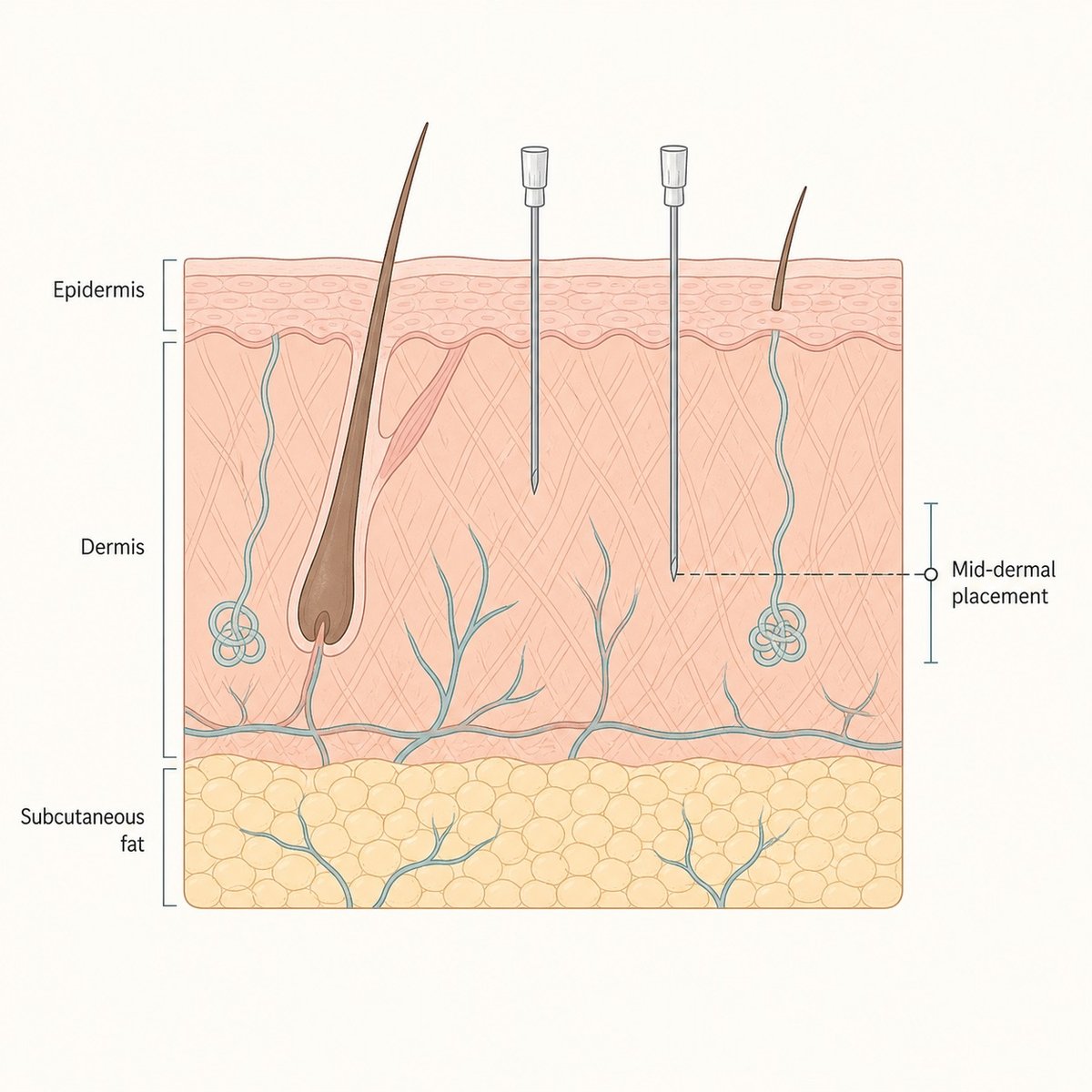
So a device locked at one depth is an excellent servant on a flat, forgiving cheek and a fairly blunt tool under the eye. Same setting, two very different outcomes. It also explains why a booster that felt transformative on your cheeks can feel underwhelming around the mouth if the depth was never adjusted for the area.
Side Effects, Bruising, and Downtime
Skin boosters are generally well tolerated, but they're still injections, and injections leave traces. Here's what tends to show up.
Redness: Common for a few hours and occasionally into the next morning, usually heavier where the skin is thin.
Pinpoint bumps: Small raised dots at the entry points that typically soften over one to two weeks as the product disperses.
Bruising: More likely under the eyes and around the mouth, where small vessels sit close to the surface.
Swelling: Depends heavily on how tightly the volume was concentrated. Spread across a wide area, it often flattens by the next morning.
A short cold compress during the first 24 hours helps redness and puffiness settle. Give the sauna, hot yoga, and alcohol a day or two off as well, since heat and vasodilation both make swelling look worse than it is.
Now the part that matters most. If you notice spreading redness, fever, worsening pain, or a firm lump that keeps growing past the two-week mark, contact your provider and seek medical care right away. Those aren't normal settling.
Worried about bruising? Some people pause alcohol and blood-thinning supplements for a couple of days beforehand. Never stop a prescribed medication on your own, though. Talk to the doctor who prescribed it first, and let your injecting provider know what you take.
Which Method Suits Which Area?
Short version: broad and flat favors the device, while small, curved, and thin favors the hand.
Factor | Manual injection | Injector device |
|---|---|---|
Depth control | Adjusted point by point, in real time | Fixed to the chosen setting |
Dose consistency | Depends on the clinician's experience | Strong at repeating identical conditions |
Session time | Longer, especially over large areas | Shorter across broad, flat zones |
Best suited to | Under-eye, around the mouth, curved contours | Cheeks, forehead, neck, flat planes |
Downtime you notice | Tracks the number of entry points | Tracks the treated pattern area |
In practice one face often receives both. Cheeks get laid down evenly with the device, then the under-eye and perioral areas are finished by hand at a shallower depth. That isn't indecision on the clinic's part. It's matching the tool to the tissue.

What to Ask Before You Book
Debating hand versus device can swallow an entire consultation while bigger levers go unexamined. These five questions tend to change outcomes more than the delivery method does.
Which product, exactly: Hyaluronic-acid hydrators and collagen-stimulating boosters target different depths and follow different timelines.
How many sessions, and how far apart: Most booster plans are built as a short series rather than one large sitting.
What depth is being targeted: A provider who can answer this specifically is a provider thinking about your anatomy.
Who is holding the syringe: Ask who performs the injection itself, not just who runs the consultation.
What your week looks like: Redness can linger for hours, so the night before a wedding isn't the moment.
On cost, we won't quote a figure here, because it shifts with the product, the treated area, and the number of sessions in the plan. Current pricing is published at our price page, and seasonal offers sit at our promotions page. If you're traveling to Seoul for treatment, it's worth confirming both the plan and the schedule before you fly, since most booster courses are spaced a few weeks apart.
The Bottom Line
Same product, different placement: Hand injection and injector devices differ in evenness and depth control, not in what they deliver.
Comfort follows punctures: Published pain scores for serial puncture and an injector device landed close together, with a blunt cannula scoring lower.
Depth decides texture: Product that stays too shallow can sit as bumps, and product placed too deep can underdeliver.
Areas differ, so methods mix: Flat planes suit a device, while thin and curved zones tend to suit a careful hand.
Like any injectable procedure, this one comes with trade-offs, and results aren't the same for everyone. Redness, small bumps, and the occasional bruise are part of the deal.
Ultimately, the choice depends on your skin, the area being treated, and how much downtime your week can absorb. A method isn't good or bad in isolation. It's either matched to the tissue in front of it or it isn't.
If you're considering a skin booster, a consultation is the best way to find out which approach fits you. Beautystone is a dermatology clinic in Seoul's Hapjeong neighborhood that regularly treats international patients, and current offers are listed at /en/promotion.
Frequently asked questions
Q. Does an injector device hurt less than hand injection?
A. Not reliably. In a case report comparing delivery methods for the same hyaluronic acid product, serial puncture and an injector device scored 4.6 and 4.5 on average, while a blunt cannula scored 2.2. Discomfort tracks how many times the skin is entered more than whether a motor is involved, so numbing cream and technique matter more than the hardware.
Q. How long does redness last after a skin booster?
A. For most people it fades within a few hours, though it can carry into the next morning on thinner skin. Small raised dots at the entry points usually soften over one to two weeks. If redness spreads instead of settling, or you develop fever or worsening pain, contact your provider right away.
Q. Can both injection methods be used on the same face?
A. Yes, and it's common. Cheeks and the forehead are broad, flat planes where a device lays product down evenly, while the under-eye and the area around the mouth are thin and curved, so many providers finish those by hand at a shallower depth. Mixing methods is about matching the tool to the tissue.
Q. How much does a skin booster cost in Seoul?
A. It varies with the product, the area treated, and how many sessions your plan includes, so a single number would be misleading. Current pricing is published on our price page, and seasonal offers appear on our promotions page. If you're traveling in, ask for the full course price rather than a per-session figure.
Content




skin
Why Does Fractional CO2 Take Longer to Heal?

Contouring & Volume
How Many cc Does Forehead Filler Need?

skin
Why Is My Skin Oily but Tight in the Fall?

Hair Removal
Underarm Laser Hair Removal Cost: Do the Math

Tattoo removal
Laser Before a Cover-Up: How Many Sessions?

skin
큐어젯 다운타임, 다음 날 출근과 화장은 언제부터 될까요?