

Rejuran, Juvelook, Revive — three ingredient types mean three intervals: 2 weeks, 1 month, 3 months.
Published -
Updated -

Author
Wi Young-jin · Chief director
Seoul National University College of Medicine · Seoul National University Hospital Specialist
→

Skin booster types vs. treatment interval,
why the ingredients fall into three categories
“Rejuran, Juvelook, and Revive,
aren’t they all basically the same?
I’m not sure which one I should get”
There are so many people who feel this way.
Today, I’ll walk you through the reason step by step.

Skin boosters, not just the same name
they are actually divided into three categories
Skin boosters are
procedures that are injected directly into the dermal layer to supplement
collagen, moisture, and regenerative factors.
It’s an umbrella concept, not the name of a single procedure.
Unlike fillers, which add volume
, the goal is to change the skin’s ‘texture’ itself.
So even within the same skin booster,
depending on which ingredients it contains
the results and treatment interval can be completely different.
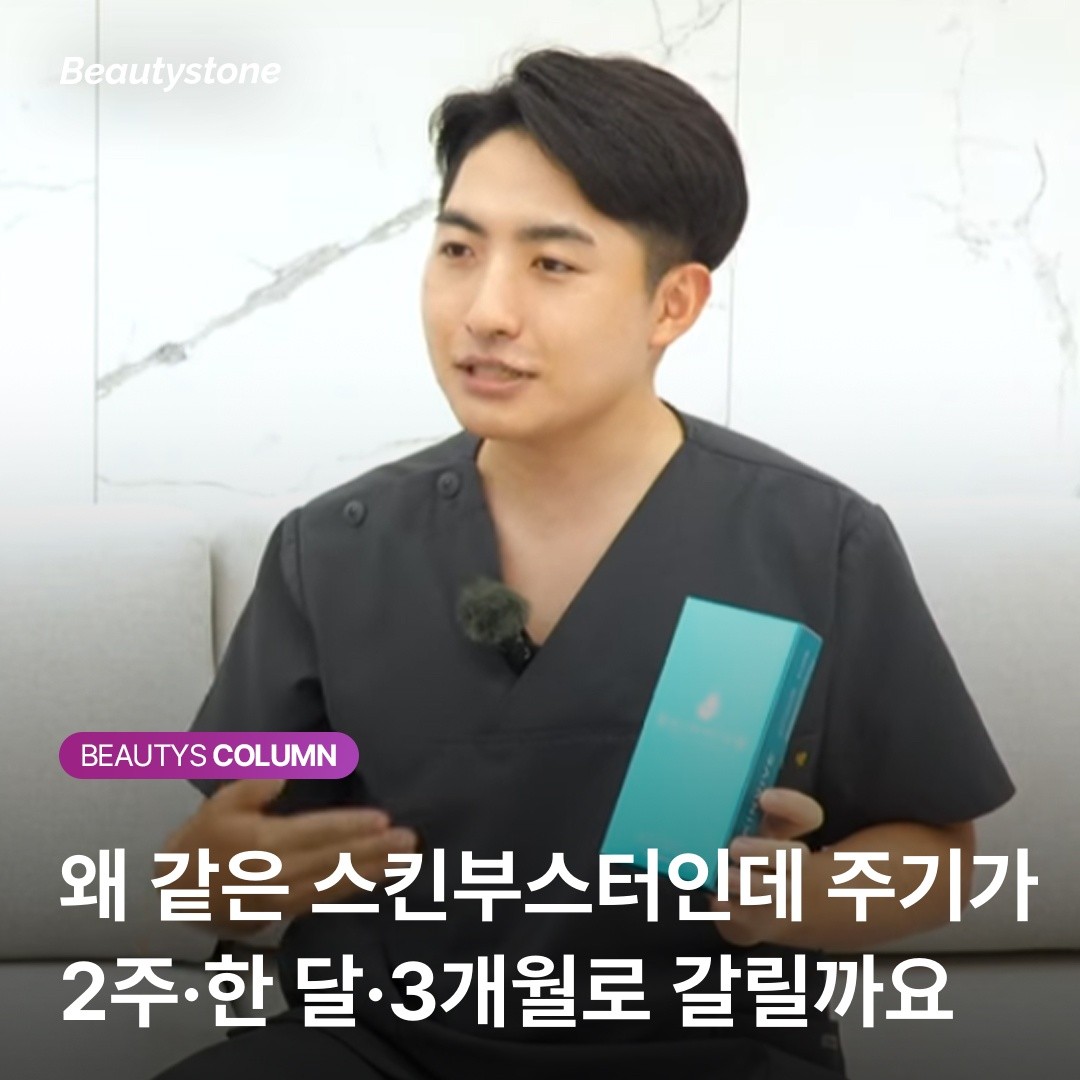
Why are the intervals 2 weeks, 1 month, and 3 months
so different?
Key insight from Dr. Wi Young-jin
Skin boosters can be broadly divided into three categories.
Collagen induction (1 month),
PN regeneration (2 weeks), HA hydration (3 months).
Once you know only the ingredient category,
the interval is automatically determined.
Rather than memorizing a hundred procedure names,
these three distinctions matter far more.
First are collagen-induction agents (such as Juvelook).
They work by encouraging your body to build collagen itself.
Because time is needed for new collagen to build up,
we usually perform a series of 3–4 treatments
at one-month intervals.
Second are PN regenerative treatments (such as Rejuran HB).
Made from ingredients extracted from salmon DNA,
they help support cell regeneration.
Because they are absorbed quickly in the body, they need to be
done at 2-week intervals
for the cumulative effect to show properly.
Third are HA hydrating treatments (such as Revive).
They directly replenish moisture in the dermal layer
for an immediate effect.
Since the results usually last about 3 months,
many people come in for a maintenance treatment once every season.
A 45-year-old patient who had improved skin texture with Rejuran last spring
came back recently concerned about sagging cheeks.
At that point, rather than a regenerative factor (PN),
it was time to move to a collagen-induction agent,
so I adjusted the consultation plan.
Even for the same person, the ingredient category needed
can change within just 6 months,
depending on the skin’s condition.
Dr. Wi Young-jin’s key summary
Don’t memorize procedure names;
just distinguish the three ingredient categories.
Collagen induction (1 month)·PN regeneration (2 weeks)
·HA hydration (3 months).
If you know just these three paths, “What should I get now?”
you’ll have 90% of the answer.

Which category is right for your skin?
Category | Representative products | Interval | Recommended for |
Collagen induction | Juvelook, Sculptra | 3–4 sessions at one-month intervals | Loss of firmness, sagging cheeks |
PN regeneration | Rejuran HB | 4 sessions at 2-week intervals | Pores, fine lines, rough texture |
HA hydration | Revive, Skinvive | Once every 3 months | Dryness, dullness |
One important thing to mention is that
these three categories
are not substitutes for one another—they complement each other.
Depending on the skin condition, doing them sequentially or in combination
gives the best synergy.
Common questions we hear in the consultation room
Q1. Can I get all three at once?
It is possible, but not recommended.
If the stimulation to the dermal layer is concentrated all at once,
the risk of bruising or nodules increases.
Usually, we finish the regenerative (PN) series first
and then
move on to a collagen-induction agent.
Q2. Doesn’t the cost become too high all at once?
You don’t have to start by getting all three
at once.
Taking them one category at a time
is much more reasonable.
Start by addressing the most urgent concern,
observe how your skin responds, and
then move on to the next step.
Q3. I’m worried about side effects like bruising or nodules.
PN and HA treatments
tend to bruise easily because of the many needle marks,
but the bruising usually fades naturally within a week.
Collagen-induction agents bruise less,
but because of the risk of nodules, the injector’s skill and
massage guidance are very important.
If you take away just one thing today,
— remember the three paths: collagen, PN, and HA,
and the treatment intervals that go with them.
In the next article,
‘the optimal timing to move from regenerative care
to elasticity care’ will be shown with real cases.
That’s it from Dr. Wi Young-jin.
Frequently asked questions
Q. Can all three be administered at the same time?
A. It is possible, but we do not recommend it. This is because if the stimulation is concentrated in the dermis all at once, the risk of bruising or nodules increases.
Q. Doesn’t the cost end up being quite large all at once?
A. You don’t need to address all three from the start. It’s much more practical to take them one category at a time.
Q. I’m concerned about side effects such as bruising or nodules.
A. PN or HA-based treatments can leave many needle marks, so bruising may appear easily, but it usually fades naturally within a week.
Q. If I want to get collagen stimulation, PN regeneration, and HA hydration all together, what is the best order for the treatments?
A. These three categories of treatments are not substitutes but rather complements, so doing them in sequence creates great synergy. Normally, we complete the PN regeneration treatment first before moving on to the collagen stimulator. It is best to address your high-priority concerns first and observe how your skin responds.
Content




Contouring & Volume
How Many cc Does Forehead Filler Need?

skin
Why Is My Skin Oily but Tight in the Fall?

Hair Removal
Underarm Laser Hair Removal Cost: Do the Math

Tattoo removal
Laser Before a Cover-Up: How Many Sessions?

skin
큐어젯 다운타임, 다음 날 출근과 화장은 언제부터 될까요?

Lifting
Titanium Lifting Side Effects: When to Worry