

Is it too early for pore treatment in your 20s? Here's how to judge the timing.
Published -
Updated -

Author
Wi Young-jin · Chief director
Seoul National University College of Medicine · Seoul National University Hospital Specialist
→
If you've started noticing that the pores on your nose and cheeks look more obvious than they did a couple of years ago, you're not alone. It shows up for plenty of people well before 30.
Here's the short version: pore size tracks oil output far more closely than it tracks how thoroughly you cleanse. Cleansers and serums work on the surface. They can't reach the collagen scaffolding that holds the pore opening in shape, which is why a lot of people in their 20s start asking about in-clinic options like Potenza, a microneedle radiofrequency (RF) device.
In this article, we'll cover why pores change in your 20s, how Potenza works, how to tell whether it's genuinely too early for you, what a realistic session plan looks like, and the side effects worth knowing about before you book.
Why Do Pores Look Bigger in Your 20s?
The short answer? Oil. A dermatology review that gathered the factors behind pore size describes sebum output from the sebaceous gland (the small oil-producing gland attached to the side of each pore channel) as having a direct relationship with how large pores appear. Scrubbing harder doesn't shrink them. It usually irritates the skin and makes the rim read sharper.
Think of a hair tie that's been stretched around a thick ponytail for hours. Early on it snaps back to almost its original shape. Stretch it long enough, while the elastic itself slowly loses its spring, and the shape stops bouncing back. Your 20s are usually the window where oil glands are still working hard and the collagen supporting the pore rim is only beginning to change. Pores that used to look round start reading oval and elongated, pulled downward — cheeks tend to show it first.
That's why stepping in while the pore is still round tends to have an advantage in recovery speed compared with waiting until it's fully stretched. It doesn't mean the door closes on your 30th birthday. What decides the timing is the state of your skin, not the number on your ID.
How Does Potenza Work on Pores?
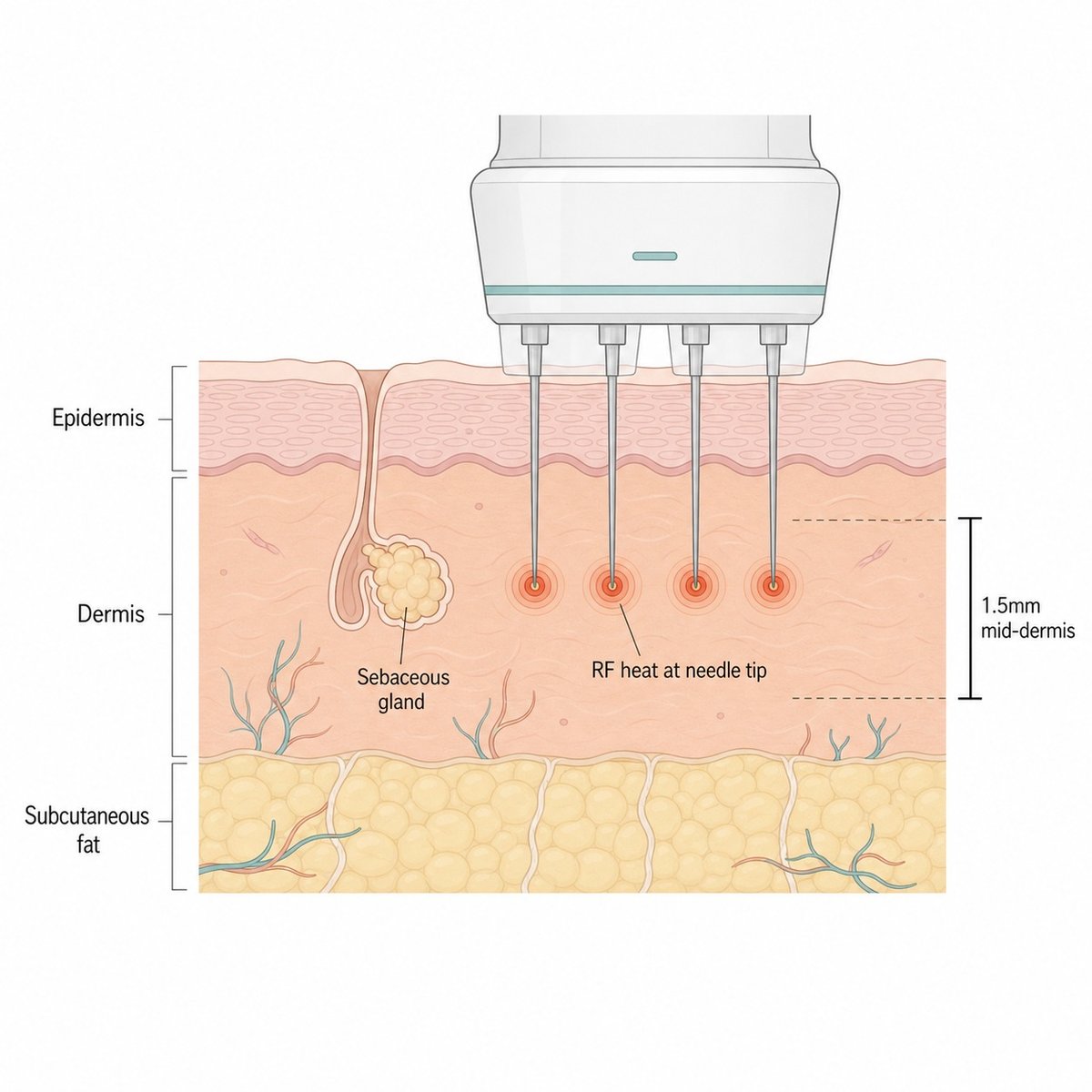
Potenza is a microneedle RF device. Ultrafine needles pass through the surface, and radiofrequency energy is released from the needle tips inside the dermis. That puts controlled heat where you actually want it while disturbing the outer layer less than heating the skin from the outside in.
When the dermis takes on that controlled heat, the body responds with a repair-and-remodel process that lays down new collagen. As the scaffolding under the pore rim firms up, an opening that looked wide has a chance to read smoother, and skin overall often feels denser. This is a gradual build rather than a same-day change, and individual results vary.
Here's the distinction that matters most. Exfoliating acids work on what's sitting inside the opening. Microneedle RF works on the structure holding that opening in shape. Those are two different jobs, and one doesn't replace the other.
Needle depth and energy level have to be set per area. Nose, cheek, and forehead skin aren't the same thickness, so one setting across the whole face rarely fits every zone. Your provider will map that during the exam, and it's fair to ask which device they use and what it's cleared for in your case.

Should You Start Now, or Wait?
The honest answer is that it depends on the shape of your pores right now, not on your age. Look at your skin in natural light, then see which line below sounds like you.
Still round, only obvious in harsh light: consistent oil control and daily sunscreen usually earn more at this stage than a treatment course would.
Starting to read oval or elongated on the cheeks: that's a signal the supporting structure is changing, and it's the point where most people start asking about collagen stimulation.
Active breakouts or flaring redness: settle the inflammation first, then plan pore work.
Freshly sunburned, peeling, or an important event within a week: push the appointment out.
One clarification, because this gets misread constantly: treating early isn't the same as treating often. If your pores genuinely haven't changed yet, sunscreen and oil control are the better spend, and there's no prize for starting a course before your skin needs one.

How Many Sessions, and How Far Apart?
Rarely just one. A retrospective chart review of 75 patients reported that after a single session, moderate-or-better improvement came in at roughly 13.8 percent on the nose, 8.9 percent on the forehead, and 11.1 percent on the cheeks, and that the improvement rate climbed as the number of sessions went up. Read that as a caution against judging a whole plan from session one.
On spacing, a clinical report using non-insulated microneedle RF in 19 participants ran sessions about a month apart, for a total of two to six. That's why courses are typically laid out at roughly monthly intervals with a re-assessment along the way. Individual results vary with your skin and your aftercare.
Where you are | What people usually notice | What to do |
|---|---|---|
Session 1 | Temporary smoothness, partly from swelling | Photograph the same angle in the same light |
Sessions 2 to 3 | The rim reads less sharp in some spots | Flag slow-responding areas so depth can be adjusted |
Session 4 and beyond | Overall smoothness usually reads more clearly | Review with your provider whether to continue or pause |
Cost depends on the tip used, the area treated, and how many sessions you end up booking, so a single number wouldn't be honest here. Current figures live on our price page and current offers. These are Seoul clinic prices and subject to change.
Side Effects, Risks, and Safety
Redness and swelling at the treated area are common and usually settle on their own. In the 19-participant report mentioned above, redness and swelling lasted roughly two to five hours, and no burns or pigment changes were reported. If you notice spreading redness, fever, worsening pain, or pus, seek medical care right away.
Does it hurt? You'll feel it — this is needles plus heat. Numbing cream is typically applied for about 30 minutes beforehand, and energy is adjusted to how you respond. If one spot becomes too much, say so during the session instead of pushing through it.
Talk to your provider before booking if any of these apply to you:
You're pregnant or breastfeeding.
You have active acne, a rash, or an infection in the treatment area.
You're taking an oral retinoid, or stopped one recently.
You scar easily, keloids especially.
You have a pacemaker or another implanted electronic device.
Aftercare matters more than most people expect. Skip makeup on day one and cleanse gently with room-temperature water. Hold off on saunas, hard workouts, and alcohol for two to three days. Sunscreen is non-negotiable. Leave gritty physical scrubs and exfoliating acids alone until your provider clears you to bring them back.
The Bottom Line
The driver is oil, not hygiene: pore size tracks sebum output, and the collagen rim supporting each opening starts changing in your 20s.
Round beats stretched: stepping in while pores are still round tends to favor recovery speed over waiting until they're fully elongated.
Plan on a course: published reports ran two to six sessions at roughly monthly spacing, with results building gradually.
Judge your skin, not your birthday: current shape and condition decide the timing.
Like any procedure, this one comes with trade-offs: downtime, cost, and results that vary from person to person. Ultimately, the choice depends on your skin, your goals, and your budget.
If you're weighing whether it's too early, a consultation is the most direct way to find out. Beautystone is a dermatology clinic in Seoul's Hapjeong area, and you can see current offers at our promotion page. For more depth, our guides on how microneedle RF reaches the dermis and how to space sessions pair well with this one.
Frequently asked questions
Q. Is it too early to treat pores in my 20s?
A. Age isn't the deciding factor, shape is. If your pores still look round and only stand out under harsh light, steady oil control and daily sunscreen usually earn more than a treatment course would. If they're starting to read oval and elongated on the cheeks, that's the point where the supporting structure is changing and it's worth having a provider assess you in person.
Q. How many Potenza sessions before I see a difference?
A. Plan on a course rather than a single visit. In a chart review of 75 patients, moderate-or-better improvement after one session was roughly 13.8 percent on the nose, 8.9 percent on the forehead, and 11.1 percent on the cheeks, and the rate climbed with more sessions. Published clinical reports ran two to six sessions about a month apart. Individual results vary.
Q. Does Potenza hurt, and how long is the downtime?
A. You'll feel it, since it combines fine needles with radiofrequency heat. Numbing cream is typically applied for about 30 minutes first, and energy is dialed to your response. In a 19-participant report, redness and swelling lasted roughly two to five hours with no burns or pigment changes reported. If redness spreads or pain worsens, seek medical care right away.
Q. What can't I do right after a session?
A. Skip makeup on day one and cleanse gently with room-temperature water. Hold off on saunas, hard workouts, and alcohol for two to three days. Wear sunscreen daily, and leave gritty physical scrubs and exfoliating acids out of your routine until your provider tells you it's fine to bring them back.
Content


skin
Why Does Fractional CO2 Take Longer to Heal?

Contouring & Volume
How Many cc Does Forehead Filler Need?

skin
Why Is My Skin Oily but Tight in the Fall?

Hair Removal
Underarm Laser Hair Removal Cost: Do the Math

Tattoo removal
Laser Before a Cover-Up: How Many Sessions?

skin
큐어젯 다운타임, 다음 날 출근과 화장은 언제부터 될까요?