

Hormonal melasma recurs differently. Here's how laser plans change while you're on the pill.
Published -
Updated -

Author
Wi Young-jin · Chief director
Seoul National University College of Medicine · Seoul National University Hospital Specialist
→
If you've been taking an oral contraceptive for a while and noticed a soft brown patch spreading across both cheekbones, you're not imagining it. It usually starts faint enough to blame on summer, and then it stays put through autumn, sometimes looking a little deeper than it did in July.
Hormonal melasma doesn't behave like an ordinary sun spot. The signal telling your skin to make more pigment is still switched on inside, every day you keep taking the pill, so surface care alone rarely settles it. Pushing a strong laser to clear it quickly can also backfire.
In this article, we'll cover what makes hormonal melasma different, the mechanism behind its recurrence, how a treatment plan is usually built while you're still on the pill, and the risks worth weighing before you book anything.
How Hormonal Melasma Differs From Sun Spots
The patch itself can look unremarkable. Melasma appears as a brown patch with soft, blurred edges, usually fairly symmetrical across the cheekbones, forehead and upper lip. Freckles and isolated sun spots are smaller, more sharply defined, and rarely mirror each other side to side.
The hormonal link is well documented. A review of treatment considerations in melasma reports the condition in roughly 10 to 15 percent of pregnancies and 10 to 25 percent of women taking oral contraceptives. A separate review of newer insights into melasma pathogenesis gives a wider range, 8 to 34 percent among women using oral contraceptives or hormone replacement.
Genetics matter as well. In that same review, about 48 percent of patients reported a family history of melasma, and 97 percent of those cases involved a first-degree relative such as a mother or a sibling. That's why two people can take the same pill and only one of them develops a visible patch within a few months.
Why the Pill Makes Melasma Come Back
Hormones don't darken skin directly. They raise the output of a pigment factory that's already sitting there.
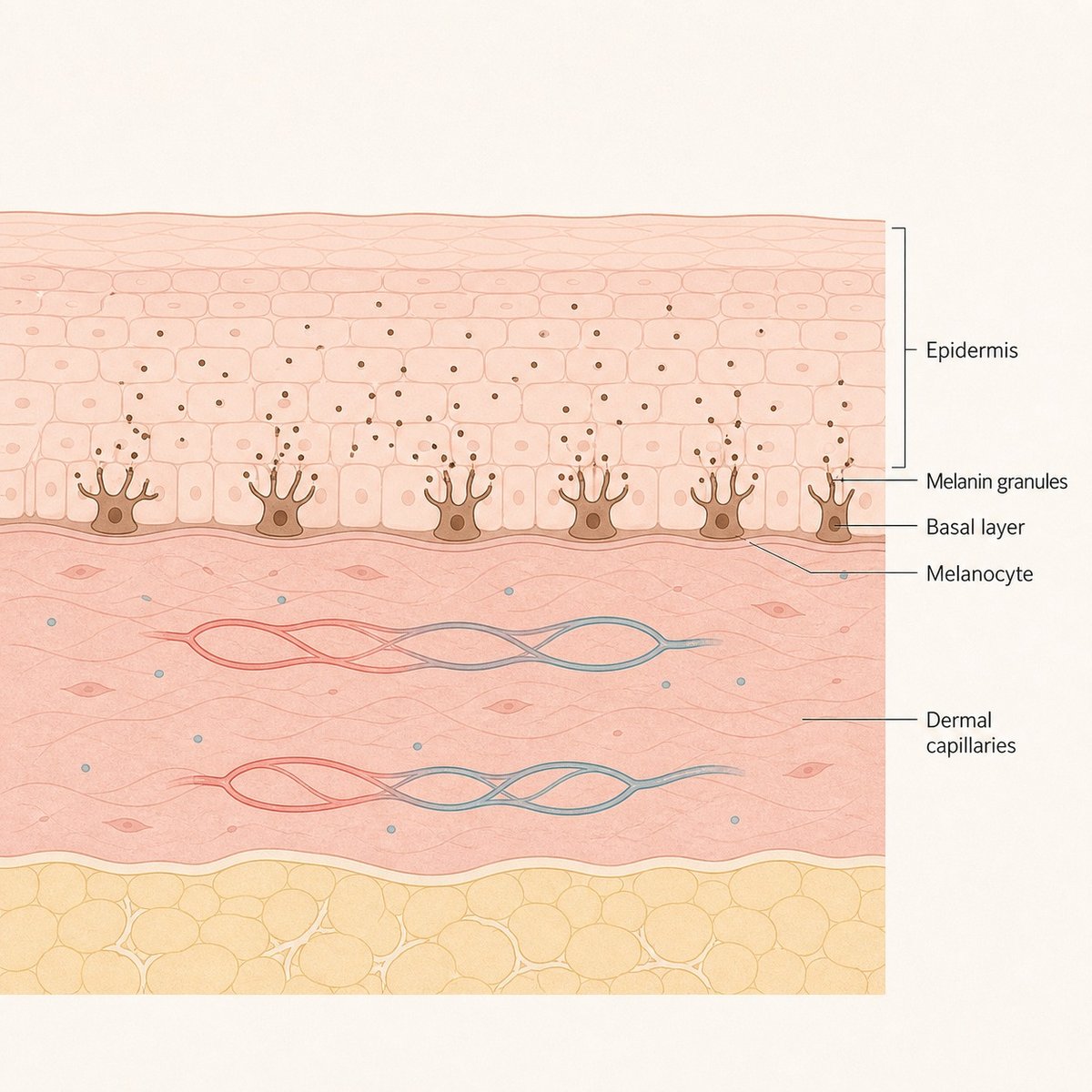
Estrogen increases the activity of tyrosinase, the first gate in melanin production. A paper on the mechanisms behind melasma describes melanocytes producing more melanin when they're cultured at estradiol levels close to those seen in pregnancy and contraceptive use.
There's more than one route in play. Estrogen acts directly through estrogen receptor beta on melanocytes, and it also interferes with Wnt/β-catenin signaling in keratinocytes. Estradiol has additionally been described as increasing the number of small blood vessels in the skin and raising endothelin-1 release, which loops back to stimulate tyrosinase again. So this kind of patch often carries both a pigment component and a vascular one.
Sunlight then piles on. Reviews describe ultraviolet exposure as the main aggravating factor, and in deeper skin tones visible light on its own can add pigment too, so it isn't only UV you're managing.
Think of a tap you've left running. However well you mop, the floor stays wet until you turn the tap down. That's why success here isn't measured by how much lighter you look after a single session, but by how long you hold that result.

Building a Plan While You're Still on the Pill
The short version: lower energy, more sessions, and topical support running alongside, rather than one aggressive pass meant to finish the job.
On the device side, low-fluence 1064 nm Q-switched Nd:YAG delivered over repeated sessions has been reported to produce considerable results in Asian skin, which is more prone to post-inflammatory hyperpigmentation than lighter skin. Turn the energy up to see change faster and the skin can answer with inflammation and then more pigment, layering PIH on top of the melasma you started with.
Topicals are the other pillar. Reviews describe a triple combination cream, hydroquinone with tretinoin and a corticosteroid, as more effective than single agents, though also more irritating, which is why concentration and duration have to be set by a doctor for each person. Tranexamic acid has data suggesting it dampens melanin production partly through TGF-β1 in keratinocytes. Where the vascular component is prominent, pulsed dye laser combined with a topical has been reported to hold relapses off better than the topical used alone.
The table below is a rough orientation rather than a formula, since a real assessment needs your skin looked at in person under specialist lighting.
What you notice | What it often suggests | Usual direction |
|---|---|---|
Redness sitting under the patch | A vascular component alongside pigment | Address the vessels together with topicals |
Blurred edges over a wide area | Pigment spread broadly, not in spots | Lower energy, spread across more sessions |
Clearly darker every summer | Strong light sensitivity | Start with sun protection and topicals |
Session counts and intervals get set case by case once your skin has been assessed. Cost depends on the route and the number of sessions, and you'll find current guidance on our price page, which can change.

Side Effects and Risks Worth Knowing
Low-energy sessions are generally well tolerated. The usual after-effects are mild redness and a warm, prickly feeling across the treated area, which typically settles within one to three days. Swelling that keeps spreading, blistering, broken skin or unusual pain isn't part of that normal course, so call the clinic instead of waiting it out.
The risk that matters most while a hormonal trigger is still active is post-inflammatory hyperpigmentation. Treat too often, use too much energy, or treat skin that's still reactive after sun exposure, and the area can end up darker than it was beforehand, sometimes for months. Moving slowly genuinely is the safer route here.
Talk things through carefully, or wait, if any of the following apply:
You're pregnant or breastfeeding
You've had heavy sun exposure or sunburn in the past two weeks
There's an active rash, inflamed acne or a wound in the area
You're taking medication that makes skin photosensitive
You've pigmented easily after laser or inflammation before
One more thing worth saying plainly: don't stop your contraceptive on your own to treat melasma. The pill is prescribed for several reasons besides contraception, so that conversation belongs with the doctor who prescribed it, and your skin plan should follow that decision rather than drive it.
Daily Care and What to Tell Your Doctor
Sunscreen isn't an optional extra here, it's the floor the whole plan stands on. Broad-spectrum sunscreen has been reported to cut new melasma during pregnancy by roughly half, and because visible light affects deeper skin tones, a tinted or mineral-containing formula does more work than a clear one.
While you're in treatment, ease off anything abrasive: gritty scrubs, vigorous towel-drying, stacking several exfoliating acids at once. Repeated small inflammation stimulates pigment just as reliably as a sunburn does. A plain routine with a decent moisturizer beats an ambitious one.
Bring this list to your consultation and your doctor can sequence things far more precisely:
The contraceptive you're taking, and when you started it
Whether you plan to continue, switch or stop
Whether melasma appeared during pregnancy or with other hormones before
Every topical and supplement you're currently using
Any previous laser work, when it was, and how your skin responded
One habit worth keeping on your own: photograph your face in the same position and lighting once a month. Melasma fades gradually, so week to week your eyes won't register the change, but the photos will tell you whether the plan is moving in the right direction.

The Bottom Line
Melasma that arrives alongside the pill comes from estrogen turning up pigment production, with sun exposure adding a second layer on top. As long as that trigger is active, the recurrence pattern differs from ordinary sun-induced patches, which is why the plan that fits tends to be lower energy across more sessions, with topicals and daily sun protection as the base, rather than a rush to clear everything at once.
Results vary from person to person depending on skin type, genetics and daily care, so it's worth having a specialist assess your skin before you decide anything. If you're taking a contraceptive, keep the prescribing doctor in that conversation as well.
If you're worried the patch will fade and then come straight back, come and talk it through with us first. Beautystone Clinic sits in Hapjeong, Seoul, and a consultation costs you nothing. You might also want to read how melasma differs from other pigmentation and why melasma tends to recur after laser.
Frequently asked questions
Q. Can I have laser for melasma while I'm on the pill?
A. In most cases yes, though the plan looks different from someone who isn't taking hormones, because the pigment trigger is still active. The usual approach leans on lower energy spread over more sessions, with topicals and daily sun protection running underneath. Tell your doctor which contraceptive you take and how long you've been on it at the first consultation, since that changes the sequencing.
Q. How many sessions before I see a difference?
A. There's no fixed number. Low-energy work usually needs several sessions before the change shows up clearly in photographs, and your doctor may build in a rest period before continuing. Results vary from person to person depending on how deep the pigment sits and how consistent your care is between sessions.
Q. Will melasma fade on its own if I stop the pill?
A. Some people see it lighten after stopping, and others find the patch stays where it is. Pigment already deposited in the skin doesn't disappear along with the trigger, and daily sun exposure keeps working on it. The important part is not stopping your contraceptive on your own to treat melasma, but raising it with the doctor who prescribed it.
Q. Can laser make my melasma darker instead?
A. It can, particularly with energy set too high, sessions booked too close together, or treatment on skin that's still reactive after sun exposure. That reaction is called post-inflammatory hyperpigmentation, and while it usually fades, it can take months. Keeping energy low and sun protection consistent is what reduces the risk.
Content





skin
Why Does Fractional CO2 Take Longer to Heal?

Contouring & Volume
How Many cc Does Forehead Filler Need?

skin
Why Is My Skin Oily but Tight in the Fall?

Hair Removal
Underarm Laser Hair Removal Cost: Do the Math

Tattoo removal
Laser Before a Cover-Up: How Many Sessions?

skin
큐어젯 다운타임, 다음 날 출근과 화장은 언제부터 될까요?