

Don't pick the scab and block UV religiously. Here's how to heal cleanly after PicoWay.
Published -
Updated -

Author
Wi Young-jin · Chief director
Seoul National University College of Medicine · Seoul National University Hospital Specialist
→
After treating melasma or freckles with PicoWay, the spots can darken or form a thin scab for a few days, and it's easy to worry, "Is this only going to look duller?" With pigment treatments, the after-care shapes your result just as much as the laser does.
The short answer: it's normal for pigment to darken right after treatment and then flake off as a scab. Get through this window the right way and the skin clears up nicely. But if you force the scab off or let sun hit the area, it can actually trigger more pigmentation, so it's worth knowing the key points.
This article shares treatment information from Hapjeong Beautystone.
What you'll learn
How PicoWay actually breaks down pigment
Which post-treatment reactions are within the normal range
How to care for skin to keep pigmentation from returning
What to avoid while you heal
How PicoWay breaks down pigment
PicoWay fires ultra-short laser pulses at pigment particles, shattering them with a physical shock rather than burning them with heat. Your body then clears the tiny fragments out gradually over time. During this process the spot may darken briefly or form a thin scab*, which is simply the broken-up pigment rising to the surface and clearing. Research showing that short-pulse lasers remove pigmented lesions effectively while reducing surrounding heat damage helps explain why recovery with this approach tends to be relatively quick.
scab*: a thin crust that forms over the treated spot, made up of broken-down pigment rising to the surface and clearing. It's best left alone until it falls off on its own.
Because it relies on shock rather than heat, the surrounding skin takes on comparatively less strain, but the skin right after treatment is still sensitive. So the key to a clean result is to minimize irritation and protect the area until all the broken-up pigment has cleared.
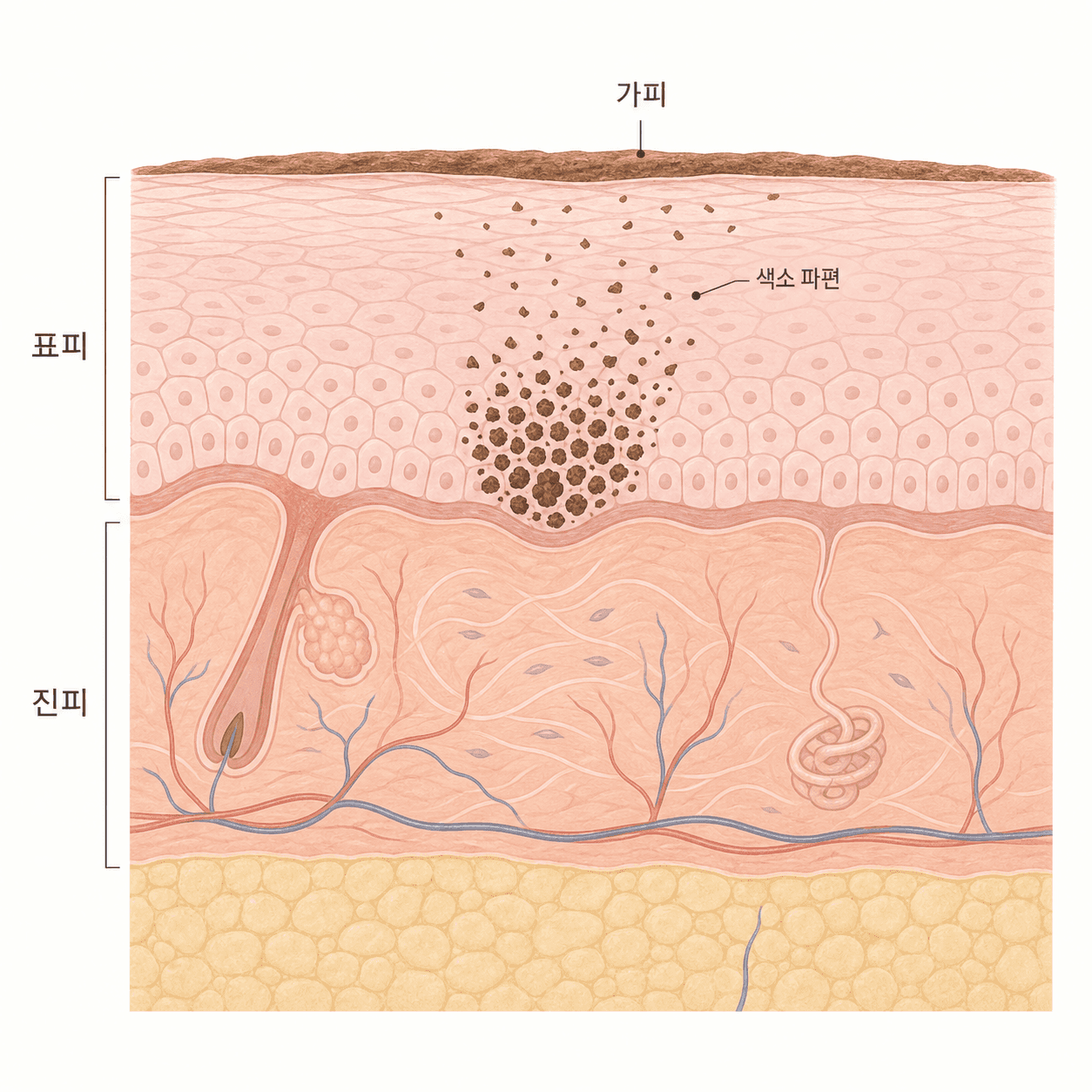

Which reactions are normal after treatment?
Even with the same pigment treatment, "clearing as it should" and "a sign that needs attention" feel different. Pigment darkening right after, with some mild redness, then a thin scab forming a few days later and falling off on its own is generally a normal course. On the other hand, if a forcibly removed scab stays red for a long time, or the treated area looks duller over a wider patch, that leans more toward a sign to watch.
Reaction | Closer to normal | Worth care or a question |
|---|---|---|
Pigment intensity | Darkens, then flakes off | Duller over a wider area after |
Scab | Thin crust, sheds naturally | Redness where it was picked off |
Redness | Fades within a few days | Clearly lasts past two weeks |
Sensation | Mild stinging | Burning or oozing |
As the table shows, the common thread in a normal course is the "darkens right after, then flakes off as a scab and clears" flow. Getting through this window without irritation is the biggest part of preventing pigmentation.


How to keep pigmentation from coming back
After a pigment treatment, the two most important things are leaving the scab alone and blocking UV thoroughly. The scab is a protective layer over the clearing pigment, so if you let it stay until it falls off, fresh skin comes up underneath. Pick it off and that spot turns red and can actually lead to more pigmentation.
UV is the thing to guard against most after a pigment treatment. When healing skin gets sun, melanin is stimulated again, which can dial back your results or bring the color back. So apply sun protection carefully whenever you go out, keep your skin barrier strong with moisturizer, and give the scab time to fall off on its own.

Why Hapjeong Beautystone?
At Hapjeong Beautystone, the thinking isn't "we erased it, so we're done." We tell you up front that scab and UV care after treatment shape the result, and we look at your reactions together to judge whether they're part of the normal course. Even with the same pigment, recovery varies by depth and skin type, so before treatment we look at your skin and tailor the care points to you. As a small clinic within walking distance of Hapjeong Station, we can watch each person's recovery pace and plan the next timing together.

What to avoid during aftercare
During recovery from a pigment treatment, avoiding just a few things sharply lowers the risk of pigmentation.
Picking the scab off — waiting for it to shed on its own is safest
Harsh exfoliation or scrubs — they irritate sensitive skin
Direct UV exposure — melanin gets stimulated and the color can resurface
Hot saunas or steam treatments — hold off on heat and irritation until you've fully healed
Using whitening products on your own — ask first, since the wrong one can irritate
This article is general information, so it's safest to decide on your own recovery course and care routine in consultation with the medical team that treated you.

Frequently asked questions
Q. The pigment got darker after treatment — does that mean it failed?
A. Pigment darkening right after is the broken-up pigment rising to the surface and clearing, so it's generally a natural course. In many cases it forms a thin scab a few days later, sheds, and fades, so rather than judging the result by how it looks right after, it's better to give it time.
Q. Can I wash my face or wear makeup before the scab falls off?
A. Washing gently without irritation is fine, but avoid rubbing or peeling the scab. Makeup is safest after the scab has fallen off, and if the timing is unclear, ask your clinic when it's okay to start.
Q. How careful do I need to be with sun protection?
A. After a pigment treatment, UV is the thing to guard against most, so blocking it carefully throughout recovery matters. Sun stimulates melanin again and can bring the color back, so be thorough with protection when you go out and reduce direct exposure where you can.
Q. Does it all clear in one session?
A. It depends on the type and depth of the pigment, but rather than finishing in one go, it's often lightened over several spaced-out sessions. It's best to look at your own pigment and decide how many sessions are right together with the medical team.
Content



skin
Why Does Fractional CO2 Take Longer to Heal?

Contouring & Volume
How Many cc Does Forehead Filler Need?

skin
Why Is My Skin Oily but Tight in the Fall?

Hair Removal
Underarm Laser Hair Removal Cost: Do the Math

Tattoo removal
Laser Before a Cover-Up: How Many Sessions?

skin
큐어젯 다운타임, 다음 날 출근과 화장은 언제부터 될까요?