

Can you keep eyelash extensions during eye-area procedures? Here is what to remove before laser, lifting, or skin boosters, and when to reattach them safely.

Author
Wi Young-jin · Chief director
→
One of the most common questions we hear from clients who maintain eyelash extensions is: do I need to take them off before my eye-area procedure? It depends on what you're having done — and the answer can change your whole appointment timeline.
Extensions are bonded to your natural lashes with cyanoacrylate-based adhesive — the same chemistry as instant glue. That adhesive reacts to heat, and it reacts to solvents. Both of those happen to be things that eye-area aesthetic procedures use, which is why the question deserves a clear, procedure-by-procedure answer.
In this article, we'll cover why the adhesive is the variable that matters, which procedure types require removal and which don't, how to schedule removal and re-application around your visit, and what to check before you book. Read on — this article could save you a same-day cancellation.
Why the Adhesive Is the Problem
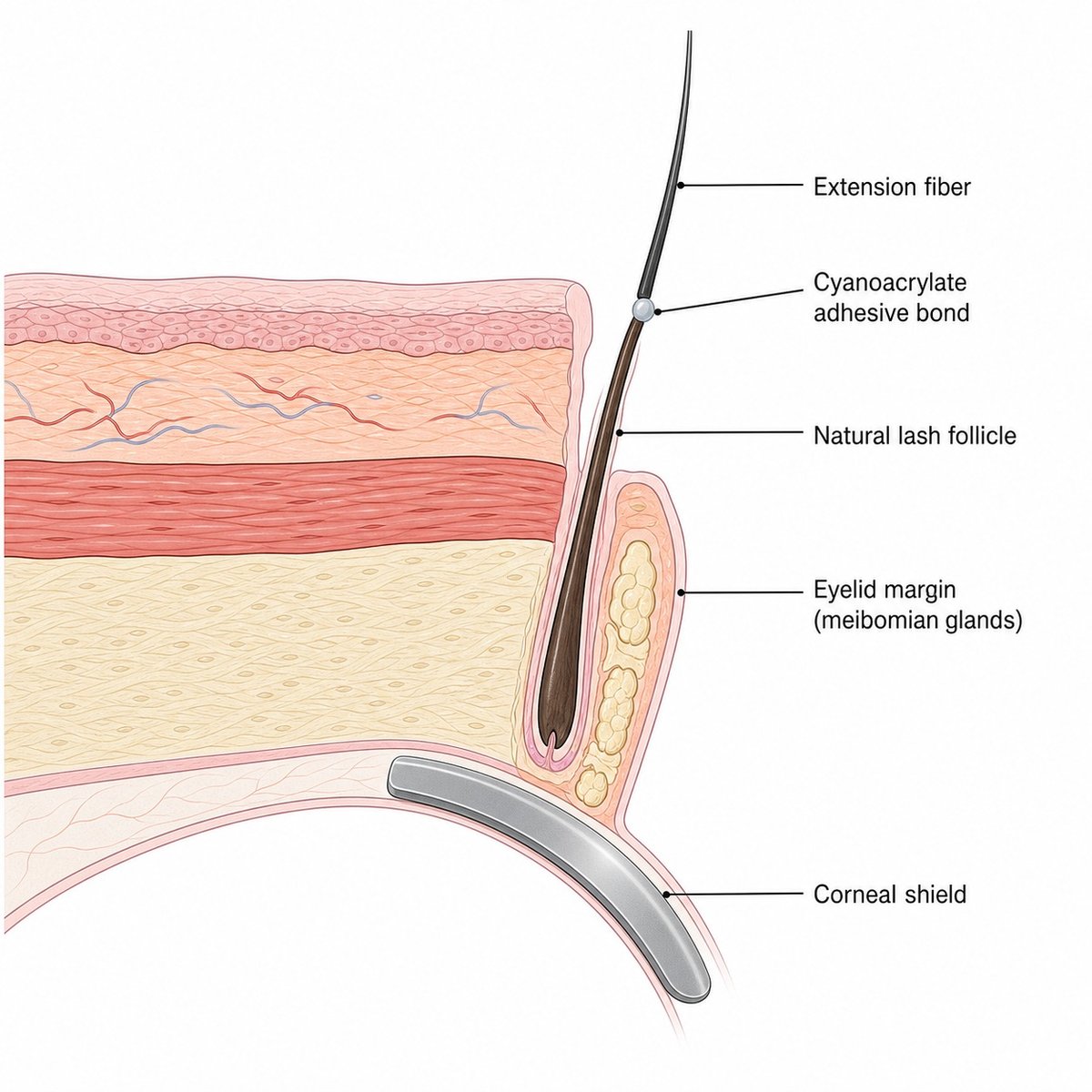
Eyelash extension adhesive is not just decoration — it is a structural bond sitting very close to your eyelid margin. Cyanoacrylate-based glues are stable in normal conditions, but they weaken with heat and dissolve partially under solvent exposure.
That creates three specific issues in an eye-area procedure context:
Heat sensitivity: Treatments that deliver thermal energy near the eye — lasers, RF, ultrasound — can loosen the adhesive bond, cause odor, or produce chemical irritation as the glue degrades. A published case report documented chemical conjunctivitis after extension remover use, attributing the injury to formaldehyde released as the cyanoacrylate adhesive broke down — the same chemistry that can be triggered by heat.
Solvent exposure: Pre-procedure antiseptic cleansing and numbing cream removers can partially soften the adhesive, loosening extensions mid-procedure and introducing irritants near the eye.
Protective equipment fit: Corneal shields used during laser and energy-based treatments need to sit flush against the eyelid margin. Extensions physically obstruct proper placement. Research comparing eye protection devices for periorbital laser procedures found that metal shields placed inside the eyelid provide adequate thermal protection, while darker plastic alternatives are not recommended. That inside-lid placement is exactly what extensions make difficult.
These are not theoretical concerns. Any of them can mean a postponed procedure — or, in a laser context, a genuine safety issue.
Which Procedures Require Removal — and Which Do Not?
The deciding factor is how the procedure interacts with heat, solvents, and protective equipment needs. Here is how the main categories break down:
Eye-area laser (pigment, rejuvenation): Removal required. Corneal shields must be placed inside the eyelid, and the laser thermal energy poses a direct risk to the adhesive. Do not arrive with extensions intact for any laser near the periorbital area.
Ultrasound and RF lifting (HIFU, Thermage Eye, Sofwave, Oligio): Situation-dependent. If the treatment zone extends to the eyelid margin, removal is typically advised. If the practitioner is working on the brow bone or cheekbone only, staying on may be possible — but this needs to be assessed at consultation, not assumed.
Eye-area skin booster injections (Rejuran, Juvelook, HA boosters): Usually possible to keep. Injections work with depth and needle placement rather than heat, so the adhesive is not a direct variable. That said, swelling after under-eye injections is common — and if you are managing puffiness by touching the eye area, you will risk dislodging extensions in the process.
This framework is general guidance. Individual decisions depend on the specific device, the exact treatment area, and your provider assessment of your anatomy. When in doubt, ask your clinic before you schedule the adjacent salon appointment.
Side Effects, Risks, and Safety Considerations
Even when extensions do not need to be removed, there are risk factors worth understanding before you proceed:
Post-procedure swelling: Under-eye or lid-area edema after injections or RF treatment is common. Swollen, tight skin pressing on extension adhesive can cause a burning sensation or temporary bond loosening.
Solvent sensitivity: If you have a history of eye irritation or chemical sensitivity, alert your provider before your appointment. The combination of pre-procedure prep solutions and even small amounts of released adhesive compounds can irritate already-sensitized tissue.
Improper shield placement: Proceeding with laser without adequate corneal protection because extensions prevented proper shield placement is a non-negotiable safety issue. If the shield does not seat correctly, the provider should pause and address it before continuing.
Adhesive breakdown products: Formaldehyde and other byproducts of cyanoacrylate degradation are known ocular irritants. Any procedure that introduces heat, solvent, or mechanical stress to the bond near the eye carries this risk.
Redness and mild swelling are common after eye-area procedures and usually resolve within a few days. If you notice spreading redness, discharge, worsening pain, or any change in vision after an eye-area procedure, seek medical care right away. The eye area does not leave room for a wait-and-see approach.
How to Time Removal and Re-Application
If removal is required — or advisable — here is how to build the timeline without doubling your trips to the salon:
Remove at your salon, not at home. DIY removal with over-the-counter solutions carries a real risk of getting remover into the eye. Your extension salon has the tools and positioning to do it safely.
Schedule removal the day before, not the morning of your procedure. Any minor irritation from the removal process — eye puffiness, slight redness, trace adhesive residue — needs time to settle before your treatment. Arriving with fresh irritation compounds the variables unnecessarily.
Wait for redness and flaking to fully clear before re-application. After laser, that is typically around 3 days. After RF or ultrasound lifting, typically 2 days. After injection-only procedures, as early as 1 day — but only if there is no visible irritation. If healing is slower, wait longer.
Delay re-application if you have crusting or discharge. Any active wound healing at the eyelid margin is incompatible with adhesive application. Adhesive on healing tissue can trap bacteria and extend recovery time.
Your provider or salon may advise different intervals based on your skin response. These timelines are general clinical guidelines. Individual results vary, and if healing is slower than expected, waiting longer is always the right call.

What to Check Before You Book
A little upfront coordination saves a lot of last-minute schedule juggling. Here is what to confirm before you call the clinic:
Your extension date and your next retouch appointment: If your retouch is scheduled two to three weeks out and you can slot the procedure in the gap, you avoid removal altogether for the right procedure type.
What adhesive type you are using: Some extensions use lower-sensitivity formulas. Your extension artist knows the product — tell your clinic which brand or type you are wearing so they can factor it into their pre-procedure assessment.
Whether you have had any recent eye irritation: A history of sensitivity, stinging during application, or persistent eye watering may change how your provider approaches the pre-procedure plan.
Exactly where on the eyelid area the procedure will be done: The term eye area covers a broad range — brow bone, upper lid, lower lid, under-eye, outer corners. The closer to the lid margin, the more likely removal becomes necessary. A consultation photo helps clarify this faster than a phone description.
At Beautystone (Hapjeong, Seoul), the pre-consultation intake asks about extension status specifically — because a same-day discovery that removal is needed means a rescheduled appointment. Coordinating clinic and salon timelines in advance is always the cleaner path.
The Bottom Line
Whether you can keep your eyelash extensions on for an eye-area procedure depends on the treatment type, the specific zone being treated, and the equipment involved.
Eye-area laser procedures require removal in almost every case, because corneal shields cannot seat properly with extensions in place.
Ultrasound and RF lifting is situation-dependent — check with your provider based on the exact treatment zone before you schedule anything.
Skin booster injections can usually proceed with extensions on, though post-procedure swelling management matters for keeping the extensions intact.
When removal is needed, do it at your salon the day before — not at home, and not the morning of your appointment.
Like any procedure, it comes with trade-offs that are worth understanding in advance. Ultimately, the right call depends on your procedure, your provider assessment, and your own healing history.
If you are considering an eye-area procedure and are not sure how your extensions factor in, a consultation is the simplest way to get a clear answer before you book. Beautystone is a dermatology clinic in Seoul Hapjeong area — see current offers at /en/promotion.


Lifting
Hard Lump After Sofwave: Is It Normal?
Feeling a firm, pebble-like lump after Sofwave? Here's what's happening under your skin, how long it usually takes to soften, and the signs worth a call.

skin
Pigment Lasers After a Tan: How Long to Wait?
A tan changes where laser energy lands. Here's how long to wait before pigment treatment, why the delay matters, and how to tell your skin is finally ready.

Tattoo removal
피코 레이저로 문신 지우는 중인데 살구색 부분만 더 검어졌어요, 흰색 잉크 때문일까요?
커버업 문신을 지우다 색이 반대로 짙어졌을 때 무엇을 확인하고 다음 세션 상담에서 어떤 정보를 말해야 하는지 설명해요.

skin
써마지 시술을 받은 뒤에 사우나와 찜질방, 그리고 운동은 언제부터 다시 해도 될까요?
써마지 시술 직후 진피에서 진행되는 회복 반응과, 열 자극이 홍반을 길게 만드는 경로를 나눠서 자세히 설명했어요.

skin
Lash Extensions & Eye Procedures: Timing Guide
Can you keep eyelash extensions during eye-area procedures? Here is what to remove before laser, lifting, or skin boosters, and when to reattach them safely.

Contouring & Volume
Radiesse vs Juvelook: Which Collagen Booster?
Radiesse or Juvelook? How these collagen boosters differ and why the injector matters.