

HA filler adds volume right away; Juvelook builds collagen over weeks. Which to do first.
Published -
Updated -

Author
Wi Young-jin · Chief director
Seoul National University College of Medicine · Seoul National University Hospital Specialist
→
If you've noticed the area under your cheekbones looking sunken, or a shadow forming where your face used to look full, you're not alone. Midface volume loss is one of the most common age-related changes people raise in skin consultations, and it can make the whole face read as tired even when the skin itself is in good condition.
Two options come up most often in these conversations: hyaluronic acid (HA) filler, which adds volume immediately, and collagen biostimulators like Juvelook (PDLLA), which coax the skin into building its own collagen over weeks. In this article, we'll cover how each one works, what the actual difference is in timing and texture, which situations favor filler first, which favor a biostimulator first, and the side effects you need to know before choosing either.
Why Does the Midface Lose Volume?
The area between the cheekbone and the nose-to-mouth fold sits on top of several distinct fat compartments. Starting in the mid-thirties for most people, those compartments shrink, shift downward, and gradually stop supporting the overlying skin. At the same time, collagen and elastin production slows, so the skin itself gets thinner and less resilient.
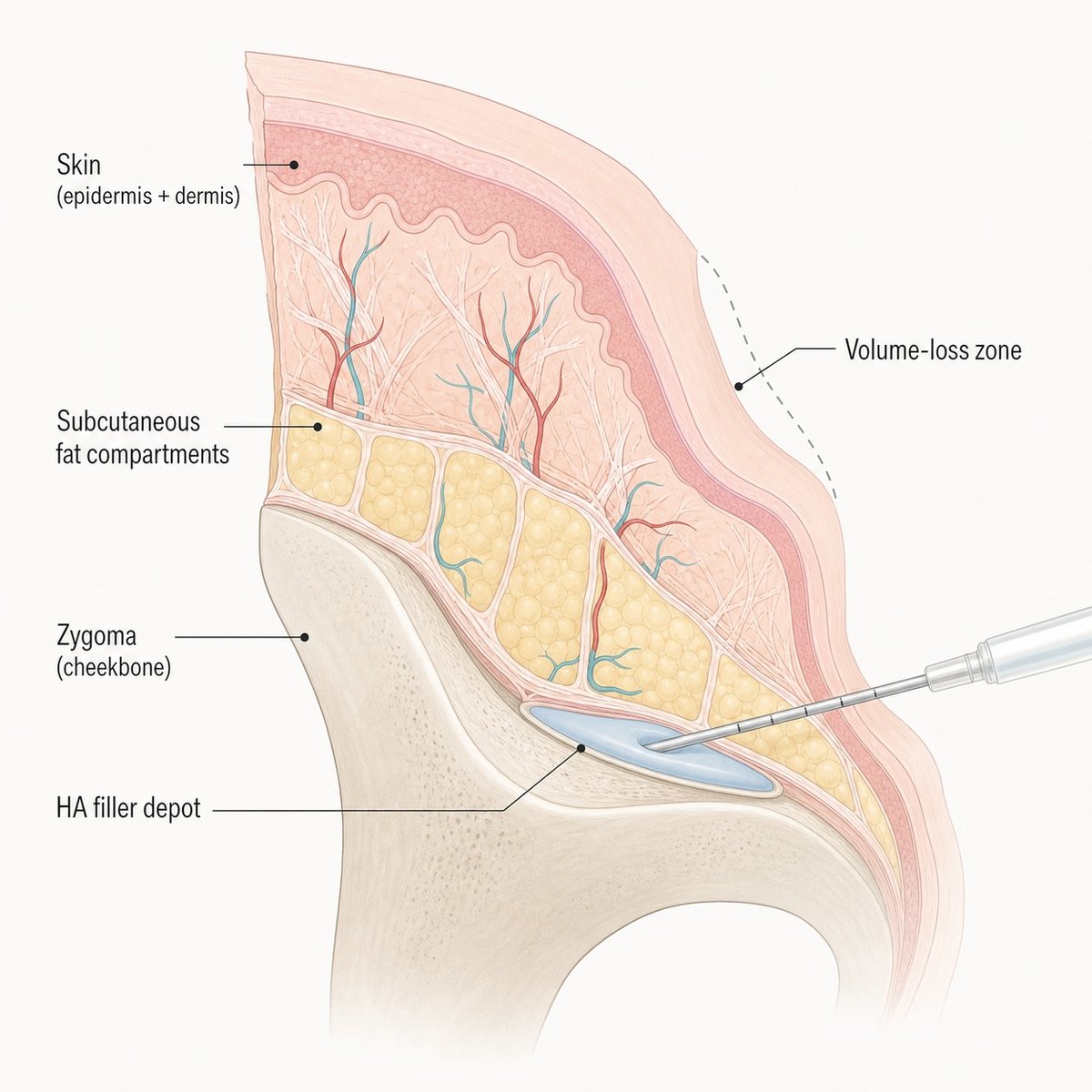
Rapid weight loss, certain lifting procedures, and some genetic facial structures accelerate the process. The distinction between fat-compartment shrinkage and skin-quality thinning matters because the two problems respond to different treatments — understanding which one you're dealing with is the first step in choosing between filler and a biostimulator.
HA Filler vs. Juvelook: How They Actually Differ
Both are injected into the midface, and both can improve the hollowed look, but the mechanism, timing, and what they're actually doing in the tissue are quite different.
Factor | HA Filler | Juvelook (PDLLA biostimulator) |
|---|---|---|
Main ingredient | Cross-linked hyaluronic acid | PDLLA microspheres + non-cross-linked HA |
How it works | Physically fills the space with gel | Stimulates fibroblasts to produce collagen |
When you see results | Immediately to a few days | Gradually over 1 to 2 months |
Typical duration | 6 to 12 months (varies by person) | 12 to 18 months once collagen has built |
Reversible? | Yes — hyaluronidase dissolves HA | No — PDLLA absorbs naturally over time |
Think of it this way: HA filler is like inflating a cushion directly. Juvelook is more like reseeding the soil — nothing shows immediately, but over time the structure rebuilds from the inside. The right choice depends on which problem you're primarily solving and how quickly you need to see it.
When Does Filler Make Sense First?
There are situations where HA filler is clearly the better starting point.
You need visible results within days: an event, a trip, a reunion. Filler works immediately — collagen biostimulators don't.
The hollowing is localized and sharply defined: a specific indentation under the cheekbone, a distinct shadow under the eye. Filler can be placed precisely in that compartment.
You want to test-drive volume before committing long-term: because HA dissolves, you can try a conservative amount, judge how your face responds, and then decide whether to layer in a biostimulator at a later visit.
Fat-compartment shrinkage is the main driver: when the hollowing comes primarily from lost fat volume rather than skin thinning, directly replacing that volume with filler often produces a faster, more readable improvement.
Research published in PubMed (PMID 35039828) confirms that injection plane and volume design in HA midface filler have significant impact on both safety and aesthetic outcomes. Individual results vary.
When Does a Collagen Biostimulator Make Sense First?
There are equally clear situations where Juvelook or a similar PDLLA-based product is the better opening move.
Skin thinning and quality loss are the main complaints: if the midface looks dull, papery, or lacks bounce rather than showing a defined hollow, building collagen from within tends to produce a more fitting result.
Subtlety is the priority: collagen biostimulators change the face gradually over six to eight weeks, which makes the result difficult to trace to any single appointment — useful if you'd rather results be seen but not sourced.
Long-term maintenance efficiency matters: once collagen is established, the interval before the next session tends to be longer than with HA filler, which needs topping up more frequently.
You've had a lifting procedure and feel deflated afterward: Ultherapy, Thermage FLX, or thread lifting can sometimes leave the skin looking tighter but thinner. A collagen biostimulator can help restore skin thickness without adding the gel bulk of filler.
A study in PubMed (PMID 41184662) documents the fibroblast-activation mechanism behind PDLLA, supporting the clinical observation that collagen builds progressively over the months after treatment. Individual results vary depending on age, skin condition, and lifestyle.
Side Effects and Risks
Both procedures involve injections, which means both carry real, if usually manageable, risks.
HA filler side effects. Swelling, bruising, and mild redness at the injection site are the most common and typically settle within three to seven days. Asymmetry or a palpable lump can appear, more often when filler is placed too superficially. The serious risk — vascular compression or occlusion, where filler enters or presses on a blood vessel — is rare but important. It's why injection depth knowledge and access to hyaluronidase matter: a clinic that keeps it on hand can respond immediately if needed. Redness and swelling are common and usually settle within a few days. If they worsen or spread, contact your provider right away.
PDLLA biostimulator side effects. Swelling in the first three to five days is expected and resolves on its own in most cases. Nodules — small firm areas where PDLLA microspheres cluster — are uncommon but possible, and the standard prevention is a massage protocol your provider will walk you through. Because PDLLA can't be dissolved, an unwanted result has to wait out natural absorption, which takes considerably longer than dissolving HA.
Seek medical care right away if you notice: skin blanching or a dusky discoloration, severe or escalating pain out of proportion to the injection, vision changes, or fever with spreading redness. These are not wait-and-see symptoms.
Who Should Hold Off?
Some situations call for a longer conversation with your provider before either procedure.
Pregnancy or breastfeeding: both treatments are typically deferred until after the postpartum period.
Active infection or open wound at the site: injections wait until the skin is calm.
Autoimmune conditions or immunosuppressant medications: these affect healing and collagen response — full disclosure is essential.
Blood thinners or clotting disorders: bruising risk increases significantly; timing and dosing adjustments may be needed.
Known allergy to any filler component: confirm what's in the product before it goes in.
Your provider will assess your specific situation — don't assume a contraindication rules everything out, but do raise it before the appointment rather than at it.
The Bottom Line
Midface volume loss responds to both HA filler and collagen biostimulators like Juvelook, but the two work on different timelines and on different aspects of the problem. The short version:
HA filler: immediate, precise, reversible — best when you have a defined hollow, want to see results fast, or want to test-drive volume before committing.
Juvelook (PDLLA): gradual, structural, longer-lasting once established — best when skin quality and thickness are the primary issue, subtlety matters, or you're thinking about maintenance over time.
Which one first comes down to whether you're solving a volume problem or a skin-quality problem, and how quickly you need the change to show. Many people end up using both in sequence, starting with filler to define the shape and adding a biostimulator to build texture.
Side effects are real on both sides: swelling and bruising for filler, potential nodules for PDLLA, and vascular risk with any injection that makes injector anatomy knowledge essential.
Like any procedure, it comes with trade-offs, and the right sequence depends on your skin, your goals, and your timeline. Individual results vary.
If you're considering midface volume treatment, a consultation is the clearest way to figure out where to start. Beautystone is a dermatology clinic in Seoul's Hapjeong area — see current offers at /en/promotion.
Frequently asked questions
Q. How long does midface filler last?
A. HA filler in the midface typically lasts around 6 to 12 months. How long it holds depends on the product's cross-linking density, how much was placed, the injection plane, your metabolism, and how much the area moves. Some people need a top-up closer to six months; others get past a year. Individual results vary, so treat those numbers as a planning range rather than a guarantee.
Q. Does Juvelook hurt more than filler?
A. They're similar in terms of injection discomfort. Topical numbing cream is applied before either procedure, and both products contain lidocaine that numbs the area further as they're injected. Juvelook tends to cause more noticeable swelling in the first few days afterward compared to a conservative filler session, so plan your schedule with that in mind.
Q. Can I get filler and Juvelook at the same appointment?
A. Sometimes, yes. Some providers combine a small amount of HA filler for immediate structure and a biostimulator for longer-term texture improvement in a single session. Others prefer to do them separately to assess each result cleanly. There's no universal rule — your provider will decide based on what your face needs and how your skin is responding.
Q. What's the most important safety question to ask before booking?
A. Two things: what injection plane will be used for filler (deep placement near the periosteum is safer in the midface than superficial placement in the dermis), and whether the clinic keeps hyaluronidase on hand to dissolve HA immediately if a vascular issue arises. A clinic that answers both confidently is telling you something useful about how seriously they take the anatomy.


Hair Removal
레이저 제모 1회에도 남는 몫이 있어요 — 밀도를 모자이크로 보는 법

Tattoo removal
Why Extremity Tattoos Are Slower to Remove

Tattoo removal
Tattoo Removal Cost: Why Quotes Vary by Area

Tattoo removal
Unused Tattoo Removal Sessions: What Happens?

Lifting
Forehead Thread Lifting: How Far Can It Go?

skin
Skin Booster Prices: What to Check in a Quote