

Scars need depth, pores sit mid dermis, fine lines stay shallow. How Potenza depth gets set.
Published -
Updated -

Author
Wi Young-jin · Chief director
Seoul National University College of Medicine · Seoul National University Hospital Specialist
→
A question that comes up constantly in Potenza consultations: if it is the same device, why does everyone get a different depth? Someone treating enlarged pores and someone treating old acne scars are using the same needles, yet the distance those needles travel into the skin is set differently for each.
Here is the short answer first. Potenza releases radiofrequency heat at the point where the needle tip sits, so the depth is chosen according to how deep the layer you are targeting actually is. Concerns that live deep in the dermis, such as scars and stretch marks, go deep. Pores sit in the middle. Fine lines and surface texture stay shallow. Once you see why depth moves with the concern, the numbers thrown around in consultation stop sounding arbitrary.
This article is general information from Beautystone, a skin clinic in Hapjeong, Seoul.
What you will learn
Why Potenza needle depth changes with the concern being treated
Roughly what depth range scars, pores and fine lines each call for
How depth interacts with energy level and number of sessions
What to ask in consultation when depth comes up
Why Potenza starts with needle depth
Potenza is a microneedling device where fine needles enter the skin and radiofrequency* is then released from the needle tips. The critical detail is that the heat comes from wherever those tips are sitting. So how deep the needles go directly decides which layer of skin receives the energy. In the US, Potenza is an FDA-cleared device, and clearance covers specific uses rather than every concern people bring to it.
Radiofrequency*: electrical energy that generates heat inside the skin to prompt a collagen response, often shortened to RF. Potenza releases this heat at the needle tip depth, which limits surface damage while stimulating the dermis.
Skin divides broadly into the outer epidermis, the dermis beneath it, and subcutaneous fat below that. Because different concerns originate in different layers, it follows naturally that deep dermal tissue problems like scarring are approached deep, while surface concerns like texture are approached shallow. Published work on insulated radiofrequency microneedling describes limiting epidermal damage while matching needle depth to the dermis to deliver heat there, which makes the reasoning behind splitting depth by area and target layer clearer. In practice, even within one face, the forehead, cheeks, nose and mouth area differ in skin thickness, so depth is normally adjusted slightly from region to region.
Epidermis*: the outermost layer of skin. It is thin and regenerates quickly, so limiting damage here helps recovery move faster.
Dermis*: the thicker layer beneath the epidermis. Collagen and elastic fibres live here, which makes it the real target for scarring and firmness concerns.
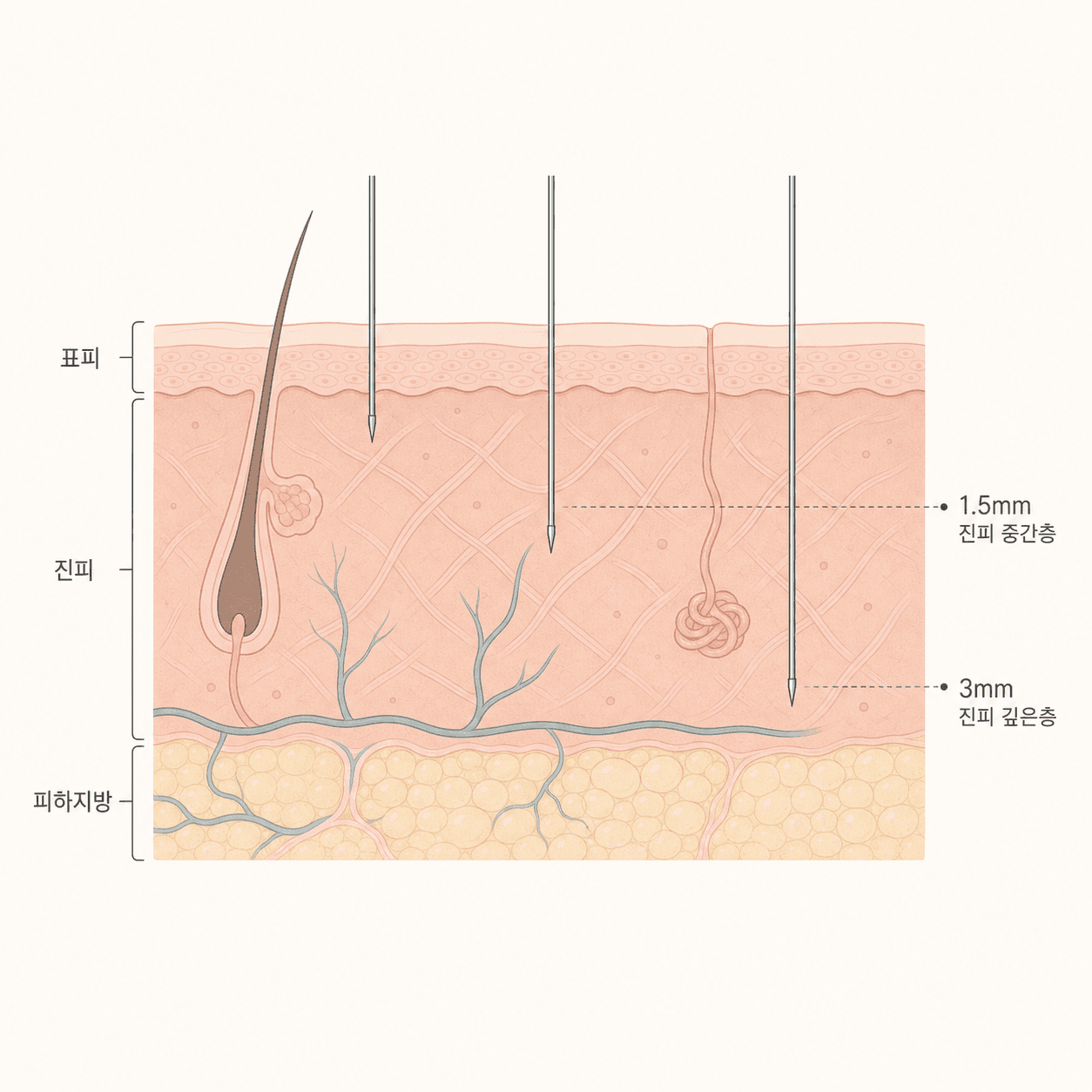

How depth changes for scars, pores and fine lines
Splitting concerns into three groups gives you a feel for the ranges. The table below sets out roughly which layer each targets and how depth, energy and session count move with it. Exact values shift with skin condition and treatment area, so read it as direction rather than a prescription.
Concern | Target layer | Approximate depth | RF energy | Usual approach |
|---|---|---|---|---|
Acne scars and stretch marks | Deep dermis | Deep, roughly 2.0 to 3.5mm | Higher | Split across several sessions |
Enlarged pores | Mid dermis | Middle, roughly 1.0 to 2.0mm | Moderate | Repeated over a few sessions |
Fine lines and texture | Upper dermis | Shallow, roughly 0.5 to 1.0mm | Lower | Kept light |
Scars and stretch marks involve tissue deep in the dermis that has collapsed or been pulled taut, so heat has to reach that layer for any remodelling response to be worth expecting. Depth goes deep and energy runs higher, but spread across several sessions rather than forced into one. Fine lines and texture sit close to the surface, so shallow depth and lower energy make more sense and keep the recovery burden down. Pores usually land between the two, aimed at the mid dermis.
Depth does not have to stay fixed within a single session either. Research describes dividing passes, targeting deeper scars first with greater depth and higher energy, then lowering the settings for shallower scars. So even on one face, deep scarring and shallow texture can be handled at different depths. Which is why the more useful question is not how many millimetres am I getting, but which layer does my concern live in.

Depth, energy and session count move together
Depth is never set on its own. It moves alongside RF energy and the number of sessions. Going deeper stimulates deeper dermal tissue, which generally means a bigger recovery response, so energy and spacing get adjusted with it.
Depth and energy — going deeper does not mean pushing energy up indiscriminately; it is stepped up while watching how the skin responds
Depth and sessions — deeper concerns such as scars and stretch marks are refined across several visits rather than crammed into one
Depth and recovery — shallow work leaves redness for a day or two, deeper work can run a few days longer, so leave margin in your calendar
Depth by area — even on the same person, the forehead, cheeks, nose and mouth area vary in thickness, so depth shifts slightly by region
Comparing the target depth range for each concern in one view looks like this.
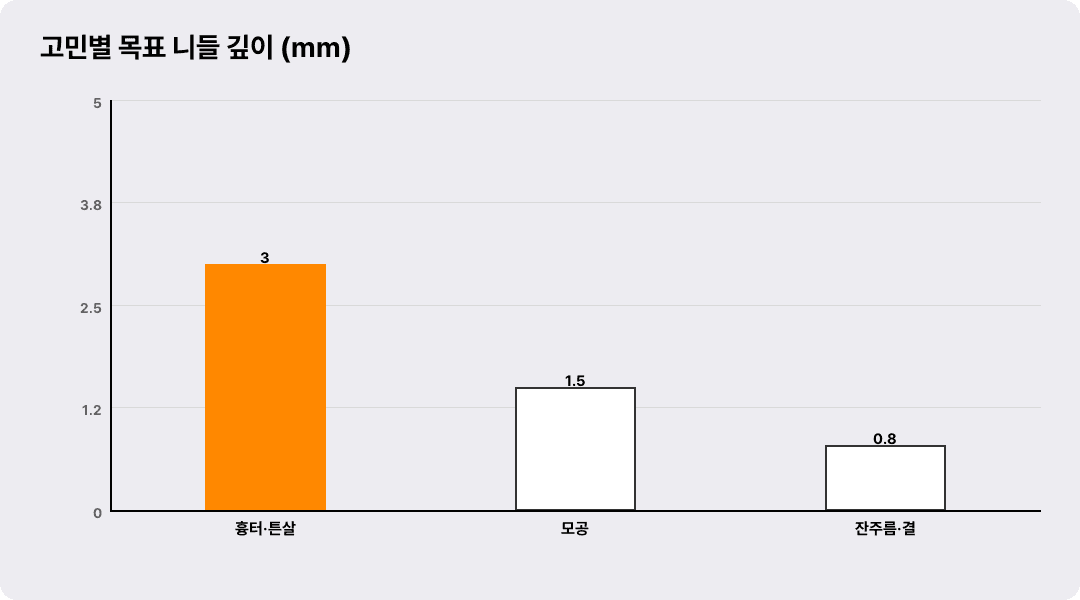
More useful than the numbers themselves is the direction they encode: deep concerns go deep and get split up, shallow concerns stay shallow and stay light. Hold that and the explanation you get in consultation becomes easy to follow.

Why the provider you choose still matters
The habit worth looking for is a clinic that reads your skin and identifies the layer before it sets a depth, even with the same device. Scars, pores and fine lines usually turn up together, so agreeing which one takes priority comes before depth and session count get fixed. At Beautystone, a small clinic a short walk from Hapjeong Station in Seoul, the pace is set by how you recover rather than by pushing everything into one visit. This is general educational information rather than medical advice, so whether the treatment suits you is a decision to make with the clinician who has examined you. If you are travelling for this, plan for the fact that any follow-up after you fly home will need a provider where you live.

What to ask when depth comes up in consultation
A few questions go a long way toward making the depth setting make sense. Rather than fixating on one number, it is easier to ask why that number was chosen.
Which layer is my concern in — scars and stretch marks are deep, pores are mid, fine lines and texture are upper
How depth and energy are set together — ask what governs the energy level when going deeper
How many sessions are planned — the deeper the concern, the more stable it is to split the work
How long recovery will take — redness and swelling vary with depth, so plan the calendar around it
Whether depth varies by area — check that forehead, cheek, nose and mouth thickness differences are being accounted for
Depth is not a single correct value. It is a setting adjusted to the layer your concern occupies and to the state of your skin. Walk into a consultation understanding that and the numbers stop being intimidating and start being a conversation. For reference, this article gathers general treatment information from Beautystone, so confirm any actual treatment plan through a consultation.

Frequently asked questions
Q. I have scars and enlarged pores. Does the depth have to be one number?
A. Not necessarily. Even within a single session, deeper scarred areas and areas of enlarged pores can be handled at different depths. What is worth agreeing in consultation is which of them takes priority. Whether it is done in one visit or split across several also depends on how your skin responds and how much recovery time you have.
Q. Does deeper mean better results?
A. Depth is not the same thing as effect size. The response comes from matching depth to the target layer, and treating a shallow concern deeply mainly adds recovery burden. Surface concerns such as fine lines and texture actually do better at shallow depths. Which layer your concern lives in is what sets the depth.
Q. Does going deeper stretch out recovery a lot?
A. Redness and swelling can run a few days longer than with shallow work. Light texture sessions tend to settle in a day or two, while deeper scar work is easier if you allow a bit more margin. Asking about recovery time before you book makes the scheduling far simpler.
Q. Should I decide the millimetres in advance?
A. There is no need to arrive with a number. Depth is adjusted during the consultation according to skin thickness, the layer involved and the area, so it is natural to settle it once someone has looked at you. What does help is arriving clear on which layer your concern sits in.
Content




skin
Why Does Fractional CO2 Take Longer to Heal?

Contouring & Volume
How Many cc Does Forehead Filler Need?

skin
Why Is My Skin Oily but Tight in the Fall?

Hair Removal
Underarm Laser Hair Removal Cost: Do the Math

Tattoo removal
Laser Before a Cover-Up: How Many Sessions?

skin
큐어젯 다운타임, 다음 날 출근과 화장은 언제부터 될까요?