

Shurink quotes for 300 shots can differ several times over. The gap comes from the area, depth split, and extras. Here's what to check on each quote.
Published
Updated

Author
Wi Young-jin · Chief director
Seoul National University College of Medicine · Seoul National University Hospital Specialist
→
One of the most common things we hear before someone books Shurink is this: "I got quotes for 300 shots from three clinics, and one costs several times more than another. What's the difference?" It's a fair question. The short answer? The shot count is usually the same, but what happens inside those 300 shots isn't. Clinics can split them across different cartridge depths, use a different mode, and cover a smaller or larger part of your face.
That means two quotes that only say "300 shots" may be pricing two different treatments. Before you line up the numbers, it helps to fill in the same few details on each one. In this article, we'll cover what the shot count hides, why the treatment area moves the price, the five lines worth filling in on every quote, when more shots aren't the right fix, how to think about cost over a full year, and the side effects to ask about.
What's Really Inside a 300-Shot Quote?
Shurink Universe is a high-intensity focused ultrasound (HIFU) device made by the Korean company Classys, which sells its device outside Korea under the name Ultraformer MPT. It gathers ultrasound energy into a single point at a set depth under the skin and leaves a tiny thermal coagulation point* there.
*Thermal coagulation point: a very small spot of controlled heat injury where the ultrasound energy concentrates. As your body repairs these spots, the tissue around them tends to tighten.
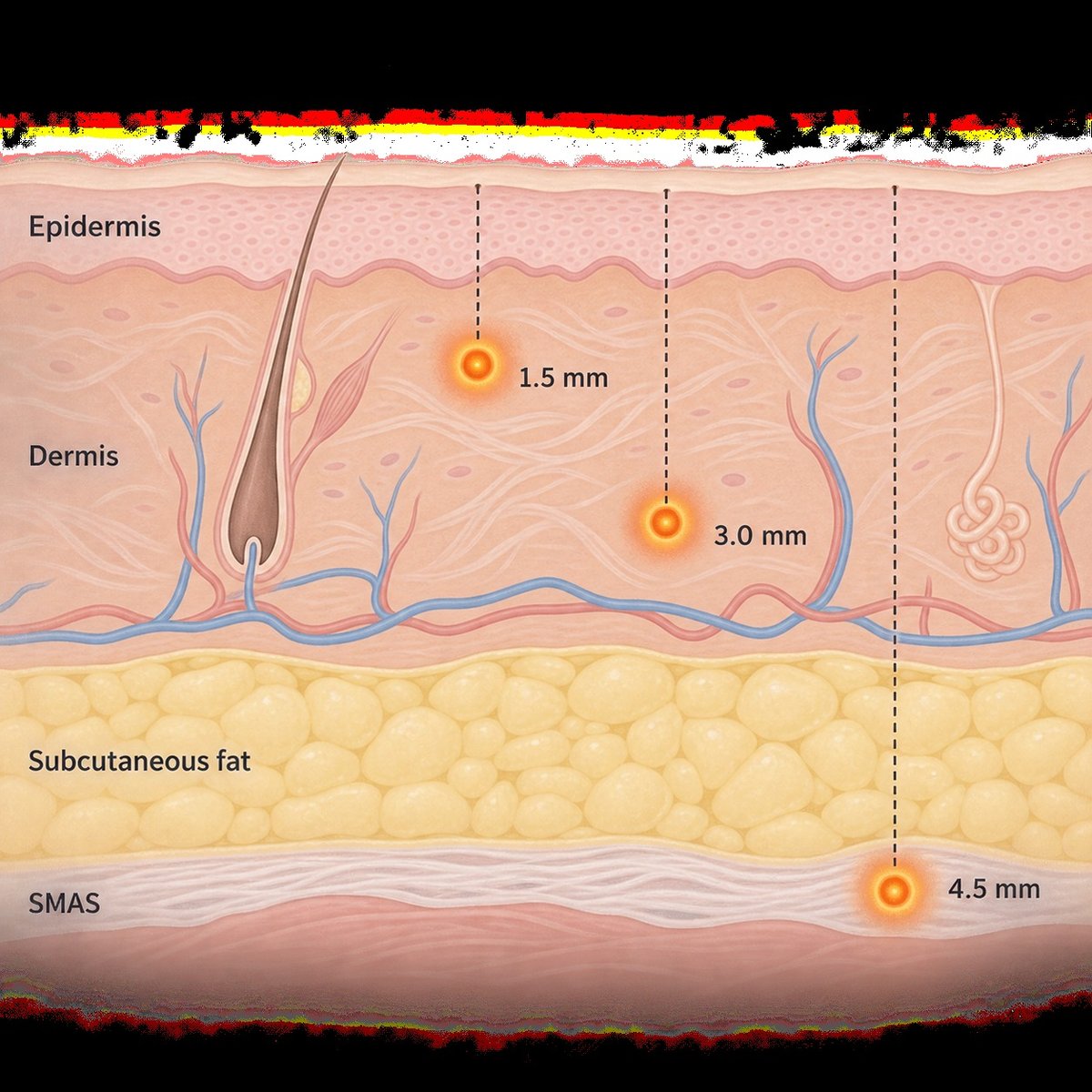
According to the manufacturer's product information, the face cartridges come in four depths: 1.5, 2.0, 3.0, and 4.5 mm. The device also has two ways of delivering heat, called MP mode and normal mode.
Depth matters because each setting aims at a different layer:
Shallow (1.5 mm): works in the dermis, where fine lines and skin texture live.
Middle (2.0 and 3.0 mm): reaches further down into the deeper part of the dermis.
Deep (4.5 mm): aims for the SMAS, the fibrous fascia layer beneath the fat that's tied to sagging.
So a quote that puts most of its 300 shots at 4.5 mm and one that spreads them across shallow depths aren't the same treatment, even if they share a name and a shot count. To keep that planning from being guesswork, a panel of Asian experts recommended using ultrasound imaging before treatment to estimate how deep the SMAS sits, then choosing the right transducers and number of lines for each tissue layer. That consensus was written for Ultherapy, a related focused-ultrasound device, not Shurink itself. Still, the principle of checking depth first and allocating shots second carries over well when you're reading a Shurink quote.

Why the Treatment Area Changes the Price
"Full face" doesn't mean the same thing everywhere. At one clinic it runs from the forehead down to the neck. At another, it stops at the cheeks and jawline. That difference alone can move the shot count, and the price moves with it.
A study of Ultraformer MPT shows how differently each area responds. Researchers treated 50 people, splitting five cartridge types according to the anatomy they saw on ultrasound, then measuring the lift with a 3D scanner right after treatment:
Area | Lift right after treatment |
|---|---|
Forehead | 1.24 mm |
Crow's feet | 2.25 mm |
Cheekbone area | 2.46 mm |
Back of the cheek | 3.40 mm |
Jowls | 2.90 mm |
Jawline | 3.09 mm |
Neck | 3.53 mm |
The authors explained the lower forehead number by noting that the tissue there is thin and has to be approached carefully. Keep the limits in mind, though. This was a single-center study with no control group, and it measured only one moment, right after treatment. It can't tell you what you'll see months later, and individual results vary. What it does show is that different parts of the face respond differently, and that extending treatment below the jawline and onto the neck takes more shots. That's one of the clearest places where quotes split apart.
Five Lines to Fill In on Every Quote
If any of these lines is blank, there's no way to explain where a price gap comes from. Fill in the same five for every quote you've received.
What to check | Why it changes the price | What to ask |
|---|---|---|
Treatment area | Cheeks and jawline only, or double chin and neck too, since each extra zone takes shots | Where will these shots go? |
Shots per depth | How many shots go to 4.5 mm versus the shallower depths is the real substance of the treatment | How many shots at each depth? |
Mode | MP mode and normal mode deliver heat differently | Which mode will you use? |
Cartridge | It's a consumable, so it's reasonable to ask whether a new one is opened for you | Can I see the cartridge being opened? |
What's included | Numbing cream, soothing care, and follow-up visits vary from clinic to clinic | What does this price include? |
If you're not sure how many shots a given area usually needs, our guide to Shurink Universe shot counts by area and goal makes these lines easier to fill in. At Beautystone, Shurink pricing follows our posted price list, and we confirm the final figure once the area and depth split are set. You can check the current list on our price page.

Sagging or Hollowing? When More Shots Aren't the Answer
For deeper sagging, a quote with more shots isn't always the right comparison. Sometimes it makes more sense to put a device that works the sagging layer harder on the table next to it. In our clinic's view, Ultherapy often comes out ahead of Shurink when sagging is the main goal, while Shurink's strengths show up when you want a lower-commitment treatment you can repeat for regular maintenance. We compare the two in more detail in our Shurink vs. Ultherapy guide.
A face that already looks thin is another case where a quote shouldn't come first. If your main concern is volume loss in the cheeks rather than drooping, adding more deep-layer shots calls for extra caution about hollowing, so a plan to restore volume may deserve a look first. We explain why in how to avoid a gaunt look after Shurink Universe.
Here's a quick mirror check you can try at home. Lie flat on your back. If your jawline sharpens and your smile lines soften, sagging is probably the bigger part of the picture. If your cheeks still look hollow while you're lying down, volume loss is likely playing the larger role. It's a rough guide, not a diagnosis, but it gives you a better question to bring to your consultation.

Think in One-Year Cost, Not One Visit
A single price tells you what one session costs, not what keeping the result costs. A systematic review that pooled 16 studies found that after one focused-ultrasound session, the share of patients who reported improvement rose from 42% at 90 days to 53% at 360 days, though the improvement was mild and there was no follow-up data beyond one year. Most of those studies looked at Ultherapy-type devices, so the numbers don't translate directly to Shurink. The takeaway still applies: if you compare one-time prices only, you'll miss what you spend over the following year.
So next to each quote, jot down two more things:
Retreatment interval: how soon the clinic expects you to come back.
Shots at the next visit: whether the next session repeats the same plan or uses a lighter one.
A lower one-time price can still add up to more over a year if the plan has you coming back at short intervals. That said, there's no single right interval. It depends on your skin, your goals, and how you responded last time.
Side Effects and Risks to Ask About
Does it hurt? Most people feel heat and some discomfort. In the same review, the average pain score across 565 patients was 3.8 out of 10. Those were mostly Ultherapy-type studies, so treat that as a rough reference for Shurink, and check whether numbing cream is part of your quote.
Here's what the review reported after treatment:
Common: Temporary redness and swelling showed up in nearly all patients. They're typically mild and ease over several days.
Less common: Numbness or heightened sensitivity, bruising, and visible streak marks on the skin were reported in about 2% of patients.
Redness and swelling that ease day by day are a normal reaction. If numbness, unusual sensitivity, bruising, or streak marks don't go away, let the clinic that treated you know right away. If you notice spreading redness, fever, or pain that keeps getting worse, seek medical care right away.
It also helps to tell your provider about any lifting treatment you've had recently, including the date and the number of shots. That way, they can decide whether it makes sense to heat the same layer again so soon.
The Bottom Line
A 300-shot Shurink quote can hide very different treatments, depending on how the shots are split across the 1.5, 2.0, 3.0, and 4.5 mm depths.
The treatment area changes the shot count, since each part of the face responds differently and extending to the neck takes more shots.
Fill in the same five lines on every quote: area, shots per depth, mode, cartridge, and what's included.
Add the retreatment interval so you're comparing a year of cost, not a single visit.
Like any procedure, Shurink comes with trade-offs, and research on long-term results is still limited. Ultimately, the choice depends on your skin, your goals, and your budget.
If you're considering Shurink, a consultation is the best way to decide how a 300-shot plan should be split across depths and when your next session should be. Beautystone is a dermatology clinic in Seoul's Hapjeong area. Feel free to bring any quotes you've already received, along with the date and shot count of your last lifting treatment. You can also see current offers.


