

Both are HIFU lifts, and pain depends on the layer and area treated. A Seoul doctor compares depth, pain, side effects and fitting a session into your trip.
Published
Updated

Author
Wi Young-jin · Chief director
Seoul National University College of Medicine · Seoul National University Hospital Specialist
→
Shurink and Ultherapy both lift by focusing ultrasound heat under the skin (HIFU), so the choice comes down to how the depth is set: Ultherapy shows me an ultrasound image of your layers while I treat, and Shurink works at the preset depth of each cartridge without that live image. Both can hurt, and how much depends mostly on which layer and which part of your face gets the energy, not on the brand name.
If you've typed "shurink vs ultherapy" or "pain level hifu treatment seoul" a few weeks before a flight, you probably want three answers. Which one fits my face? How much will it hurt? And can I still sightsee and fly home on schedule? In this article, I'll walk through how I decide between the two in the consultation room, what the research says about pain and side effects, and how a session fits into a Seoul itinerary.
Shurink vs. Ultherapy: What's the Real Difference?
The real difference is how the depth gets chosen, not the kind of energy. Both devices send focused ultrasound through the surface and create tiny heated points at a set depth underneath, and the tissue then remodels around those points over time.
Ultherapy changes depth by swapping the head that touches your skin (the transducer), and its screen shows the layers underneath, so I can check that the depth matches your tissue before each line goes in.
Shurink does the same job with interchangeable cartridges, each set to its own depth. Shurink Universe is the Korean name; outside Korea, the maker, Classys, presents the same platform as Ultraformer MPT. So if you've been reading "shurink vs ultraformer," you're mostly comparing names, although approved uses and cartridge sets can differ from country to country. In a Korean study of 50 patients treated with the Ultraformer MPT, treatment protocols were tailored to leverage five cartridges with micropulsed mode options.
There's a regulatory difference worth knowing, too. In the US, Ultherapy is FDA-cleared to lift the eyebrow and the skin on the neck and under the chin. Approval in Korea is decided separately, so it's fair to ask what the device in front of you is approved for here.
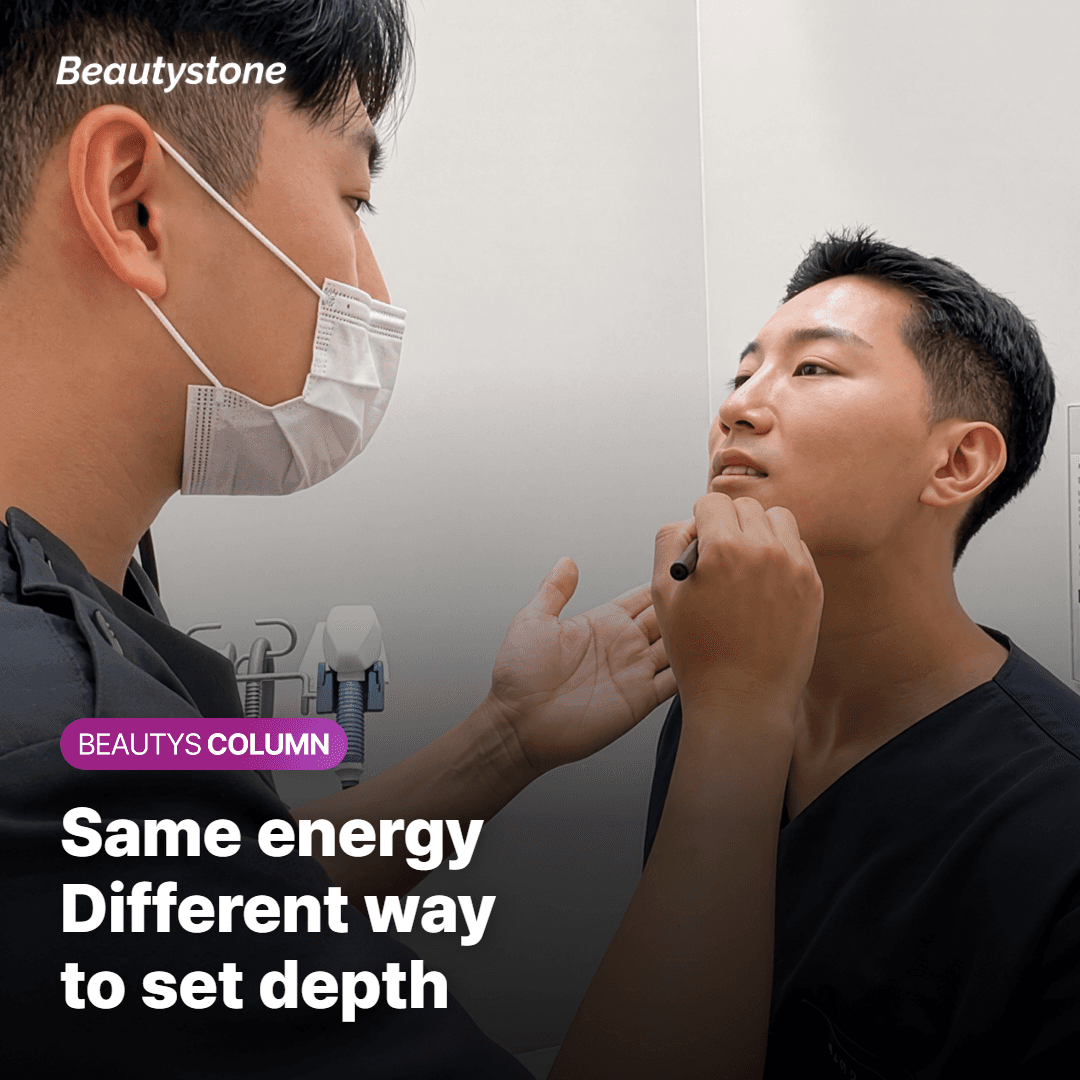
Does Shurink or Ultherapy Hurt More?
Both can hurt, so the honest answer to "does Shurink hurt?" is yes, to a degree that depends on where the energy lands. A systematic review and meta-analysis of Ultherapy-type treatment (microfocused ultrasound with visualization, or MFU-V) found that patients reported a pooled mean pain score of 4.85, indicating moderate pain.
Why does it vary so much from person to person, and from one part of the face to another? Part of the answer is the SMAS, the firm sheet of tissue over the facial muscles (superficial musculoaponeurotic system), which is one of the main layers a lifting plan aims for.
A narrative review of pain during microfocused ultrasound states that energy delivered to the subdermis or SMAS produces higher pain scores than treatment restricted to adipose tissue. The same review describes pain during microfocused ultrasound as varying by facial region and treatment depth.
So what about one device versus the other? In a split-face study of two different HIFU devices in 20 Korean patients, the two devices had similar efficacy in blinded clinician and quantitative assessment, although there were some differences in patient satisfaction and degree of pain. That study doesn't tell you which brand will feel worse on your face, and I wouldn't choose a device on that basis alone.
Device generation can matter as well. In a single-center survey in Bangkok, participants reported significantly less pain, erythema, and edema after treatment with Ultherapy PRIME than after Ultherapy Legacy. It wasn't blinded, so I read it as a reason to ask which generation you're getting, not as proof.
If pain is your biggest worry, the first thing I'd change isn't the brand. It's where the deep lines go and how many each zone receives. Telling me up front that you're sensitive lets me plan around it instead of pushing through.

Shurink or Ultherapy: Which Would I Pick for You?
I don't start with the device. I start by reading your face in layers: the skin surface, the dermis beneath it, the fat layer, and the SMAS over the muscle. Then I decide which zones need deep lines, which only need shallow ones, and which should be left alone.
When I treat with Ultherapy, I check the treatment depth on the ultrasound image and treat only the areas that actually sag. That's where the live image earns its place: when tissue thickness changes a lot from one zone to the next, or when you've lost weight and the jawline has dropped while the cheeks have thinned.
The zone I watch most closely is the one that's already hollow. In a case report of four women treated with MFU-V for face slimming, the treated areas were chosen aiming to create a reduction in the volume and a pattern of contraction.
Volume reduction is the opposite of what you want on cheeks or temples that are already sunken, so I keep deep energy out of those zones whichever device we use.
Here's how I'd sort the two options:
Ultherapy makes more sense if: your tissue thickness varies across your face, you've lost volume in some areas but sag in others, or you'd like the depth checked on screen line by line.
Shurink is a reasonable start if: your laxity is mild and fairly even, the areas that would get deep cartridges aren't hollow, and you're comfortable with depth chosen by assessment rather than a live image.
For the reader I have in mind, here's my call. If you're visiting for a few days with mild sagging along the jaw and no hollow cheeks, either device can work, and I'd choose by how your tissue looks on the day. If your face has thinned with weight loss while the jaw has dropped, I'd go with Ultherapy so the depth can be checked zone by zone.
In the same meta-analysis, 89% of patients demonstrated some degree of global aesthetic improvement, as assessed by investigators. The authors also caution that the potential misclassification of neutral responses as positive may result in an overestimation of the treatment's efficacy. Individual results vary, and a lift from HIFU is gradual rather than surgical.

Shurink and Ultherapy Side Effects, Risks and Downtime
The common reactions are short-lived; the rare ones are the reason depth planning matters. A systematic review of Ultherapy adverse events found that transient edema, erythema, and postprocedural pain were observed most often. The same review noted that instances of significant treatment-related adverse events were limited in the scientific literature.
In the FDA's MAUDE device-report database, that review found lipoatrophy (fat loss), neurologic sequelae such as focal numbness, and scarring reported with the most frequency. Those reports aren't verified case by case, but they line up with what I plan around: fat that shouldn't be thinned and nerves that run close to the surface. Data like this exist mainly for Ultherapy, so I apply the same caution with Shurink.
Before your session, tell me about any of the following:
Pregnancy or breastfeeding.
Active acne, a cold sore or broken skin in the area to be treated.
Recent filler or thread lifting in the same zone.
A history of keloid scarring or numbness anywhere on the face.
What's expected: redness, mild swelling and some tenderness when you touch the treated area. Red flags: numbness or weakness that doesn't settle, a new dent or hollow, blistering, or redness that spreads with heat or a fever. If you notice any of these, seek medical care right away.

Fitting HIFU Into Your Seoul Trip
Unless you've had sedation that day, there's no reason to push back your flight home because of a HIFU session. Sightseeing and photos are a separate question, and for Ultherapy my rule of thumb is that up to around 300 shots, swelling usually barely shows. With more shots, or with a Shurink plan, I'll give you my estimate once I've seen your face and the plan, so put any wedding, shoot or important dinner date in your first message.
Is one visit worth it? Yes, one visit can mean something. HIFU doesn't change your face overnight; it tends to bring things back gradually toward how you looked a little earlier, rather than all at once. If you'll be back in Seoul, I'd rather plan the next session with you than squeeze extra treatment into one trip.
After you're home, if something looks off, you can send photos to our WhatsApp consultation line and ask. If it's a strong sign, such as spreading redness, a fever or numbness that keeps getting worse, see a doctor where you are first; that shouldn't wait for a reply from Seoul.
Getting here is simple if you're staying around Hongdae. I see patients in Hapjeong, one stop from Hongik Univ. station on subway Line 2, and the airport railroad also stops at Hongik Univ. station.

The Bottom Line: Ask Which Zones Get Which Depth
Shurink and Ultherapy are both HIFU; the difference is how depth is set, with or without a live image.
Both can hurt, and the layer and area treated matter more than the brand.
Hollow zones should stay out of deep lines on either device.
A flight home isn't a reason to delay, unless you've had sedation that day.
Like any procedure, it comes with trade-offs. When a clinic gives you a plan, look for three lines on it: which depth goes into each zone, how many lines each zone gets, and which zones are left out. If the last line is missing, ask about it before you book, because the zones left out are often where a natural result is protected. Ultimately, the choice depends on your face, your pain tolerance and your travel dates.
If you're planning a trip, you can reach Beautystone in Hapjeong, Seoul on WhatsApp before you book. A first message can be as short as: "I'm in Seoul from [date] to [date], I'm comparing Shurink and Ultherapy for my [jawline / lower face], and here are two daylight photos of my face from the front and side."



Contouring & Volume
Glabella Botox Side Effects: Droopy Eyelids

Contouring & Volume
Juvelook Volume Not Working After 3 Sessions?

Contouring & Volume
Hip Dip Filler Before and After: 4 Checks

Body
Potenza Treatment Interval: Why 4 Weeks?

Lifting
Ultherapy Before and After: Why Wait 90 Days?

Contouring & Volume
Belotero Revive Cost: 2cc Price vs. 3 Sessions