

Heavy eyes are often brow descent, not the lid. What ultrasound lifting can and cannot do.
Published -
Updated -

Author
Wi Young-jin · Chief director
Seoul National University College of Medicine · Seoul National University Hospital Specialist
→
Your eyes look heavier than they used to. The brow sits lower and the whole expression reads tired. Eyeshadow disappears into the lid, and in photographs the eye looks smaller than it feels. It is one of the most common things people bring up, and the reason is often not where they think it is.
Changes like these frequently come from the forehead and brow descending together rather than from the eyelid itself. A brow only has to drop a little to cover the lid and make the eye look heavy. So instead of looking at the eye alone, checking the forehead and brow line usually makes the cause much clearer.
This article covers how ultrasound lifting works on the forehead and brow, and when it is a fit rather than a workaround. Individual results and recovery vary, so read it as background for a conversation.
This is general information from Beautystone, a skin clinic in Hapjeong, Seoul.
What you will learn
Why heavy-looking eyes are often a brow and forehead issue
How ultrasound lifting works on the forehead and brow
When a forehead and brow lift fits, and when a different route is better
What to know before and after, and which recovery signals matter
Heavy eyes are not only an eyelid problem
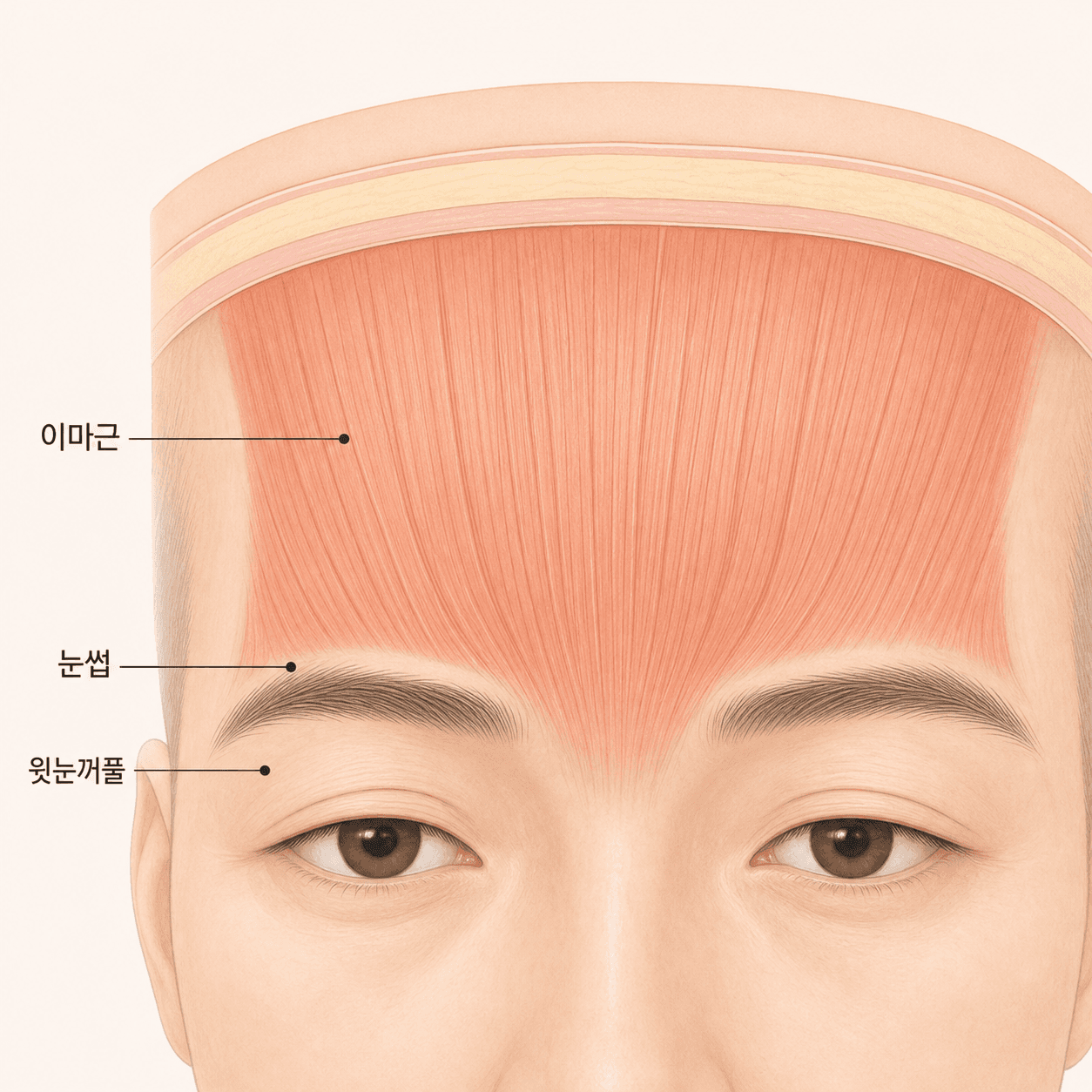
More often than not, the reason an eye looks crowded sits above the upper lid rather than in it. As the frontalis muscle* loses some of its support with age and the brow settles downward, it covers the lid and the eye reads smaller and heavier. That descent of the brow is what gives the appearance its name.
Frontalis muscle*: the broad muscle covering the forehead, which lifts the eyebrow. When that pull weakens, the brow tends to drift downward.
A systematic review finding that microfocused ultrasound creates thermal coagulation points within the skin, driving collagen contraction and regeneration, and improving facial firmness including forehead descent sets out how energy-based lifting approaches an area like the brow and forehead that is prone to dropping. Which is why working on the firmness of the forehead and brow line, rather than the eye alone, is what tends to change how the face reads.

How ultrasound lifting works on the forehead and brow
Ultrasound lifting does not touch the surface of the skin. It concentrates energy at a set depth to create coagulation points*. Collagen contracts momentarily at those points, and as the body fills them in, new collagen forms and firmness comes up with it.
Coagulation points*: the microscopic spots created when ultrasound energy converges and the temperature rises briefly, acting as the starting point for collagen regeneration.
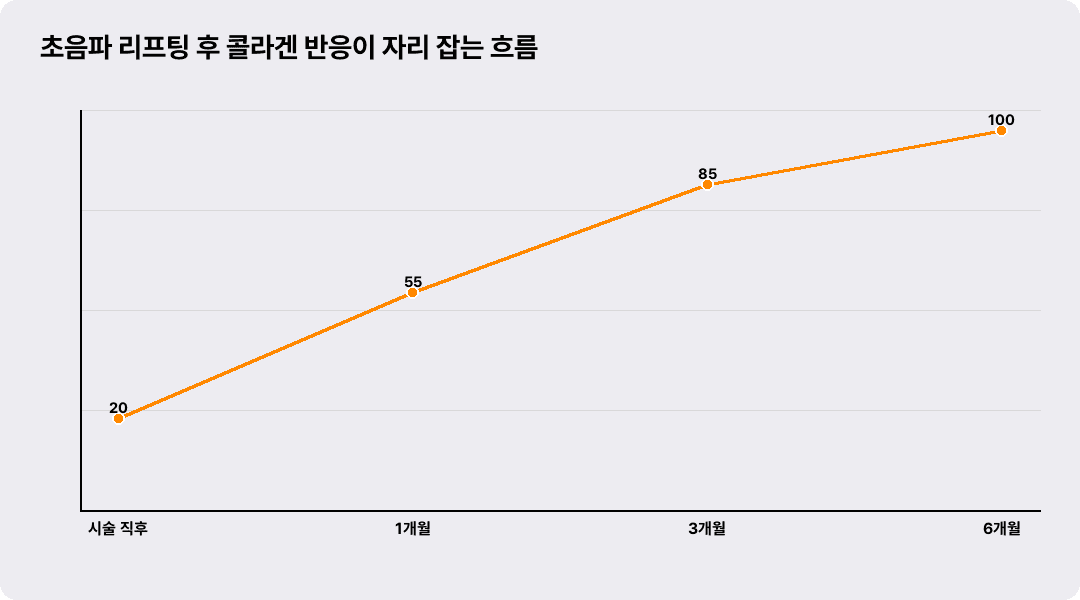
A long-term study describing ultrasound energy converging at a narrow point about 1mm below the surface, raising the temperature to roughly 65 degrees Celsius to denature collagen and stimulate new collagen formation, with the effect carrying through to one year describes the same principle that applies to the forehead and brow. In the US, the ultrasound platforms used this way are FDA-cleared devices, and Sofwave specifically holds clearance for lifting the eyebrow; cleared is the correct word for a device, while approved applies to a drug, and neither is a promise about your result. Because collagen takes time to settle, the change tends to appear gradually over one to three months rather than immediately after the session.

When a forehead and brow lift fits, and when it does not
The same heavy-looking eye can call for different things depending on the cause. Broken out by situation, it looks like this.
Situation | Ultrasound forehead and brow lift | Worth considering alongside |
|---|---|---|
The brow has descended and the eye reads crowded | A good fit | Forehead firmness care alongside if needed |
Forehead firmness is in early decline | A fit | Run it with everyday habits |
The eyelid skin itself has stretched significantly | Partial help only | An eyelid consult comes first |
Expression lines are the main concern | A supporting role | Discuss approaches to the expression muscles |
Where the brow has dropped and made the eye look heavy, a forehead and brow lift generally suits. Where the eyelid skin itself has stretched significantly, ultrasound alone has limits, so it is worth having a clinician determine which is the primary driver before choosing a direction. Costs vary by clinic and by how much area is treated, so ask for the specifics rather than working from a headline number.

Why where you have it done still matters
At Beautystone, a small clinic a short walk from Hapjeong Station in Seoul, the first step is not recommending a treatment because the eye looks heavy, but working out whether the heaviness comes from the brow or from the lid skin. Depending on the answer, ultrasound lifting may suit well, or a different consult may need to come first. Being small is what makes it practical to look at one person eye and brow line together and agree on the order. Wherever you go, a good question to ask is which of the two your clinician thinks is driving it, and what result they expect if only the brow is addressed.
What to expect, and the recovery signals
An ultrasound forehead and brow lift is done without an incision, so getting back to normal is quick. The collagen response takes time to settle, though, so the change appears gradually.
Worth knowing beforehand.
When it shows — it comes up gradually across one to three months rather than right after the session
Common reactions — mild redness or stinging usually settles within a day
Temporary numbness — the forehead and brow area can feel slightly numb for a few days
When to check back — if swelling or pain worsens rather than easing after a few days, contact the clinician who treated you, and seek urgent care for severe or rapidly worsening symptoms
How much changes and how long it holds differ from person to person with skin condition and the degree of descent, and individual results vary. Rather than expecting a dramatic shift from a single session, it is better to look at your own firmness and agree the timing and number of sessions with a clinician. If you are travelling for treatment, plan for follow-up where you live as well, since a clinic in Seoul cannot assess something that develops after you fly home. This article is general information, so whether the treatment suits you is for the clinician who examined you to decide with you.

Frequently asked questions
Q. When does an ultrasound brow and forehead lift start to show?
A. You may feel some tightness right after the session, but the actual change in firmness arrives as new collagen forms. It usually comes up gradually over one to three months and tends to carry through to around the six-month mark. Individual results vary, so it is better to give it room than to judge it early.
Q. Can I go back to normal life the same day?
A. There is no incision, so most people return to their usual routine from the day of treatment. Mild redness or a numb feeling around the forehead can last a few days but generally settles on its own. Sauna and hard exercise are worth skipping on the day itself. If you are flying, keep in mind that any follow-up will need to happen where you live.
Q. My upper lids are quite heavy. Is ultrasound lifting enough on its own?
A. It helps when the heaviness comes from the brow descending, but if the eyelid skin itself has stretched significantly, ultrasound alone has limits. Which of the two is driving it changes the approach, so it is better to have the area examined and then decide the direction.
Q. How often should I have it done?
A. There is no fixed interval, because firmness and the degree of descent differ from person to person. The usual practice is to space sessions with the period of the collagen response in mind. Deciding the next point from how your own skin responds, together with your clinician, works better than a schedule.
Content


skin
Why Does Fractional CO2 Take Longer to Heal?

Contouring & Volume
How Many cc Does Forehead Filler Need?

skin
Why Is My Skin Oily but Tight in the Fall?

Hair Removal
Underarm Laser Hair Removal Cost: Do the Math

Tattoo removal
Laser Before a Cover-Up: How Many Sessions?

skin
큐어젯 다운타임, 다음 날 출근과 화장은 언제부터 될까요?