

Sofwave on a heavy forehead: what a millimetre-scale brow lift really looks like, and by when.
Published
Updated

Author
Wi Young-jin · Chief director
Seoul National University College of Medicine · Seoul National University Hospital Specialist
→
You catch yourself in the mirror and your forehead looks heavier than it used to, with the outer ends of your brows sitting slightly lower. Makeup seems to disappear into the lid, and you notice yourself recruiting your forehead just to open your eyes properly, which in turn makes the horizontal lines more obvious.
Here is the short answer first. A dropping forehead and brow line is not only a surface issue — the muscle and the connective tissue underneath loosen alongside the skin. Ultrasound lifting such as Sofwave* works by delivering heat into those deeper layers to prompt new collagen, aiming to raise the line gradually without anything invasive. That is a different proposition from "one session lifts you as much as surgery," so it helps to be clear about the realistic ceiling before you go in for a consultation.
Sofwave*: a lifting device that delivers ultrasound heat energy to a set depth in the skin to stimulate collagen production. Energy is sent through the surface rather than by inserting needles.
This article collects general treatment information from Beautystone, a skin clinic in Hapjeong, Seoul.
What you'll learn
Why a heavy forehead and brow is not just a surface problem
Which layer Sofwave ultrasound acts on, and how
Roughly how much change to expect, and by when
When something else belongs in the conversation instead
A heavy forehead is not just about the skin on top
When the forehead and brows start to drop, the easy assumption is that the skin has stretched. In reality several layers change together. The forehead has the muscles that make your expressions, plus a thin connective tissue layer* wrapped around them, and as those loosen with age the upward support holding the brow weakens. The brow settles lower, the lid looks more covered, and the whole face reads as heavier.
Connective tissue layer*: a thin membrane structure linking muscle to skin and holding shape. When it loosens, the tissue above it drops more easily.
That is why treating only the surface often fails to change a heavy impression. It is also why lifting treatments aimed at the forehead target the layers underneath rather than the skin itself. Ultrasound lifting works, as a paper describes, by creating thermal coagulation points across depths from the skin surface down to 8mm, with that stimulus recruiting fibroblasts to build new collagen and elastin, precisely because the cause of the drop sits deep.
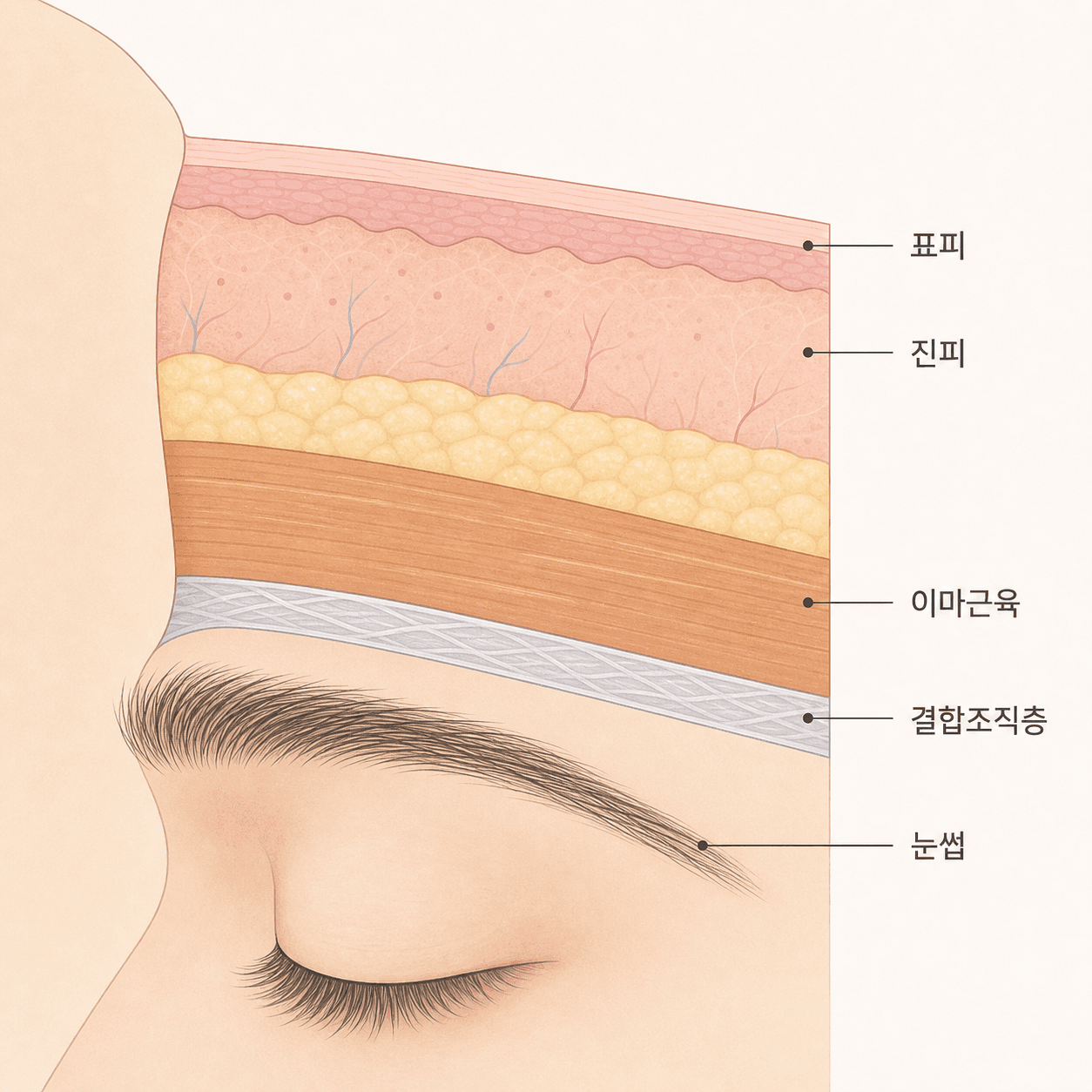
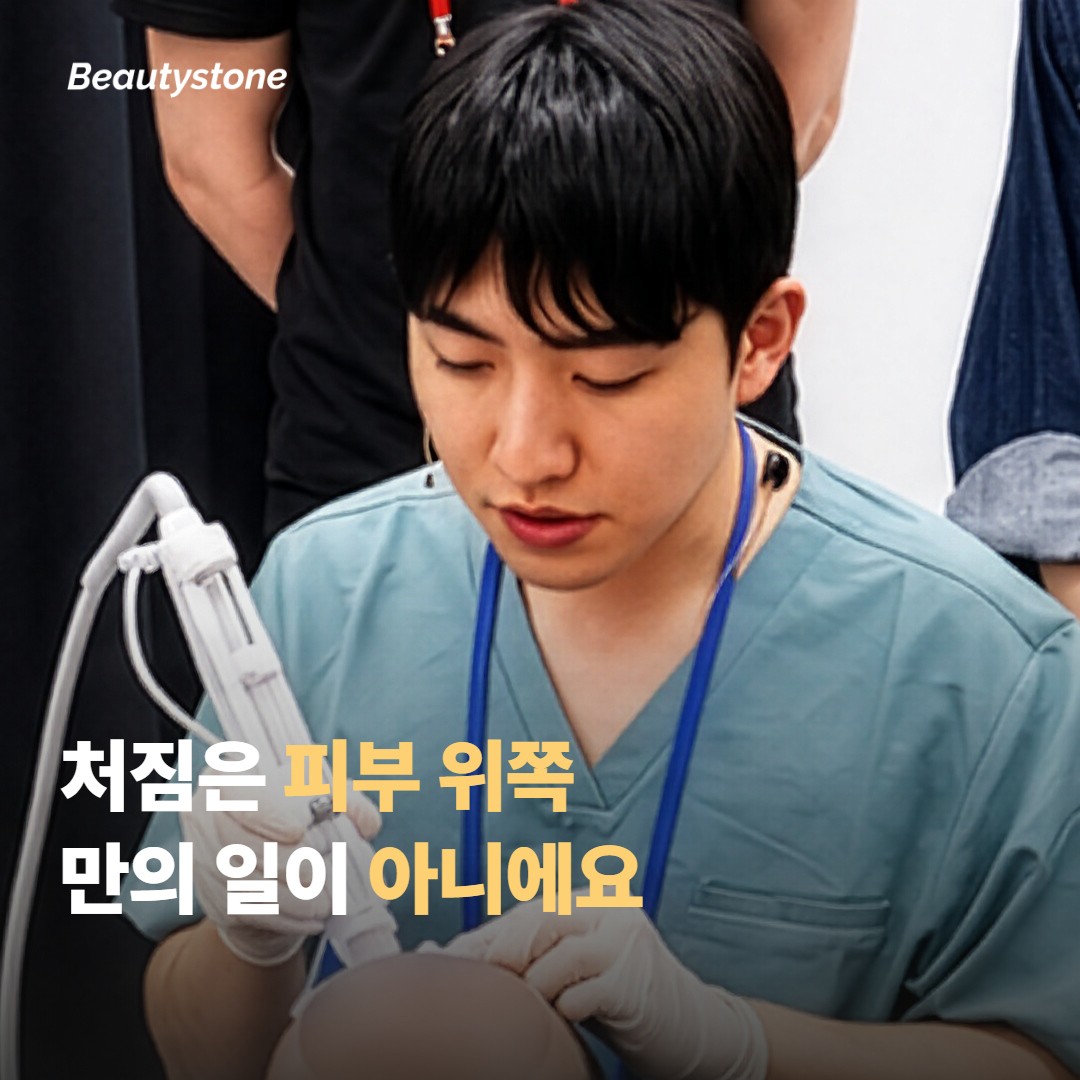
How Sofwave gets heat into the deeper layers
Sofwave concentrates ultrasound heat energy at a set depth in the skin to create very small coagulation points. At each of those points the skin begins its own repair response, and over time collagen and elastin fill back in. Rather than a change you can see immediately, it is a gradual firming across weeks to months, with the line tidying up as it goes. In the US Sofwave is an FDA-cleared device — "cleared" is the correct term for a device, whereas a drug such as botulinum toxin is "FDA-approved."
Areas like the forehead and brow, where muscle sits close and the skin is thin, need particular care with how deep the energy goes and how much of it is delivered. Too shallow and you only irritate the surface; too strong and you invite unnecessary swelling and discomfort. So even with the same device, settings are separated out by area.
Working depth — it targets the deeper layer where collagen is concentrated, not the surface
Repair response — new collagen fills in gradually around each coagulation point
Pace of change — cumulative over weeks rather than immediate
Area-specific settings — the forehead and brow sit close to muscle, so settings are kept more cautious
This is not a treatment that lifts dramatically in one go. It is closer to giving back a little of the support that was lost, so the heaviness eases. Setting your expectation alongside a surgical lift will disappoint; framing it as natural tidying is a fairer read.

How much lift, and by when?
The question everyone actually has is how much, and how soon. Because ultrasound lifting depends on new collagen forming, the change usually becomes clearer over the weeks and months after the session rather than on the day. The movement at the brow line is modest, so it is more realistic to expect a lightening of the heaviness than a dramatic rise.
In practice, a systematic review of ultrasound lifting reported brow elevation of roughly 0.47mm to 1.7mm from a single session, with about 92 percent of patients perceiving an improvement — which tells you that millimetre-scale movement can land quite differently on the face than it sounds on paper. As covered above, because the drop originates in the deeper layers, tidying those layers can visibly lighten a heavy look even with a small measured change. Individual results and recovery vary.
Item | Right after | 4 to 8 weeks | Around 3 months |
|---|---|---|---|
Brow line | Little visible change | Gradually tidier | Most noticeable |
Forehead heaviness | Slightly lighter | Progressively eased | Holding steady |
Texture and firmness | Little change | Improving slowly | Collagen accumulating |
Swelling and redness | Possible | Mostly settled | Largely gone |
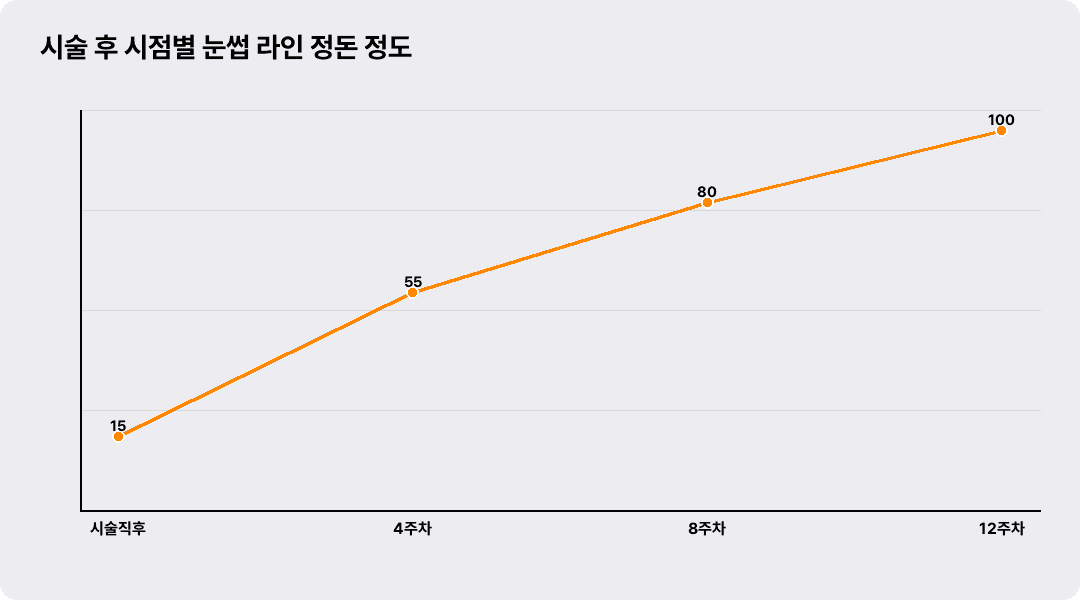
How long it holds varies enough between people that it is hard to state flatly, but newly formed collagen does loosen again over time, so this is not a one-and-done treatment that holds indefinitely. Work out the maintenance interval from your own skin and how quickly you see change.

Why where you have it done still matters
For an area like the forehead and brow, where muscle sits close and skin is thin, we would rather look at your skin thickness and how far the drop has progressed than apply a blanket setting. Even with the same Sofwave, the result shifts depending on where the energy goes and at what depth, so before treating we are straightforward about what you can expect to change and where the limits are. We are a small clinic within walking distance of Hapjeong Station in Seoul, so there is room to watch one person's recovery and rate of change and pick the next timing together. Pricing varies by clinic and by how many areas are covered, so ask for a written quote. If you are having this done while travelling, arrange a qualified provider near home for follow-up once you are back.

When something else belongs in the conversation
Ultrasound lifting suits people whose drop has not progressed far and who want to take some weight out of the look. In the following situations, though, it may leave you wanting more on its own, so it is worth raising other options at the consultation.
The lid itself is heavily covered — where there is a lot of excess muscle and skin, treatment alone has limits
Deep set forehead lines — expression lines may also need an approach such as botulinum toxin*
You want a big change in one go — ultrasound lifting is cumulative, so it may not match that expectation
Botulinum toxin*: an agent that temporarily reduces movement in the muscles that create expressions. It is commonly used for lines caused by muscle movement, such as horizontal forehead lines.
You also need to tell your clinician beforehand if you are pregnant or breastfeeding, if there is active inflammation or infection in the treatment area, if you scar with keloids, or if you have an implant in that area. If swelling or pain increases rather than settling in the days afterwards, or the area becomes hot and red, contact your provider or seek urgent care. This article is general information; whether the treatment suits you is something to decide with the clinician who examined you.

Frequently asked questions
Q. Does Sofwave hurt?
A. It varies with the area and the output setting, but the forehead and brow sit close to bone, so you may feel heat or a dull ache. Most people find it manageable, and if the discomfort is significant the output can be lowered or a topical anaesthetic used alongside. Say how it feels as you go and the intensity will be matched to you.
Q. Can I go straight back to normal life afterwards?
A. Generally you can wash your face and carry on with light daily activity from the same day. For the first day or two, though, hold off on saunas and hard workouts, or anything else that raises heat and blood flow a lot. Mild redness or a slightly puffy feeling usually settles within a day.
Q. When is the effect most noticeable?
A. Because new collagen takes time to form, the change is most distinct from around four to eight weeks onward, often peaking around the three-month mark rather than immediately after treatment. Rather than expecting an instant change, read it as a gradual tidying.
Q. Is one session enough, or do I need several?
A. It depends on how far the drop has progressed and how much change you want. If the initial change is modest, the usual approach is to give it time, see the response, and then decide about anything further. Newly formed collagen also loosens over time, so maintenance intervals are set together based on your own situation.


Lifting
Eye Thermage Results: Is 1 Session Enough?

skin
Rejuran vs. Juvelook Cost: What 1 Session Buys

Lifting
XERF for a Thin Face: Depth vs. Hollowing?

Lifting
Thread Lift Swelling: What's Normal in 5 Days?

Lifting
Thermage Cost: 4 Lines to Check on a Quote

Contouring & Volume
Xeomin Cost: Why Do 50-Unit Quotes Differ?