

A tan changes where laser energy lands. Here's how long to wait before pigment treatment, why the delay matters, and how to tell your skin is finally ready.
Published
Updated

Author
Wi Young-jin · Chief director
Seoul National University College of Medicine · Seoul National University Hospital Specialist
→
One of the most common questions we hear at the end of summer sounds simple: my tan is fading, so can I finally book that pigment treatment? The honest answer is that it depends less on the calendar than on what your skin looks like right now.
It's a frustrating answer, because the spots you want gone tend to look worse in September than they did in May. Sun exposure darkens existing pigment and brings new spots to the surface, so the motivation peaks at exactly the moment your skin is least ready.
In this article, we'll cover why a tan changes how a pigment laser behaves, how long people typically wait, what can go wrong if you don't, how to judge whether your skin is ready, and what's worth doing in the meantime.
Why Does a Tan Change What the Laser Does?
Short answer: pigment lasers target melanin, and a tan puts melanin everywhere instead of only where you want it.
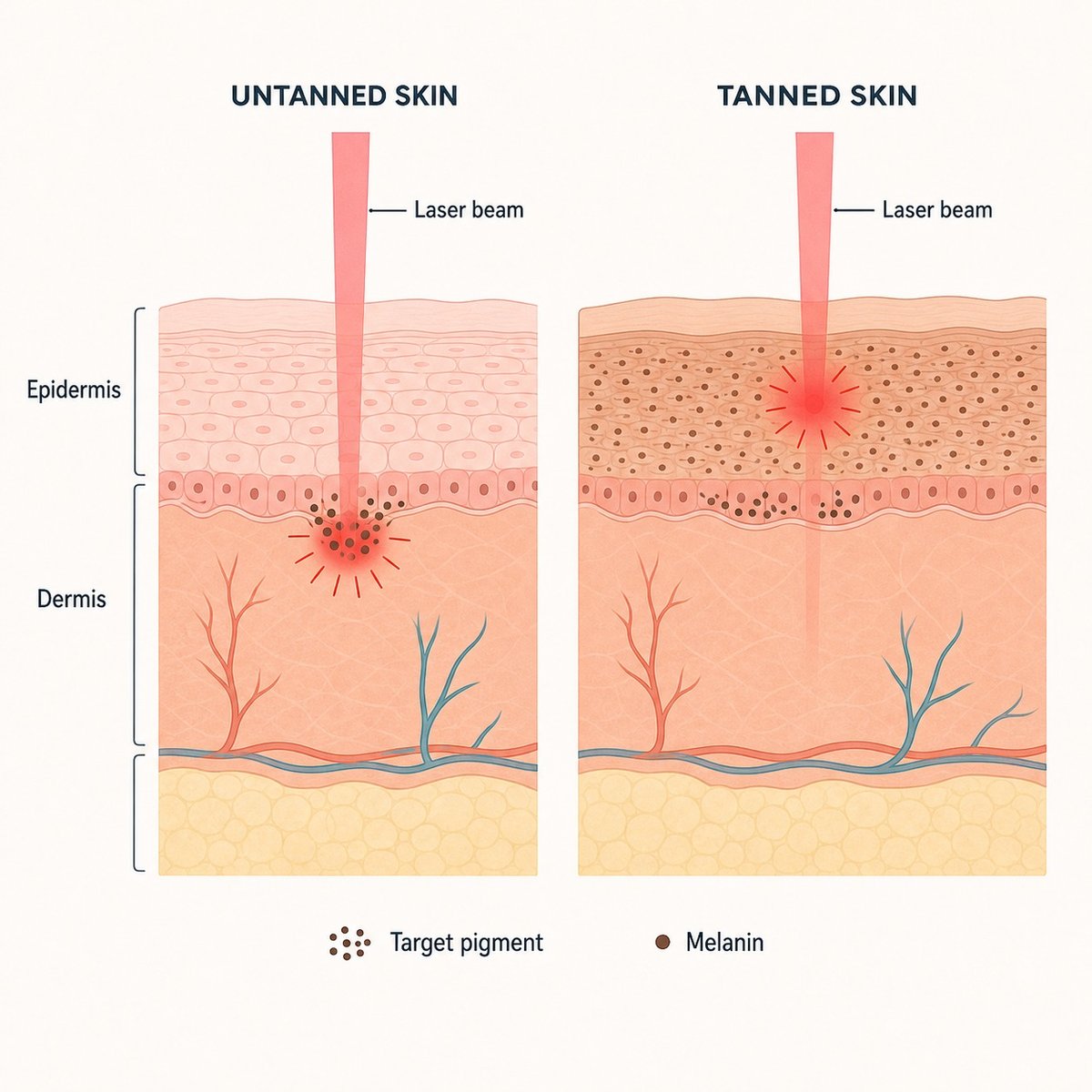
Pigment lasers work on a principle called selective photothermolysis. The device emits a wavelength that melanin absorbs more readily than the tissue around it, and the pulse is short enough that the heat stays where it's absorbed instead of spreading. That selectivity is the whole reason a laser can break up a sun spot without cooking the skin around it.
The catch is that selectivity depends on contrast. When your skin is untanned, the darkest thing in the beam's path is the lesion itself, so that's where the energy goes. After a summer of sun, your epidermis holds far more melanin across the board, and the beam runs into that first. Reviews of laser treatment for pigmented lesions describe this directly: the more competing epidermal melanin there is, the higher the risk of epidermal injury and the less energy reaches the intended target.
So treating a tanned face is a losing trade twice over. The spot you're aiming at gets a weaker dose, and the surface layer absorbs heat it wasn't meant to absorb. Waiting isn't caution for its own sake — it's restoring the contrast the technology needs.
How Long Should You Wait?
There's no universal number, because tans fade at the speed of your own skin turnover. Here's the general range providers work with, though everyone's skin is different.
How much sun you got | Typical waiting window |
|---|---|
Light pinkness from a short outing | About two weeks after the redness fully settles |
An all-summer, gradual overall tan | Roughly four to eight weeks out of the sun |
A strong burn with peeling | Around two to three months, and only after peeling is long gone |
Post-inflammatory darkening left behind | Treat the discoloration first; timing is a conversation with your provider |
Notice what these windows have in common: they all assume you're staying out of the sun during the wait. Eight weeks on a calendar means nothing if you're commuting on foot at midday without sunscreen. The clock effectively restarts every time you pick up more color.
Turnover speed matters too. The epidermis replaces itself over a period that lengthens with age, so the same tan can take noticeably longer to clear at 50 than at 25. That's not a problem to fix, just a variable to plan around.
Side Effects and Risks of Treating Too Soon
Pigment lasers have a long track record, but no laser is risk-free, and the risk profile shifts when there's extra melanin in the way. These are the outcomes providers are trying to avoid by asking you to wait.
Burns and blistering: Surface melanin absorbs heat meant for deeper targets, which can leave crusting or a blister.
Post-inflammatory hyperpigmentation: The treated area darkens instead of clearing, sometimes for months.
Hypopigmentation: Pigment-producing cells take too much energy and the area ends up lighter than the skin around it.
Underwhelming results: Less energy reaches the lesion, so you spend sessions without seeing much change.

Post-inflammatory hyperpigmentation deserves extra attention if you have a medium or deeper skin tone. More reactive melanocytes mean the skin is more likely to respond to injury by making pigment, which is the opposite of what you came in for. Research on post-inflammatory hyperpigmentation lists ongoing sun exposure as a factor that both triggers it and slows its resolution.
Some redness, mild swelling and small dark crusts are expected after pigment treatment, and they usually settle within a few days to two weeks. If the area darkens and stays that way past a month, spreads beyond where you were treated, or blisters, contact your provider. Fever or spreading redness means you should seek medical care right away.
How to Tell Your Skin Is Ready
Your provider makes the final call at the consultation, but there's a simple check you can do at home first.
Compare against skin the sun never sees. Hold your inner upper arm or lower abdomen next to your face in natural light. When you can't easily tell the two apart, your baseline is back. When the difference is still obvious, you're not there yet.
Check the barrier, not just the color. Flaking, stinging when you apply products, or lingering warmth all suggest the skin is still recovering. Treating over a compromised barrier raises the odds of an exaggerated reaction.
Be honest about the next few weeks. A beach trip two weeks after your session undoes a lot of the work, since fresh sun exposure is one of the reliable ways to bring pigment back. If your calendar is full of outdoor plans, starting in late autumn is often the better call.
What to Do While You Wait
The waiting period isn't wasted time. What you do during it changes how well the eventual treatment goes.
Sunscreen is non-negotiable. Broad-spectrum, applied every morning, reapplied when you're outside for long stretches. Add a hat or an umbrella when you can — shade does more for a fading tan than any product.
Keep it gentle. Aggressive scrubs and harsh peels feel productive, but irritation is exactly what drives more pigment production. Never pick at flaking skin.
Ask before you start actives. Topicals aimed at pigment can be useful in the interim, but some need to be paused before a laser session and some interact with the treatment plan. Bring a list of everything you're using to your consultation. It's also worth understanding how sun exposure factors into aftercare — see how to handle sun protection around laser and lifting treatments.
The Bottom Line
Pigment lasers rely on contrast between your target spot and the skin around it, and a tan erases that contrast.
Typical waiting windows run from about two weeks for light color to two or three months after a peeling burn.
The real test isn't elapsed days — it's whether your face matches skin the sun never reaches.
Sunscreen and gentle care during the wait protect both your results and your recovery.
Like any procedure, pigment treatment comes with trade-offs, and timing is the one you have the most control over. Individual results vary, and the right device and settings depend on what kind of pigment you're treating in the first place.
Ultimately, the choice depends on your skin, your schedule and how much sun the next few months hold. If you're considering pigment treatment after a summer of sun, a consultation is the best way to find out where you actually stand. Beautystone is a dermatology clinic in Seoul's Hapjeong area — you can see current offers at /en/promotion.
Frequently asked questions
Q. How long after a tan can I get a pigment laser?
A. It depends on how much color you picked up. Light pinkness usually needs about two weeks after the redness settles, an all-summer tan often means four to eight weeks, and a peeling burn can mean two to three months. The number that matters is whether your face matches skin the sun never sees, not the days on the calendar.
Q. I've been wearing sunscreen daily. Can I skip the wait?
A. Sunscreen protects you going forward, but it doesn't clear melanin that's already sitting in your epidermis. Providers judge readiness by your current skin tone, not by how diligent your routine has been. Keep applying it during the wait — it's what keeps the clock from restarting.
Q. What about gentler options like laser toning?
A. Lower-energy settings reduce the thermal load, but the underlying issue is unchanged: extra epidermal melanin still absorbs energy first. Whether a gentler approach is appropriate, and at what settings, is something your provider decides after looking at how much color is left.
Q. Will my spots get worse while I wait?
A. Existing spots may look darker at the end of summer, and that's usually the tan around them plus sun-stimulated pigment rather than a permanent change. Consistent sun protection during the waiting period often makes them look better on its own, which also gives your provider a clearer picture of what actually needs treating.



Contouring & Volume
Hip Dip Filler Before and After: 4 Checks

Body
Potenza Treatment Interval: Why 4 Weeks?

Lifting
Ultherapy Before and After: Why Wait 90 Days?

Contouring & Volume
Belotero Revive Cost: 2cc Price vs. 3 Sessions

skin
Lip Hyperpigmentation Laser: Does It Work?

Contouring & Volume
Men's Forehead Filler: Hollow or Just Lines?