

How long chin filler lasts, what it does, and the side effects to know before you book.
Published -
Updated -

Author
Wi Young-jin · Chief director
Seoul National University College of Medicine · Seoul National University Hospital Specialist
→
If you've taken a photo from the side and wished your chin came forward a little more, you're not alone. A short or recessed chin is one of the most common things people raise in a profile-balance consultation, and hyaluronic acid (HA) filler has become the go-to non-surgical answer because it works in one appointment and doesn't involve incisions.
But the two questions that decide whether it's worth booking are simpler: how long does it really last, and what can go wrong? In this article, we'll cover what chin filler does to your profile, why injection depth matters so much, the honest timeline from injection day to fade-out, the side effects from routine to rare, the warning signs that mean you call someone, and who's actually a good candidate.
What Does Chin Filler Actually Do?
It adds projection and length to the chin point, which changes how the whole lower face reads. Chin filler doesn't shrink your jaw or slim your cheeks — it borrows forward projection so the chin lines up with the rest of your profile. Most people notice three things once swelling settles:
A longer-looking profile: bringing the chin point forward or slightly down makes the lower third of the face read as more balanced against the nose and lips.
A crisper jawline shadow: a projecting chin changes how the jaw-to-neck border catches light, so the jawline can look more defined even though nothing was done to the jaw.
Less strain on the chin muscle: a short chin often comes with dimpled "orange-peel" texture from an overworking mentalis. Structure underneath can soften that, though it's no substitute for treating the muscle directly.
What it can't do is worth saying plainly, since that's where disappointment comes from. Filler is a soft gel: it refines proportions by a few millimeters, and it can't do what an implant or genioplasty would. A straight-talking provider will say so rather than stacking syringes. Individual results vary.
How Is It Injected, and Why Does Depth Matter So Much?
It's placed deep — usually right down on the bone at the chin point — and depth is the single biggest safety variable in the procedure.
The chin is a good filler target because it has a hard backstop. When a firm, cohesive HA gel is laid on the mandible, the bone supports it and a small amount buys visible projection. Filler placed too shallow tends to look soft, migrate, or show as a lump.
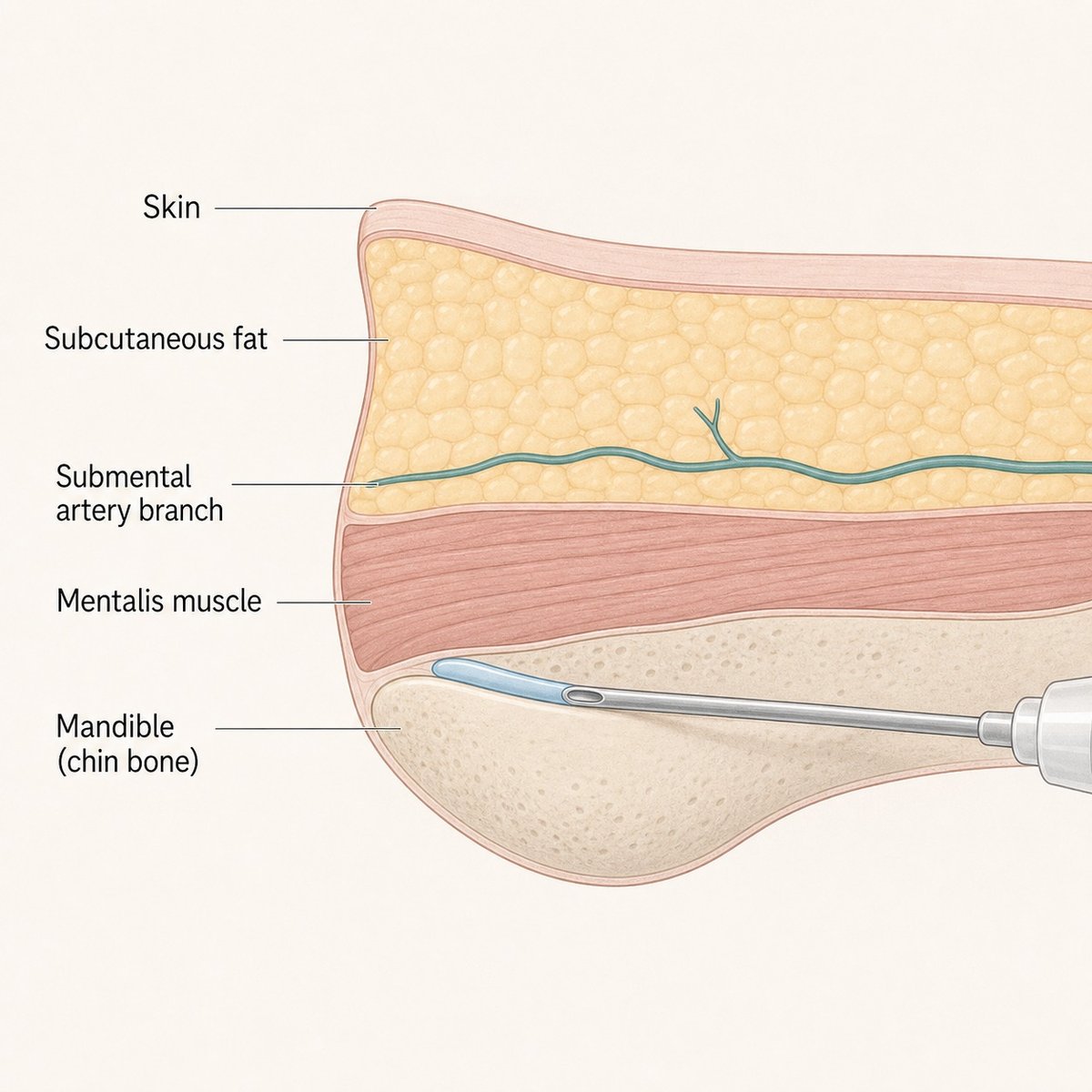
The layers matter because of what runs between them. The submental and inferior labial vessels travel through the soft tissue above the bone, not on it. Staying deep, on the periosteum, keeps the needle or cannula out of that zone. Here's how a typical appointment runs:
Assessment: your provider reads your profile and chin-to-lip relationship, then decides how much projection your soft tissue can carry.
Numbing: topical anesthetic needs roughly 20 to 30 minutes to work, and most HA products contain lidocaine that numbs further as the gel goes in.
Placement: the injection is usually the quickest part — often 10 to 15 minutes — through a fine needle or a blunt cannula, with no incisions and no stitches.
Shaping: your provider may mold the gel against the bone and check symmetry with you sitting upright, since lying flat changes how the chin reads.
One note worth being precise about: HA dermal fillers are FDA-approved, but each product carries its own approved indications, and not every HA filler is approved specifically for chin augmentation — some are used there off-label. Ask which product is going in and what it's approved for.

How Long Does Chin Filler Really Last?
Typically about 8 to 12 months, though the honest range is wider on both ends. Some people see it soften by around six months; others still have a visible result past the one-year mark.
The spread exists because HA is a substance your body already makes and already knows how to break down. Cross-linking slows that process, but enzymes chip away at the gel from day one. Four things move the needle:
The product: firmer, more heavily cross-linked gels built for bone-level work generally outlast the soft gels made for fine lines.
The amount and the plane: a supported bolus on bone tends to hold longer than the same volume feathered through soft tissue.
Your metabolism: everyone clears HA at their own rate, and very active people often report injectables fading faster.
Movement: the chin talks and chews all day, and constant motion shortens filler's life.
This is temporary by design. Chin filler isn't a one-and-done fix, and anyone presenting it as a lasting structural change is overselling it. Most people who like their result plan a touch-up inside that 8-to-12-month window. Individual results vary, so treat any number here as a planning estimate.
The timeline from injection day looks roughly like this:
When | What's usually happening |
|---|---|
Day of | Immediate projection change, plus swelling and tenderness. Most people go back to their normal day the same afternoon. |
Days 1 to 3 | Swelling usually peaks, often worse in the morning. Any bruise shows up now. |
Days 3 to 7 | Most routine swelling and bruising settle. |
Weeks 2 to 4 | The gel integrates and softens. This is the point to judge the result and book a review if something looks uneven. |
Months 8 to 12 | Projection fades as the HA breaks down. It's smooth, not a cliff, so many people don't notice until they compare photos. |
Side Effects and Risks: The Honest List
Most side effects are mild, expected, and short-lived. One is rare and genuinely serious. Here's the full picture rather than the marketing version.
Common and expected. Swelling and bruising at and around the injection point are the two to plan for, not be surprised by. Tenderness, a tight feeling in the chin, and small red marks where the needle entered are routine too. These usually settle within three to seven days. If they're getting worse instead of better, contact your provider.
Less common. Asymmetry or an uneven contour can show up once swelling resolves — which is exactly why judging the result at day two is a mistake. Palpable lumps or product sitting off from where it was placed also happen, more often when filler is laid too superficially. Delayed nodules, a firm bump appearing weeks or months later, are uncommon but documented and need a provider to assess.
Rare and serious. The complication that matters most is vascular compression or occlusion — filler pressing on or entering a blood vessel and interrupting blood supply to the tissue it feeds. It's rare. It's also why anatomy knowledge and injection depth are worth more than a discount. Infection is possible too, as with any injection through the skin.
Reversibility changes the math. Because chin filler is hyaluronic acid, it can be dissolved. An enzyme called hyaluronidase breaks HA down, and a provider equipped to manage complications can use it both to treat a suspected vascular event urgently and to soften a result you're unhappy with. That built-in undo is the biggest safety argument for HA over non-dissolvable products, where an unwanted result has to be waited out or removed surgically. Ask a clinic outright whether they keep hyaluronidase on hand — the answer tells you a lot.
Stop and seek medical care right away if you notice:
Blanching: skin around the chin or lower lip turning white, pale, or dusky and mottled.
Severe or escalating pain: pain out of proportion to a routine injection, or that keeps building instead of easing.
Vision changes: blurred vision, double vision, or loss of vision.
Fever or spreading redness: warmth, redness expanding outward from the site, or feeling unwell.
None of those are wait-and-see symptoms. Ordinary bruising and swelling look and feel boring; these don't. If you're unsure which camp you're in, call the clinic that treated you and describe what you're seeing.
Aftercare: What Helps the Result Settle
Mostly, leaving it alone. A few habits in the first 24 to 48 hours genuinely reduce swelling and bruising.
Skip alcohol on treatment day: it dilates vessels and makes swelling and bruising worse.
Hold off on hard workouts: anything that spikes blood flow on day one can amplify swelling.
Avoid saunas and long hot showers: heat aggravates swelling in a fresh treatment area.
Don't press, rub, or massage the chin: unless your provider tells you to, keep your hands off while the gel settles against the bone.
Sleep with your head elevated: for the first night or two, this helps fluid drain rather than pool in your lower face.
One piece of timing advice beats all the rest: if you've got a wedding, a shoot, or anything you'll be photographed at, book about two weeks ahead. That leaves room for swelling and any bruise to clear and for the shape to settle. Getting filler two days before a big event is a common, avoidable regret.
Who's a Good Candidate, and Who Isn't?
The best candidates want a modest change to profile balance and understand they're renting the result, not buying it. If a slightly recessed chin makes your nose look larger in profile or your jawline read as soft, filler is a reasonable, reversible way to test what more projection looks like on your face. It tends to be a good fit if:
Your goal is millimeters, not a new jaw: subtle profile refinement is what this procedure does well.
You want an exit route: HA dissolves, which makes it a lower-commitment trial.
You can plan around maintenance: revisiting it roughly once a year suits you.
It's a poor fit, or needs a longer conversation first, if:
You want a large structural change: big projection goals are better served surgically, and pushing filler to do that job tends to look heavy.
You have an active infection or breakout at the site: treatment waits until the skin is calm.
You're pregnant or breastfeeding, have a bleeding disorder, or take blood thinners: all need raising before anything is booked.
Your chin dimpling is muscle-driven: an overactive mentalis may respond better to a different approach.
Two things to check before booking anywhere: what product is being used and why that one, and how the clinic handles complications. A clinic that answers both easily is telling you something useful about how often they do this.
The Bottom Line
Chin filler is a small procedure with a real effect on profile balance, and its risks are manageable when someone who knows the anatomy is holding the needle. The recap:
Duration: HA chin filler typically lasts around 8 to 12 months, with wide person-to-person variation.
Routine side effects: swelling, bruising, and tenderness, usually settling in three to seven days.
The serious one: vascular compression or occlusion is rare, and it's why injector experience and depth control matter most.
The safety net: HA is reversible with hyaluronidase, a meaningful advantage over non-dissolvable fillers.
Like any procedure, it comes with trade-offs, and the temporary nature of it cuts both ways — you'll be back, but you're also not stuck with a result you don't love. Ultimately, the choice depends on your anatomy, your goals, and how much maintenance you want. Individual results vary.
If you're weighing chin filler, an in-person consultation is the only way to find out how much projection your face can carry. Beautystone is a dermatology clinic in Seoul's Hapjeong area — see current offers at /en/promotion. If you've already been treated and something doesn't look or feel right, talk to your provider rather than waiting it out.
Frequently asked questions
Q. How long does chin filler last?
A. HA chin filler typically lasts about 8 to 12 months. Some people notice it softening by around six months, while others still see projection past a year. Product firmness, how much was placed, your metabolism, and how much the area moves all shift the number. Because HA is broken down naturally, the result is temporary by design, and most people who want to keep it plan a top-up inside that window. Individual results vary.
Q. Does chin filler hurt?
A. Most people describe it as pressure rather than sharp pain. A topical numbing cream is usually applied and given roughly 20 to 30 minutes to work, and most HA products contain lidocaine that numbs the area further as the gel goes in. The injection itself is short, often around 10 to 15 minutes. Some soreness and a tight feeling afterward are normal and generally settle within a few days.
Q. Can chin filler be dissolved if I don't like it?
A. Yes. Because it's hyaluronic acid, a provider can inject an enzyme called hyaluronidase to break the gel down. That's used both urgently, if a vascular complication is suspected, and electively, if you're unhappy with the shape. This reversibility is the main safety argument for HA over non-dissolvable fillers, and it's worth confirming that your clinic keeps hyaluronidase on hand.
Q. What's the most serious risk, and what are the warning signs?
A. Vascular compression or occlusion, where filler presses on or blocks a blood vessel, is the rare but most serious complication. Watch for skin blanching to white or dusky, severe or escalating pain, vision changes, or fever and spreading redness. Any of those mean you should seek medical care right away rather than waiting. Ordinary bruising and swelling feel uneventful by comparison.
Content




skin
Why Does Fractional CO2 Take Longer to Heal?

Contouring & Volume
How Many cc Does Forehead Filler Need?

skin
Why Is My Skin Oily but Tight in the Fall?

Hair Removal
Underarm Laser Hair Removal Cost: Do the Math

Tattoo removal
Laser Before a Cover-Up: How Many Sessions?

skin
큐어젯 다운타임, 다음 날 출근과 화장은 언제부터 될까요?