

Juvelook Volume and HA filler both reshape the chin — but they work very differently. Here's how to choose what's right for your jawline.
Published -
Updated -

Author
Wi Young-jin · Chief director
Seoul National University College of Medicine · Seoul National University Hospital Specialist
→
If you've been researching chin and jawline treatments, you've probably noticed that Juvelook Volume keeps coming up alongside hyaluronic acid (HA) fillers. They're both injectables, both used in the lower face — but they're not interchangeable, and using them interchangeably is where a lot of confusion starts.
In this article, we'll cover what makes Juvelook Volume different from HA filler at a biological level, how each one performs at the chin and along the jawline, what the recovery looks like, and how to know which one fits your situation. Let's get into it.
What Is Juvelook Volume — and How Is It Different from HA Filler?
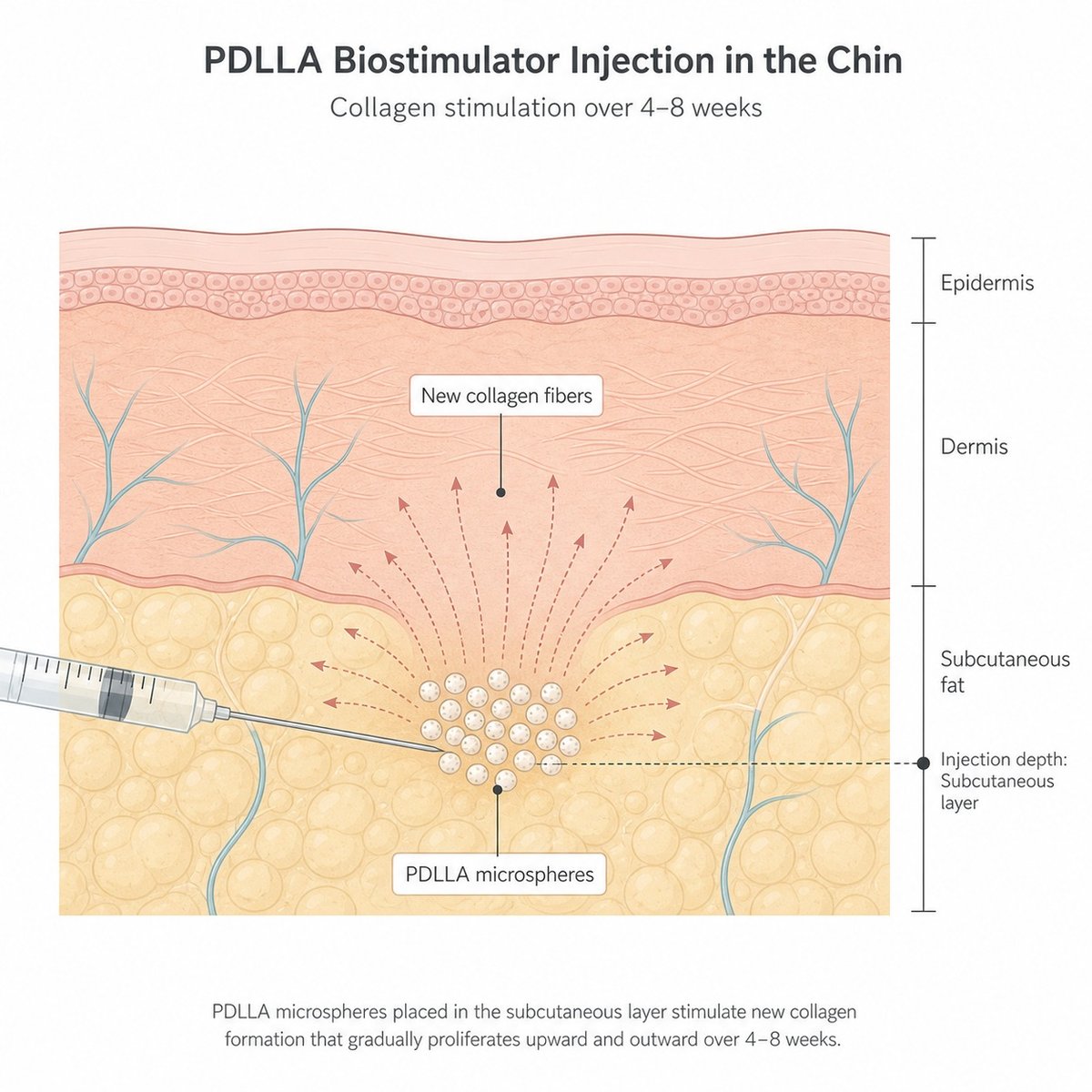
Juvelook Volume is a PDLLA-based collagen biostimulator. PDLLA stands for poly-D,L-lactic acid, and unlike HA filler, it doesn't fill space directly — it triggers your skin's collagen-building response over time. The result isn't immediate volume; it's a gradual structural build-up as new collagen replaces the dissolving PDLLA microspheres.
HA filler, on the other hand, works by physically occupying space. Hyaluronic acid is injected into a target layer, provides lift or shape right away, and slowly breaks down over months. If you want your chin projection to look sharper this week, HA filler is what does that.
Juvelook Volume sits between a traditional skin booster and a structural filler — it contains both PDLLA and a small amount of HA for immediate hydration, but the long-term effect depends on your own collagen production. Think of HA filler as renting volume, and Juvelook Volume as investing in your skin's ability to generate it.
How Does Juvelook Volume Work at the Chin and Jawline?
The chin area has a relatively thin soft tissue layer over the chin bone. When someone has a recessed or short chin — what's sometimes called a 'weak chin' — there's often not enough forward projection, and the jawline can look undefined or heavy in photos.
HA filler addresses this structurally, right at the periosteal (bone-adjacent) or deep dermal level. The effect is visible within minutes of injection and softens gradually over 6–18 months depending on the product and placement depth.
Juvelook Volume works differently in this region. Because it needs time to stimulate collagen remodeling, the initial few weeks can look subtle — sometimes even slightly uneven as the PDLLA settles. Most patients start to notice meaningful change at 4–8 weeks, with peak results typically appearing around 2–3 months post-treatment. Research on PDLLA-based injectables supports a gradual collagen-synthesis timeline consistent with this window, as collagen deposition from biostimulator materials follows a predictable fibroblast activation sequence (PMC10985543).
Along the jawline, Juvelook Volume can improve definition by building collagen scaffolding in the pre-jowl sulcus and lateral chin — areas where skin laxity, not just volume loss, is the main concern. This is one area where it can complement (rather than replace) HA filler.
What to Expect: Timeline and Results
Here's an honest breakdown of what the experience actually looks like:
Day of treatment: Small injection-site bumps, mild redness, and some swelling are normal. The area may feel slightly firm. Individual results vary.
Days 2–5: Swelling peaks and then subsides. Some bruising is possible, especially at the chin tip. Avoid pressing or massaging the area.
Week 1–4: This is the quiet phase. Don't expect to see dramatic change yet. The PDLLA is integrating into the tissue and your fibroblasts are just starting to respond.
Month 2–3: Most patients see noticeable improvement in chin definition and lower-face firmness. This is where the collagen buildup becomes visible to others, not just you in harsh lighting.
Month 4–6: Results tend to stabilize. Duration depends on your skin's metabolism, lifestyle factors, and how many sessions were done. Studies suggest biostimulators can support collagen for 12–24 months, but individual results vary significantly.
If you've had HA filler before and you're expecting that same instant transformation, Juvelook Volume will feel underwhelming at first. That's a normal part of the process, not a sign it isn't working.

Juvelook Volume vs. HA Filler: A Practical Comparison
These two treatments aren't rivals — but they're also not the same thing. Here's where they differ in practical terms:
Factor | Juvelook Volume | HA Filler |
|---|---|---|
Onset of results | 4–8 weeks (gradual) | Immediate |
Primary mechanism | PDLLA collagen stimulation | Physical volume (HA) |
Reversible? | No (PDLLA isn't dissolvable) | Yes (hyaluronidase enzyme) |
Best for | Skin quality, subtle structural lift, jawline firmness | Precise chin projection, immediate reshaping |
Downtime | 3–5 days swelling/bruising | 2–5 days swelling/bruising |
Duration | 12–24 months (varies) | 6–18 months (varies by product) |
One important caveat: because Juvelook Volume isn't reversible with an enzyme, it requires more careful placement from the start. This is not a treatment to approach casually or at a discount.
Side Effects, Risks, and What to Watch For
Like any injectable, Juvelook Volume carries real risks. Being informed about them isn't pessimistic — it's just responsible.
Swelling and bruising: Common and usually settle within a week. Applying a cold compress (not ice directly) in the first 24 hours can help.
Nodule formation: Small, firm bumps can form if PDLLA isn't injected evenly or is placed too superficially. They're usually temporary but can persist for weeks. This is more likely with poor injection technique.
Asymmetry: Because results develop gradually, the two sides of the chin may appear uneven during the collagen-building phase. Don't rush to reassess — wait until the 3-month mark.
Vascular complications: Rare but serious. The chin and perioral area have small vessels that, if accidentally occluded during injection, can cause tissue damage. Signs include immediate blanching, severe pain, or mottled skin.
Redness and swelling are expected and usually resolve within a few days. If you notice spreading redness, fever, increasing pain after day 3, or any vision changes, seek medical care right away.
HA filler carries the same vascular risk — it isn't safer in that specific regard. The difference is that HA complications can be partially reversed with hyaluronidase; PDLLA-related vascular events cannot. This makes provider selection especially critical for Juvelook Volume at the chin.

Who's a Good Candidate — and Who Should Choose HA Filler Instead?
The honest answer is: it depends on what you're actually trying to fix.
Juvelook Volume may be a better fit if:
You want gradual, natural-looking improvement in jawline definition rather than a sharp immediate change
You're concerned about your skin's overall collagen density, not just chin projection
You're open to multiple sessions over a few months
You've had HA filler before and want something that builds on it structurally
HA filler may be a better fit if:
You want visible chin projection before an event or within a week
You want the option to dissolve the product if you don't like the result
Your primary concern is adding forward projection to a flat or recessed chin tip
You prefer a one-session result
In some cases, a combination approach makes the most sense — HA filler for immediate structural projection and Juvelook Volume for longer-term collagen building in the surrounding tissue. That sequencing is something to discuss with your provider based on your current tissue quality and goals. Individual results vary.

The Bottom Line
Juvelook Volume is a PDLLA collagen biostimulator, and that distinction genuinely matters when you're planning a chin or jawline treatment. Here's the short version:
It doesn't give you the same-day result that HA filler does — that's by design, not a flaw
Results build over 2–3 months as new collagen forms, and can last considerably longer than standard HA filler
It's not reversible, which means provider skill and placement precision matter more, not less
For a weak chin needing immediate projection, HA filler is still often the right first step — Juvelook Volume can be layered in afterward, or used as a maintenance tool
Like any procedure, it comes with trade-offs. The gradual timeline can feel frustrating if you're used to instant results, and the non-reversibility raises the stakes on getting the placement right. Ultimately, the choice depends on your skin, your goals, and what timeline you're working with.
If you're considering Juvelook Volume for your chin or jawline, a consultation is the best way to figure out whether your tissue is ready for it or whether HA filler makes more sense first. Beautystone is a dermatology clinic in Seoul's Hapjeong area — see current offers at /en/promotion.
Frequently asked questions
Q. Does Juvelook Volume hurt more than regular filler?
A. Pain levels are similar to HA filler — most people describe a mild stinging sensation during injection, which passes quickly. Numbing cream is typically applied beforehand to minimize discomfort. The chin area can be slightly more sensitive than the cheeks, so let your provider know if you're particularly pain-sensitive.
Q. How long do results from Juvelook Volume at the chin last?
A. Results vary from person to person, but studies suggest PDLLA-based collagen stimulators can support new collagen for 12–24 months. Factors like your skin's baseline collagen density, lifestyle habits, and how many sessions you've had all affect longevity. Most providers recommend a touch-up evaluation around the 12-month mark.
Q. Can Juvelook Volume be dissolved if I don't like the result?
A. No — this is a key difference from HA filler. PDLLA cannot be dissolved with hyaluronidase (the enzyme used to reverse HA filler). This is why careful provider selection matters: once it's in, the collagen-building process runs its course. Most people are happy with the outcome, but it's worth discussing realistic expectations before treatment.
Q. Can I get Juvelook Volume and HA filler at the same time?
A. Sometimes, yes — but sequencing matters. Some providers prefer to place HA filler for structural projection first, then add Juvelook Volume once the HA has settled, to avoid guessing at the final shape. Others do both in the same session depending on the treatment design. This is a conversation to have with your provider based on your specific anatomy and goals.
Content





skin
Why Does Fractional CO2 Take Longer to Heal?

Contouring & Volume
How Many cc Does Forehead Filler Need?

skin
Why Is My Skin Oily but Tight in the Fall?

Hair Removal
Underarm Laser Hair Removal Cost: Do the Math

Tattoo removal
Laser Before a Cover-Up: How Many Sessions?

skin
큐어젯 다운타임, 다음 날 출근과 화장은 언제부터 될까요?