

Hot water lifts the oil film that keeps water in your skin, so tightness and lingering redness often start in the shower. Here's how to judge lukewarm.
Published -
Updated -

Author
Wi Young-jin · Chief director
Seoul National University College of Medicine · Seoul National University Hospital Specialist
→
You'll read the ingredient list on a cleanser twice before you buy it. The water you rinse it off with? That part usually gets no thought at all.
It probably deserves some. Water temperature and how long you stay under it are variables for your skin barrier in the same way your cleanser is. And because washing is something you repeat every single day, small differences don't stay small for long.
In this article, we'll cover what hot water does at the surface of your skin, where hot and lukewarm actually part ways, how to judge lukewarm without a thermometer, how long to wash, when to put moisturizer on, and how to handle showering right after a treatment.
What Hot Water Actually Does to Your Skin
Your stratum corneum — the outermost layer of skin — is covered by a thin film of sebum. That film isn't there for decoration. It slows the rate at which water escapes from the skin into the air around you.
Washing lifts part of that film away for a while. That isn't a flaw in washing; it's more or less the definition of washing.
The catch is that temperature decides how much of it comes off. Research on cleansing and the skin barrier indicates that hot water dissolves surface oils faster, which pushes transepidermal water loss upward and tends to leave skin looking flushed. Transepidermal water loss, or TEWL, is simply the water that evaporates outward through the surface of the skin.
So on the days when your face feels unusually tight the moment you towel off, the cleanser isn't automatically the culprit. The tap is a variable too, and it's the one almost nobody checks.
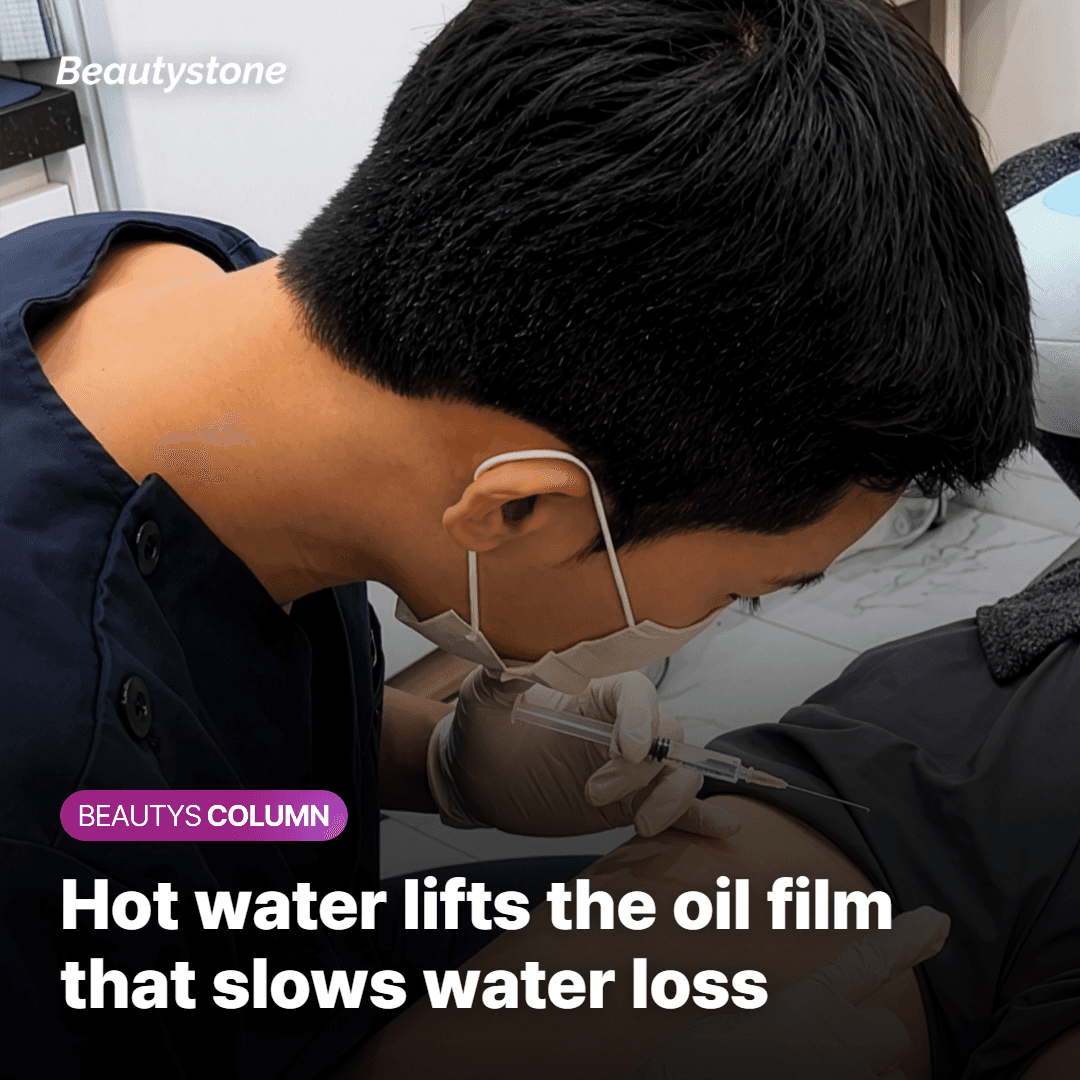
Hot vs. Lukewarm: Where the Difference Shows Up
Two things move together here: how hot the water is, and how long your skin sits in it. A longer wash means a longer exposure to both the water and the cleansing agents in it, so temperature and time tend to compound rather than cancel each other out.
That's worth sitting with for a second, because most people treat these as one setting. Turning the temperature down while doubling the length of your shower isn't obviously a win. Here's roughly where the two columns diverge:
What you're comparing | Hot water | Lukewarm water |
|---|---|---|
Effect on the sebum film | Dissolves surface oils faster | Lifts them more slowly |
Right after washing | Tightness comes on easily | Less of that tight feeling |
Redness | Vessels widen briefly, so it stands out more | Little visible change |
Load on the skin barrier | Higher | Lower |
Redness is the part that gets misread most often. When your face goes pink after a hot shower, that's blood vessels widening briefly, and it settles on its own. A single hot shower isn't damage. But when it's a daily event, the impression can stick around — the version of your face you see in the mirror starts to be the flushed one.
Everyday dermatology advice for washing lands in the same place from a different direction: lukewarm water, a gentle touch, nothing forced.
How to Judge Lukewarm Without a Thermometer
The short answer? Use the back of your hand. No one is standing at the bathroom sink with a thermometer, and you don't need to be.
Run the water over the back of your hand. It shouldn't register as cold or as hot — ideally it barely registers at all.
If you feel any sting or bite, take it down a notch. If warm is the first word that comes to mind, you're already higher than you want to be.
Re-check whenever something changes — a new apartment, a new water heater, a cold snap. The dial position you memorized isn't the same temperature everywhere.
There's no single number that's correct for everyone, which is exactly why the hand test works better than a chart would. Comfortable, with no sting, is the practical standard. Your own skin gives you a faster reading than a thermometer, and it's the reading that matters.

How Long to Wash, and When to Moisturize
Answer first: keep the washing short, and put moisturizer on while your skin is still damp.
Cleansing: Keep it brief. Lather doesn't need to sit on your face while you plan out your morning.
Showers: Same principle. Time under the water is exposure, and exposure is the cost you're paying.
Moisturizer: Apply it while your face still feels damp, not after you've dried it off completely.
That last one carries more weight than it sounds like it should. Putting moisturizer onto skin that's still damp helps hold on to water that's already sitting there. Dry your face all the way down with a towel first and there's simply less left to hold on to — you're asking the product to do a harder job for no reason.
None of this requires a timer or a new product. It's the same routine you already have, with two settings adjusted.
Side Effects of Too-Hot Water and Showering After Treatments
Day to day, water that runs too hot shows up as tightness after washing, a flushed look that hangs around longer than you'd like, and skin that starts reacting to products it used to tolerate without complaint. On any one day none of that is dramatic. Repetition is what does the work.
Right after a treatment that acts directly on the skin — filler or laser work, for instance — the barrier is more sensitive than it usually is. Temperature and shower length deserve more attention than usual during that window.
Skip hot water and long showers. Saunas and long soaks are the same problem in a different room.
Don't aim the stream straight at your face. Let the water run down over it instead of hitting it head-on.
Cleanse lightly. No scrubbing, no rubbing, nothing abrasive.
Moisturize a little more attentively than you would on an ordinary day.
How long to keep this up depends on which treatment you had and how your skin is responding, so the clinic that treated you is the right place to ask — not a general article, and not a friend's experience with something else. And if redness spreads, pain gets worse, or you're running a fever, seek medical care right away rather than waiting it out.
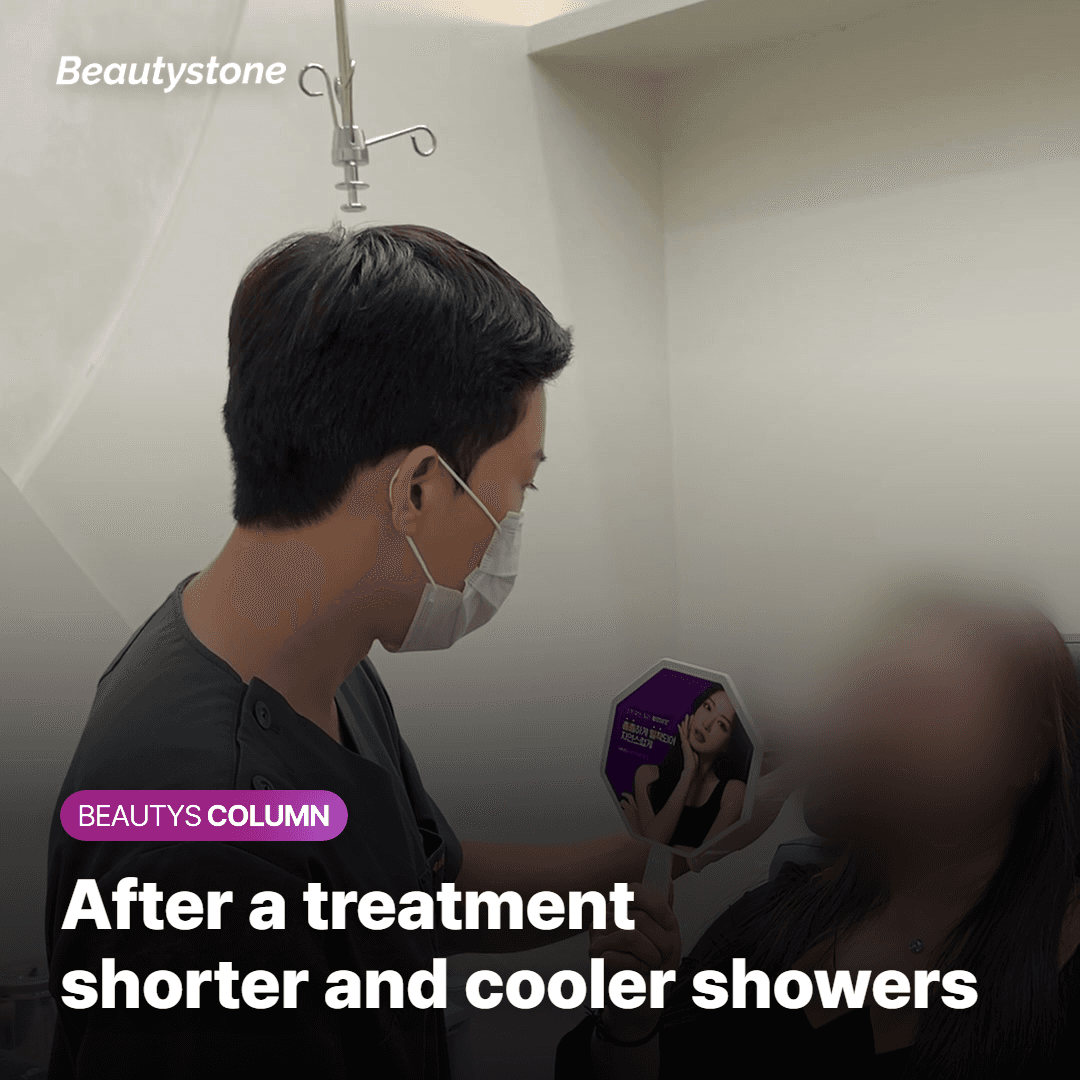
Why We Ask About Your Water Temperature First
When someone comes in about tightness or redness that won't settle down, the first questions usually aren't about products. They're about washing: how hot the water runs, how long the shower lasts, when the face gets washed and with what.
The reasoning is straightforward. Skincare is something you apply a couple of times a day. Washing is a condition your skin lives under daily. If that condition doesn't change, whatever you layer on top keeps starting from further back than it should.
It matters more if you're planning a treatment. Since there's no single temperature that suits everyone, and since comfortable-with-no-sting is the working standard, calibrating together in a consultation beats guessing from a chart. Beautystone is a dermatology clinic in the Hapjeong area of Seoul, and this is a routine part of the conversation before anything gets scheduled.
The Bottom Line
Hot water lifts more of the sebum film than lukewarm water does, and that film is what slows water loss from your skin.
Temperature and time compound. A shorter wash at a comfortable temperature beats fixing only one of the two.
The back of your hand is a good enough thermometer: no cold, no sting, barely noticeable.
Moisturize while your skin is still damp, and after a treatment, ask the clinic that treated you how long to stay careful.
Like any habit adjustment, this one is undramatic. Individual results vary, and water temperature isn't going to rewrite your skin on its own — it just stops quietly working against everything else you're doing.
Ultimately, the choice depends on your skin, your routine, and what feels comfortable rather than what feels satisfying in the moment. If you're weighing a treatment and want your at-home basics reviewed at the same time, a consultation is the practical way to do it, and current offers are listed on the /en/promotion page.
Frequently asked questions
Q. Does cold water shrink your pores?
A. It doesn't. Water temperature doesn't change pore size, and the tight, snapped-shut feeling cold water gives you is a passing sensation rather than a structural change. Using lukewarm water and keeping the wash short does more for your barrier than a cold rinse at the end.
Q. Should I still use lukewarm water in winter?
A. The standard doesn't change with the season, but the temptation does. On a cold day, water that would have felt too hot in July feels comforting, so the dial creeps upward without you noticing. Check with the back of your hand before you start, especially in winter.
Q. Can I wash my face in the shower?
A. You can, but temperature is the catch. Water set for your body is usually hotter than what your face wants. Either wash your face at the sink separately, or turn the temperature down at the end of your shower and wash it then.
Q. If I switch to a gentler cleanser, does temperature stop mattering?
A. They're two separate variables. A mild cleanser still can't undo a long exposure to hot water, because the sebum film comes off either way. Adjusting the product and the temperature together is what actually changes how your skin feels afterward.
Content



![[Wi Young-jin Column] Retinol Adjustment vs Barrier Damage](https://framerusercontent.com/images/ytrEiREJ8Dzp0ifIefbteOXATU.jpg?width=1080&height=1080)


skin
Why Does Fractional CO2 Take Longer to Heal?

Contouring & Volume
How Many cc Does Forehead Filler Need?

skin
Why Is My Skin Oily but Tight in the Fall?

Hair Removal
Underarm Laser Hair Removal Cost: Do the Math

Tattoo removal
Laser Before a Cover-Up: How Many Sessions?

skin
큐어젯 다운타임, 다음 날 출근과 화장은 언제부터 될까요?