

Retinol Skin Peeling: Don't Just Endure It
Retinol Skin Peeling: Don't Just Endure It
Retinol Skin Peeling: Don't Just Endure It
A dermatologist explains how to spot retinol peeling and when to cut its strength or frequency.
Published -
Updated -

Author
Wi Young-jin · Chief director
Seoul National University College of Medicine · Seoul National University Hospital Specialist
→

Retinol skin peeling,
Don't believe the saying that it gets better if you just endure it
Beauty's Doctor Director Wi Young-jin · Former Seoul National University specialist
💡 Check this first before reading
Q. If you use retinol
isn't peeling normal?
A. Slight flaking can be a normal reaction, but
if it gets to the point where you say your skin is peeling,
there is definitely a problem with either
the concentration, frequency, or your skin condition.
Q. Should I just stop?
A. Rather than stopping unconditionally,
the key is first to tell whether your skin is in a 'process of adaptation' or a 'process of damage.'
📌 Key points of this article
If the peeling skin is due to retinol,
reduce it like this.
We reveal the medically sound way to confirm it.
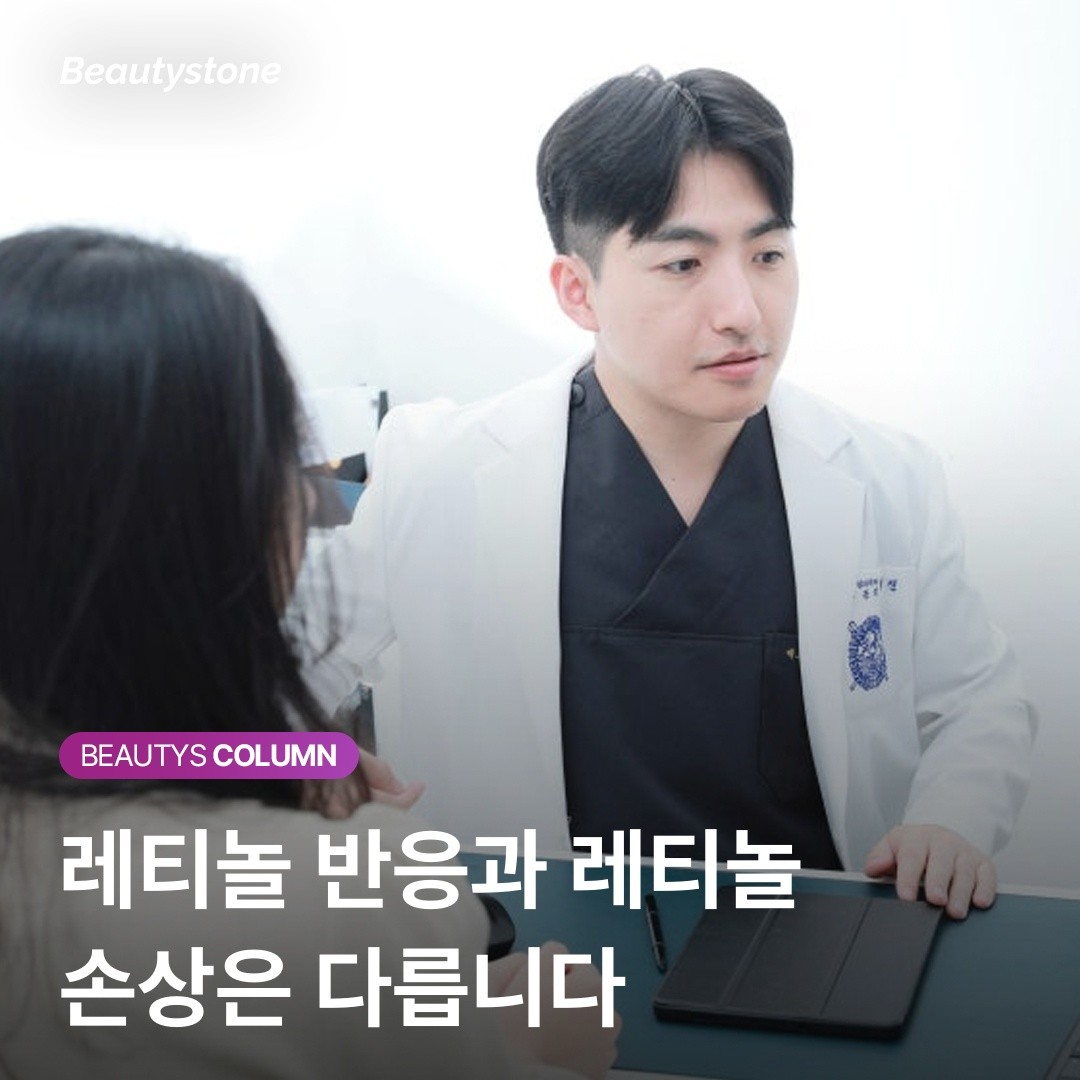
Retinol reaction and retinol damage are different
"When you use retinol, peeling at first is normal."
This statement is half right and half wrong.
I have seen quite a few people who followed common online advice and endured it,
only to arrive with their skin barrier completely broken down.
When you apply retinol, epidermal cell turnover speeds up,
and fine flaking is a normal adaptation response.
But 'adaptation' and 'damage'
are completely opposite things happening inside the skin.
Normal adaptation response vs. barrier damage
Category | Normal adaptation response | Barrier damage (overuse) |
Appearance of peeling | Fine, powder-like flaking | Large areas peel off like a thin film |
Degree of redness | Slight right after application, fades within a few hours | Lasts all day with a warm sensation |
Tightness·dryness | Resolved with moisturizer | Continues to sting and feel tight even after moisturizer |
Duration | Gradually improves after 2–4 weeks | Persists for more than 4 weeks or gets progressively worse |
Reaction to other products | No problem using existing cosmetics | Burning even with products you normally use |
This is a point many people misunderstand,
and peeling is not proof that it is effective.
The effect of retinol is in promoting collagen synthesis,
and it has no direct correlation with visible peeling.
In fact, the more severely your skin peels,
the weaker the barrier becomes, and it can become entrenched as sensitive skin.
👨⚕️ Director Wi Young-jin's key summary
If it is fine and powder-like
and can be solved with moisturizing, it is an adaptation process.
If it peels like a film and keeps stinging, that is damage.
Enduring it unconditionally
creates aftereffects, not benefits.

The medical way to check whether peeling is due to retinol
The medical way to check whether peeling is caused by retinol
Because retinol is not the only cause of peeling,
we recommend the most reliable check:
'a cause elimination test.'
Keep the rest of your routine the same
and stop only retinol for 3–5 days.
Stop retinol for 3 days
Use only a ceramide-containing moisturizer by itself
Observe changes in peeling, redness, and tightness after 3 days
With just this, you can judge your own skin condition
with more than 80% accuracy.
Reduce retinol concentration and frequency like this
The key is not 'complete discontinuation'
but 'maintaining it below your irritation threshold.'
Retinol adaptation stage-by-stage guide
Stage | Recommended concentration | Frequency of use | Application method (buffering) |
Stage 1 (recovery phase) | 0.025% or less | 1–2 times a week | Apply on top after moisturizer |
Stage 2 (adaptation phase) | 0.025–0.05% | 3 times a week (every other day) | Can be applied directly after cleansing |
Stage 3 (maintenance phase) | 0.05–0.1% | Every evening | Keep the concentration if there is no irritation |

Combinations that should never be used with retinol
Even if the concentration is well controlled
peeling will continue if the products used together are the problem.
AHA/BHA (glycolic acid, salicylic acid)
The barrier gets stripped twice.
High-concentration vitamin C (15%+)
Irritation can be amplified.
Benzoyl peroxide
Reduces retinol’s effect and leaves only irritation.
Physical scrubs·peeling pads
They give irritation the skin cannot tolerate.
If the barrier has already collapsed
— recovery at the clinic
If peeling continues for more than 2 weeks even after reducing retinol
self-recovery may be difficult.
In such cases, we quantify the degree of damage with TEWL measurement
and apply low-output LED phototherapy, etc.
Usually after about 2–3 sessions, the barrier values
returned to the normal range in most cases.
Frequently asked questions
Q1. Can I apply Vaseline when peeling is severe?
Yes, occlusive moisturizing is effective because it prevents moisture loss.
However, if you have acne-prone skin, it’s better to apply it thinly.
Q2. Can I use bakuchiol instead of retinol?
It is less irritating, but there isn’t as much
data as there is for retinol.
It’s a reasonable alternative, but not the same effect.
Q3. What tests will I get at the dermatologist?
Along with a visual examination, if needed TEWL measurement or
checks of skin moisture and oil levels will be performed.
That’s all from Wi Young-jin.
Read also
▶Rejuran’s key ingredient PN — what on earth is it??? [Summary of 2 papers]
▶Celluderm vs Rejuran HB, which one should I get?
▶There’s a reason it’s called a mecca for Hongdae laser hair removal
▶Why does the bridge of the nose look thicker after nose filler?
Retinol skin peeling,
Don't believe the saying that it gets better if you just endure it
Beauty's Doctor Director Wi Young-jin · Former Seoul National University specialist
💡 Check this first before reading
Q. If you use retinol
isn't peeling normal?
A. Slight flaking can be a normal reaction, but
if it gets to the point where you say your skin is peeling,
there is definitely a problem with either
the concentration, frequency, or your skin condition.
Q. Should I just stop?
A. Rather than stopping unconditionally,
the key is first to tell whether your skin is in a 'process of adaptation' or a 'process of damage.'
📌 Key points of this article
If the peeling skin is due to retinol,
reduce it like this.
We reveal the medically sound way to confirm it.
Retinol reaction and retinol damage are different
"When you use retinol, peeling at first is normal."
This statement is half right and half wrong.
I have seen quite a few people who followed common online advice and endured it,
only to arrive with their skin barrier completely broken down.
When you apply retinol, epidermal cell turnover speeds up,
and fine flaking is a normal adaptation response.
But 'adaptation' and 'damage'
are completely opposite things happening inside the skin.
Normal adaptation response vs. barrier damage
Category | Normal adaptation response | Barrier damage (overuse) |
Appearance of peeling | Fine, powder-like flaking | Large areas peel off like a thin film |
Degree of redness | Slight right after application, fades within a few hours | Lasts all day with a warm sensation |
Tightness·dryness | Resolved with moisturizer | Continues to sting and feel tight even after moisturizer |
Duration | Gradually improves after 2–4 weeks | Persists for more than 4 weeks or gets progressively worse |
Reaction to other products | No problem using existing cosmetics | Burning even with products you normally use |
This is a point many people misunderstand,
and peeling is not proof that it is effective.
The effect of retinol is in promoting collagen synthesis,
and it has no direct correlation with visible peeling.
In fact, the more severely your skin peels,
the weaker the barrier becomes, and it can become entrenched as sensitive skin.
👨⚕️ Director Wi Young-jin's key summary
If it is fine and powder-like
and can be solved with moisturizing, it is an adaptation process.
If it peels like a film and keeps stinging, that is damage.
Enduring it unconditionally
creates aftereffects, not benefits.
The medical way to check whether peeling is due to retinol
The medical way to check whether peeling is caused by retinol
Because retinol is not the only cause of peeling,
we recommend the most reliable check:
'a cause elimination test.'
Keep the rest of your routine the same
and stop only retinol for 3–5 days.
Stop retinol for 3 days
Use only a ceramide-containing moisturizer by itself
Observe changes in peeling, redness, and tightness after 3 days
With just this, you can judge your own skin condition
with more than 80% accuracy.
Reduce retinol concentration and frequency like this
The key is not 'complete discontinuation'
but 'maintaining it below your irritation threshold.'
Retinol adaptation stage-by-stage guide
Stage | Recommended concentration | Frequency of use | Application method (buffering) |
Stage 1 (recovery phase) | 0.025% or less | 1–2 times a week | Apply on top after moisturizer |
Stage 2 (adaptation phase) | 0.025–0.05% | 3 times a week (every other day) | Can be applied directly after cleansing |
Stage 3 (maintenance phase) | 0.05–0.1% | Every evening | Keep the concentration if there is no irritation |
Combinations that should never be used with retinol
Even if the concentration is well controlled
peeling will continue if the products used together are the problem.
AHA/BHA (glycolic acid, salicylic acid)
The barrier gets stripped twice.
High-concentration vitamin C (15%+)
Irritation can be amplified.
Benzoyl peroxide
Reduces retinol’s effect and leaves only irritation.
Physical scrubs·peeling pads
They give irritation the skin cannot tolerate.
If the barrier has already collapsed
— recovery at the clinic
If peeling continues for more than 2 weeks even after reducing retinol
self-recovery may be difficult.
In such cases, we quantify the degree of damage with TEWL measurement
and apply low-output LED phototherapy, etc.
Usually after about 2–3 sessions, the barrier values
returned to the normal range in most cases.
Frequently asked questions
Q1. Can I apply Vaseline when peeling is severe?
Yes, occlusive moisturizing is effective because it prevents moisture loss.
However, if you have acne-prone skin, it’s better to apply it thinly.
Q2. Can I use bakuchiol instead of retinol?
It is less irritating, but there isn’t as much
data as there is for retinol.
It’s a reasonable alternative, but not the same effect.
Q3. What tests will I get at the dermatologist?
Along with a visual examination, if needed TEWL measurement or
checks of skin moisture and oil levels will be performed.
That’s all from Wi Young-jin.
Read also
▶Rejuran’s key ingredient PN — what on earth is it??? [Summary of 2 papers]
▶Celluderm vs Rejuran HB, which one should I get?
▶There’s a reason it’s called a mecca for Hongdae laser hair removal
▶Why does the bridge of the nose look thicker after nose filler?


Latest post
Latest post

Hair Removal
레이저 제모 1회에도 남는 몫이 있어요 — 밀도를 모자이크로 보는 법

Tattoo removal
Why Extremity Tattoos Are Slower to Remove

Tattoo removal
Tattoo Removal Cost: Why Quotes Vary by Area

Tattoo removal
Unused Tattoo Removal Sessions: What Happens?

Lifting
Forehead Thread Lifting: How Far Can It Go?

skin
Skin Booster Prices: What to Check in a Quote
1:1 Custom Approach
1:1 Consultation Whatsapp
🌸 Beautystone Clinic attends the Meditox Bangkok Cadaver Workshop 🌸
1:1 Custom Approach