

CELLREDM vs Rejuran HB for lost volume: how they differ, and what is available in the US.
Published
Updated

Author
Wi Young-jin · Chief director
Seoul National University College of Medicine · Seoul National University Hospital Specialist
→
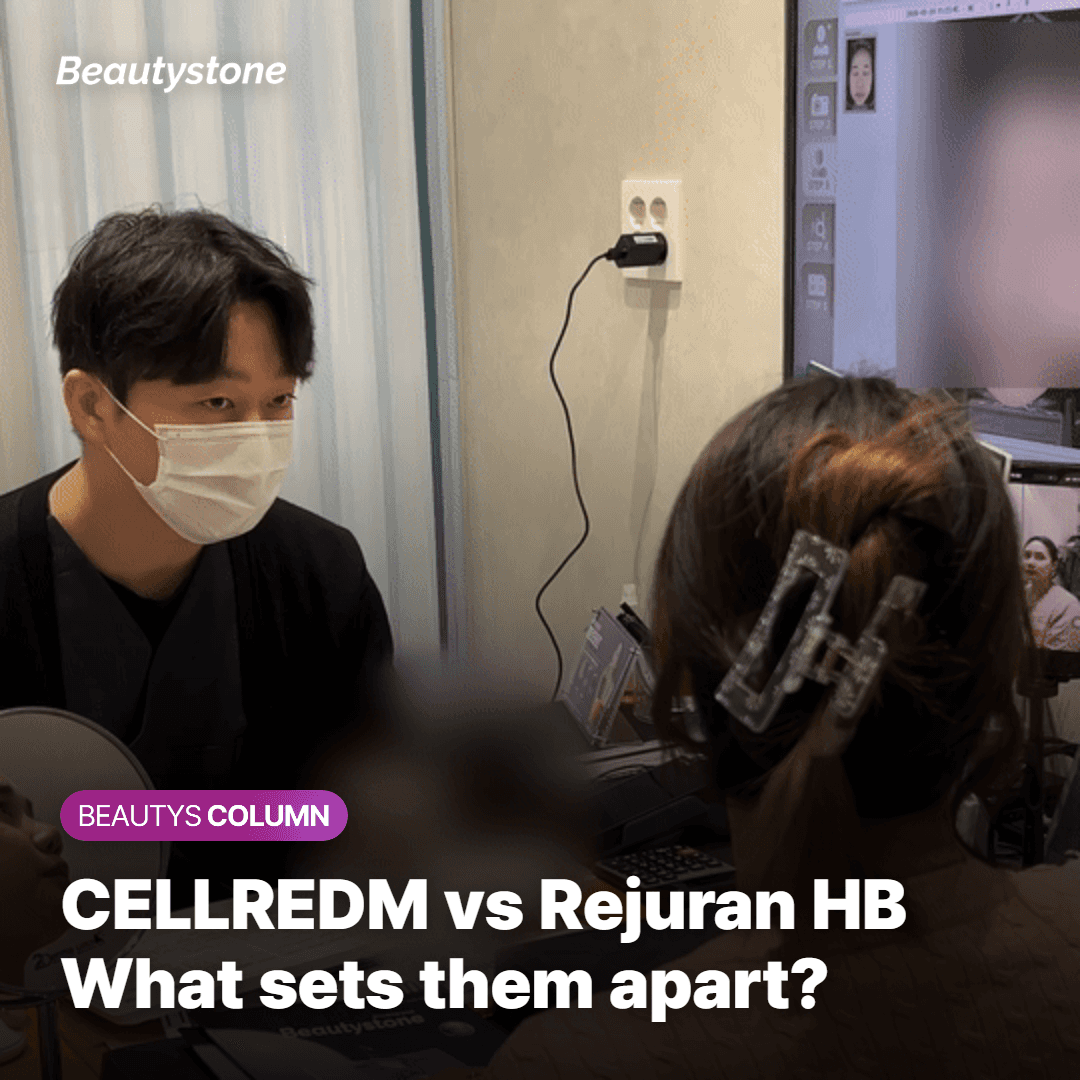
Both are sold as "skin-regeneration injections."
And everyone seems to talk about them the same way—regeneration, hydration, all of it.
So it is genuinely hard to tell them apart, right?
Here is the short answer first: just because a treatment is popular does not mean it suits everyone equally.
Today we will break these two down properly—plainly, and without overpromising.
One important note up front, since this matters for US readers: CELLREDM and Rejuran HB are Korean skin-booster products. As of June 2026 they are not FDA-approved in the United States and generally are not available there, so treat this as educational background rather than a US treatment menu. If you are in the US, talk to a licensed, board-certified provider about comparable, FDA-cleared or FDA-approved options. This is general information from Beautystone, a skin clinic in Seoul. Individual results may vary, and nothing here is medical advice. Last updated June 2026.
Read this first 💡
Q. CELLREDM and Rejuran HB—aren't they basically the same thing?
A. Not really. Their core ingredients are different. They sit in the same "regeneration injection" bucket, but how they work and what they are good for diverge.
Rejuran HB is PN-based (a polynucleotide, sometimes called "salmon DNA"). CELLREDM is ADM-based (a human acellular dermal matrix).
Q. Why are some people fine with Rejuran alone,
while others are steered toward CELLREDM?
A. It comes down to skin condition—especially whether you have lost volume. We break that down in the sections below.
Q. So which one should I pick in my case?
A. It splits by goal: hydration and bounce, versus volume restoration. We sort it out by type below.
Why these two products keep
getting confused for each other
One of the most common things I hear in the clinic is: "Doctor, are Rejuran and CELLREDM actually different? I heard both are good for the skin."
It is a fair question, and easy to get tangled up in.
Both are injectables, and both show up when you search "skin regeneration."
But here is the key point.
The two start from completely different ingredients.
Rejuran HB is built on PN (polynucleotide) extracted from salmon—essentially purified DNA fragments.
It works by signaling your skin cells to regenerate, and it is strong at smoothing texture and lifting hydration and elasticity.
CELLREDM, by contrast, is derived from a human acellular dermal matrix—
that is, the extracellular matrix (ECM) of collagen, elastin, and hyaluronic acid that remains after cells are stripped from donated human dermal tissue.
Because that structure closely resembles your own dermis, it can do more than just stimulate regeneration—it can also help support volume directly.
Simply put: Rejuran HB sends a "regenerate" signal to your skin cells,
while CELLREDM acts more like scaffolding that helps fill in the empty space within the skin's structure.
This difference matters because if your goal is different, your product choice should be too.
If regeneration and hydration are the main goals, Rejuran HB may be enough.
If age-related volume loss is what bothers you, CELLREDM is often the better fit. Individual results may vary.
👨⚕️ Dr. Wi Young-jin's bottom line
● If hydration and texture are your priority
Rejuran HB may be the right fit.
● If volume loss or hollow areas bother you
CELLREDM is the more sensible direction.
● If both apply to you
Some patients combine them.
More on that below.
Rejuran HB:
who is it actually right for?

The Rejuran line is already well known.
The HB version specifically adds hyaluronic acid to the formula.
On top of PN's regenerative effect, it is designed to boost hydration at the same time.
These are the cases where I typically suggest Rejuran HB:
Rough texture and not enough moisture
Fine lines and thinning skin as the main concern
As a supportive step to help skin recover after a resurfacing laser
General upkeep of overall skin condition
In my experience, Rejuran HB is usually placed at roughly 1–2cc for the full face per session,
and texture changes typically show after 3–4 sessions spaced about 4 weeks apart. Individual results may vary.
That said, it is not a cure-all.
The honest downside of Rejuran HB is that its direct volume-filling power is limited.
It clearly helps with regeneration and hydration, but if hollowness or sagging is the main issue, Rejuran HB alone often leaves something to be desired.
For texture and moisture, though, it remains a solid choice.
Is Rejuran HB worth it? Pros: gentle, good for texture and hydration, pairs well with other treatments. Cons: limited for true volume loss, and it is a series of sessions rather than one-and-done. On cost—because these are Korea-market products, prices are set per clinic and per region in Korea and do not map cleanly to a US price; PN/polynucleotide booster sessions in Korea often run on the order of a few hundred US dollars per session, but treat any figure as a rough ballpark that varies by provider and region, and confirm directly with the clinic. Remember Rejuran HB is not FDA-approved in the US.
👨⚕️ Dr. Wi Young-jin's bottom line
● Rejuran HB
Strong for hydration, regeneration, and texture
Limited for volume correction
Good for overall skin upkeep
● Treatment cadence
Roughly 3–4 sessions at 4-week intervals is the usual approach for meaningful texture change.
CELLREDM: why it is a different call
for skin that has lost volume
"Doctor, my skin looks dull and dry, and my cheeks feel hollow."
I hear this kind of concern often in the clinic.
In these cases, it is not simply a lack of moisture.
The structures within the dermis—collagen, elastin, and the extracellular matrix itself—have thinned, so the skin gets thinner and loses volume.
CELLREDM approaches this differently.
Because its human-dermis-derived components resemble the dermal structure,
once placed, it can provide physical volume support at the site while also nudging surrounding cells to regenerate.
Honestly, when I first came across this product, I was skeptical too.
It took me time to feel confident about whether human-derived components were safe and whether the volume difference was real.
After building up real cases, for patients whose main concern was hollow cheeks or lost volume in the forehead and temples,
CELLREDM tended to show a more noticeable change than Rejuran HB—though, again, individual results may vary.
These are the cases where I typically suggest CELLREDM:
Volume loss in specific areas—cheeks, forehead, temples
People who do not want fillers but still want some volume improvement
People who want dermal regeneration and volume support together
People whose main concern is a hollow look from thinning skin
In my experience, CELLREDM is usually placed at about 1–2cc per area, often over 2–3 sessions spaced 4–6 weeks apart.
Some patients notice a visible volume change as early as the first or second session—others do not. Individual results may vary.
One thing I should be upfront about: the downside is cost.
Compared with Rejuran HB, CELLREDM tends to carry a higher price per unit,
because the human dermal-matrix material itself costs more to produce.
For patients with a clear volume goal, though, the result often justifies the difference. Since CELLREDM is a Korea-market product not FDA-approved or generally available in the US, there is no standard US price—any number varies by clinic and country, so confirm directly.
For reference, the skin-regeneration treatments that pair well with CELLREDM are covered in our skin-booster guide by type, linked below, if you want to read on.
👨⚕️ Dr. Wi Young-jin's bottom line
● CELLREDM
Volume support and dermal regeneration at once
Higher cost
Best when volume loss is the main concern
● Rejuran HB
Centered on hydration, regeneration, and texture
Limited for volume correction
Best for overall skin upkeep
So what about doing
both together?
This is a common misconception: CELLREDM and Rejuran HB can absolutely be combined.
They are not competitors—they act on different layers of the skin.
It varies by case, but here is how I usually approach it.
For patients dealing with volume loss plus hydration or texture issues, I establish volume support first with CELLREDM,
then use Rejuran HB to fine-tune texture and moisture balance.
The tricky part is that when you do both at once, dosage and area allocation shift depending on which issue takes priority.
So if you are considering a combination, it helps to say clearly during your consultation what bothers you most right now.
When I combine the two, I build the volume structure first with CELLREDM, then layer Rejuran HB on top for added regeneration.
👨⚕️ Dr. Wi Young-jin's bottom line
● Combination order
CELLREDM (build volume structure) → Rejuran HB (add regeneration and hydration)
● Key point
If you need both, start by deciding which issue is more urgent.
Key summary
CELLREDM vs. Rejuran HB:
If your goal is hydration and regeneration, Rejuran HB fits. If your goal is volume restoration, CELLREDM is the better match. Both are Korean products that are not FDA-approved in the US—US readers should ask a licensed provider about comparable options.
Frequently asked questions
Q1. CELLREDM uses human-derived components—is it safe?
A. Some people feel uneasy when they hear "human dermis."
The human dermal matrix used in CELLREDM is fully decellularized—an acellular matrix—so the immune response is low.
Of course there are individual differences, so allergy history and related factors should be confirmed during the pre-treatment consultation.
Rather than calling it unconditionally safe, I recommend deciding based on your own condition after a proper consultation. (And note: it is not FDA-approved in the US.)
Q2. Rejuran HB and CELLREDM—
how long do the effects last?
A. In my experience, Rejuran HB's hydration and texture benefits often last around 3–6 months,
while CELLREDM's volume effect tends to last roughly 6 months to a year in many cases.
That said, it varies quite a bit with skin condition, lifestyle, and the area treated.
I avoid hard promises like "guaranteed for X months"—individual results may vary.
Q3. How is this different from fillers?
A. I get this one constantly.
CELLREDM offers volume support, but unlike a filler it does not create an immediate, dramatic volume change.
A filler injects hyaluronic acid to add volume right away, whereas CELLREDM reinforces the dermal structure and works more gradually toward restoring volume.
If you want immediate, pronounced volume, a filler is the better option. If you would rather improve the skin itself while restoring volume over time, CELLREDM fits better.
Either way, I recommend a thorough consultation before deciding.
Q4. Are these available in the US, and do they hurt?
A. Honest answer: CELLREDM and Rejuran HB are Korean products and, as of June 2026, are not FDA-approved and generally not available in the US—so most US patients cannot get these specific products at home. If you are in the US, ask a board-certified dermatologist about comparable, FDA-cleared or FDA-approved skin-rejuvenation options. As for comfort, these are injections, so expect mild stinging, small bumps, redness, or bruising that usually settle within a few days; most clinics use numbing cream. Seek prompt medical care for spreading redness, severe pain, fever, or signs of infection.
Have questions? Reach out anytime.
Talk to a provider before deciding
Want to know whether one of these is right for you? The best step is a one-on-one assessment with a qualified provider who examines your skin in person.
▶ Message the Beautystone clinic in Seoul
If you visited a clinic, it is also fine to book a quick follow-up with the provider who treated you.
— Dr. Wi Young-jin, Beautystone Clinic, Seoul
Related reading
▶Seoul LDM in Hongdae: does it actually help with 5 common skin concerns?
▶"Others got theirs gone in 5 sessions?"—the real reason your tattoo removal costs more
▶5 criteria for choosing a Hongdae dermatology clinic, from a specialist
▶What does Rejuran HB really do? The director compares it directly



Lifting
XERF for a Thin Face: Depth vs. Hollowing?

Lifting
Thread Lift Swelling: What's Normal in 5 Days?

Lifting
Thermage Cost: 4 Lines to Check on a Quote

Contouring & Volume
Xeomin Cost: Why Do 50-Unit Quotes Differ?

skin
Back Acne That Won't Clear? It Might Be Fungal

Tattoo removal
Bad Brow Tattoo: Cover It Up or Fade It First?