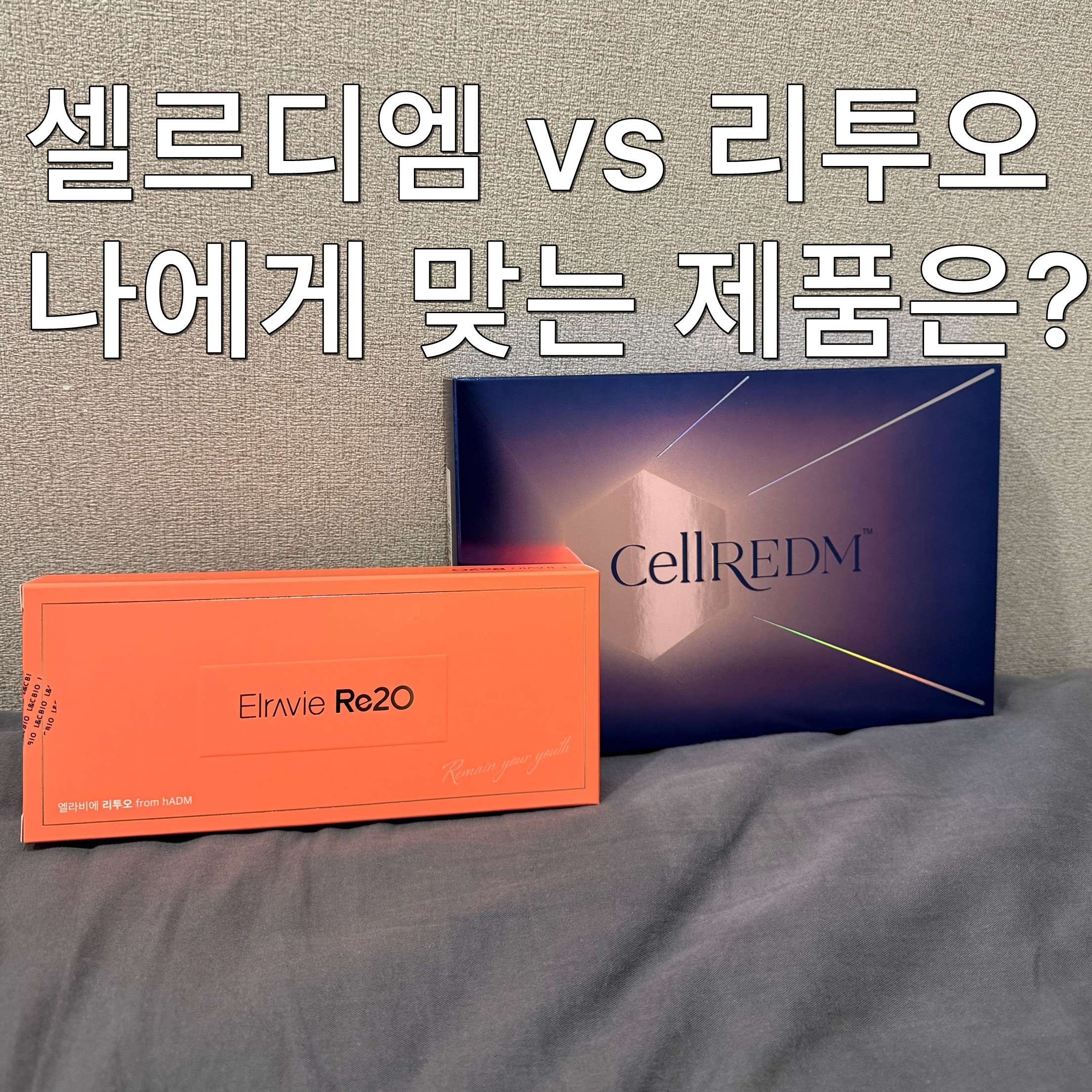
CELLREDM vs Re2O+G132: Which One Is Right for You?
Cellredm(ADM) boosts skin renewal & volume—see real case results & what to watch for.
5 Things to Know
Before a CellrDM Procedure
— The Real Conditions for
Regeneration & Volume Effects
There are countless CellrDM reviews floating around online,
some call it a "life-changing procedure,"
while others say, "Rejuran wins, no contest?"
Even though the same product is used,
why do such extreme differences occur?
The culprit isn't the device used for the treatment,
but your own 'skin environment.'
Just as a certain hairstyle
suits some people and not others,
there are people who specifically need CellrDM
— and they're a distinct group.
Today, I'll share clear criteria
and honestly explain from a doctor's perspective
what skin condition gives you results
that are actually worth the investment.
💡 Key Takeaways
Q. Is it actually effective for
regeneration and volume improvement?
A. Yes. That said, results can vary quite a bit depending on skin condition, treatment interval,
and application method.
Q. How is it different from
Rejuran or exosomes?
A. The ingredient base and mechanism of action differ.
They can be used in combination
or chosen on their own.
Q. Are there any downsides to CellrDM?
A. Yes.
One is that it uses allogeneic human dermis,
and it may fall short on hydration — more on that below.
I'll cover both honestly in the main text.
What CellrDM actually is
— Ingredients matter more than the name

I always say, start by checking
"what ingredients are in it."
CellrDM is derived from
allogeneic human dermis —
think of it as a reconstructed version
of the skin's structural foundation.
We're talking hyaluronic acid, collagen, and elastin.
Already in PubMed-indexed studies,
this material, originally used for tissue repair,
has shown consistent data supporting improvements
in elasticity and moisture retention.
With allogeneic dermal-derived
hyaluronic acid also included,
the formulation is designed to deliver not just regeneration, but volume and moisture retention
simultaneously.
The concentration blend, formulation stability,
and application technique
are what set it apart from other PN products.
👨⚕️ Dr. Wi Youngjin's Clinical Notes:
In my experience, CellrDM tends to work well for
those with significantly diminished skin regeneration,
as well as those beginning to show superficial volume loss and reduced elasticity.
These patients have responded well.
I typically set 1–3 sessions
at 4-week intervals as the baseline,
followed by maintenance
roughly once a quarter
to preserve elasticity and volume.
During periods of active acne inflammation,
the timing will need to be adjusted.
CellrDM vs. Rejuran
— Honestly, what's the difference?

Rejuran is PN.
CellrDM is ADM.
If Rejuran zeroes in on cell regeneration itself,
CellrDM leans more toward delivering regeneration + immediate volume
together.
Here's the nuance though — it's hard to say
one is simply better than the other.
The right choice depends on your skin condition.
That's why I often build the regenerative foundation first,
then layer in volume support —
a combined approach
.
Who is it right for,
and who should skip it?

![[실전 가이드] 재생에 집중할까, 얕은 볼륨까지 채울까? 상황별 시술 선택 공식](https://framerusercontent.com/images/CcL2s2kTzuYCaAJjMrxCKoVyVY.jpg)
Recommended for:
Those with reduced skin elasticity and a dull complexion
Those needing fine wrinkle care around the eyes and lips
Those beginning to notice mild volume loss in the cheeks
Those needing quick skin recovery after laser treatments
A different approach may be needed for:
Significant deep volume loss from fat tissue depletion (filler recommended)
Gravity-related skin sagging (lifting recommended)
Periods with active acne inflammation
Key Summary
CellrDM excels at regeneration and superficial volume improvement,
but is not suited for deep sagging or significant hollowing.
The downsides, honestly
— things you really should know upfront
That said, this isn't without its drawbacks.
First: how long the effects last.
It's not a permanent, one-time fix —
in my experience, after peaking around
4–8 weeks, results gradually fade.
Second: cost. ^^..
With 3–4 sessions as the standard,
factor in the total cost from the start.
Third: the immediate post-procedure response.
As an injectable, minor bleeding or swelling
can last around 2–3 days.
That said, it's far gentler than lasers
and pairs well with other procedures —
which is a clear advantage.
Frequently Asked Questions (FAQ)
Q1. Can regeneration and volume improvement
happen at the same time?
A. Yes. Volume improvement is felt early on,
while regeneration builds gradually over sessions.
Just keep in mind that the timelines are different.
Q2. How many sessions do I need?
A. In my experience, you need at least 3 sessions to notice a real difference.
Response speed varies by skin baseline, so a proper assessment comes first.
Q3. Can I combine it
with other procedures?
A. Yes — combining it after energy-based treatments (such as lasers)
for recovery purposes works very well together.
If you have any questions,
feel free to reach out via KakaoTalk.
This has been Dr. Wi Youngjin.
Further Reading
▶Beard laser hair removal: how many sessions until you're truly done?
▶[Beautystone] Why you shouldn't get jaw botox every 3 months
▶Peanut-shaped face: will temple filler help? Radiesse longevity & side effects — the facts
▶Top 10 questions about Shurink Universe, answered by the doctor
▶[Dr. Wi Youngjin] Juvelook longevity: the real story, not the ads.
5 Things to Know
Before a CellrDM Procedure
— The Real Conditions for
Regeneration & Volume Effects
There are countless CellrDM reviews floating around online,
some call it a "life-changing procedure,"
while others say, "Rejuran wins, no contest?"
Even though the same product is used,
why do such extreme differences occur?
The culprit isn't the device used for the treatment,
but your own 'skin environment.'
Just as a certain hairstyle
suits some people and not others,
there are people who specifically need CellrDM
— and they're a distinct group.
Today, I'll share clear criteria
and honestly explain from a doctor's perspective
what skin condition gives you results
that are actually worth the investment.
💡 Key Takeaways
Q. Is it actually effective for
regeneration and volume improvement?
A. Yes. That said, results can vary quite a bit depending on skin condition, treatment interval,
and application method.
Q. How is it different from
Rejuran or exosomes?
A. The ingredient base and mechanism of action differ.
They can be used in combination
or chosen on their own.
Q. Are there any downsides to CellrDM?
A. Yes.
One is that it uses allogeneic human dermis,
and it may fall short on hydration — more on that below.
I'll cover both honestly in the main text.
What CellrDM actually is
— Ingredients matter more than the name

I always say, start by checking
"what ingredients are in it."
CellrDM is derived from
allogeneic human dermis —
think of it as a reconstructed version
of the skin's structural foundation.
We're talking hyaluronic acid, collagen, and elastin.
Already in PubMed-indexed studies,
this material, originally used for tissue repair,
has shown consistent data supporting improvements
in elasticity and moisture retention.
With allogeneic dermal-derived
hyaluronic acid also included,
the formulation is designed to deliver not just regeneration, but volume and moisture retention
simultaneously.
The concentration blend, formulation stability,
and application technique
are what set it apart from other PN products.
👨⚕️ Dr. Wi Youngjin's Clinical Notes:
In my experience, CellrDM tends to work well for
those with significantly diminished skin regeneration,
as well as those beginning to show superficial volume loss and reduced elasticity.
These patients have responded well.
I typically set 1–3 sessions
at 4-week intervals as the baseline,
followed by maintenance
roughly once a quarter
to preserve elasticity and volume.
During periods of active acne inflammation,
the timing will need to be adjusted.
CellrDM vs. Rejuran
— Honestly, what's the difference?

Rejuran is PN.
CellrDM is ADM.
If Rejuran zeroes in on cell regeneration itself,
CellrDM leans more toward delivering regeneration + immediate volume
together.
Here's the nuance though — it's hard to say
one is simply better than the other.
The right choice depends on your skin condition.
That's why I often build the regenerative foundation first,
then layer in volume support —
a combined approach
.
Who is it right for,
and who should skip it?
![[실전 가이드] 재생에 집중할까, 얕은 볼륨까지 채울까? 상황별 시술 선택 공식](https://framerusercontent.com/images/CcL2s2kTzuYCaAJjMrxCKoVyVY.jpg)
Recommended for:
Those with reduced skin elasticity and a dull complexion
Those needing fine wrinkle care around the eyes and lips
Those beginning to notice mild volume loss in the cheeks
Those needing quick skin recovery after laser treatments
A different approach may be needed for:
Significant deep volume loss from fat tissue depletion (filler recommended)
Gravity-related skin sagging (lifting recommended)
Periods with active acne inflammation
Key Summary
CellrDM excels at regeneration and superficial volume improvement,
but is not suited for deep sagging or significant hollowing.
The downsides, honestly
— things you really should know upfront
That said, this isn't without its drawbacks.
First: how long the effects last.
It's not a permanent, one-time fix —
in my experience, after peaking around
4–8 weeks, results gradually fade.
Second: cost. ^^..
With 3–4 sessions as the standard,
factor in the total cost from the start.
Third: the immediate post-procedure response.
As an injectable, minor bleeding or swelling
can last around 2–3 days.
That said, it's far gentler than lasers
and pairs well with other procedures —
which is a clear advantage.
Frequently Asked Questions (FAQ)
Q1. Can regeneration and volume improvement
happen at the same time?
A. Yes. Volume improvement is felt early on,
while regeneration builds gradually over sessions.
Just keep in mind that the timelines are different.
Q2. How many sessions do I need?
A. In my experience, you need at least 3 sessions to notice a real difference.
Response speed varies by skin baseline, so a proper assessment comes first.
Q3. Can I combine it
with other procedures?
A. Yes — combining it after energy-based treatments (such as lasers)
for recovery purposes works very well together.
If you have any questions,
feel free to reach out via KakaoTalk.
This has been Dr. Wi Youngjin.
Further Reading
▶Beard laser hair removal: how many sessions until you're truly done?
▶[Beautystone] Why you shouldn't get jaw botox every 3 months
▶Peanut-shaped face: will temple filler help? Radiesse longevity & side effects — the facts
▶Top 10 questions about Shurink Universe, answered by the doctor
▶[Dr. Wi Youngjin] Juvelook longevity: the real story, not the ads.
Recommended post
Recommended post
Latest post
Latest post

Contouring & Volume
팔자주름, 선이 문제가 아닙니다! 필러로 '그늘'을 지워야 하는 이유
팔자주름 필러, 어떤 원리로 어려 보이게 만들까요? 꺼진 부위에 생기는 그늘과 필러 탄성의 관계를 알기 쉽게 설명합니다.

skin
기미 레이저, 세게 쏠수록 잘 빠진다? "오히려 더 진해질 수 있습니다"
기미 치료, 강한 레이저가 능사가 아닙니다. 뿌리 깊은 기미일수록 약한 에너지로 반복 토닝해야 하는 이유를 원리부터 설명합니다.

Hair Removal
다리 제모 싸다고 덥석 결제하면 사실 손해인 이유
레이저 제모는 금액이아닌 효과를 중점적으로 봐야합니다. 다리 제모 레이저는 왜 5회 이상 필요할까요? 왜 에너지와 파장이 중요한지. 알려드립니다.


Hair Removal
남자 제모, 병원마다 결과가 다른 진짜 이유는?
홍대 남자제모 피부과를 찾는다면 레이저 장비 차이부터 확인해야 합니다. 피부 타입에 맞춘 파장 설정이 효과와 부작용 여부를 가릅니다.

Contouring & Volume
턱선 보톡스, 진짜 어디에 맞는 건지 아세요?
턱선 보톡스의 핵심은 광대나 저작근이 아닌 경광근(platysma) 억제에 있습니다. 원리와 적합한 대상을 정리했습니다.


Contouring & Volume
Jaw Botox 60U: Don’t believe the claim that more is always better.
Why 60U of jaw Botox is not simply a "large dose." The clinic director personally explains the appropriate dosage 기준 and the differences in effects by gender and body type.

![[Beauty Stone] How to Avoid Failing at Dark Circle Filler? "The Precision of 0.3cc Changes the Results"](https://framerusercontent.com/images/F4Q84TUWgjbZJV6MNheLnWHnaw.jpg?width=1080&height=1080)