

CellREDM or Re2O? How the two human-ADM boosters differ, and how to choose the right one.
Published -
Updated -

Author
Wi Young-jin · Chief director
Seoul National University College of Medicine · Seoul National University Hospital Specialist
→
One of the most common questions we hear right now sounds simple: "CellREDM or Re2O — which one should I get?" It's a fair question, and the honest answer is less satisfying than a clean winner. These two aren't rival philosophies. They sit in the same young category of injectables, they work on the same premise, and the gap between them is narrower than the marketing suggests. In this article, we'll break down what acellular dermal matrix actually is, where the two genuinely differ, how the category compares with the collagen stimulators you already know, what recovery looks like, and how to price it out without a number pulled from thin air.
What Is an ADM Injectable, and How Does It Work?
It supplies dermal scaffolding material directly rather than relying purely on your skin to manufacture more of it. That's the whole pitch, and it's a genuine departure from how most injectable boosters operate.
ADM stands for acellular dermal matrix — human dermal tissue processed to strip out the living cells, leaving only the structural scaffolding behind. That scaffolding is the part your skin cares about: collagen, elastin, and glycosaminoglycans (GAGs), the components that give the dermis its bounce and resilience. "Acellular" simply means the cells have been removed.

In aging skin, the dermis — the thick middle layer under the epidermis — gradually loses collagen density, elastin quality, and GAG-bound water. The scaffold thins out. Most injectable boosters address this indirectly: they introduce a material your body reacts to, and that reaction eventually produces new collagen.
ADM boosters take a more literal route. Processed matrix particles are placed into the dermal plane, where they deliver collagen, elastin, and GAGs as physical material. Your skin still has to integrate what's been delivered — this isn't an instant swap — but the starting inventory is different. Practitioners often describe the difference as replenishing versus stimulating.
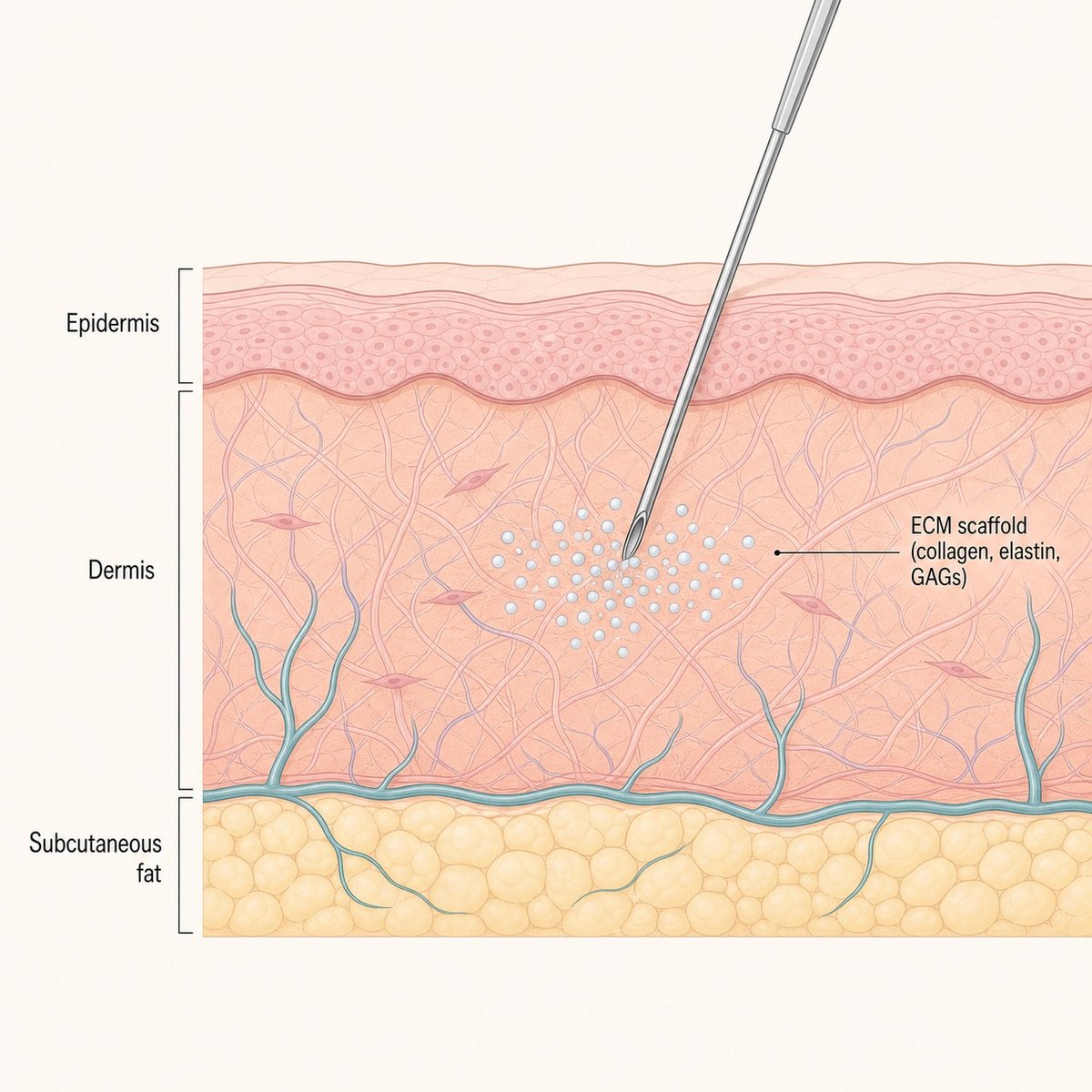
One caveat, stated plainly: that's a mechanism description, not an outcome promise. Studies suggest scaffold-based materials integrate into the dermis over a period of weeks, but published head-to-head research on these two specific products is still thin. Individual results vary.
CellREDM vs. Re2O: What Actually Differs
Manufacturer, particle size, and ECM content — that's the honest list. Everything else about the two is broadly shared.
CellREDM | Re2O (Elravie Re2O) | |
|---|---|---|
Manufacturer | HansBiomed | L&C Bio (distributed by Humedix) |
Core material | Human acellular dermal matrix | Human acellular dermal matrix |
Particle size | 75µm | 100µm |
ECM content | 160mg | 150mg |
Certification noted | AATB-certified | Confirm with your clinic |
Mechanism | Direct dermal replenishment | Direct dermal replenishment |
On particle size: CellREDM's 75µm is finer than Re2O's 100µm. In injectable materials generally, finer particles tend to spread more evenly through delicate tissue. That's a general principle, not a verdict on either product — the practical difference depends on the area treated, the depth, and the injector's technique.
On ECM content: 160mg versus 150mg is roughly a seven percent gap. It's a real number, but not the kind of margin that should decide your treatment on its own. Concentration matters less than placement.
On certification: CellREDM is described as AATB-certified, referring to standards for human tissue banking. For a human-derived product, sourcing is a reasonable thing to care about — ask your clinic to walk you through the documentation for whichever product they use. Don't accept a shrug.
The takeaway: these are siblings, not rivals. If someone hands you an absolute answer without looking at your skin first, that's a signal about the clinic, not the products.

How Do ADM Boosters Compare With Rejuran, Juvelook, and Sculptra?
Different mechanism entirely — replenishment rather than stimulation. Here's the practical breakdown.
Collagen stimulators (Sculptra, Juvelook): PLLA and PDLLA materials that trigger a controlled response. Your own fibroblasts do the building, which is why results emerge over months.
CaHA-based products (Radiesse): calcium hydroxylapatite microspheres that add immediate structure while also prompting collagen activity over time.
PN-based boosters (Rejuran): polynucleotide products that support skin quality and repair signaling rather than adding structural bulk.
ADM boosters (CellREDM, Re2O): supply dermal scaffolding directly — the material arrives already assembled rather than being manufactured on site.
None of these is the superior category. They solve different problems, and practitioners frequently treat them as complementary. Someone with thinning texture and someone with genuine volume loss aren't candidates for the same product, and a good consultation starts there rather than at the brand name.
What to Expect: Session and Timeline
Day of treatment: topical numbing first, then injection with a fine needle or cannula depending on the zone. The session itself is brief. Small raised points, redness, and swelling afterward are normal and typically settle within a day or two.
First 48 hours: skip saunas, hot yoga, intense workouts, and alcohol. Keep the area clean and don't press or massage unless your provider tells you to. Sunscreen is non-negotiable. Makeup is usually fine once injection points have closed.
Weeks one through four: the quiet stretch where nothing dramatic seems to happen. Delivered matrix integrates gradually, so changes in texture appear progressively rather than on a fixed date.
Longer term: most boosters in this space are planned as a course rather than a one-off, with intervals set by your practitioner. Individual results vary — skin condition, age, and how your body responds all move the timeline.
Side Effects, Risks, and Downtime
Downtime is generally short, but it isn't zero, and a human-derived material deserves a straight account of what can happen.
Common and expected: redness, mild swelling, tenderness, small injection-point bumps, and occasional bruising. These typically settle within a few days.
Less common: firmer areas or palpable lumps if material settles unevenly. Tell your provider — don't try to massage it out on your own.
Uncommon but serious: infection at injection sites, or an inflammatory reaction. Any injectable that breaks the skin carries this risk.
Here's the escalation rule, and it's worth remembering: if you develop a fever, spreading redness, increasing pain rather than improving pain, or any discoloration that looks like it's traveling outward from an injection site, seek medical care right away. Don't wait for a scheduled follow-up.
Two more things before you book. Tell your provider about your full medical history, including autoimmune conditions, active skin infections, pregnancy, and anything you're taking that affects bleeding. And because ADM products are human-derived, ask directly about tissue sourcing standards. A clinic that treats that question as an inconvenience is telling you something.
What Drives the Price
We're not going to quote you a figure, because a number lifted from a random blog is worse than no number at all. What we can do is explain what moves it.
Product and brand: CellREDM and Re2O are priced independently by their manufacturers and distributors, and clinic acquisition costs differ.
Volume used: how much material your plan calls for is the biggest single driver.
Treatment area: a full face prices differently than a targeted zone like the under-eye area or neck.
Number of sessions: most plans run as a course, so the meaningful figure is the total, not the per-visit number.
Who's injecting: practitioner experience is a legitimate cost variable, and usually the one worth paying for.
The only figure that means anything is the itemized quote you get after an in-person assessment. Ask for it in writing, ask what's included, and ask what a full course looks like rather than just the entry price for one session.
Who's a Good Candidate?
ADM boosters tend to suit people whose main concern is dermal quality — thinning skin, crepey texture, fine lines, a general loss of density — rather than pronounced sagging or significant volume loss.
You might be a reasonable fit if:
Your skin has lost density and firmness rather than dropping in position
You've tried hydration-focused boosters and want something that addresses structure
You're comfortable with a gradual curve rather than an immediate visible change
You're prepared to commit to a planned course rather than a single session
You may want to look elsewhere if:
Your primary concern is jowling or sagging — usually a lifting conversation, not a booster one
You need meaningful volume restored in hollow areas, where a volumizing approach may fit better
You have an active skin infection or inflammation in the treatment area
You're uncomfortable with human-derived materials, which is a valid preference to state up front
On choosing between the two specifically: the most useful input isn't a spec sheet, it's a practitioner who works with both and can tell you which they'd use on your face and why.
The Bottom Line
Same category, not rivals: CellREDM and Re2O are both human-ADM boosters that supply dermal scaffolding directly rather than only stimulating it.
The real differences are narrow: 75µm/160mg versus 100µm/150mg, plus different manufacturers and certification documentation.
Different from stimulators: this category replenishes rather than prompting your skin to rebuild, which is why it's often positioned alongside — not against — PLLA, CaHA, and PN products.
Price comes from a quote, not an article: product, volume, area, session count, and injector all move it.
Like any injectable, this comes with trade-offs, and the category is young enough that long-term comparative data is still limited. Individual results vary. Ultimately, the choice depends on your skin, your goals, and your budget — not on which product has the more impressive spec sheet.
If you're weighing CellREDM against Re2O, a consultation is the fastest way to find out which one actually fits. Beautystone is a dermatology clinic in Seoul's Hapjeong area — you can see current offers at /en/promotion.
Frequently asked questions
Q. Is CellREDM or Re2O better?
A. Neither is universally better. They're both human-ADM boosters that work by supplying dermal scaffolding directly. CellREDM uses a 75µm particle size with 160mg of ECM content; Re2O uses 100µm with 150mg. The gap is narrow enough that the right pick depends on your skin and your practitioner's assessment rather than the spec sheet. Individual results vary.
Q. Does an ADM booster injection hurt?
A. Most people describe it as manageable. Your provider will apply topical numbing cream first, and the injections themselves are quick. You'll likely feel pressure and small pinpricks, with more sensitivity in thin-skinned areas like around the eyes. Tenderness afterward is normal and usually settles within a day or two.
Q. How long before I see a difference?
A. Gradually, over weeks rather than days. The first 48 hours are mostly about swelling and redness settling. Changes in texture and skin quality typically emerge across the following few weeks as the delivered material integrates. Most plans run as a course of sessions, so the fuller picture usually takes longer than one visit. Individual results vary.
Q. What does a session cost?
A. There's no single figure worth quoting, because it moves with the product, the volume used, the treatment area, how many sessions your plan calls for, and who's injecting. Ask your clinic for an itemized quote after an in-person assessment, and ask what a realistic full course costs rather than just the entry price.


Hair Removal
레이저 제모 1회에도 남는 몫이 있어요 — 밀도를 모자이크로 보는 법

Tattoo removal
Why Extremity Tattoos Are Slower to Remove

Tattoo removal
Tattoo Removal Cost: Why Quotes Vary by Area

Tattoo removal
Unused Tattoo Removal Sessions: What Happens?

Lifting
Forehead Thread Lifting: How Far Can It Go?

skin
Skin Booster Prices: What to Check in a Quote