

Dermatologist reveals laser hair removal sessions, pain & aftercare truths. Find your clinic now.
Published -
Updated -

Author
Wi Young-jin · Chief director
Seoul National University College of Medicine · Seoul National University Hospital Specialist
→
Hello! This is Dr. Wi Young-jin,
director of Hapjeong Beautystone, graduate of Seoul National University College of Medicine.
Today, I would like to comprehensive guide you on
male laser hair removal,
a treatment we've been getting a high volume of inquiries about lately.
✦ Recommended Read
▶GentleMax Pro Plus Principle, Effects, and Side Effects A to Z
▶Preventing folliculitis after beard hair removal with just 3 rules
▶The real reason why male hair removal is challenging (from a director's personal experience)
"I'm so tired of shaving daily, maybe I should endure it just one more time..."
Has this thought ever crossed your mind?
This is actually one of the most common
concerns I hear from our clients. 😅
Constantly shaving, waxing, or using depilatory creams...
Doing this repeatedly can really exhaust your skin
not to mention the precious time wasted.
That is why so many people are
opting for laser hair removal these days.
However, when you search online, the overwhelming amount of information
can make it difficult to know what to trust.
Today, I'll explain it clearly and transparently
from my professional perspective as an SNU board-certified dermatologist.
(And also as someone who has personally received the treatment!)
🔗 Helpful Articles to Read
Why we are known as the go-to clinic for laser hair removal in Hongdae
The real reason you should start hair removal in the winter
Laser Hair Removal, Targeting the Stem Cells.
Laser hair removal works by concentrating
laser heat energy directly on the hair roots (follicles),
thereby destroying the cells responsible for hair growth.
Simply put,
it eliminates the 'seed' of the hair.
Crucially, the laser is highly responsive
to dark pigment (melanin).
Therefore, the darker and thicker your hair is, and the lighter your skin tone is,
the more effective and pronounced the results will be.
It is highly recommended for:
Individuals with thick and dark hair
Those who experience severe skin irritation after waxing
Those prone to frequent folliculitis (hair follicle inflammation) after shaving
We receive a lot of inquiries, especially from our clients in their 20s and 30s
living in the Hongdae, Hapjeong, and Mapo areas.
The key is to receive a personalized consultation and
select the laser equipment that best suits your skin type.
💬 FAQ 1
Q. Is laser hair removal permanently effective?
A. Complete, absolute permanent hair removal is difficult to achieve.
However, after a recommended number of sessions,
the hair becomes extremely fine or stops growing back almost entirely.
'Semi-permanent hair removal' is a much more accurate term.
Q. Can I still receive the treatment if I have a dark skin tone?
A. It depends on the equipment.
We have specialized, relatively safe lasers for darker skin tones,
such as the Long-pulsed Nd:YAG laser.
Please make sure to mention this during your consultation.
How many sessions are needed? Summary of Sessions and Intervals
Area | Average Sessions | Recommended Intervals | Treatment Focus |
|---|---|---|---|
Underarms | 5-7 sessions | 4-6 weeks | High hair volume leads to noticeable early results |
Legs & Arms | 6-8 sessions | 6-8 weeks | Broad area requires even, uniform laser delivery |
Face & Upper Lip | 6-10 sessions | 4 weeks | Abundant fine hair requires more sessions; gentleness is key |
Brazilian Area | 6-10 sessions | 4-6 weeks | Thinner skin requires extra care for pain and sensitive management |
※ Even with the same device, the required sessions may vary depending on the area, hair volume, and skin tone. Choosing a clinic in the Hongdae/Hapjeong area that is convenient to visit consistently will help you keep up with recommended intervals, ultimately saving you total sessions.
Occasionally, some clients get disappointed after just one session,
wondering, "Why hasn't it all gone away?"
But to be completely honest,
no laser hair removal is completed in just a single session.
(I like to be transparent with my clients! 😊)
Hair goes through three growth phases:
Anagen (growth), Catagen (regression), and Telogen (resting).
The laser only targets hair currently in the active growing (Anagen) phase.
This is why you generally need to receive
6 to 10 sessions consistently every 4 to 8 weeks.
It varies by treatment area:
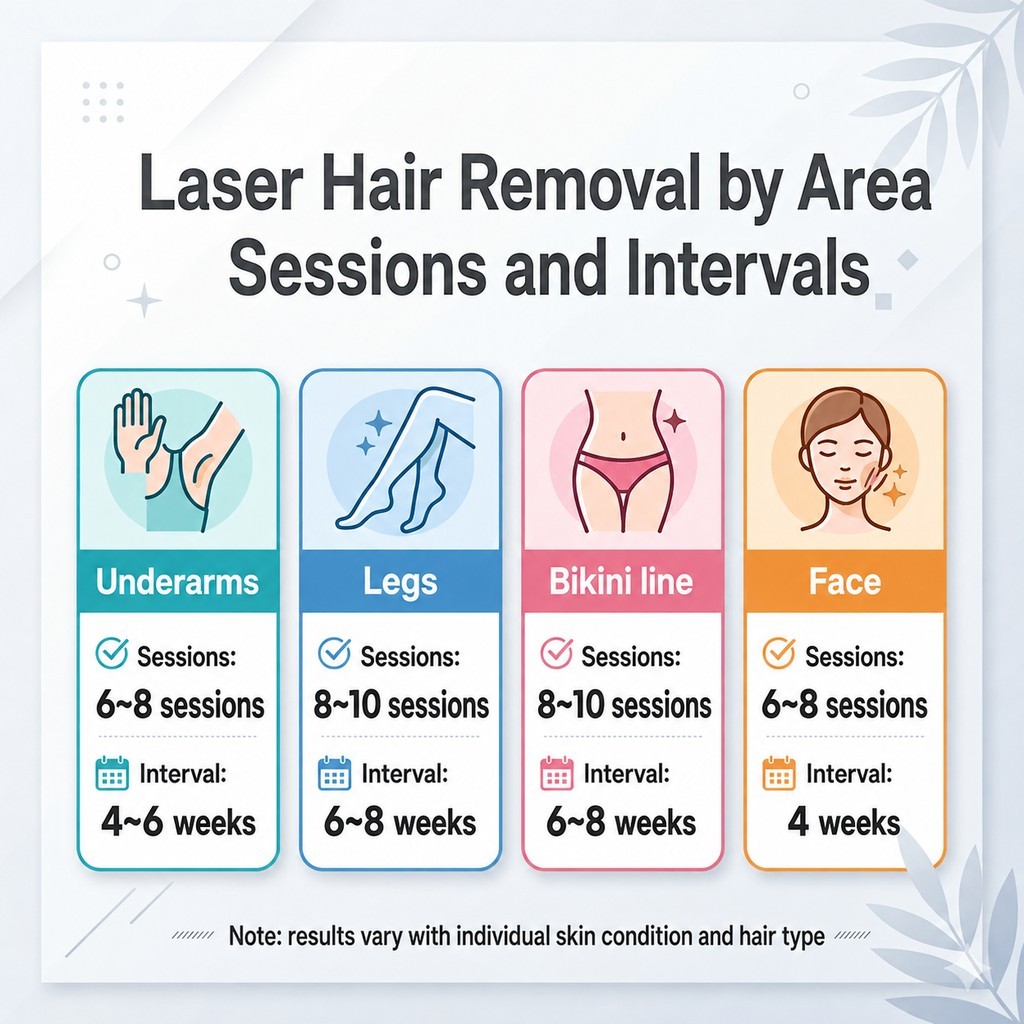
For male facial hair, a 2-week interval is also perfect.
You do not necessarily have to do 10 sessions.
Even with just 5 sessions, you will notice the hair density is reduced by more than half!
💬 FAQ 2
Q. If I miss one schedule,
do I need to start all over again from the beginning?
A. No, you do not need to restart from the beginning.
However, if the gap between sessions becomes too long,
the treatment efficiency might decline slightly.
Q. Is it bad to receive the treatment in the summer?
A. Older generations of devices required avoiding summer
due to UV radiation exposure.
But with modern, advanced devices,
you can safely get treated regardless of the season
as long as you apply sunscreen diligently.
In fact, starting early in preparation for summer is a very smart choice!
Essential Guide for
Before & After Laser Hair Removal
While receiving the procedure is crucial,
proper before & after care determines the final result.
Pre-Treatment Instructions
Please shave 1 to 2 days prior to your visit.
(Do not wax or use hair removal creams)
Avoid using lotions, oils, or perfumes on the treatment area on the day of treatment.
Please avoid tanning (excessive UV exposure)
for at least 2 weeks leading up to your session.
Post-Treatment Instructions
Avoid hot baths, saunas, or intense exercise on the day of the procedure.
Apply sunscreen meticulously (SPF 50 or higher).
Do not rub or scratch the treated area harshly.
Avoid swimming pools and public bathhouses for up to one week.
Please keep these in mind, as neglecting post-treatment care
is a major cause of developing unwanted folliculitis.
Our clinic is highly accessible,
whether you are visiting from Hongdae, Seoul, Ilsan, or Gyeonggi!
💬 FAQ 3
Q. Is redness or slight swelling normal after the session?
A. Yes, mild redness or a tingling sensation
immediately after treatment is a very natural response.
This typically subsides within a few hours.
However, if you develop blisters or experience severe pain,
please contact our clinic immediately.
Q. Can I receive the treatment during pregnancy?
A. Laser hair removal is not recommended during pregnancy.
We suggest receiving treatments only during the pre-pregnancy planning phase.
Q. I developed folliculitis after my session,
is this okay?
A. Occasionally, you may notice temporary redness
or tiny bumps around the hair follicles after the treatment.
Most cases resolve naturally on their own. But if they worsen,
it is best to visit our clinic to have it examined.
Please do not squeeze or pick at them!
[Conclusion]
Understanding the process beforehand
will lead to much more satisfying laser hair removal results.
The number of sessions, the intervals, and before & after care—
ultimately, choosing the right device for your skin type and
following proper post-care is the key to success.
Instead of worrying alone,
feel free to ask me, Dr. Wi Young-jin, directly.
I am always happy
to answer any of your questions warmly. 😊
Experience a friendly consultation at
Beautystone Hongdae.
👉 [Click here to book a consultation at Beautystone Hongdae]
`Hongdae Laser Hair Removal`, `Laser Hair Removal Clinic`, `Hapjeong Laser Hair Removal`, `Mapo Hair Removal`, `Seoul Dermatology Hair Removal`, `Laser Hair Removal Sessions`, `Laser Hair Removal Precautions`
Consultation via WhatsApp
If you are wondering if this treatment is right for you, our medical director is here to consult with you directly.
▶ Start a 1:1 WhatsApp Consultation


Hair Removal
레이저 제모 1회에도 남는 몫이 있어요 — 밀도를 모자이크로 보는 법

Tattoo removal
Why Extremity Tattoos Are Slower to Remove

Tattoo removal
Tattoo Removal Cost: Why Quotes Vary by Area

Tattoo removal
Unused Tattoo Removal Sessions: What Happens?

Lifting
Forehead Thread Lifting: How Far Can It Go?

skin
Skin Booster Prices: What to Check in a Quote