

How Radiesse Skin booster works, how it differs from standard Filler and boosters, and who it suits.
Published
Updated

Author
Wi Young-jin · Chief director
Seoul National University College of Medicine · Seoul National University Hospital Specialist
→
Radiesse Skin Booster, is it the same as filler?
I’m Director Wi Young-jin of Beautys Doctors.
💡 Please check this before reading
Q. Is the Radiesse Skin Booster just Radiesse filler diluted and spread over the face?
A. No. It is a separate procedure concept, where Radiesse is diluted to a specific ratio and redesigned for the purpose of collagen induction.
Q. How is it different from existing skin boosters (Juvelook, Rejuran, etc.)?
A. The main ingredients themselves are different. Since the CaHA (calcium hydroxyapatite) microparticles induce collagen synthesis in the dermis, the depth of action and duration are different.
📌 Key point of this article
What does it mean to use Radiesse as a skin booster? Understanding liquid Radiesse properly
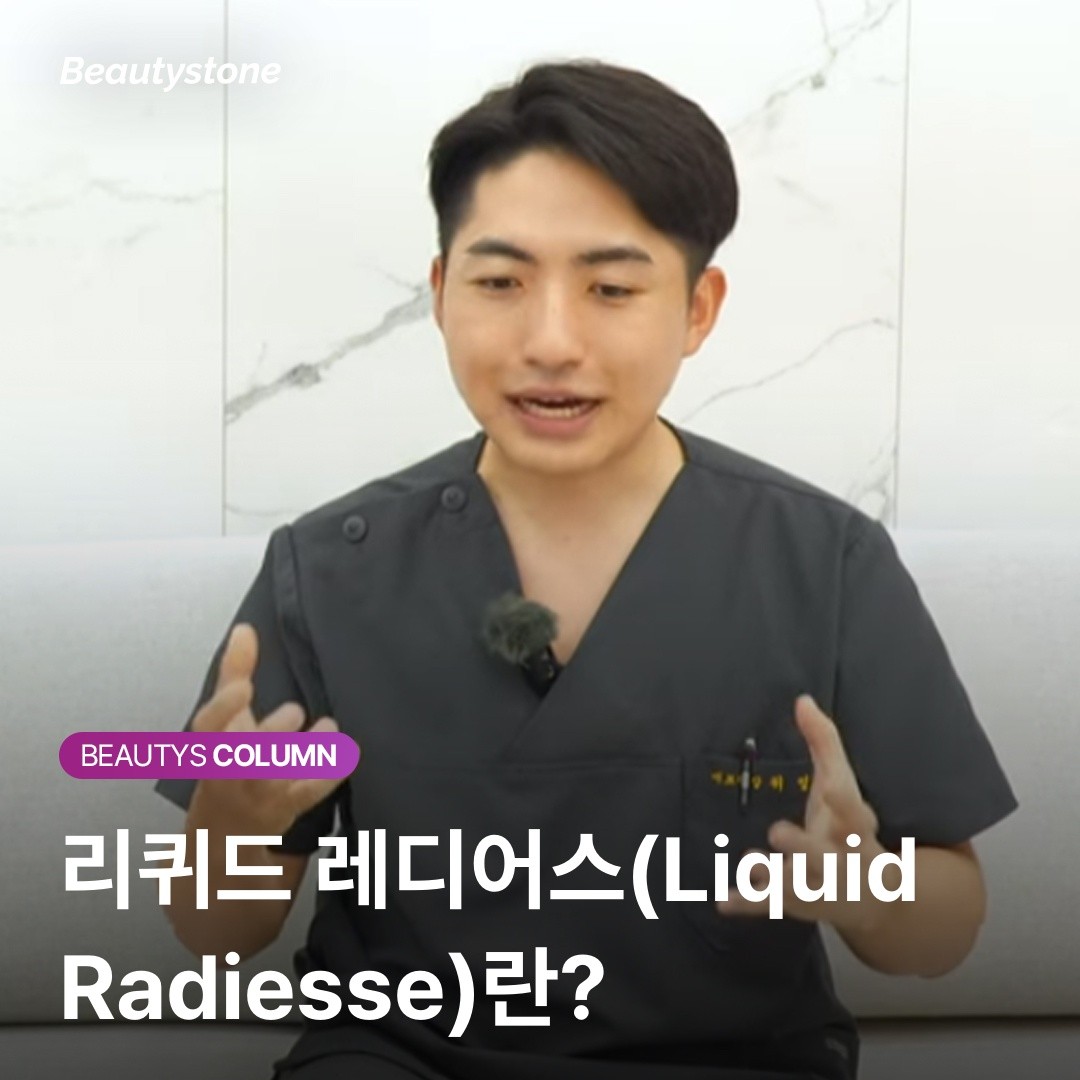
What is Radiesse?
Radiesse is
Radiesse diluted with normal saline or lidocaine
at a certain ratio
to stimulate collagen production throughout the skin,
a biostimulating skin booster procedure.
It is mainly performed on areas such as the backs of the hands, neck, and around the mouth, where fine lines appear easily,
and on areas where blood vessels are visible.
“If it’s the same Radiesse, why is the effect different?”
This is the question I get the most.
To be honest,
it is the same medication.
The CaHA microparticles, the main ingredient of Radiesse filler,
are exactly the same.
But there is one important thing here.
In filler form, Radiesse has
CaHA particles clumped together at a high concentration
inside a CMC gel.
So when injected, it creates “volume” in one place.
Liquid Radiesse dilutes this.
Usually, depending on the case, it is mixed at ratios from 1:1 to 1:4,
and in this way, the CaHA microparticles
are evenly distributed over a wide area.
These dispersed particles
stimulate dermal fibroblasts.
Fibroblasts are like factories that make collagen and elastin,
and as CaHA spreads around these cells,
it sends a signal saying, “Let’s get to work.”
Simply put, it works like this.
Filler = clump particles together to create volume
Liquid = scatter the particles to induce collagen
Even if you use the same material,
if the concentration and distribution method change,
the way the skin responds
changes as well.
The reason I began introducing this procedure in earnest was
that among people who expected elasticity improvement with
Juvelook or Rejuran,
there were quite a few saying,
“It works a bit, but something is still missing.”
Liquid Radiesse uses CaHA itself, which is a hard mineral ingredient,
so the “intensity” of collagen induction is different.
In actual cases, 2 to 3 months after the procedure,
there were many cases where the skin thickness became noticeably different.
👨⚕️ Director Wi Young-jin’s key summary:
Using Radiesse as a skin booster means
diluting a volume filler
and turning it into a catalyst for collagen production.
It’s not just the same medicine with a different concentration;
the skin’s response pathway itself changes.
So when you ask, “Isn’t it the same as filler?”
— the answer is no.
How is it different from existing skin boosters?
This is a point many people misunderstand,
but not all skin boosters work on the same principle.
If the main ingredient is different, the layer it acts on is different,
and the results naturally differ as well.
Category | Liquid Radiesse | Juvelook (PDLLA) | Rejuran (PN) |
|---|---|---|---|
Main ingredient | CaHA (calcium hydroxyapatite) | PDLLA (poly-D,L-lactic acid) | PN (polynucleotide) |
Main action | Induces collagen I & III + restores elasticity | Induces collagen + adds volume | Cell regeneration + hydration and soothing |
Depth of action | Mid-to-lower dermis | Mid-dermis | Upper dermis |
Duration | 12~18 months | 12~24 months | 3~6 months |
Perceived effect | Clear elasticity and lifting effect | Elasticity + subtle volume | Glow and improved skin texture |
Disadvantages | Requires skill in dilution ratio / risk of clumping | Possible nodules / depends on injector skill | Short duration / repeated treatments needed |
What’s a bit ambiguous here is,
“Then isn’t Radiesse the best?”
you may think,
but that’s not necessarily true.
If your skin is thin and sensitive,
and skin texture and hydration matter more than fine lines,
Rejuran may be more suitable.
If there is both volume loss and loss of elasticity,
Juvelook can be the more efficient option in some cases.
Liquid Radiesse is especially strong for people who clearly feel that
“their skin has lost its overall firmness.”
In particular, for cases in the late 30s to early 50s,
where elasticity loss is truly beginning,
satisfaction was highest.
To be honest, there are drawbacks too
But it’s not all good.
There is one thing I must definitely mention:
the results of liquid Radiesse vary greatly depending on the dilution ratio.
If it’s too concentrated, clumping can occur,
and if it’s too diluted, the collagen-inducing effect
may not be as strong as expected.
That’s why the injector’s experience
is even more important than with other skin boosters.
I also adjusted the ratios several times in the beginning
and built up data,
and now I set different dilution ratios
by area and by skin thickness.
Also,
right after the procedure, you may think, “Is this really working?”
Unlike HA fillers that fill up immediately,
this method gradually builds collagen over 2 to 3 months,
so for people who want immediate change,
the effect may feel slow.
That said, this “slow change”
is actually the key to its natural look.
You can think of it as a procedure that doesn’t look obvious,
but makes people say, “Your skin looks better these days.”
Who do I recommend liquid Radiesse for?
It depends on the case, but
I usually classify it like this.
Cases where liquid Radiesse is a good fit:
— Overall sagging elasticity in the cheeks, forehead, and jawline
— People who have had Rejuran or Juvelook several times and still feel
“something is just a little lacking”
— People who dislike filler volume
and want to strengthen the skin itself
— Areas where aging shows clearly, such as the neck, décolletage, and backs of the hands
Cases where another option may be better:
— Very thin and sensitive skin
— Situations where immediate volume is needed
— First skin booster treatment
and the person feels a strong burden about injections
In fact, there was a case of someone who had received skin booster treatments more than 10 times elsewhere
but felt the elasticity improvement was minimal,
and after 2 sessions of liquid Radiesse at our clinic,
said, “My skin feels firmer.”
This is the result of differences in how deeply the ingredients act.
Frequently asked questions
Q1. I’ve had Radiesse filler before. Can I get liquid Radiesse in the same area?
A. Yes, you can.
However, if the previous filler is still present,
the dilution ratio or injection layer should be adjusted.
It is best to make sure you tell us your prior treatment history
during the consultation.
Q2. How much does it cost, and how many sessions are needed?
A. The usual price is in the 300,000 to 500,000 KRW range per session,
and initially we recommend 2 to 3 sessions at 4 to 6 week intervals,
followed by one maintenance treatment every 6 months to 1 year.
It varies depending on the skin condition,
so we will give you detailed guidance during the consultation.
Q3. I’m worried about clumping or side effects. What should I watch out for?
A. If the dilution ratio is not appropriate,
small nodules may be felt under the skin.
For about 1 to 2 weeks after the procedure,
please avoid pressing the treatment area excessively
or massaging it,
and if you notice anything unusual,
please come in right away.
When an experienced injector follows the proper ratio,
the actual incidence of clumping is very low.
WhatsApp consultation is also available before your visit.
This was Wi Young-jin.
▶ Also read
![[Wi Young-jin Column] Radiesse Science: lasting elasticity](https://framerusercontent.com/images/lkBB0XWQPWfTJrwhvVeGShIaqM0.jpg?width=1080&height=1080)


Contouring & Volume
Hip Dip Filler Before and After: 4 Checks

Body
Potenza Treatment Interval: Why 4 Weeks?

Lifting
Ultherapy Before and After: Why Wait 90 Days?

Contouring & Volume
Belotero Revive Cost: 2cc Price vs. 3 Sessions

skin
Lip Hyperpigmentation Laser: Does It Work?

Contouring & Volume
Men's Forehead Filler: Hollow or Just Lines?