

Juvelook Volume vs Skin booster: Which First?
Juvelook Volume vs Skin booster: Which First?
Juvelook Volume vs Skin booster: Which First?
Before Juvelook in Seoul: key concentration, injection depth, and skin-type criteria explained.
Published -
Updated -

Author
Wi Young-jin · Chief director
Seoul National University College of Medicine · Seoul National University Hospital Specialist
→
What Should I Know First If I’m Getting Juvelook in Hongdae?
I’m Director Woo Young-jin of Beauty’s Doctors.
💡 Please Check This Before Reading
Q. Isn’t Juvelook just a collagen injection? Isn’t it the same no matter where you get it?
A. Even with the same drug, the results differ completely depending on the concentration, the layer it’s injected into, and the thickness of the person’s skin. It’s not the machine—it’s the 'design' that matters.
Q. Why are there so many reviews saying the effects differ even though it’s the same Juvelook?
A. Because if the depth and density at which PDLLA particles settle are different, the collagen-production response itself changes.
💡 Key Insight From Director Woo Young-jin
What to Know Before Getting Juvelook in Hongdae and Hapjeong—Beauty’s Doctor Treatment Standards

What Is Juvelook?
Juvelook is
a skin booster treatment
that injects PDLLA (poly-D,L-lactic acid)
into the skin
to induce
your own collagen production.
While the commonly compared Sculptra
is based on PLLA and focuses on restoring volume,
Juvelook has smaller particles
and is specialized in improving 'surface texture'
such as skin texture, elasticity, and pores.
Why Results Differ Even With the Same Juvelook
To be honest,
this is a somewhat tricky part.
From a patient’s perspective,
you can’t help but think,
"It’s the same drug, so why are the results different?"
But there’s something important here.
PDLLA particles meet different cells
depending on the depth at which they are injected.
If they go in too shallow,
they can clump or form white nodules
just beneath the epidermis,
and if they go in too deep,
people often don’t really feel the skin-texture improvement.
I usually explain it like this:
"The depth at which you plant a seed
determines the size of the flower."
In the upper dermis,
that is, about 1–2 mm below
the skin surface,
PDLLA particles need to be evenly distributed
so that fibroblasts (the cells that make collagen)
receive the proper stimulation.
This 'proper stimulation'
is actually directly tied to concentration adjustment.
Juvelook’s stock concentration can be
adjusted by the dilution ratio,
but if you use a strong concentration on someone with thin skin,
the risk of bruising or nodules goes up,
and if you use a diluted concentration on thick skin,
the effect is harder to feel.
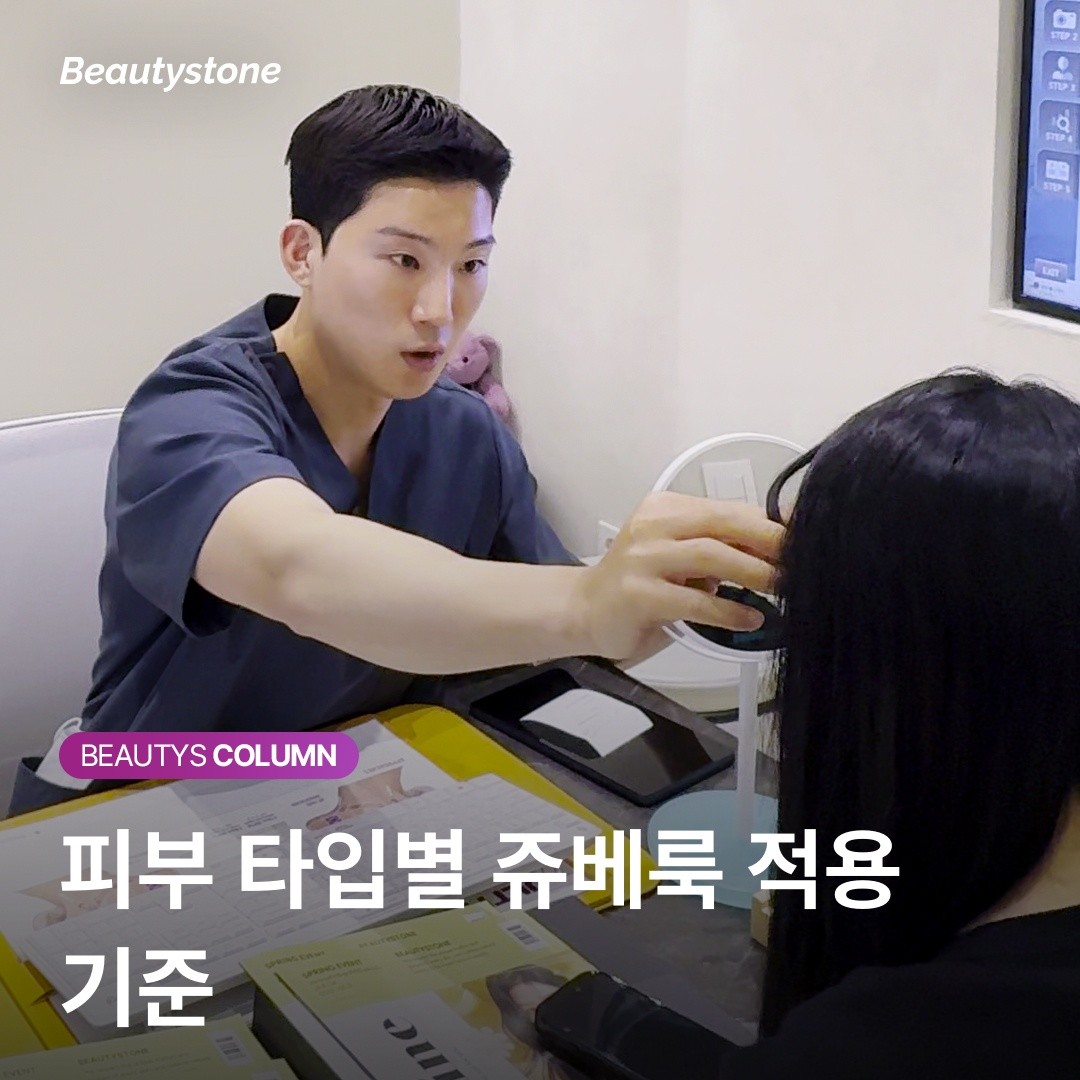
That’s why before treatment,
I always directly check skin thickness and elasticity
by palpation.
Even with the same Juvelook,
this setup process is what determines the outcome.

One thing many people misunderstand is that
"Juvelook is one and done"
is not true.
As PDLLA breaks down
and collagen gradually fills in,
the skin-texture improvement usually becomes noticeably clear
after 2–3 sessions
spaced 3–4 weeks apart.
From my experience,
among patients who came in saying
"it didn’t work" after 1–2 treatments elsewhere,
a considerable number were cases where the concentration or injection depth
didn’t match their skin condition.
👨⚕️ Director Woo Young-jin’s Key Summary:
With Juvelook, it’s less about 'which drug you get'
and more about whether it’s designed with the right concentration and depth
for your skin thickness that determines the result.
That’s where the reason for different outcomes with the same drug lies.
Juvelook Application Criteria by Skin Type
It varies by case,
but this is usually how I divide the approach.
Category | Thin, Sensitive Skin Type | Thick Skin with Large Pores Type |
|---|---|---|
Dilution Concentration | Diluted (minimize stimulation) | Concentrated (dense stimulation) |
Injection Depth | Uppermost dermis (about 1 mm) | Mid-dermis (about 1.5–2 mm) |
Recommended Sessions | 3–4 sessions (lower intensity, cumulative effect) | 2–3 sessions (higher intensity, faster response) |
Precautions | Bruising and nodule-risk management is essential | Initial swelling lasts a bit longer |
Expected Effects | Fine lines and elasticity improvement | Pore reduction and smoother skin texture |
But it’s not all good.
One thing I must tell you is that
Juvelook is not a treatment
where you can expect immediate changes.
Unlike hyaluronic acid fillers,
it doesn’t give a "wow, it’s different!" result right away,
because collagen gradually builds up
over 4–8 weeks.
So for people who need it
to be ready for an event next week,
I honestly recommend a different procedure.
However, for those who want to fundamentally improve
their skin’s own elasticity and texture
over the long term,
it is still a good choice.
It often lasts around 6 months to 1 year,
and I’ve seen quite a few cases where the maintenance period
gets even longer with repeated treatments.

Frequently Asked Questions
Q1. What’s the difference between Juvelook Volume and regular Juvelook?
A. Juvelook Volume
has a higher PDLLA content,
so it provides an effect closer to volume restoration.
Regular Juvelook
focuses on improving surface texture
such as skin texture, pores, and fine lines.
It should be applied differently
depending on the area of concern.
Q2. How much does it cost, and how many sessions are needed?
A. The price per session
varies depending on the product type and amount used,
so we’ll give you the exact information during consultation.
Usually, we set 2–3 sessions as the basic protocol
at 3–4 week intervals
and adjust it while observing the skin’s response.
Q3. Are there any precautions after the procedure?
A. On the day of treatment,
please avoid alcohol, saunas, and strenuous exercise,
and for 2–3 days,
mild bruising or swelling
may occur at the injection site.
In rare cases, if a white nodule is felt,
light massage usually helps it
absorb within 1–2 weeks.
However, if it lasts more than 2 weeks,
please be sure to have it checked
at the clinic where you received the treatment.
I recommend consulting thoroughly before deciding on the procedure.
That’s all from Woo Young-jin.
▶ Read Also
What Should I Know First If I’m Getting Juvelook in Hongdae?
I’m Director Woo Young-jin of Beauty’s Doctors.
💡 Please Check This Before Reading
Q. Isn’t Juvelook just a collagen injection? Isn’t it the same no matter where you get it?
A. Even with the same drug, the results differ completely depending on the concentration, the layer it’s injected into, and the thickness of the person’s skin. It’s not the machine—it’s the 'design' that matters.
Q. Why are there so many reviews saying the effects differ even though it’s the same Juvelook?
A. Because if the depth and density at which PDLLA particles settle are different, the collagen-production response itself changes.
💡 Key Insight From Director Woo Young-jin
What to Know Before Getting Juvelook in Hongdae and Hapjeong—Beauty’s Doctor Treatment Standards
What Is Juvelook?
Juvelook is
a skin booster treatment
that injects PDLLA (poly-D,L-lactic acid)
into the skin
to induce
your own collagen production.
While the commonly compared Sculptra
is based on PLLA and focuses on restoring volume,
Juvelook has smaller particles
and is specialized in improving 'surface texture'
such as skin texture, elasticity, and pores.
Why Results Differ Even With the Same Juvelook
To be honest,
this is a somewhat tricky part.
From a patient’s perspective,
you can’t help but think,
"It’s the same drug, so why are the results different?"
But there’s something important here.
PDLLA particles meet different cells
depending on the depth at which they are injected.
If they go in too shallow,
they can clump or form white nodules
just beneath the epidermis,
and if they go in too deep,
people often don’t really feel the skin-texture improvement.
I usually explain it like this:
"The depth at which you plant a seed
determines the size of the flower."
In the upper dermis,
that is, about 1–2 mm below
the skin surface,
PDLLA particles need to be evenly distributed
so that fibroblasts (the cells that make collagen)
receive the proper stimulation.
This 'proper stimulation'
is actually directly tied to concentration adjustment.
Juvelook’s stock concentration can be
adjusted by the dilution ratio,
but if you use a strong concentration on someone with thin skin,
the risk of bruising or nodules goes up,
and if you use a diluted concentration on thick skin,
the effect is harder to feel.
That’s why before treatment,
I always directly check skin thickness and elasticity
by palpation.
Even with the same Juvelook,
this setup process is what determines the outcome.
One thing many people misunderstand is that
"Juvelook is one and done"
is not true.
As PDLLA breaks down
and collagen gradually fills in,
the skin-texture improvement usually becomes noticeably clear
after 2–3 sessions
spaced 3–4 weeks apart.
From my experience,
among patients who came in saying
"it didn’t work" after 1–2 treatments elsewhere,
a considerable number were cases where the concentration or injection depth
didn’t match their skin condition.
👨⚕️ Director Woo Young-jin’s Key Summary:
With Juvelook, it’s less about 'which drug you get'
and more about whether it’s designed with the right concentration and depth
for your skin thickness that determines the result.
That’s where the reason for different outcomes with the same drug lies.
Juvelook Application Criteria by Skin Type
It varies by case,
but this is usually how I divide the approach.
Category | Thin, Sensitive Skin Type | Thick Skin with Large Pores Type |
|---|---|---|
Dilution Concentration | Diluted (minimize stimulation) | Concentrated (dense stimulation) |
Injection Depth | Uppermost dermis (about 1 mm) | Mid-dermis (about 1.5–2 mm) |
Recommended Sessions | 3–4 sessions (lower intensity, cumulative effect) | 2–3 sessions (higher intensity, faster response) |
Precautions | Bruising and nodule-risk management is essential | Initial swelling lasts a bit longer |
Expected Effects | Fine lines and elasticity improvement | Pore reduction and smoother skin texture |
But it’s not all good.
One thing I must tell you is that
Juvelook is not a treatment
where you can expect immediate changes.
Unlike hyaluronic acid fillers,
it doesn’t give a "wow, it’s different!" result right away,
because collagen gradually builds up
over 4–8 weeks.
So for people who need it
to be ready for an event next week,
I honestly recommend a different procedure.
However, for those who want to fundamentally improve
their skin’s own elasticity and texture
over the long term,
it is still a good choice.
It often lasts around 6 months to 1 year,
and I’ve seen quite a few cases where the maintenance period
gets even longer with repeated treatments.
Frequently Asked Questions
Q1. What’s the difference between Juvelook Volume and regular Juvelook?
A. Juvelook Volume
has a higher PDLLA content,
so it provides an effect closer to volume restoration.
Regular Juvelook
focuses on improving surface texture
such as skin texture, pores, and fine lines.
It should be applied differently
depending on the area of concern.
Q2. How much does it cost, and how many sessions are needed?
A. The price per session
varies depending on the product type and amount used,
so we’ll give you the exact information during consultation.
Usually, we set 2–3 sessions as the basic protocol
at 3–4 week intervals
and adjust it while observing the skin’s response.
Q3. Are there any precautions after the procedure?
A. On the day of treatment,
please avoid alcohol, saunas, and strenuous exercise,
and for 2–3 days,
mild bruising or swelling
may occur at the injection site.
In rare cases, if a white nodule is felt,
light massage usually helps it
absorb within 1–2 weeks.
However, if it lasts more than 2 weeks,
please be sure to have it checked
at the clinic where you received the treatment.
I recommend consulting thoroughly before deciding on the procedure.
That’s all from Woo Young-jin.
▶ Read Also


Latest post
Latest post

Hair Removal
레이저 제모 1회에도 남는 몫이 있어요 — 밀도를 모자이크로 보는 법

Tattoo removal
Why Extremity Tattoos Are Slower to Remove

Tattoo removal
Tattoo Removal Cost: Why Quotes Vary by Area

Tattoo removal
Unused Tattoo Removal Sessions: What Happens?

Lifting
Forehead Thread Lifting: How Far Can It Go?

skin
Skin Booster Prices: What to Check in a Quote
1:1 Custom Approach
1:1 Consultation Whatsapp
🌸 Beautystone Clinic attends the Meditox Bangkok Cadaver Workshop 🌸
1:1 Custom Approach