

Can Secret RF treat fine lines around your eyes? We break down needle depth settings, safe zones, and what to expect — here's what to know.
Published -
Updated -

Author
Wi Young-jin · Chief director
Seoul National University College of Medicine · Seoul National University Hospital Specialist
→
If the fine lines around your eyes bother you more than anything else on your face, you're not alone. The skin in that area is among the thinnest on the body — and it tends to show aging faster than cheeks or the forehead. So it makes sense to ask: can Secret RF actually treat 'crow's feet' and the delicate skin under the eye?
The short answer? Yes — but with meaningful caveats that any good provider will walk you through before touching that area. In this article, we'll cover how the periorbital zone differs from the rest of your face, what needle depth and energy adjustments are required, and which specific spots should never be treated with RF microneedling.
What Is Secret RF, Exactly?
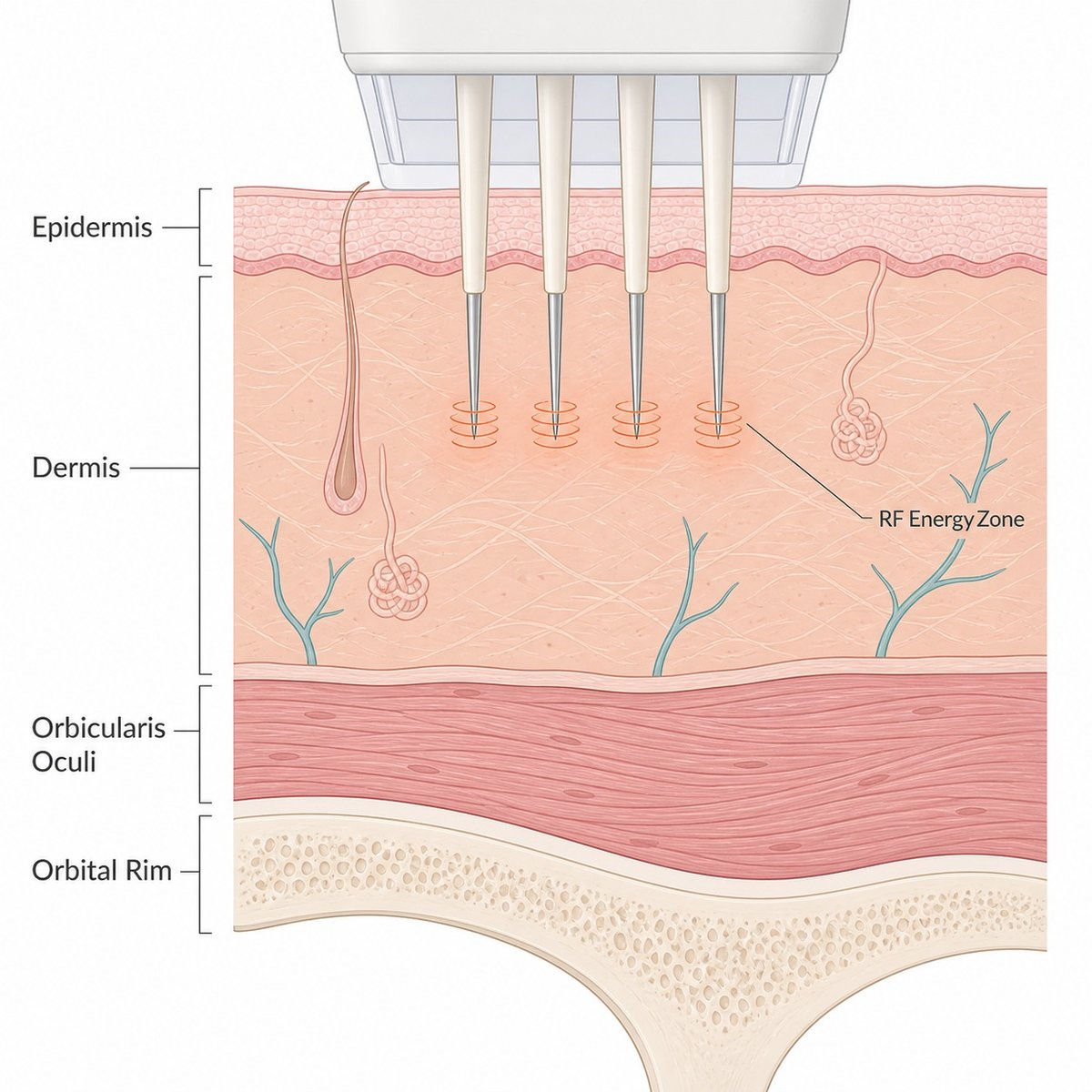
Secret RF is a fractional RF microneedling device made by Cutera. It uses a grid of insulated microneedles that penetrate the skin, then deliver radiofrequency energy directly into the dermis at a controlled depth. Because the energy is deposited below the surface rather than above it, the outer layer of skin (epidermis) stays largely intact — which is part of why the procedure tends to have a shorter recovery than ablative lasers.
The result: controlled thermal injury in the mid-to-deep dermis triggers the skin's wound-healing response. Over the following weeks, collagen remodeling kicks in and skin texture, tone, and firmness gradually improve. Studies suggest RF microneedling can produce measurable wrinkle reduction in the periorbital area, with outcomes that tend to build over a 3–6 month window as new collagen matures. Individual results vary.
On most parts of the face — forehead, cheeks, lower face — providers have considerable flexibility with needle depth, typically working in the 1.0–3.5mm range. The eye area is a different story.
Why the Eye Area Requires a Different Approach
The periorbital skin — the zone directly around your eye socket — is structurally unique in several ways that matter for Secret RF.
Skin thickness: Periorbital skin can be as thin as 0.5mm in some individuals, compared to 1.0–2.0mm on the cheek. That leaves very little room between the skin surface and the underlying orbicularis oculi muscle.
Orbital proximity: The orbital rim (the bony structure surrounding the eye) lies just beneath, and the globe itself is a sensitive structure. Any energy that penetrates too deeply or too close to the lid margin creates genuine risk.
Lymphatic and vascular density: The under-eye area has a rich lymphatic network, which is part of why swelling after any periorbital procedure tends to be more pronounced and longer-lasting than elsewhere.
Muscle movement: The eye area is in near-constant motion — blinking, squinting, smiling. This creates dynamic wrinkles ('crow's feet') that are mechanically different from static lines on the forehead, and that distinction affects treatment planning.
In practice, these differences mean your provider needs to dial down needle depth and reduce energy levels significantly when working near the eyes — and to leave certain zones alone entirely.
Safe Zones vs. Off-Limits Areas: Where Providers Draw the Line
Not every part of the eye area is a candidate for Secret RF. Here's how most experienced providers break it down:
Treatable zones (with adjusted settings):
Lateral canthus ('crow's feet' region): The outer corner of the eye, extending toward the temple, is the most commonly treated periorbital zone. The skin here is thicker than the under-eye area, and the orbital rim provides some buffer. Needle depth is typically reduced to 0.5–1.0mm in this region.
Infraorbital area (under-eye): The zone just below the orbital rim — roughly the upper cheek — can be approached carefully. Research on RF microneedling in Asian patients showed statistically significant improvement in periorbital wrinkles with good safety profiles when depth and energy were appropriately calibrated. Providers typically stay at 0.5–0.8mm here and apply lower energy settings.
Brow and upper orbital rim border: The skin just below the eyebrow can be treated along its outer third, again with conservative depth settings.
Off-limits zones:
Eyelid skin (upper and lower lids): The skin on the eyelid itself — above the lashline or below the lower lashline — is not treated with standard Secret RF applicators. This is one area where the risk-to-benefit ratio doesn't support routine treatment.
Medial canthus (inner corner): The inner corner of the eye has extremely thin, delicate skin and close proximity to the lacrimal drainage system. This zone is generally avoided.
Within 5mm of the lashline: A meaningful margin must be maintained from the lid margin itself, regardless of which side is being approached.
Keep in mind that these boundaries aren't arbitrary — they reflect the anatomical realities of the orbital region and the behavior of RF energy as it disperses through tissue. The exact margins your provider uses may vary slightly based on the specific applicator tip, your anatomy, and their clinical assessment.
What to Expect: The Treatment Itself and After
Here's a practical timeline for what periorbital Secret RF typically looks like:
Before the session: A topical numbing cream is applied to the area, usually for 30–45 minutes before the procedure begins. Eye protection (external shields) will be placed over your eyes.
During treatment: Most people describe the sensation around the eye area as a series of quick warmth pulses or a mild pricking feeling. Because the settings are dialed down compared to the cheek or lower face, the sensation is often less intense here than you might expect. Sessions typically run 30–60 minutes when the full face including periorbital zones is treated.
Immediately after: Redness and some swelling are normal and usually more noticeable around the eyes than elsewhere on the face, given the thinner skin and the area's tendency to retain fluid. Plan on looking puffy for 24–48 hours.
Days 2–5: Redness generally subsides. You may notice some pinpoint marks or mild dry texture as micro-channels heal. Keep the area clean and moisturized; avoid rubbing.
Weeks 1–4: The skin may feel slightly firmer as initial collagen activity begins. Makeup is typically fine to resume within a day or two once redness settles, but ask your provider's guidance before applying anything around the eye.
Months 1–3: Results typically become most visible 4–12 weeks after treatment, as collagen remodeling progresses. Studies on periorbital RF microneedling suggest outcomes continue building for up to 3 months post-treatment. Individual results vary.
Contact lenses: You'll be asked to remove contact lenses before the procedure. Most providers recommend waiting at least 24 hours before reinserting them.
Side Effects and Risks Around the Eyes
The periorbital zone carries some risks that don't apply to lower-risk areas of the face. Knowing what's typical versus what warrants a call to your provider is important.
Common and expected:
Redness (erythema) and swelling — typically resolves within 48–72 hours, though under-eye puffiness can linger a bit longer
Pinpoint bleeding at needle entry sites — minimal and self-resolving
Dry or tight skin sensation for a few days
Mild bruising, especially in the infraorbital area where blood vessels are close to the surface
Less common, worth monitoring:
Temporary hyperpigmentation in darker skin tones (Fitzpatrick types IV–VI) — insulated needles reduce but don't eliminate this risk
Prolonged swelling lasting more than a week
Milia (tiny white cysts) in the treated area as skin heals
Red flags — contact your provider right away:
Spreading redness or warmth beyond the treated zone
Signs of infection: fever, increasing pain, discharge, or worsening redness after the first 48 hours
Any changes in vision, eye pressure, or sensation in the eye itself
If you notice any of the above, seek medical care right away. Don't wait for your next scheduled check-in.
It's also worth noting that individuals with a history of cold sores (herpes simplex virus) should discuss this with their provider before any microneedling procedure. HSV can reactivate after needling procedures; antiviral prophylaxis is often recommended.
How Many Sessions Do You Need?
For the periorbital area specifically, most providers recommend a series of 3–4 sessions spaced 4–6 weeks apart to see meaningful improvement in fine wrinkle texture and skin firmness. Deeper static wrinkles — lines that are visible even when your face is at rest — may respond more slowly than dynamic 'crow's feet' lines.
Maintenance sessions every 6–12 months can help sustain results, though this varies by individual skin type and the natural pace of aging. Your provider will assess your baseline skin condition and adjust the protocol accordingly.
A note on combination approaches: Secret RF for the periorbital area is sometimes paired with Botox for crow's feet (to address the underlying muscle movement that creates dynamic lines) or with under-eye treatments like Rejuran or hyaluronic acid skin boosters for volume and hydration. These combinations aren't right for everyone, and the sequencing matters — something your provider can walk you through in a consultation.
The Bottom Line
Secret RF can be used in the periorbital zone, but it requires a specific skill set and a clear understanding of the anatomy involved. Here's what to take away:
The eye area is treatable — crow's feet and the infraorbital zone can respond well to RF microneedling with appropriate depth adjustments (typically 0.5–1.0mm).
Certain zones, including the eyelid skin and medial canthus, are off-limits with this device. A qualified provider won't cut corners here.
Side effects around the eyes tend to be more pronounced than on other parts of the face — particularly swelling — and you should plan for 2–3 days of visible downtime.
Results build gradually over 1–3 months. A series of 3–4 sessions is typically needed.
Like any procedure, it comes with trade-offs. Ultimately, the choice depends on your skin, your goals, and your tolerance for downtime in a visible area of your face.
If you're considering Secret RF for the eye area, a consultation is the best way to assess whether your anatomy and skin type make it a good fit. Beautystone is a dermatology clinic in Seoul's Hapjeong area — you can explore current offers at /en/promotion.
Frequently asked questions
Q. Does Secret RF hurt when used around the eyes?
A. Most people find the periorbital zone more tolerable than they expect, partly because settings are dialed down compared to the cheeks or jaw. Topical numbing cream is applied beforehand, and the sensation is typically described as brief warmth or mild pricking. Everyone's pain threshold is different, so let your provider know during the session if any area feels uncomfortable.
Q. How long does swelling last after Secret RF near the eyes?
A. Redness and swelling are common and usually settle within 48–72 hours. Under-eye puffiness can occasionally linger a day or two longer than on other parts of the face because of the area's lymphatic structure. Sleeping with your head slightly elevated in the first night or two may help. If swelling is worsening after 48 hours rather than improving, contact your provider.
Q. Can Secret RF replace Botox for crow's feet?
A. They work differently. Botox addresses dynamic crow's feet by relaxing the orbicularis oculi muscle that causes the lines when you smile or squint. Secret RF works on skin texture and collagen in the dermis — it improves the quality and firmness of the skin itself but doesn't address the underlying muscle movement. Many people benefit from both, used at the right intervals. Your provider can help you decide what makes sense for your specific pattern of wrinkling.
Q. How many sessions of Secret RF are needed for eye wrinkles?
A. A typical protocol for the periorbital area is 3–4 sessions spaced 4–6 weeks apart. Fine dynamic lines tend to respond faster than deeper static lines. Results continue to build for up to 3 months after each session as collagen remodeling progresses, so patience is part of the plan. Individual results vary.
Content
![[Wi Young-jin] CureJet vs Potenza: cleanse or remodel?](https://framerusercontent.com/images/2raXkXYV4e1v80g7u2Tb6KKkCQ.jpg?width=1080&height=1080)



skin
Why Does Fractional CO2 Take Longer to Heal?

Contouring & Volume
How Many cc Does Forehead Filler Need?

skin
Why Is My Skin Oily but Tight in the Fall?

Hair Removal
Underarm Laser Hair Removal Cost: Do the Math

Tattoo removal
Laser Before a Cover-Up: How Many Sessions?

skin
큐어젯 다운타임, 다음 날 출근과 화장은 언제부터 될까요?