

Booked a Potenza session? Here's a day-by-day countdown for pausing retinol, exfoliating acids, waxing, and self-tanner before your appointment.
Published -
Updated -

Author
Wi Young-jin · Chief director
Seoul National University College of Medicine · Seoul National University Hospital Specialist
→
If you've got a Potenza session on the calendar, you're probably wondering what you're supposed to stop using — and exactly how many days out. You're not alone. It's one of the most common questions we hear in the week before a microneedle RF appointment, and it's a smart one to ask early rather than the night before.
Here's the short answer: most of the prep work happens between one and two weeks out. Retinol, exfoliating acids, waxing, and self-tanner all change the condition of your skin's surface, and RF microneedling tends to behave most predictably on skin that's calm, intact, and its own natural tone. In this guide, we'll cover why the timing matters, a countdown you can work backward from, how long to pause each product or habit, and what actually happens if you don't.
Why Potenza Prep Starts Days Before Your Appointment
Because Potenza doesn't stay on the surface — it passes through it.
Potenza is an FDA-cleared radiofrequency microneedling device. Very fine needles pass through the epidermis and deliver RF energy into the dermis, where collagen remodeling happens. Depending on the tip and the setting your provider chooses, needle depth typically lands somewhere between roughly 0.5 mm and 3.5 mm, which is why depth selection varies by indication.
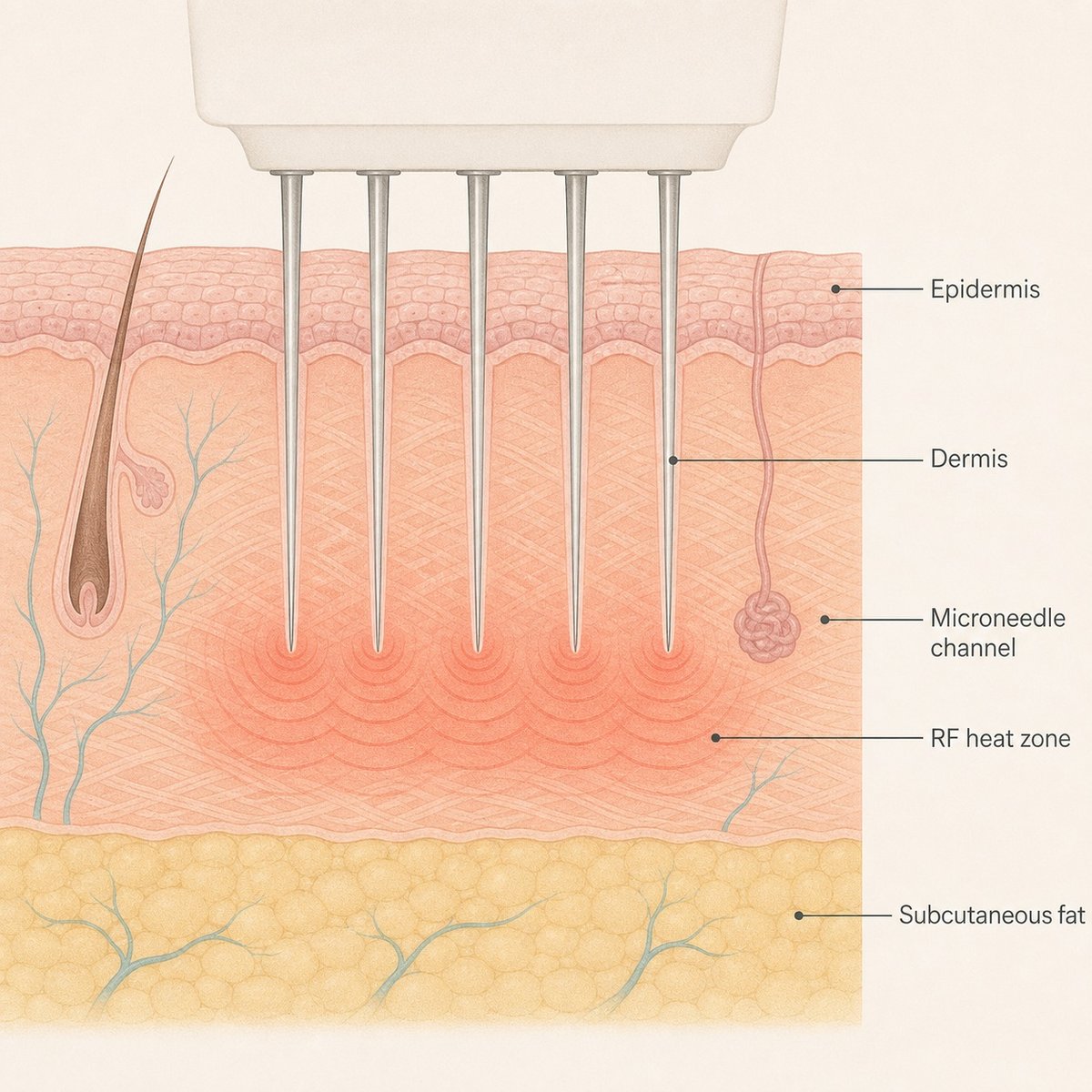
That entry point is the whole reason home care matters. Your epidermis is the door the needles pass through, and its condition on the day of treatment changes the experience in three practical ways:
Barrier integrity: Retinoids and acids speed up cell turnover and thin the outermost layer. Skin that's already sensitized tends to sting more and stay pink longer.
Even energy delivery: Flaking, scabbing, or a fresh wax injury makes the surface uneven, and providers generally avoid treating over compromised patches.
Infection and irritation risk: Freshly waxed follicles and micro-abrasions from scrubs are small openings. Adding needle channels on top of them is an avoidable risk.
Clinical references on skin needling consistently frame pre-treatment skin condition as part of the safety picture, not an afterthought. The good news is that none of this is complicated — it's mostly a calendar exercise.
Your Potenza Countdown at a Glance
If you like working backward from a date, start here. These are typical ranges used in clinical practice, not rules carved in stone — your provider's protocol always wins.
What to pause | How far ahead | Why |
|---|---|---|
Waxing, threading, depilatory cream | 7 to 14 days | Follicle irritation and surface trauma |
Laser hair removal on the same area | About 2 weeks | Stacked heat on the same tissue |
Self-tanner (including gradual lotions) | About 2 weeks, until fully faded | Color masks your true skin response |
Deliberate sun exposure or tanning beds | About 2 weeks | Recently tanned or burned skin is reactive |
Prescription retinoids | 5 to 7 days | Turnover and surface thinning |
Over-the-counter retinol | 3 to 5 days | Same mechanism, milder |
AHA, BHA, at-home peel pads | 3 to 5 days | Chemical exfoliation of the barrier |
Physical scrubs and cleansing brushes | About 3 days | Micro-abrasion |
Neurotoxin or filler in the same zone | About 2 weeks, provider's call | Overlapping healing windows |
Makeup and heavy sunscreen | Day of — arrive clean | Numbing cream works better on bare skin |
A few situations sit outside a simple table. If you take oral isotretinoin, have an active cold sore history, or are on blood thinners, those are provider conversations rather than self-directed pauses — and you should never stop a prescription medication on your own to make an appointment work.
When to Stop Retinol and Prescription Retinoids
Five to seven days for prescription strength, three to five for a drugstore retinol. That's the range most providers land on.
Retinoids work by accelerating how fast your skin sheds and rebuilds. That's exactly why they're effective, and exactly why they're a poor companion to needling. Skin in an accelerated turnover state has a thinner outermost layer, so treatment day tends to feel sharper and recovery tends to run a day or two longer.
Tretinoin, adapalene, tazarotene: Stop about a week out. If you use them nightly and your skin is already flaky, tell your provider — they may adjust settings.
Retinol, retinaldehyde, retinyl esters: Three to five days is typically enough, since these convert more slowly and irritate less.
Oral isotretinoin: This one isn't a home-care decision. Many practices defer energy-based treatments for a period after the course ends, and the specifics vary by provider and by country. Ask before you book.
Prescription combination creams: Hydroquinone blends and compounded actives often contain a retinoid. Read the label rather than guessing.
Restarting is its own question. Most people wait until visible redness and flaking have fully settled — commonly one to two weeks, and sometimes longer for deeper settings. Our day-by-day recovery guide walks through what that window usually looks like. Individual results vary, and your provider will give you a restart date based on how your session actually went.
Exfoliating Acids, Scrubs, and At-Home Peels
Three to five days for acids, about three days for anything gritty, and a longer conversation if you've had a professional peel recently.
Chemical exfoliants loosen the bonds between surface cells. Physical exfoliants scrape them off. Either way, you arrive with less buffer than usual, and needle channels through an already-stripped barrier are a recipe for a stingier session and a longer flush.
Glycolic, lactic, and mandelic acid (AHA): Pause three to five days out. Toner pads count, even the gentle daily ones.
Salicylic acid (BHA): Same window. If you use it only as a spot treatment on one or two blemishes, mention it rather than assuming it's fine.
At-home peel pads and enzyme masks: Five days is a safer margin, because strength varies wildly between products.
Scrubs, konjac sponges, sonic brushes: Three days, and skip them on the morning of your appointment entirely.
In-office chemical peels or dermaplaning: These generally need two to four weeks of separation. Your provider decides based on depth.
If your routine leans heavily on exfoliation, it's worth revisiting how often you actually need it — our guide to exfoliation frequency by skin type covers that in more detail. In the week before Potenza, the goal is boring skin: a gentle cleanser, a plain moisturizer, and daily sunscreen.
Hair Removal and Self-Tanner: The Two-Week Window
Two weeks is the number to remember for both, and for slightly different reasons.
Waxing, threading, and laser
Waxing pulls hair from the follicle and takes a thin layer of surface cells with it. That leaves the area briefly inflamed and slightly more prone to folliculitis, which isn't what you want under a grid of needle channels. Seven to fourteen days of separation gives the follicles time to settle. Threading and depilatory creams follow the same logic.
Laser hair removal on the same area deserves the full two weeks in either direction. Both treatments deposit heat into tissue, and stacking them on the same week doesn't make either work better — it just makes the reaction harder to interpret.
Shaving, on the other hand, is fine. Most providers are happy for you to shave the area the day before or the morning of, as long as you use a fresh blade and skip the aftershave.
Self-tanner and sun
Self-tanner binds to the outermost layer of your skin, so color fades unevenly as those cells shed. Two problems follow. First, your provider is reading your actual skin tone when choosing settings, and a bronzed layer makes that reading less reliable. Second, patchy fading after treatment looks alarming even when your skin is healing normally.
The same two-week principle applies to deliberate tanning and to sunburn. Skin that's freshly tanned or pink from UV exposure is already inflamed, and most providers will reschedule rather than treat over it. That's a good call, not an inconvenience — and it's far easier to plan a holiday around a session than the other way around.

Side Effects and Risks of Skipping the Pause
Let's be straightforward about what a normal recovery looks like first, so you have something to compare against.
Redness and warmth for roughly 24 to 48 hours are common, along with pinpoint bleeding on the day, mild swelling that tends to peak around day one, and a stretch of tightness or fine flaking a few days later. That's the usual arc for most people.
Arriving without the pause doesn't create new categories of side effects so much as it turns up the volume on the existing ones:
Sharper discomfort during treatment: A thinned barrier from retinoids or acids tends to register more heat and more sting.
Longer redness: What might have settled in two days can stretch toward four or five.
Pigment changes: Recently tanned or already-inflamed skin carries a higher risk of post-inflammatory hyperpigmentation, particularly in medium and deeper skin tones.
Folliculitis: Freshly waxed follicles plus needle channels is the combination most likely to produce small, irritated bumps.
A rescheduled appointment: Providers do turn people away, and they should. Losing a slot is better than treating over compromised skin.
Be honest at check-in about what you used and when. Nobody is going to lecture you, and the information genuinely changes how a session is run — settings, depth, and which areas get treated at all.
One firm safety note: if you notice spreading redness, swelling that worsens after day two, pus or crusting, or fever after any needling procedure, seek medical care right away. Infection after RF microneedling is uncommon, but it isn't impossible when the skin barrier has been opened.
The Bottom Line
Prepping for Potenza isn't complicated — it's just a countdown you start earlier than most people expect.
Two weeks out: stop waxing, threading, and laser hair removal on the treatment area, let self-tanner fade, and stay out of deliberate sun.
One week out: put prescription retinoids away, and drop over-the-counter retinol three to five days out.
Three to five days out: pause AHA and BHA products, peel pads, scrubs, and cleansing brushes.
Day of: arrive with clean, bare skin, and flag anything you used that you weren't sure about.
Like any procedure, Potenza comes with trade-offs, and a well-prepped session is mostly about making the recovery predictable rather than dramatic. Individual results vary, and the right pause length for you depends on your routine, your skin type, and the depth your provider plans to use.
Ultimately, the choice depends on your skin, your goals, and your schedule. If you're considering Potenza, a consultation is the best way to get a countdown built around your actual routine — bring a photo of your skincare shelf, honestly. Beautystone is a dermatology clinic in the Hapjeong and Hongdae area of Seoul, South Korea; current offers are listed at /en/promotion, and treatment pricing is confirmed at consultation and outlined at /en/price.
Frequently asked questions
Q. How many days before Potenza should I stop retinol?
A. Most providers ask you to stop prescription retinoids such as tretinoin or adapalene about five to seven days before your session, and over-the-counter retinol three to five days out. The goal is to let your outermost skin layer recover from accelerated turnover so treatment day feels less sharp. If you take oral isotretinoin, don't stop it on your own — that's a conversation with your prescriber and your provider.
Q. Can I wax before a Potenza appointment?
A. Waxing on the treatment area is generally paused seven to fourteen days beforehand, because it briefly inflames the follicles and removes surface cells. The same window applies to threading, depilatory creams, and laser hair removal on that zone. Shaving is usually fine — most providers are happy for you to shave the day before or the morning of, with a fresh blade and no aftershave.
Q. Do I really need to stop self-tanner before microneedle RF?
A. Yes, and about two weeks is the usual guidance. Self-tanner binds to the outermost skin layer and fades unevenly, which makes it harder for your provider to judge your true skin tone when selecting settings. Patchy fading afterward can also look alarming even when healing is going normally. The same two-week principle applies to tanning beds and deliberate sun exposure.
Q. What happens if I forget and use an exfoliating acid the night before?
A. Tell your provider at check-in rather than staying quiet. One gentle application usually means adjusted settings or skipping a sensitive zone; a strong peel pad may mean rescheduling. Neither outcome is a failure, and being upfront is far better than treating over a stripped barrier. Individual skin responses vary, so your provider will make the call on the day.
Content






skin
Why Does Fractional CO2 Take Longer to Heal?

Contouring & Volume
How Many cc Does Forehead Filler Need?

skin
Why Is My Skin Oily but Tight in the Fall?

Hair Removal
Underarm Laser Hair Removal Cost: Do the Math

Tattoo removal
Laser Before a Cover-Up: How Many Sessions?

skin
큐어젯 다운타임, 다음 날 출근과 화장은 언제부터 될까요?