

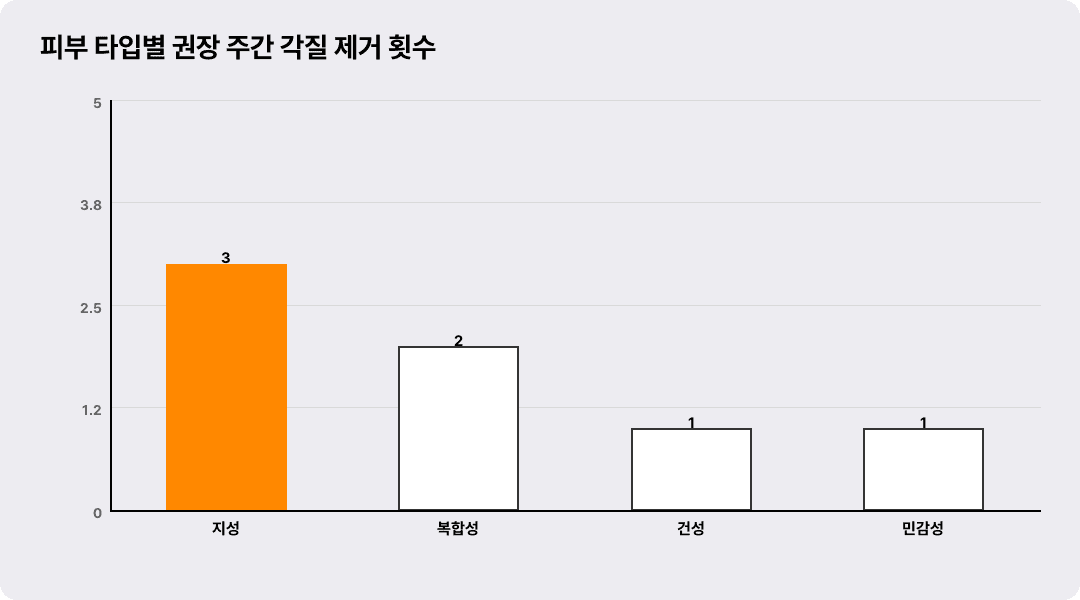
Dry and sensitive skin usually caps out at about once a week, and going past it tends to show up as dullness and rough texture before flaking does.
Published -
Updated -

Author
Wi Young-jin · Chief director
Seoul National University College of Medicine · Seoul National University Hospital Specialist
→
When looking into exfoliation products, the first questions that often come to mind are, "How many times a week should I do this?" or "Would a scrub or AHA be better for my skin?" While the products themselves are easy to find, the most confusing part is figuring out the right frequency and strength for your specific skin type.
In short, more exfoliation isn't necessarily better. It's a skincare step where the ideal frequency varies significantly depending on your skin type. While oily skin can generally handle more frequent exfoliation, dry or sensitive skin needs a much lower frequency to prevent the skin barrier from breaking down. Getting familiar with the general guidelines first will make it much easier to safely adjust your routine at home.
This content is a helpful guide compiled by Hapjeong Beautystone.
What you will learn from this article:
The mechanism of how exfoliation removes dead skin cells
The recommended weekly frequency for each skin type
Which skin types work best with AHA, BHA, and scrubs
Signs of over-exfoliation and how to recover from it
Let's start with how exfoliation actually removes dead skin cells
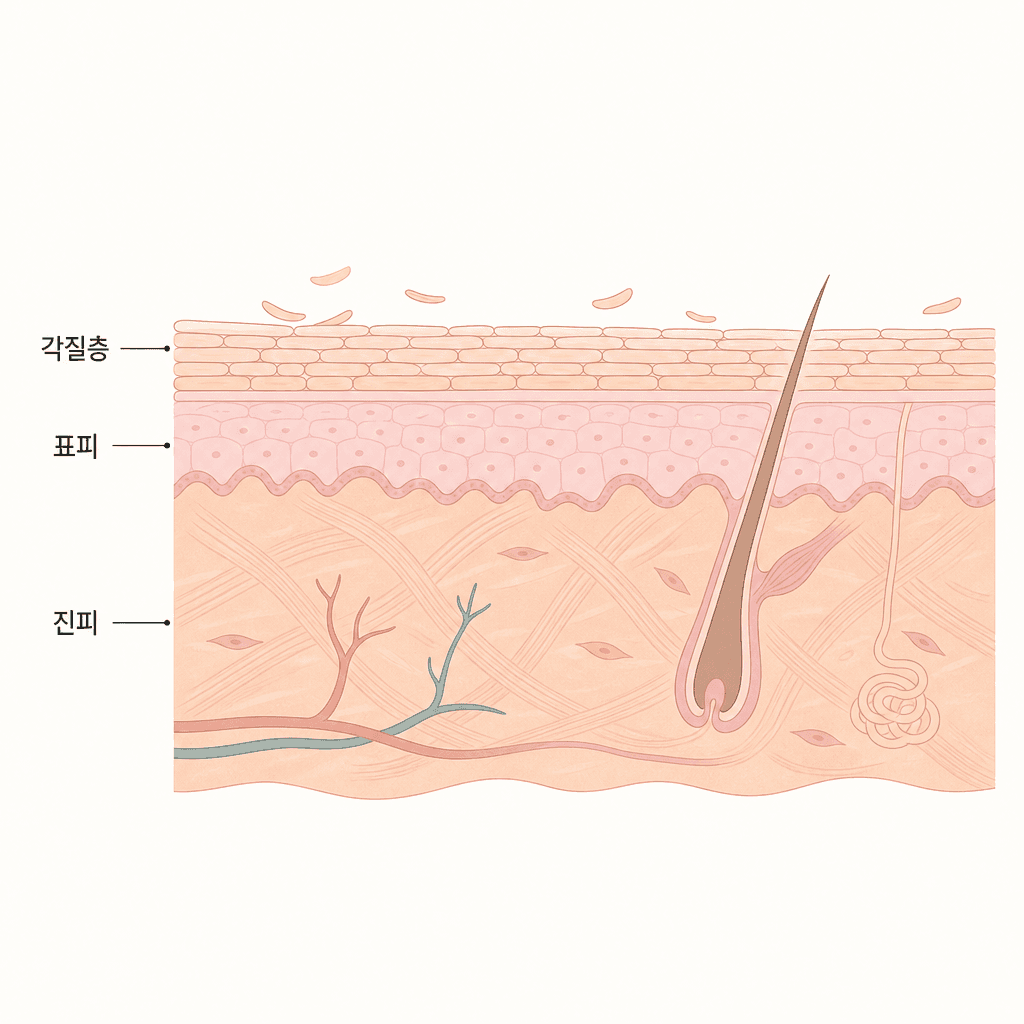
The outermost layer of your skin, the stratum corneum*, is made of dead cells stacked like bricks to lock in moisture and block external irritants. Normally, old cells shed naturally, but as we age or when the skin becomes dry, this cycle slows down. This causes dead cells to build up, making the skin look dull or feel rough.
Stratum Corneum*: The outermost layer of the epidermis, consisting of dead cells. It acts as a protective skin barrier that retains moisture and defends against external irritants.
AHA* is a well-known active ingredient used to gently remove these built-up dead skin cells. Understanding the mechanism of how AHA weakens the bonds between skin cells, allowing older cells to shed naturally, makes it clear why regular, moderate exfoliation helps smooth the skin's surface. However, because the stratum corneum also serves as your protective barrier, exfoliating too frequently can strip away moisture and lead to sensitivity.
AHA*: Short for Alpha Hydroxy Acid. It is a water-soluble acidic ingredient commonly used to remove dead cells from the skin's surface.

How many times a week is right for your skin type?
The starting point for exfoliation frequency depends entirely on your skin type. Oily skin, which produces more sebum, often benefits from deeper pore care and can handle relatively frequent exfoliation. On the other hand, dry skin lacking moisture or easily irritated sensitive skin should keep exfoliation to a minimum to protect the barrier. Here is a general guide by skin type:
Skin Type | Recommended Frequency | Best Ingredients | Key Considerations |
|---|---|---|---|
Oily | 2–3 times a week | Primarily BHA | Overdoing it can trigger excess sebum |
Combination | 1–2 times a week | BHA on T-zone / AHA on cheeks | Adjust strength by facial zone |
Dry | Once a week | Low-concentration AHA | Pair with thorough moisturization |
Sensitive | Once a week or less | Gentle Enzymes / Low-irritant | Stop immediately if irritation occurs |
Please note that the frequencies in this table are just general starting points. Even within oily skin types, if your skin is thin or breakout-prone, it is better to lower the frequency. Everyone's skin is unique. It is always safest to start with the lowest frequency, observe how your skin reacts, and gradually increase it step by step.
Here is a quick visual representation of how recommended frequencies differ by skin type.

AHA, BHA, and Scrubs: Which one is right for you?
Exfoliation methods are broadly divided into physical scrubs and chemical acids. While scrubs that use physical granules offer instant smoothness, they can cause micro-irritation. Modern dermatology generally favors chemical methods that gently dissolve dead skin cells without friction.
AHA — Being water-soluble, it works beautifully on the skin surface to address dead skin and dullness. It is widely used for dry and combination skin.
BHA — Being oil-soluble, it penetrates deep into the pores, making it ideal for oily skin, clogged pores, and tiny congestion bumps.
Enzymes & Low-Irritant Products — These are very gentle, making them excellent, worry-free options for sensitive skin.
Scrubs — Because friction from granules can be harsh, these should be used sparingly and very gently.
As shown in clinical reviews on how using AHA peels (like glycolic acid) at the right concentration and frequency effectively improves skin texture and flakiness, the key is consistency within your skin's tolerance, rather than using strong products frequently. It is safest to start with a low concentration and gradually increase it if there is no irritation, keeping in mind that reactions always vary from person to person.

Why Beautystone in Hapjeong?
At Beautystone in Hapjeong, we believe that for routine skincare like home exfoliation, understanding your unique skin type and current barrier status must come first. Rather than applying a rigid rule like "frequent for oily skin, rare for dry skin," we carefully examine your breakout frequency and barrier health to help you find your personalized sweet spot. As a cozy clinic located just a short walk from Hapjeong Station, you are always welcome to bring in your current products and routine for a warm, personalized consultation.

Signs of over-exfoliation and how to recover
When exfoliation is overdone, the skin barrier breaks down, leading to sensitivity rather than improvement. If you experience any of the following signs, it is best to reduce the frequency or pause exfoliating altogether:
Burning or stinging — If your daily products suddenly sting or feel uncomfortable upon application, it's a sign of a compromised barrier.
Dehydration combined with flakiness — A vicious cycle where stripping the skin causes extreme dryness, which in turn creates more flaky skin.
Redness or sudden bumps — A state where the weakened barrier makes the skin highly reactive to even minor triggers.
Dullness and rough texture — When efforts to get glowing skin turn into a dull, rough appearance instead.
If this happens, stop all exfoliation for 1 to 2 weeks and focus purely on rich moisturization and sun protection to allow your barrier to heal. Once fully recovered, you can slowly restart at a lower frequency than before. Keeping in mind that exfoliation is about respecting your skin's limits—not pushing them—will help you maintain a healthy glow safely.

Recommended Reads
We have compiled helpful guides on other home skincare topics as well, so feel free to explore them together.
Frequently Asked Questions
Q. Can I exfoliate daily?
A. Exfoliating daily is far too harsh for most skin types. Because the stratum corneum protects your skin, stripping it daily can lead to dehydration and high sensitivity. Even for oily skin, 2–3 times a week is sufficient, while dry and sensitive skin should stick to about once a week. It is always best to adjust based on how your skin feels.
Q. Can I use AHA and BHA together?
A. While they can be used in the same routine, applying both on the same day can multiply the risk of irritation. We recommend starting with just one to see how your skin adjusts. For combination skin, a great approach is targeting different areas—applying BHA to the oily T-zone and AHA to the drier cheeks. Always reduce frequency if you experience any irritation.
Q. Is there any specific post-exfoliation care I should follow?
A. Since skin can be temporarily sensitive after exfoliation, thorough hydration and sun protection are essential. Because removing dead cells allows moisturizing ingredients to absorb beautifully, give your skin an extra layer of hydration. If you exfoliate with acids, be sure to apply sunscreen diligently the following day.
Q. My skin is very sensitive. Do I absolutely have to exfoliate?
A. No, it is not a necessity. Because sensitive skin has a naturally thinner or weaker barrier, standard exfoliation can sometimes do more harm than good. Instead of pushing your skin, utilizing a very gentle enzyme product occasionally is often more than enough. If you experience any redness or stinging, discontinue immediately. Consulting with a medical professional is a safe way to determine the best approach for you.
Related Articles


Tattoo removal
손가락 문신은 작으니까 금방 지워질 거라 생각하셨나요?

Tattoo removal
문신제거 견적이 병원마다 다른 이유, 크기 기준부터 달라서예요

Tattoo removal
10회 결제했는데 그 전에 다 지워지면 돈이 아깝지 않을까요?

Lifting
Forehead Thread Lifting: How Far Can It Go?

skin
Skin Booster Prices: What to Check in a Quote

Contouring & Volume
InMode Cost: Why One Area, Three Line Items