

Repairing a damaged barrier at home—what to do, what to stop, and habits that help.
Published -
Updated -

Author
Wi Young-jin · Chief director
Seoul National University College of Medicine · Seoul National University Hospital Specialist
→
Many people experience their skin suddenly feeling tight, stinging, and burning or flaking even with products they usually use without any issues. When these signs appear all at once, it is easy to get flustered and worry, "Is my skin completely ruined?" However, in most cases, it simply means your skin barrier has temporarily weakened.
To give you a quick answer, a damaged skin barrier has an innate ability to recover on its own over several days to weeks. At home, a simple skincare routine focused on minimizing irritation and maximizing hydration is much more helpful. However, since the recovery speed and level of sensitivity vary from person to person, understanding the general recovery process first will make it much easier to gauge what is best for your skin.
This content is a helpful guide compiled by Hapjeong Beautystone.
By reading this article, you will learn
Why your skin feels tight and stings when the skin barrier is damaged
The proper order of home care steps to gently aid recovery
How to distinguish between what to include and what to temporarily pause in your routine
What signs to check for if your recovery seems slow
Let's start by looking at why your skin feels tight and stings when the barrier is damaged
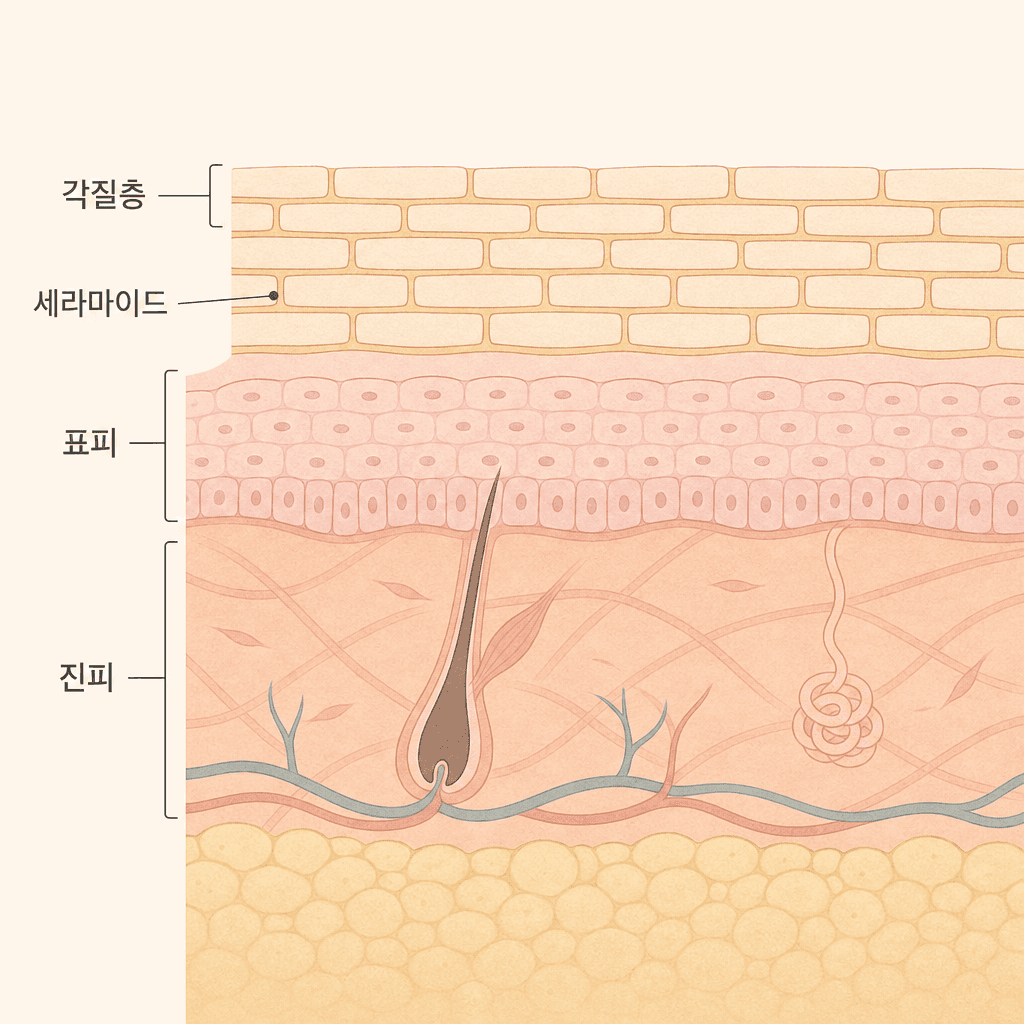
The outermost layer of your skin, the stratum corneum, is structured like bricks and mortar. If the skin cells are the bricks, lipids like ceramide that fill the spaces between them act as the mortar, preventing moisture from evaporating. When this lipid layer thins out, moisture evaporates easily, and external irritants penetrate directly inside, causing tightness, stinging, and redness.
Ceramide*: A lipid component in the skin that fills the spaces between skin cells to prevent moisture loss.
Stratum corneum*: A thin protective layer at the outermost part of the skin that locks in moisture and keeps out external irritants.
Studies showing that ceramide-containing formulations improve skin barrier function and reduce trenegative water loss (TEWL) make it clear why using skincare ingredients that rebuild this broken mortar is so meaningful for recovery. Here, the rate at which moisture evaporates from the skin is called TEWL*, and as the barrier heals, it lowers again.

What is the best step-by-step approach to help recovery at home?
When restoring a damaged barrier, the key is "subtracting" rather than "adding." By minimizing irritation and focusing solely on basic hydration, you give your skin the time it needs to rebuild its own mortar. TEWL* also tends to stabilize and decrease more reliably when irritation is reduced. Here is a quick guide on what to embrace and what to temporarily pause at home.
Category | What to Embrace | What to Pause |
|---|---|---|
Cleansing | Lukewarm water, low-pH (mildly acidic) cleanser | Hot water, harsh foaming cleansers, double cleansing |
Moisturizing | Ceramide and Panthenol moisturizers | Products with heavy fragrances or high alcohol content |
Active Ingredients | Simple, hydration-focused products | Retinol, high-dose Vitamin C, AHAs |
Exfoliation | Letting dead skin slough off naturally | Scrubs, peeling gels, frequent exfoliation |
The guidelines in this table are specifically for the recovery period, so once your skin calms down, you can gradually reintroduce your usual routine. Rather than switching multiple products at once, it is much safer to keep the flow simple: hydration → soothing → recovery. Adding new functional products before the stinging subsides makes it hard to identify what might be causing irritation, so it is best to minimize the number of steps during this recovery phase.
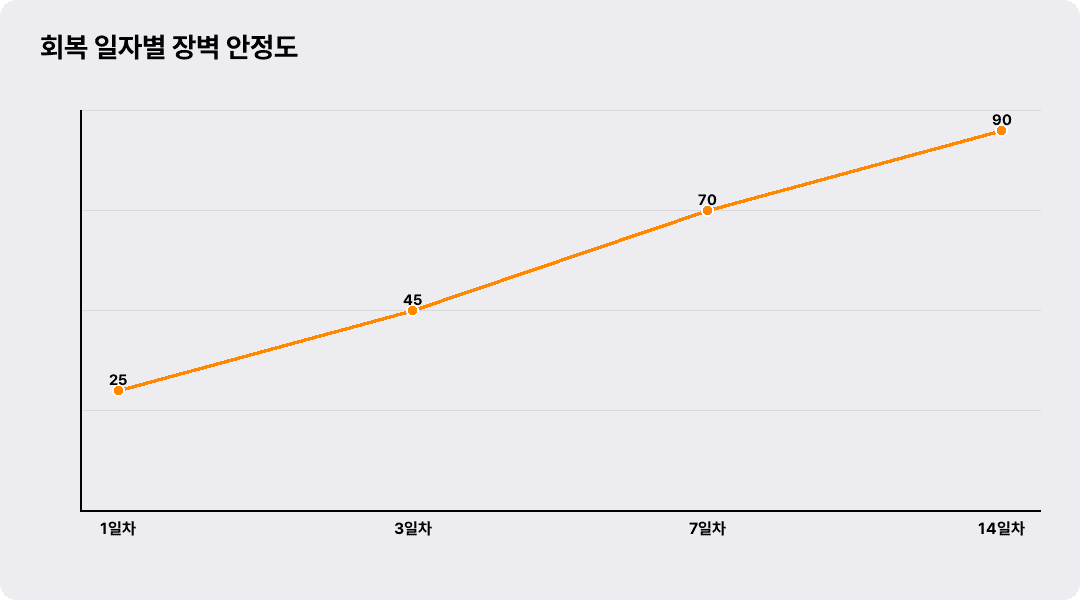
Typically, recovery begins with a reduction in tightness within a few days, followed by a gradual calming of stinging and redness over 1 to 2 weeks. If we were to picture the general progress of barrier stabilization day by day, it would look something like this.
Common mistakes to avoid during the recovery phase
When your skin barrier is weakened, well-intentioned skincare steps can sometimes actually delay healing. Applying too many products or cleansing too frequently in an effort to heal quickly is like scraping away the already thinned-out mortar of your skin.
Forcibly removing flaking skin — Flaking is actually a sign of healing, so it is best to let it shed naturally.
Using multiple soothing products at once — When you use too many products, it becomes difficult to identify which one actually suits your skin.
Hot water and frequent cleansing — This washes away the remaining natural lipids, making dryness and tightness even worse.
Neglecting sun protection — UV rays cause greater irritation to a weakened barrier, so be sure to apply a gentle sunscreen.
Clinical evaluations on using ceramide moisturizers for skin conditions and barrier care also highlight that simple yet consistent moisturizing is the cornerstone of soothing a weakened barrier. Rather than looking for miraculous ingredients, stick to the basics of minimizing irritation and locking in hydration as the core of your recovery. Note, however, that if stinging or redness persists for more than 2 weeks, or if oozing or blisters develop, it may indicate a condition beyond simple barrier damage, so seeing a doctor is the safest course of action.

Why choose Hapjeong Beautystone?
At Hapjeong Beautystone, when dealing with a weakened skin barrier, we prioritize assessing the level of irritation your skin can currently tolerate before adding any treatments or products. This is because even for the same tightness and stinging, the direction of care changes depending on whether the cause is temporary damage or an underlying skin condition. As a cozy clinic conveniently located within walking distance of Hapjeong Station, we offer a peaceful environment where you can comfortably discuss the next steps of your skincare journey, tailored to your skin’s unique recovery pace.

Daily habits that gently support your recovery
Just like your skincare routine at home, your daily lifestyle habits play a big role in barrier recovery. To help your skin synthesize new lipids from within, your body needs a supportive environment to heal.
Adequate sleep — Ensure you get enough sleep so your skin has time to regenerate overnight.
Indoor humidity — An environment that is too dry accelerates moisture evaporation, so make sure to use a humidifier.
Gentle, consistent hydration — Even after your skin has calmed down, continue using ceramide moisturizers regularly.
Mindful product testing — When introducing new products, it is safest to introduce them one by one, spaced several days apart.
These habits are also key to keeping your recovered skin barrier healthy and strong in the long run. Since the skin barrier does not remain perfect forever and can weaken again depending on the season or your physical condition, it is best to keep your skin continuously hydrated.
Frequently Asked Questions
Q. How can I tell if my skin barrier is damaged?
A. If products you normally use suddenly sting or burn, and you experience tightness, flaking, and redness, these are common signs that your barrier has weakened. Typically, if you minimize irritation and focus on moisturizing, the skin will calm down within a few days to 1–2 weeks. However, if the symptoms persist or worsen, other skin conditions might be involved, so it is safest to consult a medical professional.
Q. How often should I apply moisturizer during the recovery phase?
A. Rather than sticking to a fixed number of times, it is best to reapply whenever your skin feels dry or tight so that it never loses moisture. Usually, applying it after cleansing in the morning and evening, and whenever you feel dryness, is sufficient. Selecting simple formulas with fewer artificial fragrances or alcohols, and focusing on skin-soothing ingredients like Ceramides or Panthenol, will make your recovery phase much more comfortable.
Q. Can I peel off flaking skin?
A. Forcibly peeling off dead skin cells or scrubbing them away can delay the recovery process. Flaking is a natural phase where old skin is shed as the damaged barrier is rebuilt with new cells. It is best to wait patiently while keeping the skin texture smooth with hydration. Once the stinging completely subsides, you can slowly and safely reintroduce ultra-gentle exfoliation.
Q. When can I start using Retinol or Vitamin C again?
A. It is best to reintroduce them one by one after the stinging and redness have fully subsided and your skin feels perfectly comfortable with just a basic moisturizer. Because recovery speed varies from person to person, it is safer to guide your routine based on your skin's reaction rather than a fixed number of days. Gently start with lower concentrations and space them out by a few days, rather than applying multiple active ingredients all at once, to avoid irritation.
Further Reading


Tattoo removal
손가락 문신은 작으니까 금방 지워질 거라 생각하셨나요?

Tattoo removal
문신제거 견적이 병원마다 다른 이유, 크기 기준부터 달라서예요

Tattoo removal
10회 결제했는데 그 전에 다 지워지면 돈이 아깝지 않을까요?

Lifting
Forehead Thread Lifting: How Far Can It Go?

skin
Skin Booster Prices: What to Check in a Quote

Contouring & Volume
InMode Cost: Why One Area, Three Line Items