

When swelling and bruising fade after Juvelook Volume, recovery care, and signs to call.
Published -
Updated -

Author
Wi Young-jin · Chief director
Seoul National University College of Medicine · Seoul National University Hospital Specialist
→
When looking into Juvelook Volume*, many people first ask questions like, "How much swelling will there be after the treatment?" or "How many days does it take for bruises to fade?" While the treatment itself doesn't take very long, what really concerns most patients is how they should manage the next few days once it's over.
In short, swelling is most noticeable immediately after the procedure and gradually subsides over a few days, while bruising—if it occurs—tends to fade within 1 to 2 weeks. However, because Juvelook Volume is a treatment where volume builds as new collagen settles in, how you spend your recovery period also affects the final shape. Having an idea of the average recovery timeline beforehand will make it much easier to discuss your specific case during your consultation.
This content is a guide on treatment information from Beautystone in Hapjeong.
In this article, you will learn:
When swelling and bruising typically subside after Juvelook Volume
Recommended care and behaviors to avoid during the recovery period
When the volume begins to settle as collagen starts to build up
How to distinguish between normal responses and signs that require contacting your medical team
Let's start with the timeline of swelling and settling for Juvelook Volume
Juvelook Volume is a treatment where a collagen stimulator* is injected into the dermal layer. Immediately after the injection, the area may look slightly swollen due to the volume of the product itself and the stimulation from the needle, but this initial swelling subsides over a few days. After that, as the ingredients stimulate collagen production, the volume gradually builds up over time. Therefore, the appearance immediately after the procedure and the final settled shape tend to differ slightly.
Collagen Stimulator*: An injectable substance that induces collagen production within the skin. It works by gradually building volume and elasticity over time rather than providing immediate filling.
Research explaining how PDLLA (poly-D,L-lactic acid) stimulates collagen synthesis to build volume and elasticity over time makes it clear why changes a few weeks later play a much bigger role than those seen immediately after the procedure. Since it takes time for new collagen to build, it is more natural to wait for the settling process rather than judging the final results solely by how it looks once the initial swelling goes down.


When do swelling and bruising usually subside?
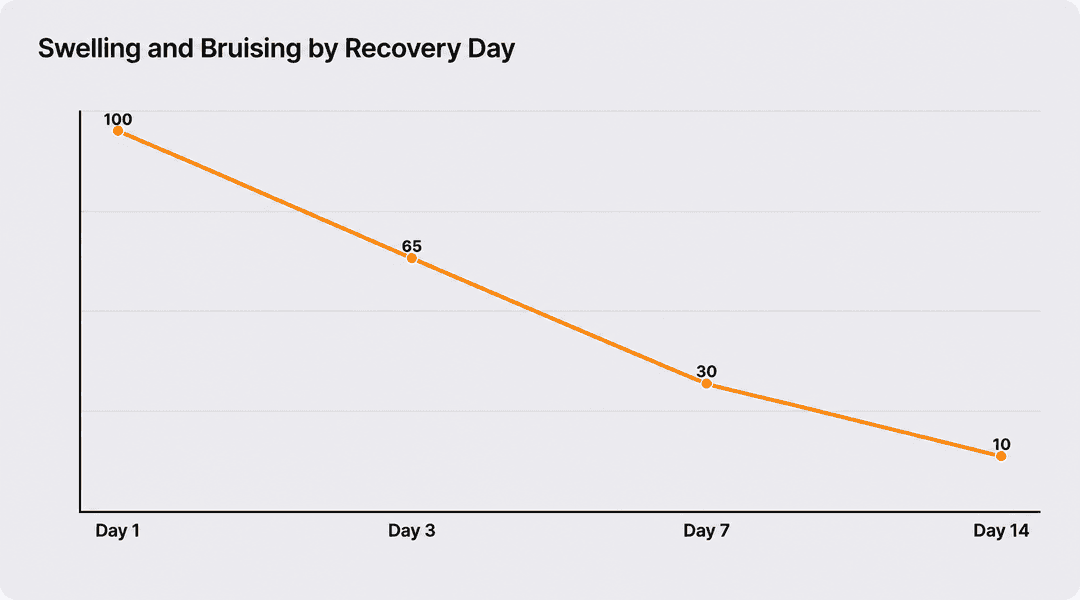
Swelling and bruising have slightly different recovery rates depending on the individual. Although results vary from person to person, here is a general summary of the average timeline for when they fade.
Recovery Item | Days 1–3 | Days 4–7 | Weeks 1–2 |
|---|---|---|---|
Initial Swelling | Most noticeable | Visibly decreases | Almost completely subsided |
Bruising | Looks dark if present | Fades in color | Mostly disappears |
Needle Marks | May be slightly visible | Fades away | Hardly visible |
Volume Shape | Hard to gauge right after | Contours begin to form | Starts to build up |
The timeline shown in the table is only an average reference. Some people do not get any bruises at all, and the intensity and duration of bruising depend on how much the blood vessels were stimulated. Since looking swollen for the first few days is within the normal range, it is best to wait at least 1 to 2 weeks to see the swelling fully subside.
This is a conceptual illustration of how swelling and bruising generally subside as recovery progresses over the days.
These care tips are helpful during the recovery period
How you care for yourself during the first few days after a Juvelook Volume treatment can affect how quickly the swelling subsides and how the final shape settles. Rather than complex aftercare, consistently following basic guidelines is much more helpful.
Cold Compress — Applying a gentle cold compress on the day of the treatment helps reduce swelling and bruising.
Avoid Excessive Heat Stimulation — Please postpone saunas, hot stone rooms, and hot showers for a few days after the procedure.
Postpone Strenuous Exercise — Increased blood flow can make swelling and bruising more pronounced, so please lower your exercise intensity for 2 to 3 days.
Avoid Applying Pressure to the Treated Area — It is best to avoid pressing hard or rubbing the area while it is settling.
Adequate Hydration and Moisturizing — Since the skin's recovery environment supports collagen production, keeping up with basic health and hydration is highly beneficial.
A review on how PLLA-based collagen stimulators undergo facial regeneration highlights that even with the same ingredients, how well the volume settles depends on the individual's skin condition and recovery environment. That work studied PLLA, while Juvelook Volume uses PDLLA — the same polylactic-acid family, so the collagen-stimulating mechanism is comparable, though the isomer differs and it does not break down on the same schedule. Therefore, recovery care is meaningful for securing stable results, and it is wise to take it easy for a few days.
Why choose Beautystone in Hapjeong?
At Beautystone Hapjeong, especially for collagen-stimulating treatments like Juvelook Volume, we make sure to explain the settling process first rather than just focusing on the immediate post-procedure look. We guide you beforehand on what level of initial swelling is a common reaction and which signs require a follow-up. Since we are a cozy clinic located within walking distance of Hapjeong Station, we can closely monitor each individual's recovery speed and calmly discuss the next steps together.
Distinguishing common reactions from signs to contact your doctor
Mild reactions are frequently reported during the first few days after a Juvelook Volume treatment. Most of these resolve naturally without any special treatment.
Swelling and redness at the injection site — This typically fades within a few days.
Mild bruising — If it occurs, it usually fades within 1 to 2 weeks and can be easily covered with concealer.
Slight firmness to the touch — This usually softens naturally as the product settles.
Mild stinging in the treated area — This typically lasts for about a day.
However, it is safest to consult with your medical team if you experience any of the following signs:
Swelling that does not go down even after 2 weeks
Pain in the treated area that progressively gets worse
Asymmetric swelling that is noticeably more pronounced on one side
High fever, severe redness, or intense heat — These are signs suggesting a possible infection.
Skin turning pale or accompanied by severe pain — Though extremely rare, please contact us immediately in this case.
Recovery speed and the settling process vary from person to person depending on age and skin condition. As this article provides general information, it is safest to discuss your suitability for the procedure and recovery management directly with your treated doctor. Since it typically takes a few weeks for collagen to build and the volume to settle, it is best to monitor the progress patiently rather than worrying about the immediate appearance.

Juvelook Volume treatment details
This month: Filler & Collagen Booster
Frequently Asked Questions
Q. How many days does it take for swelling to go down after Juvelook Volume?
A. While it varies by individual, initial swelling is usually most noticeable immediately after the procedure and gradually subsides over a few days. It decreases significantly after about a week, but it is best to wait 1 to 2 weeks to see the fully settled shape. The degree of swelling depends on the treated area and skin condition, so looking swollen for the first few days is completely normal.
Q. I have some bruising. Is there a way to make it fade faster?
A. Applying a gentle cold compress on the day of the treatment helps. Avoid any hard, pressing pressure. Mild bruising typically fades naturally within 1 to 2 weeks. If you want to manage it faster, you can consult with your doctor about using products like vitamin K cream.
Q. When do the volume effects start to settle?
A. Juvelook Volume is a treatment where volume gradually builds up as collagen is stimulated, so changes become more visible over several weeks rather than immediately. Contours start to form after the initial swelling goes down, and the exact settling timeline varies individually. It is best to wait and see the progress rather than expecting instant results.
Q. How soon after the treatment can I exercise or go to a sauna?
A. Strenuous exercise, saunas, and hot stone rooms can rapidly increase blood flow, making swelling and bruising more pronounced, so please postpone them for a few days after the procedure. Light walks are fine, and it is safest to increase your activity level gradually. You can confidently consult with your medical team regarding your exact recovery timeline based on your progress.
Recommended Reading


Hair Removal
레이저 제모 1회에도 남는 몫이 있어요 — 밀도를 모자이크로 보는 법

Tattoo removal
Why Extremity Tattoos Are Slower to Remove

Tattoo removal
Tattoo Removal Cost: Why Quotes Vary by Area

Tattoo removal
Unused Tattoo Removal Sessions: What Happens?

Lifting
Forehead Thread Lifting: How Far Can It Go?

skin
Skin Booster Prices: What to Check in a Quote