

Relax your face. If the line stays, it is structural, not muscular, and the approach changes.
Published -
Updated -

Author
Wi Young-jin · Chief director
Seoul National University College of Medicine · Seoul National University Hospital Specialist
→
You catch yourself in the mirror and the crease that used to appear only when you smiled is still sitting there with your face relaxed. That is usually the moment the question starts. But not all wrinkles are the same kind of wrinkle: a line that appears when you move and a line that stays when you do not come from different places.
This article covers how dynamic wrinkles, made by expression, differ from static wrinkles, which settle in over time, why each forms, and why the approach to them splits. Individual results and skin behavior vary, so read this as background for a conversation, not a diagnosis.
This is general information from Beautystone, a skin clinic in Hapjeong, Seoul.
What you will learn
What actually separates a dynamic wrinkle from a static one
Why muscle movement creates dynamic wrinkles
Why changes deep in the skin create static wrinkles
Why the approach to the two parts ways
What actually separates the two
There are broadly two kinds. One appears while the muscle contracts, when you smile or frown. The other is still there with your face at rest. Because the cause differs, so does the approach. A review dividing facial wrinkles into dynamic lines produced by repeated contraction of the expression muscles and static lines produced by extracellular matrix damage and collagen breakdown from ultraviolet exposure and oxidative stress, and noting that the two mechanisms are closely linked, with repeated muscle contraction promoting extracellular matrix breakdown in the dermis shows that these are not two separate stories but one continuous one.
That is why a line that first appeared only with an expression can, over the years, become fixed in place. Fold the same patch of skin often enough and its structure gradually changes, until the crease is there whether you move or not.
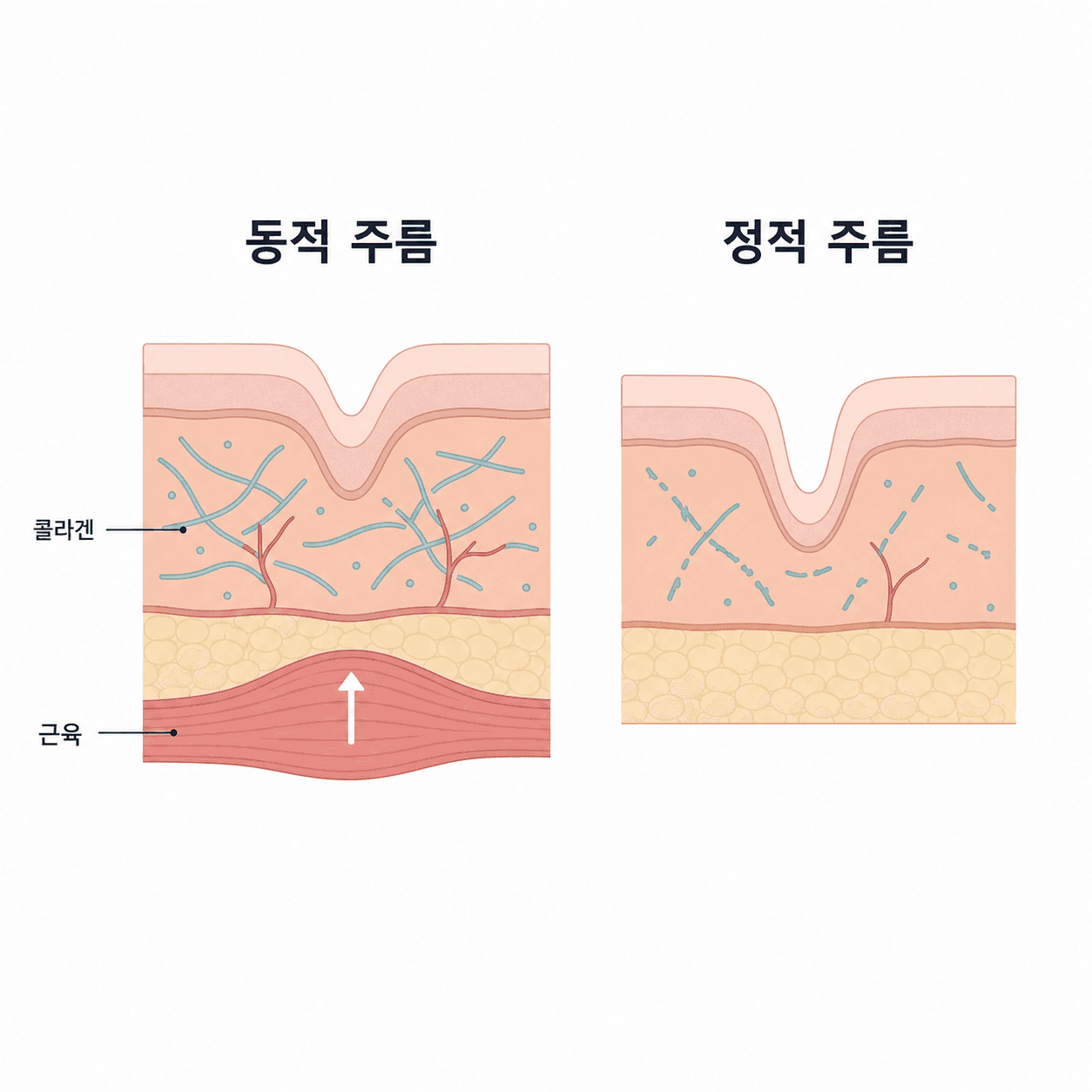

Dynamic wrinkles: your muscles fold the skin
A dynamic wrinkle is what you get when a facial muscle contracts and the skin over it creases. The fine lines at the outer eye when you smile, the vertical lines between the brows when you frown, the horizontal lines on the forehead when you raise your eyebrows. They surface as the muscle moves and fade again as the expression relaxes.
The point is that the driver here is the muscle underneath, not the skin itself. Make the same expression often and strongly, and the line tends to settle in more visibly in that spot. Because the skin structure has not changed much yet, this is the stage where the approach centers on the movement rather than on rebuilding anything.

Static wrinkles: the support underneath has changed
A static wrinkle is one that stays without any muscle moving, and it starts with change inside the skin. As you age, the extracellular matrix* along with collagen and elastic fibers that hold the skin up thins and takes damage, and the skin no longer springs back the way it used to. A histology study finding that even in skin shielded from sun exposure the dermis thins with age and elastic fibers gradually decrease, with fewer fibroblasts and a shifting extracellular matrix composition reducing skin elasticity shows that static wrinkles are tied to the structure underneath rather than to the surface.
Extracellular matrix*: the collagen, elastic fibers, and related structures that fill the space between cells in the skin and hold it up. When they thin or take damage, the skin loses elasticity.
So a static wrinkle is visible regardless of expression, and it is the harder of the two to work with, because the diminished support has to be addressed rather than just the surface. Add ultraviolet exposure and that change arrives sooner.

Why the approach parts ways
Because the two form differently, the direction of the approach splits as well. Here is a side-by-side of how they behave and where each one is usually addressed.
Feature | Dynamic wrinkle | Static wrinkle |
|---|---|---|
When you see it | Only while making an expression | Even with the face at rest |
Main driver | Muscle movement | Change in skin structure and collagen |
Typical areas | Outer eye, between the brows, forehead | Nasolabial folds, neck, cheeks |
Direction of approach | Toward reducing the movement | Toward rebuilding the support |
The chart below compares how much weight each factor tends to carry in each type. These are relative tendencies for orientation, not measured values.
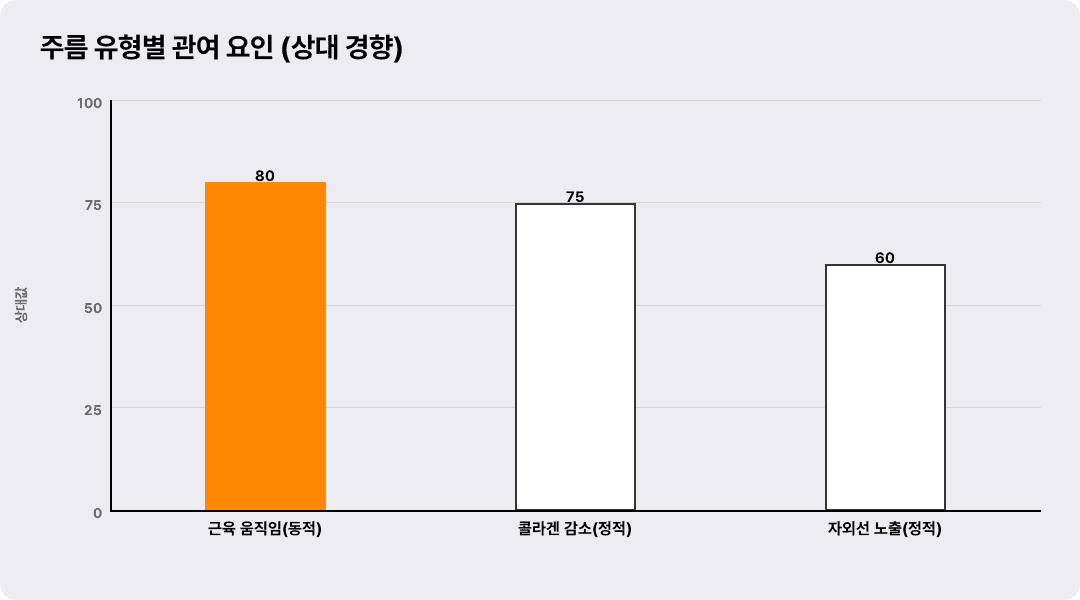
One point of vocabulary worth having straight if you are reading US sources: botulinum toxin is a drug, so it is FDA-approved, while the energy-based devices used to work on skin structure are FDA-cleared. Neither word is a promise about your result, and individual results vary. In practice most areas carry a mix of both wrinkle types, so having the area looked at is what settles the direction.

Why where you have it assessed still matters
At Beautystone, a small clinic a short walk from Hapjeong Station in Seoul, a wrinkle consult starts by checking whether the line only shows with an expression or stays at rest. Two people with a crease in the same spot can need opposite directions depending on which type dominates, so the character of the line comes first and the plan second. Being small is what makes it practical to work through one face at a time. Wherever you go, a useful question to ask is simply which of the two your clinician thinks is driving your line, and why.

Common misconceptions, and when to get it checked
A few things trip people up when they start thinking about wrinkles.
That one method covers everything — the two types are approached differently, so a mixed area has to be read as both
That not making expressions prevents them — static wrinkles are structural and progress independently of expression
That ultraviolet exposure is beside the point — it is one of the larger factors pulling static wrinkles forward
In the following situations it is worth having the area looked at rather than judging it yourself.
A crease that has started staying put once you relax your face
One side deepening noticeably more, or progressing asymmetrically
A sense that a line is getting deeper quickly over a short period
Wrinkles usually progress as a mix of the two, so sorting out which character dominates is the starting point rather than the conclusion. This article is general information, so the direction that suits your own lines is for the clinician who examined you to decide with you.
Frequently asked questions
Q. If I leave a dynamic wrinkle alone, does it become a static one?
A. That progression does happen. When skin folds in the same spot over and over, the structure of that patch gradually changes, and the line can settle in where it stays visible with your face relaxed. That is why habits and care are worth looking at while a line is still only showing up with movement.
Q. Do static wrinkles form regardless of expression?
A. Yes. Static wrinkles come from collagen and the supporting structure inside the skin thinning out, so they are not directly tied to expression. That said, an expression line repeated for years can settle into the same spot and carry over into a static one, so the two are not entirely separate.
Q. How do I tell which kind I have?
A. The quick version: relax your face completely and look in the mirror. If the line only shows when you move, it is closer to dynamic. If it is still there at rest, it is closer to static. Many areas carry a mix of both, so an accurate read comes from having the area looked at directly.
Q. Does sun protection actually matter for wrinkles?
A. It matters a great deal. Ultraviolet exposure damages collagen and elastic fibers inside the skin, and it is a major factor in bringing static wrinkles on earlier. That is why sun protection sits close to the base of any wrinkle plan. Everyday habits are what create the difference over the long run.
Content



skin
Why Does Fractional CO2 Take Longer to Heal?

Contouring & Volume
How Many cc Does Forehead Filler Need?

skin
Why Is My Skin Oily but Tight in the Fall?

Hair Removal
Underarm Laser Hair Removal Cost: Do the Math

Tattoo removal
Laser Before a Cover-Up: How Many Sessions?

skin
큐어젯 다운타임, 다음 날 출근과 화장은 언제부터 될까요?