

If you've had it done several times elsewhere but it still won't go away
Published -
Updated -

Author
Wi Young-jin · Chief director
Seoul National University College of Medicine · Seoul National University Hospital Specialist
→
A multi-colored tattoo, .
treated with just one
wavelength—are you getting proper care?
Before you know it, the season
for short sleeves is coming.
Many people want to remove theirs before summer,
before meeting the in-laws,
or before important occasions.
Today, for those looking into tattoo removal for the first time,
or those who have had several sessions elsewhere
but say blue ink won’t fade well—
that’s a wavelength issue, haha.
Based on my real clinical experience,
I organized the things
I often thought, “I wish you had known this beforehand.”
First, let’s start by covering
the three most frequently asked questions.
Q. Can tattoo removal
be done with just one type of laser?
A. No.
Depending on the color and pigment depth,
different wavelengths are needed.
I’ll explain in detail below.
Q. About how many sessions
for complete removal?
A. It varies by case,
but there are criteria we can use to predict in advance.
I’ll explain below
which factors affect the number of sessions.
Q. During treatment,
does it hurt a lot?
A. To be honest, yes, it hurts a lot.
But there are ways to reduce pain,
and I’ll explain those differences too.
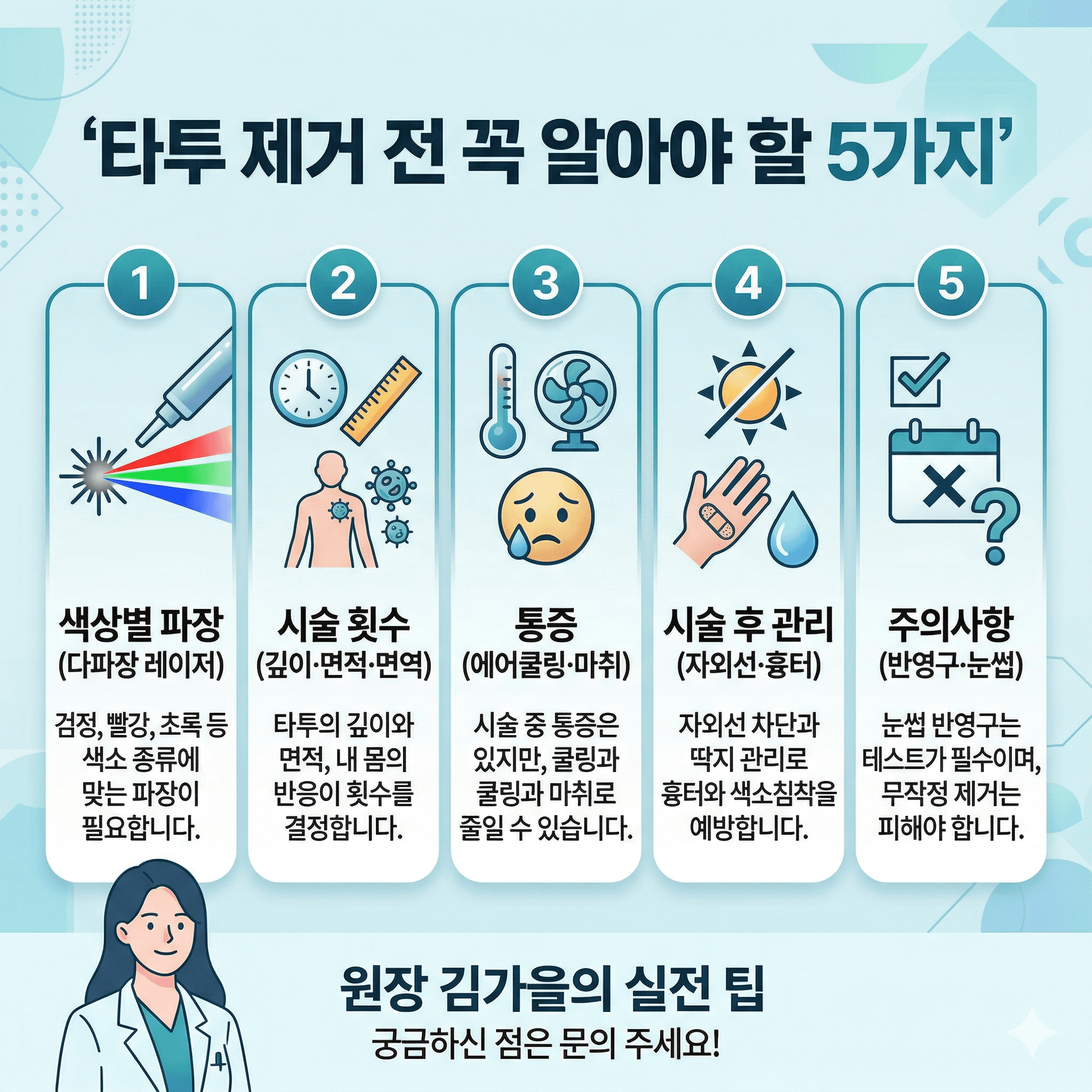
Laser wavelengths,
one is not enough for everything

This is a common misunderstanding:
tattoo pigments, depending on color,
absorb different light wavelengths.
Black and blue tones
respond well to 1064nm,
red and orange tones to 532nm,
and green and sky-blue tones to 694nm
are most effective.
There’s one key point here.
If a clinic only has a single-wavelength device
and treats a tattoo with mixed colors,
some specific colors
may not fade well.
From the outside, treatment was done,
but only some colors fade
while others remain.
From the patient’s perspective,
it feels like “there was no effect,”
but in many cases, it’s simply because
the proper wavelength for that color wasn’t used.
If your tattoo contains multiple colors,
it’s important to choose equipment
and a practitioner capable of multi-wavelength treatment.
Number of sessions,
these 3 factors decide it

When asked, “How many sessions to remove it all?”
this is what I say:
“It’s hard to answer immediately,
because we can’t see inside,,
we need to check these three things first.”
Pigment depth
The deeper the pigment is embedded in the skin,
the more sessions are needed.
Tattoos done by professional artists
often have deeper, more uniform pigment placement,
so they may respond well,
but still take longer to remove completely.
Pigment amount and area
The darker the color and the wider the filled area,
the more energy and sessions are required.
A single line tattoo and a fully colored tattoo
can differ quite a lot in session count.
Your immune response
The laser breaks pigment into tiny particles,
and then your immune cells (macrophages)
absorb and clear them.
So it doesn’t end with the laser itself—
what matters is how quickly
your body processes things afterward.
That’s key.
That’s why allowing enough interval between sessions,
UV protection, and maintaining good health
all have real impact on the total number of sessions.
In my experience,
for black single-color line tattoos,
it is often around 5–10 sessions,
while color-filled tattoos
often require longer treatment.
Director Kaeul Kim’s practical note:
I’ve seen quite a few people who came in saying
they had multiple laser sessions elsewhere
but saw little fading,
and when we checked, treatment intervals were too short,
or the energy had been set
too low in many cases.
No matter how good the device is,
if the energy setting is too conservative,
it’s hard to get results.
On the other hand, if energy is too high,
pigment breaks down faster,
but the risk of burns or hyperpigmentation rises.
After building up many cases,
I’ve again confirmed that
balancing proper energy and interval
is the most important thing.
Pain
Let me be honest

To be honest, it hurts quite a lot.
Many people describe it as a completely different level of pain
compared with getting the tattoo.
That’s because the laser delivers
strong instantaneous energy to pigment,
which also irritates the skin itself,
and it tends to be worse for larger areas
or areas near bone.
So before treatment, we
apply numbing cream as standard,
and use air cooling (cold air) at the same time
to lower skin temperature during the procedure.
Using both together
does reduce perceived pain considerably,
but still, it’s hard to say
that it is “not painful.”
There are limits here,
and with current technology,
completely eliminating pain is difficult.
Still, depending on pre-treatment preparation,
the difference is definitely noticeable.
Post-treatment care,
is more important than you think

It’s not over just because the laser session is over.
Right after treatment, the skin is in a state
similar to having a wound,
so scabbing for 2–3 days
and swelling can occur.
If you forcibly peel off scabs during this period,
or expose skin to UV without protection,
post-inflammatory hyperpigmentation (PIH)
or scarring may occur.
The three most important points
in post-treatment care are:
Protect the treated area from UV
During recovery, be sure to apply sunscreen
or keep the area covered.
Let scabs fall off naturally
If removed forcefully,
the chance of hyperpigmentation increases.
Maintain moisture
If skin gets dry, recovery slows
and irritation worsens.
Also, leave enough time before the next session—
in my experience, at least 6–8 weeks are needed.
If the next session is done too soon,
additional irritation hits before skin recovers,
which can actually worsen results.
Frequently asked questions
Q1. Are eyebrow tattoos (semi-permanent)
removed with the same laser?
A. Semi-permanent eyebrow tattoos can also be removed with laser,
but because their pigment composition differs from regular tattoos,
responses may appear differently.
Especially with brown and peach-toned pigments,
an oxidation reaction can temporarily darken the color
immediately after laser exposure,
so a test spot is essential before treatment.
Q2. What happens if I stop
midway through removal?
A. Even if you stop midway,
the progress achieved up to that point remains.
Even without aiming for complete removal,
some people simply aim to make it lighter,
and
for cover-up tattoos, there are also cases
where only part of the existing tattoo is removed.
Q3. I got a tattoo recently—
can I remove it right away?
A. It’s better to start removal
at least 4–6 weeks after getting the tattoo.
After the pigment has settled stably in the skin,
the laser responds more efficiently, and
treatment on skin that has itself recovered
helps reduce unnecessary
side effects.
WhatsApp consultation before your visit is also available.
If you have questions, feel free to contact us.
This was Kaeul Kim.
✦ Read together
How many sessions for irezumi tattoo removal? Around 15 on average
Color tattoo removal with PicoWay: an honest comparison of removal rates by color
5 criteria for choosing a dermatology clinic in Hongdae, explained directly by a specialist
Session counts vary widely from one tattoo to another. Beautystone uses the Kirby–Desai assessment in consultation, reviewing skin type, location, ink amount, layering, scarring and colour, to estimate an expected range. It is an estimate rather than a fixed number and is reviewed as your response becomes clear, so it is worth discussing your stay length or ability to return if you are travelling.
Content

![[Wi Young-jin] Color tattoos need 30% more removal sessions](https://framerusercontent.com/images/0qM2zEPvNpSasNc56D0vXAxxH4.jpg?width=1080&height=1080)



skin
Why Does Fractional CO2 Take Longer to Heal?

Contouring & Volume
How Many cc Does Forehead Filler Need?

skin
Why Is My Skin Oily but Tight in the Fall?

Hair Removal
Underarm Laser Hair Removal Cost: Do the Math

Tattoo removal
Laser Before a Cover-Up: How Many Sessions?

skin
큐어젯 다운타임, 다음 날 출근과 화장은 언제부터 될까요?