Droopy Mouth Corners at Rest? Check This First
Mouth corner Botox: why some see dramatic lifts & others nothing. Find out the real difference.
Corner-of-mouth Botox,
how much does it actually lift?
These days, people going around without masks
have noticeably increased.
As the whole face is now visible,
and since no face is perfectly symmetrical,
for various reasons,
the way the corners of the mouth look droopy at rest
suddenly starts to bother you—
this is often that kind of time.
Today, I’ll give you
a complete guide to corner-of-mouth Botox.
I’ll start by bringing up
the questions I get asked most often.
Q. Corner-of-mouth Botox—
is it effective for drooping
mouth corners at rest?
A. Yes, it is.
However, how much they lift
depends on each person’s muscle condition.
I’ll explain this part in detail in the main text.
If done too strongly,
facial expressions can become unnatural.
Q. After the procedure, can it look unnatural,
or make your smile
look strange?
A. If the dose is well controlled, it looks natural.
But if the dose is excessive,
your expression may look awkward.
I’ll definitely cover this point too.
Q. How long does the effect last?
A. In my experience, usually 3–4 months.
With repeated treatments,
it can gradually last a bit longer.
And, don’t overdo it!
Why the corners of the mouth look droopy:
it’s because of muscles

Mouth corners turning downward
generally come from two main causes.
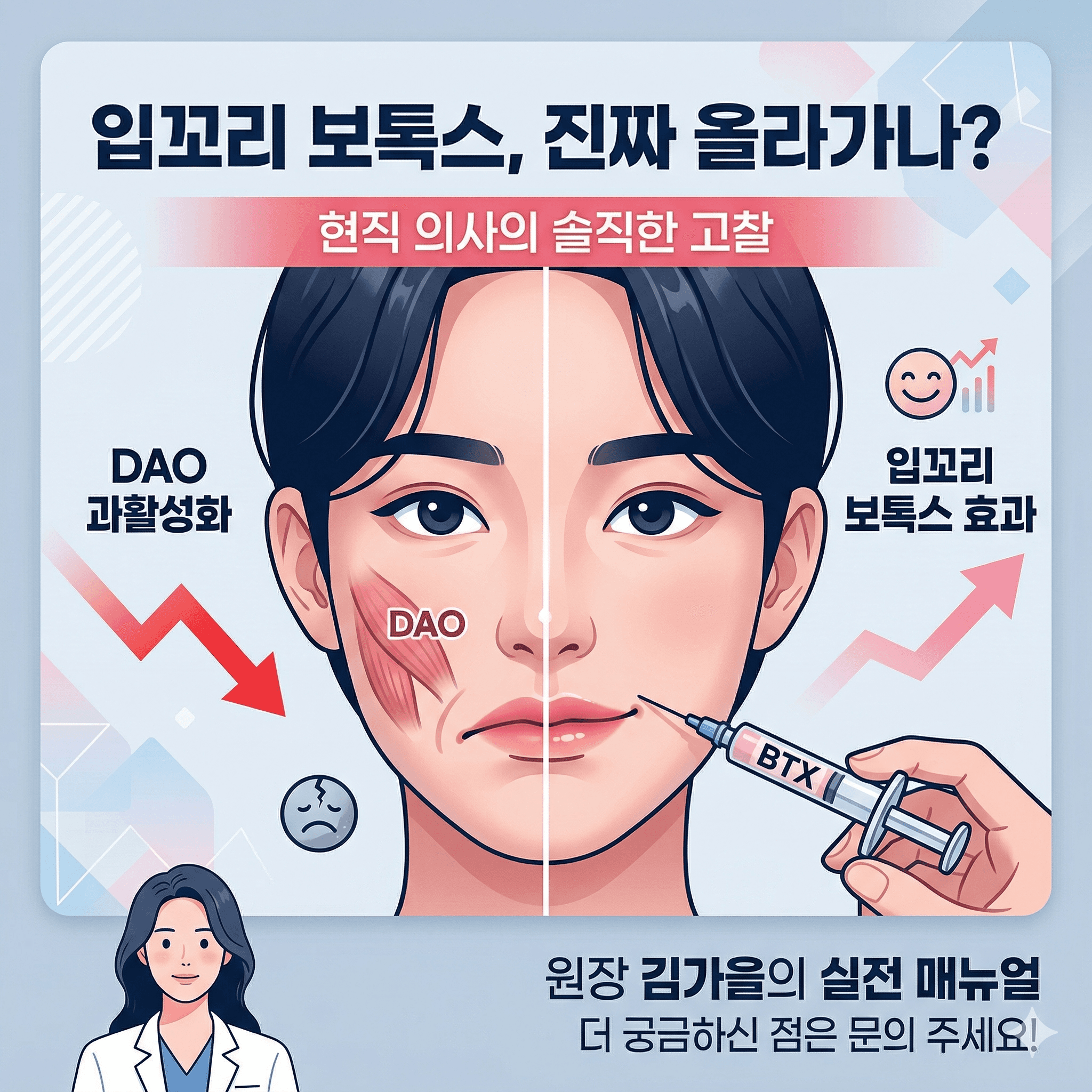
The muscle called DAO (Depressor Anguli Oris),
which pulls the mouth corners downward, is overactive
As cheek fat sags,
support around the mouth corners decreases
What corner-of-mouth Botox targets
is exactly #1: the DAO muscle.
When Botox is injected into this muscle,
the downward pulling force decreases,
and the muscles that lift the mouth corners
become relatively dominant.
This is a common misunderstanding:
corner-of-mouth Botox is not a procedure
that "forcibly lifts" the mouth corners.
It reduces the downward force
to naturally rebalance things,
so for people whose mouth corners are already quite lifted,
the effect may not feel very dramatic.
On the other hand, for people whose mouth corners
bend downward a lot when expressionless,
and who often hear comments like
"you always look angry" or "you look tired,"
the perceived effect
tends to feel much greater.
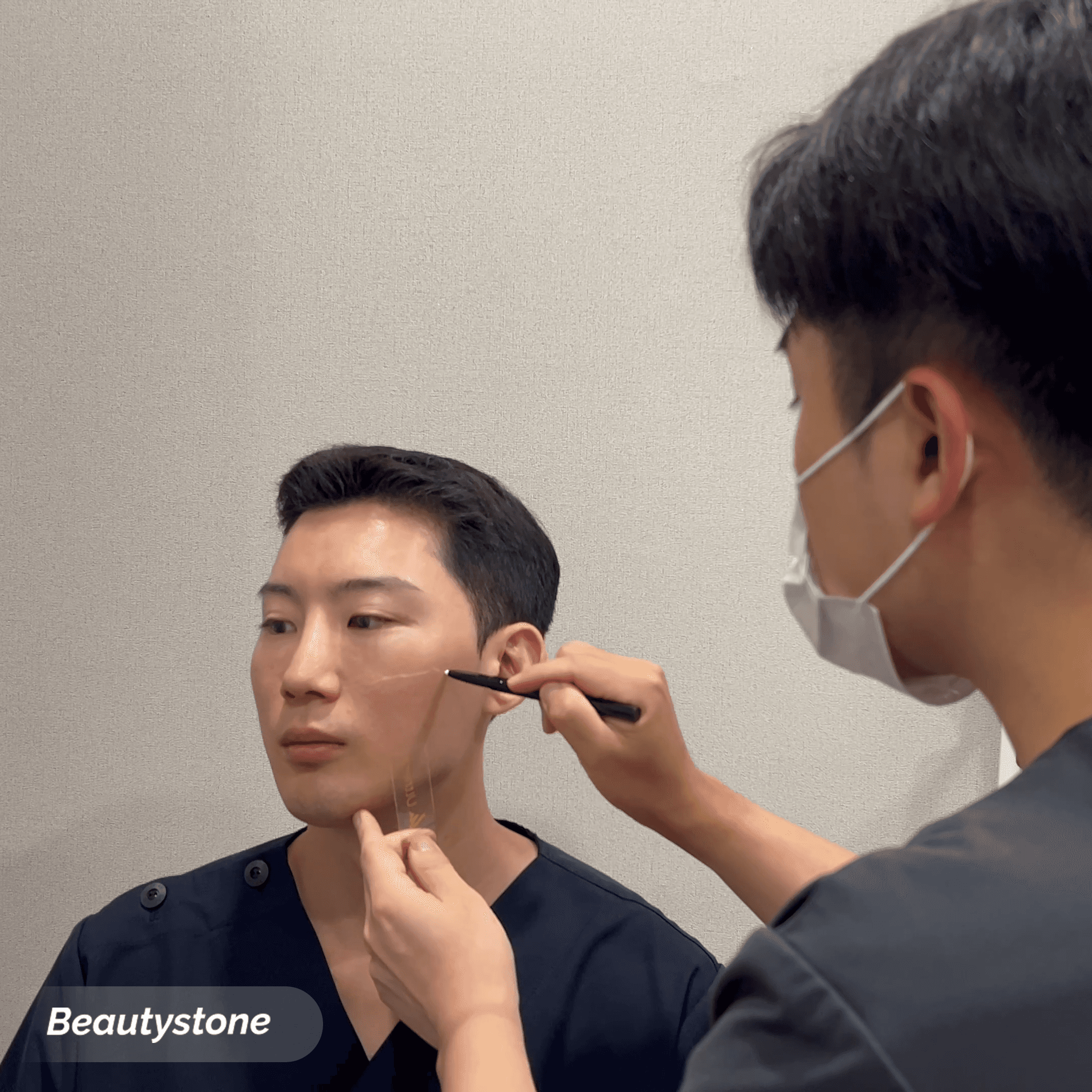
As for where and how it is injected,
to explain simply:
the injection point is slightly below the mouth corner,
along the area where the DAO muscle runs.
Injecting about 1–2 points per side
is typical.
If the placement is too superficial, the effect is insufficient,
and if too deep or too broad,
nearby muscles may also be affected, causing
asymmetry when smiling,
or an unnatural
mouth shape.
Especially if it spreads to the orbicularis oris (around the mouth)
or to the zygomatic muscles,
it may lead to side effects where
the smile itself looks awkward.
Dose is important too.
If too much is injected,
overall strength of the mouth-corner muscles can drop,
so one side may not lift when smiling,
and in rare cases pronunciation can become slurred.
I usually start with a small amount first,
then decide whether to add more
after checking the response at 2 weeks.
Director Wi Young-jin’s practical note:
For corner-of-mouth Botox,
it’s no exaggeration to say
dose and placement are everything.
Too little effect is a problem,
but too strong is also problematic.
In my experience, among first-time visitors,
quite a few come in after getting overtreated elsewhere,
and
say that only one mouth corner won’t lift when smiling,
or that their mouth shape while speaking
feels awkward.
In such cases, the only option is to wait
until the Botox wears off,
so the initial dose setting is truly important.
No matter how good the Botox product is,
if placement and dose are wrong,
it’s hard to get the desired result.
To summarize the effect honestly
I’ve rarely seen anyone
say there was absolutely no effect.
But this is also a treatment where people who say
"it changed dramatically" and those who say
"maybe there’s a difference…" coexist.
That difference
depends on whether the cause of drooping mouth corners
is a DAO muscle issue or cheek sagging
.
Judging only from photos without consultation
to decide "Will Botox work?"
has limitations.
You need to observe actual muscle movement
and identify which muscle is the main cause
to suggest an appropriate approach.
Cause of sagging | Effect of corner-of-mouth Botox | What to additionally consider |
|---|---|---|
DAO muscle overactivity | High perceived effect | Often sufficient with Botox alone |
Cheek sagging / midface volume loss | Limited effect | Often combined with filler/lifting |
Combination of both | Partial effect | Needs combined approach after accurate cause analysis |
Before and after the procedure,
please follow just these
The procedure itself finishes in about 5 minutes.
There are few injection points and shallow skin depth,
so bruising or swelling is usually
less than Botox in other areas.
On the day of treatment, do not
rub or massage the area aggressively.
After treatment, it’s best not to lie down for 4–6 hours.
Botox can spread.
Effects usually begin to appear within 3–7 days,
and settle in by 2 weeks.
If there isn’t as much change as desired even after 2 weeks,
that’s the right time to decide on additional injection.
Since the duration is usually 3–4 months,
for those wanting semi-permanent effects,
the downside is that ongoing maintenance is needed.
Still, with repeated treatments,
muscles gradually atrophy,
so the effect duration tends
to increase over time.
Frequently asked questions
Q1. If I get corner-of-mouth Botox,
won’t my smile
look weird?
A. If the dose is properly adjusted, it looks natural.
However, if over-injected or placed incorrectly,
one corner may lift less when smiling,
or the expression may look asymmetric.
For first treatment, start with a small dose,
and checking response after 2 weeks is safest.
Q2. Corner-of-mouth filler vs Botox—
what’s the difference?
A. Botox works by reducing
the force of muscles pulling downward,
while filler adds volume to the mouth-corner area
to lift it physically.
If the cause is a muscle issue, Botox;
if it’s volume loss or deep-set wrinkles,
filler is often more suitable.
Sometimes both are combined.
Q3. Corner-of-mouth Botox,
how much does it cost?
A. It varies by clinic,
and also differs by product used.
As it is a non-covered item, there is no publicly fixed price,
but if you contact us via WhatsApp first,
we’ll guide you.
If you have any questions,
feel free to message us on WhatsApp.
You can ask before visiting as well.
This was Wi Young-jin.
✦ Read together
Corner-of-mouth Botox,
how much does it actually lift?

These days, people going around without masks
have noticeably increased.
As the whole face is now visible,
and since no face is perfectly symmetrical,
for various reasons,
the way the corners of the mouth look droopy at rest
suddenly starts to bother you—
this is often that kind of time.
Today, I’ll give you
a complete guide to corner-of-mouth Botox.
I’ll start by bringing up
the questions I get asked most often.
Q. Corner-of-mouth Botox—
is it effective for drooping
mouth corners at rest?
A. Yes, it is.
However, how much they lift
depends on each person’s muscle condition.
I’ll explain this part in detail in the main text.
If done too strongly,
facial expressions can become unnatural.
Q. After the procedure, can it look unnatural,
or make your smile
look strange?
A. If the dose is well controlled, it looks natural.
But if the dose is excessive,
your expression may look awkward.
I’ll definitely cover this point too.
Q. How long does the effect last?
A. In my experience, usually 3–4 months.
With repeated treatments,
it can gradually last a bit longer.
And, don’t overdo it!
Why the corners of the mouth look droopy:
it’s because of muscles

Mouth corners turning downward
generally come from two main causes.
The muscle called DAO (Depressor Anguli Oris),
which pulls the mouth corners downward, is overactive
As cheek fat sags,
support around the mouth corners decreases
What corner-of-mouth Botox targets
is exactly #1: the DAO muscle.
When Botox is injected into this muscle,
the downward pulling force decreases,
and the muscles that lift the mouth corners
become relatively dominant.
This is a common misunderstanding:
corner-of-mouth Botox is not a procedure
that "forcibly lifts" the mouth corners.
It reduces the downward force
to naturally rebalance things,
so for people whose mouth corners are already quite lifted,
the effect may not feel very dramatic.
On the other hand, for people whose mouth corners
bend downward a lot when expressionless,
and who often hear comments like
"you always look angry" or "you look tired,"
the perceived effect
tends to feel much greater.
As for where and how it is injected,
to explain simply:
the injection point is slightly below the mouth corner,
along the area where the DAO muscle runs.
Injecting about 1–2 points per side
is typical.
If the placement is too superficial, the effect is insufficient,
and if too deep or too broad,
nearby muscles may also be affected, causing
asymmetry when smiling,
or an unnatural
mouth shape.
Especially if it spreads to the orbicularis oris (around the mouth)
or to the zygomatic muscles,
it may lead to side effects where
the smile itself looks awkward.
Dose is important too.
If too much is injected,
overall strength of the mouth-corner muscles can drop,
so one side may not lift when smiling,
and in rare cases pronunciation can become slurred.
I usually start with a small amount first,
then decide whether to add more
after checking the response at 2 weeks.
Director Wi Young-jin’s practical note:
For corner-of-mouth Botox,
it’s no exaggeration to say
dose and placement are everything.
Too little effect is a problem,
but too strong is also problematic.
In my experience, among first-time visitors,
quite a few come in after getting overtreated elsewhere,
and
say that only one mouth corner won’t lift when smiling,
or that their mouth shape while speaking
feels awkward.
In such cases, the only option is to wait
until the Botox wears off,
so the initial dose setting is truly important.
No matter how good the Botox product is,
if placement and dose are wrong,
it’s hard to get the desired result.
To summarize the effect honestly

I’ve rarely seen anyone
say there was absolutely no effect.
But this is also a treatment where people who say
"it changed dramatically" and those who say
"maybe there’s a difference…" coexist.
That difference
depends on whether the cause of drooping mouth corners
is a DAO muscle issue or cheek sagging
.
Judging only from photos without consultation
to decide "Will Botox work?"
has limitations.
You need to observe actual muscle movement
and identify which muscle is the main cause
to suggest an appropriate approach.
Cause of sagging | Effect of corner-of-mouth Botox | What to additionally consider |
|---|---|---|
DAO muscle overactivity | High perceived effect | Often sufficient with Botox alone |
Cheek sagging / midface volume loss | Limited effect | Often combined with filler/lifting |
Combination of both | Partial effect | Needs combined approach after accurate cause analysis |
Before and after the procedure,
please follow just these

The procedure itself finishes in about 5 minutes.
There are few injection points and shallow skin depth,
so bruising or swelling is usually
less than Botox in other areas.
On the day of treatment, do not
rub or massage the area aggressively.
After treatment, it’s best not to lie down for 4–6 hours.
Botox can spread.
Effects usually begin to appear within 3–7 days,
and settle in by 2 weeks.
If there isn’t as much change as desired even after 2 weeks,
that’s the right time to decide on additional injection.
Since the duration is usually 3–4 months,
for those wanting semi-permanent effects,
the downside is that ongoing maintenance is needed.
Still, with repeated treatments,
muscles gradually atrophy,
so the effect duration tends
to increase over time.
Frequently asked questions
Q1. If I get corner-of-mouth Botox,
won’t my smile
look weird?
A. If the dose is properly adjusted, it looks natural.
However, if over-injected or placed incorrectly,
one corner may lift less when smiling,
or the expression may look asymmetric.
For first treatment, start with a small dose,
and checking response after 2 weeks is safest.
Q2. Corner-of-mouth filler vs Botox—
what’s the difference?
A. Botox works by reducing
the force of muscles pulling downward,
while filler adds volume to the mouth-corner area
to lift it physically.
If the cause is a muscle issue, Botox;
if it’s volume loss or deep-set wrinkles,
filler is often more suitable.
Sometimes both are combined.
Q3. Corner-of-mouth Botox,
how much does it cost?
A. It varies by clinic,
and also differs by product used.
As it is a non-covered item, there is no publicly fixed price,
but if you contact us via WhatsApp first,
we’ll guide you.
If you have any questions,
feel free to message us on WhatsApp.
You can ask before visiting as well.
This was Wi Young-jin.
✦ Read together
Latest post
Latest post

Lifting
울쎄라·써마지 받고 붓기가 언제 빠지는지, 직후·1주·2주로 나눠 알 수 있을까요?
리프팅 붓기 회복 타임라인 — 시술 직후 가장 붓는 구간부터 1주·2주 정리 시점까지, 울쎄라와 써마지의 붓는 양상 차이와 회복을 편하게 보내는 관리, 의료진에게 문의할 신호를 시점별로 짚어봐요.

Lifting
소프웨이브 리프팅 처음인데, 뭘 알고 시작하면 덜 헤맬까요?
소프웨이브가 어떤 초음파 방식으로 콜라겐 재생을 유도하는지, 다른 초음파 리프팅과 뭐가 다른지, 처음 받을 때 확인하면 좋은 것들을 짚어봐요.

Hair Removal
젠틀맥스 프로 플러스와 다이오드 레이저 제모, 파장과 피부톤에서 뭐가 어떻게 다를까요?
제모 레이저가 털 속 멜라닌을 겨냥하는 원리부터 젠틀맥스 프로 플러스의 두 파장, 다이오드의 한 파장 방식까지, 피부톤별 적합도를 비교해 선택 기준을 짚어봐요.

skin
레이저 시술 뒤에 거뭇하게 올라오는 색소침착, 시술 전부터 어떻게 예방하면 좋을까요?
레이저 후 색소침착 예방 — 멜라닌세포가 자극받는 원리부터 시술 전 준비, 회복기 자외선 차단 강도, 색소가 올라왔을 때 관리 방향까지 단계별로 짚어봐요.

Contouring & Volume
레이저·필러·보톡스 시술 후에 화장은 시술 종류마다 언제부터 다시 해도 괜찮을까요?
시술 후 화장이 걱정된다면 이 글 하나로 정리해요. 시술별 화장 가능 시점부터 색조·베이스·클렌징 되돌리는 순서, 다시 시작해도 되는 신호까지 짚어봐요.

Lifting
20대부터 50대까지, 연령대별 리프팅 시술은 언제 어떤 것부터 시작하면 좋을까요?
리프팅 시작 시점은 나이보다 피부 신호가 기준이에요. 연령대별 로드맵과 방식을 고르는 기준, 흔한 오해까지 짚어봐요.
1:1 Custom Approach
1:1 Consultation Whatsapp
🌸 Beautystone Clinic attends the Meditox Bangkok Cadaver Workshop 🌸
1:1 Custom Approach