

Old tattoos really removable? Hongdae clinic reveals depth, sessions & aftercare. Find out now.
Published -
Updated -

Author
Wi Young-jin · Chief director
Seoul National University College of Medicine · Seoul National University Hospital Specialist
→
🎨 Removing Old Tattoos —
How Many Sessions Do You Need?
Hello, I'm from Beautystone Clinic.
I'm Dr. Wi Young-jin, a Seoul National University–trained specialist.
Check out these related posts!~
✦ You Might Also Like
▶Red Residue After Eyebrow Tattoo Removal: 3 Causes & Solutions
▶Botox Results: Wrinkles in 1 Week, Jaw in 1 Month? Complete Timeline
"It's been over 10 years — can it still be removed?"
This is one of the most common questions I hear in the clinic.
Let me clear up the myths around old tattoos
and share what I've personally observed
through years of treating patients —
as honestly as I can.
1. Old Tattoos —
How Does Laser Actually Remove Them?

Tattoo ink is embedded deep in the dermis,
and it stays there no matter how much time passes.
The laser targets ink pigment using specific wavelengths,
breaking it into tiny particles
that your immune cells then clear away.
At Beautystone Clinic, we use
for tattoo removal —
including old, long-standing tattoos.PicoWay
2. Old Tattoos Can Actually
Work in Your Favor
Over time, tattoo ink naturally breaks down on its own,
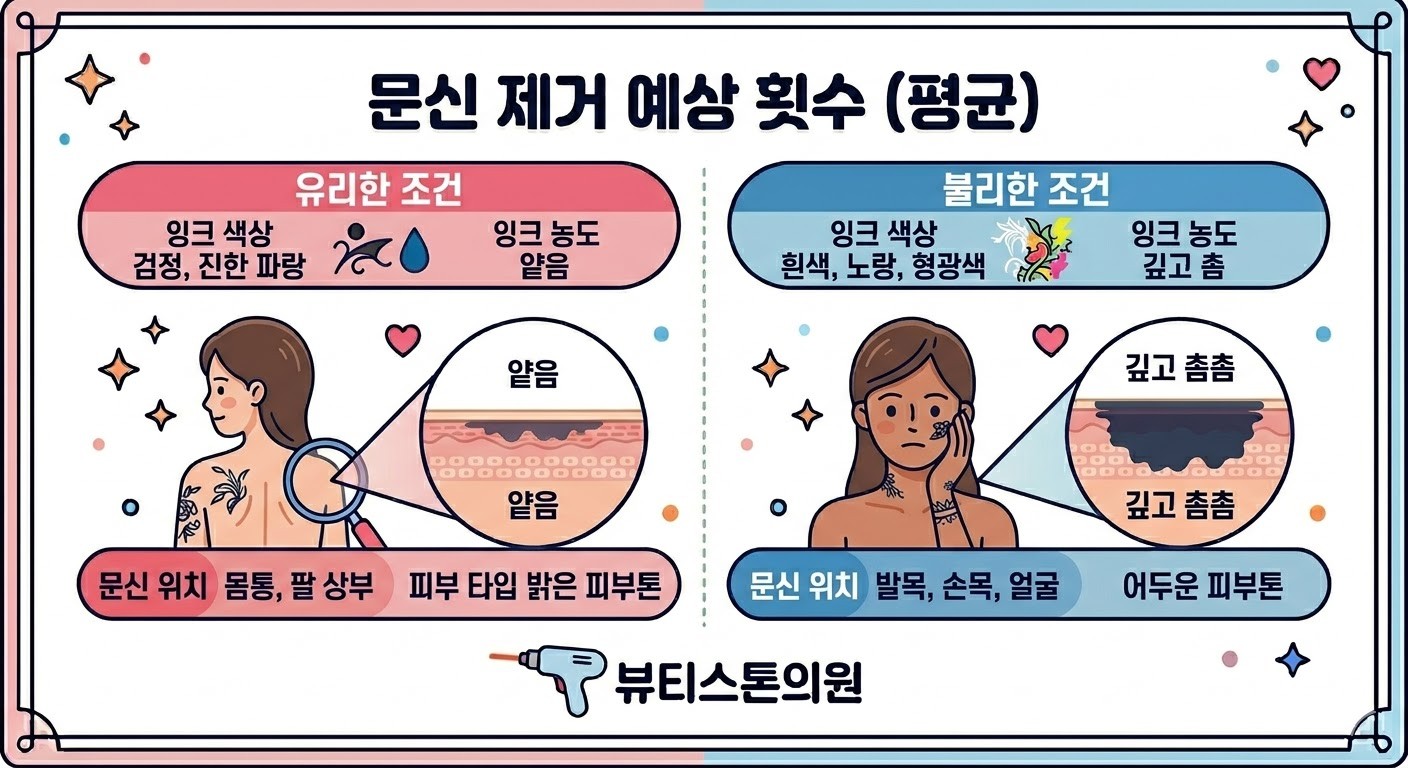
which means older tattoos
may require fewer laser sessions to remove!
(Good news, right?)
That said, the number of sessions needed
can vary greatly depending on
the type and depth of the ink.
Factor
Favorable
Unfavorable | Ink Color | Black, Dark Blue |
White, Yellow, Fluorescent | Ink Density | Shallow |
Deep & Dense | Tattoo Location | Torso, Upper Arm |
Ankle, Wrist, Face | Skin Type | Light Skin Tone |
Dark Skin Tone | 3. Being Honest About | the Limits of Treatment |
One or two sessions rarely removes a tattoo completely —
patience and repeated treatments are essential.
Dense professional tattoos,
or those that have been retouched two or more times,
may still show faint traces
even after 10+ sessions —
from fading (hypopigmentation)
or texture changes (scarring).
Skipping sun protection or moisturizing after treatment
significantly raises the risk of PIH.
Think of aftercare as half the result —
it deserves just as much attention
as the treatment itself.
💬 Frequently Asked Questions (FAQ)
Q1. How much does it cost,
and how painful is it?
Cost varies depending on size and color.
A.
With numbing cream applied, most patients describe the sensation as a light rubber band snap.
Q2. How many sessions until it's completely gone?
A. It varies greatly depending on the size and color,
and with numbing cream applied, the pain
eases to about the level of a rubber band snap.
Q2. How many sessions it will take —
Can it be predicted in advance?
A. It's difficult to predict from just the first consultation.
We typically assess your response after 2–3 sessions
and then determine how many more you may need.
If you're overwhelmed by too much information,
the fastest way forward is a hands-on evaluation
and a personalized plan.
Beautystone Clinic, seoulat
I personally handle everything — from consultation to treatment.
We're also open on Sundays for your convenience.
Frequently asked questions
Q. Can tattoos that are over 10 years old also be removed?
A. Yes, it is possible! In fact, as time passes, some of the ink naturally breaks down, which can sometimes even reduce the number of removal sessions needed. However, the exact number of sessions required varies greatly depending on the type and depth of the ink used.
Q. How many sessions of tattoo removal will I need to receive?
A. It can be difficult to predict after just the first consultation. Usually, it's more accurate to assess how your skin responds after 2 to 3 sessions before deciding on the remaining number of treatments. For high-density professional tattoos, it can take 10 or more sessions.
Q. Which types of tattoos are more difficult to remove?
A. The color and depth of the tattoo affect the results. Black and dark blue ink are easier to treat, whereas white, yellow, and fluorescent colors are more challenging. Deeper, denser ink, tattoos located on the ankles, wrists, or face, and darker skin tones also make the process more difficult.
Q. How painful is tattoo removal, and how should I care for my skin afterward?
A. Applying a numbing cream will soothe the sensation to feel more like a light flick of a rubber band. Please be sure to keep up with sunscreen and moisturizer after your procedure, as neglecting post-care can increase the risk of pigmentation.
How long a long-standing tattoo takes depends on more than its age. Beautystone uses the Kirby–Desai assessment in consultation, reviewing skin type, location, ink amount, layering, scarring and colour, to discuss an expected session range. It remains an estimate, revised as we see how the ink responds rather than fixed in advance.
Content




skin
Why Does Fractional CO2 Take Longer to Heal?

Contouring & Volume
How Many cc Does Forehead Filler Need?

skin
Why Is My Skin Oily but Tight in the Fall?

Hair Removal
Underarm Laser Hair Removal Cost: Do the Math

Tattoo removal
Laser Before a Cover-Up: How Many Sessions?

skin
큐어젯 다운타임, 다음 날 출근과 화장은 언제부터 될까요?