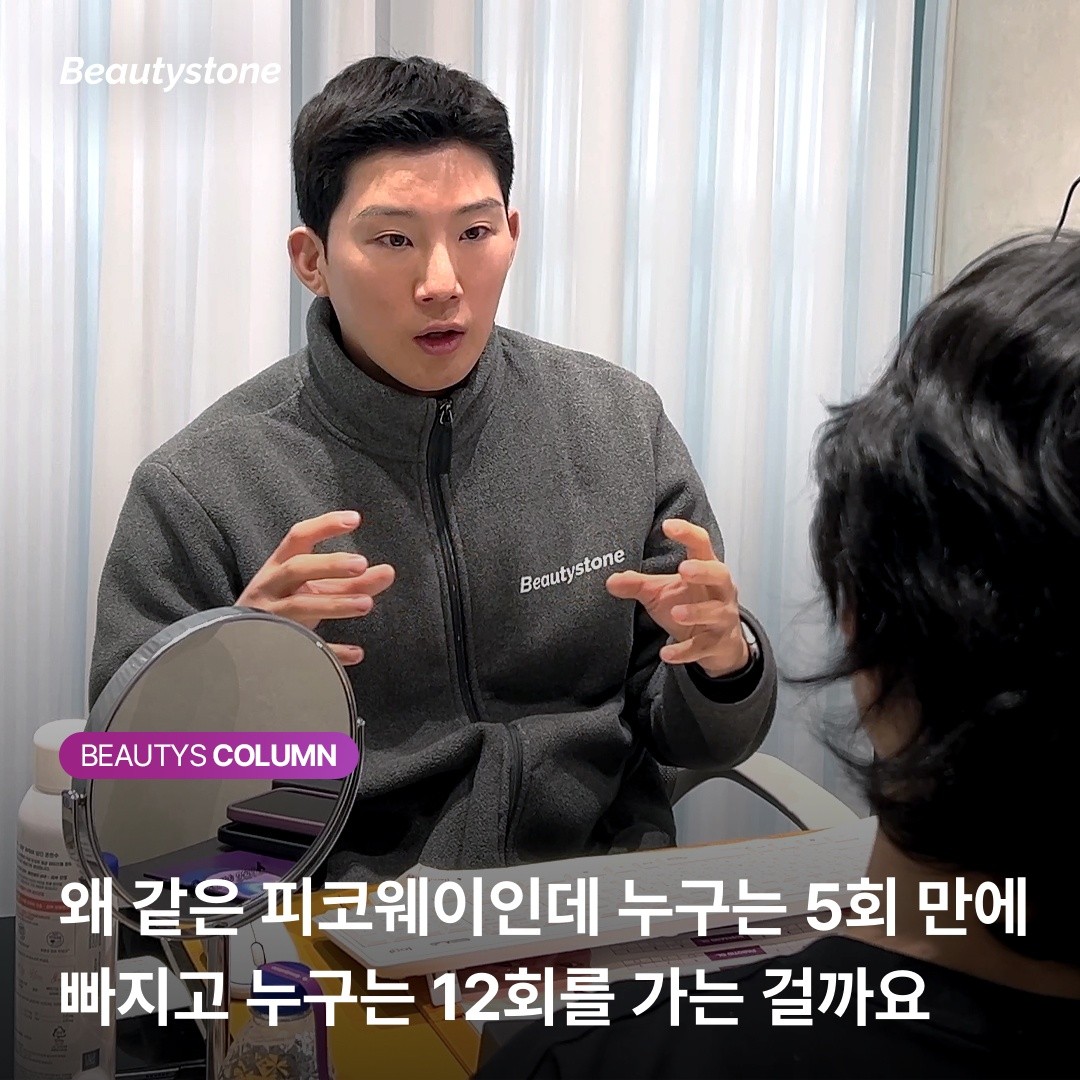
Dr. Wi Young-jin and Dr. Kim Ga-eul, Directors of Hongdae Beautystone Clinic
Hongdae Beauty Doctor Beauty Stone Clinic

"Doctor, 10 sessions really make it all go away?"

"Doctor, 10 sessions really make it all go away?"

"Doctor, 10 sessions really make it all go away?"

When choosing a place that does PicoWay tattoo removal well, be wary of low price

"피코웨이인데 왜 안 빠질까?" 타투 제거 결과가 갈리는 '줌 핸드피스'의 비밀


"Doctor, if I do 10 sessions, will it really all be gone?"

— A question I got even yesterday


Check this first before reading


Q. I went in for a consultation,

and they immediately recommended a "10-session package,"

is that normal?

A. Honestly, that's closer to average sales talk.

If a place locks in the number of sessions without a prior evaluation,

you should assume they are

ignoring variables like color and touch-up.


Q. It's the same PicoWay, so

why are the results so different from one hospital/clinic to another?

A. It comes down completely to the operator's skill with the handpieces (toning vs. zoom)

and the accuracy of the session design.


Even with the same device,

results vary widely depending on who uses it.


문신 제거 전 'Kirby-Desai 스케일' 평가를 안 받으면 돈 낭비인 이유


Picoway looks pretty much the same, right?

But the truth is

PicoWay delivers laser pulses in trillionths of a second

to shatter tattoo ink

into tiny pieces.


Because it uses three wavelengths, 1064nm, 785nm, and 532nm,

it can respond to different colors

from black all the way to yellow.


Unlike other pico devices,

PicoWay is characterized by using its handpieces

separately for toning and zoom

treatments.


Why does one person clear it in 5 sessions,

while another needs 12?


Director Wi Young-jin's

key insight


Before asking, "How many sessions will it take?"

check whether they evaluate you with the

Kirby-Desai scale.


If they talk about the number of sessions without an evaluation,

it's likely sales talk that ignores variables.


Tattoo removal is similar to

sifting out grains of sand one by one from muddy water.


When ink particles are broken up into tiny pieces, our immune cells

clean them up and remove them from the body.


Variables like color, depth, amount of ink, and skin tone

all differ from person to person.


That's why in medicine,

we use an assessment tool called the

'Kirby-Desai scale.'


A 45-year-old patient who came in last year

had been told elsewhere that "10 sessions would be enough,"

and received 5 sessions, but less than half had faded.


When we reassessed, due to the amount and depth of the ink,

it was a case that needed 12 sessions or more.


With PicoWay, you need to hit the deep-layer ink

using the Zoom handpiece,

and if you only keep repeating toning,

the number of sessions just goes up

and you only waste money.


Director Wi Young-jin's key summary

If the answer to "How many sessions will it take?"

comes out as a number right away,

that's not an evaluation—it's sales.


You need to find a place that properly scores the case and

designs the treatment precisely by combining toning and zoom.


컬러 문신 제거, 532nm 파장을 제대로 안 쓰면 횟수만 2배 늘어납니다


For a clinic that does tattoo removal well,

look for these 5 things

Check item

Good clinic (trustworthy)

Clinic to avoid (sales-driven)

Pre-assessment

Uses the Kirby-Desai system

Recommends a package before evaluation

Handpiece

Alternates between toning and zoom handpieces

Only performs procedures with the same settings every time

Who performs treatment

The doctor personally evaluates and treats

Only the consultation is with the doctor; the operator changes every time

Color response

Uses all three wavelengths in the right places

"It all comes out regardless of color"

Aftercare

The retouch policy is clear

They say it's over once the sessions are used up

Especially check whether the doctor personally looks at how much fades each session

and changes the energy settings.


The 3 most common

questions in the exam room


Q1. "Can I ask you to evaluate me with the Kirby-Desai scale?"

Is it okay to say that?

A. Of course. From a doctor's perspective,

it's only natural to be glad when someone has studied beforehand.


If a place is flustered by that question,

it's proof that session design is being done based on averages.


Q2. Which is better, per-session pricing or a package?

A. If it's a single color and small,

a package may be advantageous.


But if it's a color tattoo or a large piece,

per-session payment, which allows flexible adjustments

while watching progress, is safer.


Q3. After the procedure, I got blisters or

hyperpigmentation. Is that normal?

A. Small blisters may be within the normal range.


But if fluid keeps oozing,

or pigmentation spreads around the area,

that's a sign the energy was too strong or the aftercare wasn't right,

so you should come in right away.


If you take only one thing away today,

don't start by asking about the number of sessions,

and first check whether they use a pre-assessment tool.


In the next article,

'how to score the 6 items of the Kirby-Desai scale

on your own tattoo' I'll show you.


This has been Wi Young-jin.


Also read

"피코웨이인데 왜 안 빠질까?" 타투 제거 결과가 갈리는 '줌 핸드피스'의 비밀


"Doctor, if I do 10 sessions, will it really all be gone?"

— A question I got even yesterday


Check this first before reading


Q. I went in for a consultation,

and they immediately recommended a "10-session package,"

is that normal?

A. Honestly, that's closer to average sales talk.

If a place locks in the number of sessions without a prior evaluation,

you should assume they are

ignoring variables like color and touch-up.


Q. It's the same PicoWay, so

why are the results so different from one hospital/clinic to another?

A. It comes down completely to the operator's skill with the handpieces (toning vs. zoom)

and the accuracy of the session design.


Even with the same device,

results vary widely depending on who uses it.


문신 제거 전 'Kirby-Desai 스케일' 평가를 안 받으면 돈 낭비인 이유


Picoway looks pretty much the same, right?

But the truth is

PicoWay delivers laser pulses in trillionths of a second

to shatter tattoo ink

into tiny pieces.


Because it uses three wavelengths, 1064nm, 785nm, and 532nm,

it can respond to different colors

from black all the way to yellow.


Unlike other pico devices,

PicoWay is characterized by using its handpieces

separately for toning and zoom

treatments.


Why does one person clear it in 5 sessions,

while another needs 12?


Director Wi Young-jin's

key insight


Before asking, "How many sessions will it take?"

check whether they evaluate you with the

Kirby-Desai scale.


If they talk about the number of sessions without an evaluation,

it's likely sales talk that ignores variables.


Tattoo removal is similar to

sifting out grains of sand one by one from muddy water.


When ink particles are broken up into tiny pieces, our immune cells

clean them up and remove them from the body.


Variables like color, depth, amount of ink, and skin tone

all differ from person to person.


That's why in medicine,

we use an assessment tool called the

'Kirby-Desai scale.'


A 45-year-old patient who came in last year

had been told elsewhere that "10 sessions would be enough,"

and received 5 sessions, but less than half had faded.


When we reassessed, due to the amount and depth of the ink,

it was a case that needed 12 sessions or more.


With PicoWay, you need to hit the deep-layer ink

using the Zoom handpiece,

and if you only keep repeating toning,

the number of sessions just goes up

and you only waste money.


Director Wi Young-jin's key summary

If the answer to "How many sessions will it take?"

comes out as a number right away,

that's not an evaluation—it's sales.


You need to find a place that properly scores the case and

designs the treatment precisely by combining toning and zoom.


컬러 문신 제거, 532nm 파장을 제대로 안 쓰면 횟수만 2배 늘어납니다


For a clinic that does tattoo removal well,

look for these 5 things

Check item

Good clinic (trustworthy)

Clinic to avoid (sales-driven)

Pre-assessment

Uses the Kirby-Desai system

Recommends a package before evaluation

Handpiece

Alternates between toning and zoom handpieces

Only performs procedures with the same settings every time

Who performs treatment

The doctor personally evaluates and treats

Only the consultation is with the doctor; the operator changes every time

Color response

Uses all three wavelengths in the right places

"It all comes out regardless of color"

Aftercare

The retouch policy is clear

They say it's over once the sessions are used up

Especially check whether the doctor personally looks at how much fades each session

and changes the energy settings.


The 3 most common

questions in the exam room


Q1. "Can I ask you to evaluate me with the Kirby-Desai scale?"

Is it okay to say that?

A. Of course. From a doctor's perspective,

it's only natural to be glad when someone has studied beforehand.


If a place is flustered by that question,

it's proof that session design is being done based on averages.


Q2. Which is better, per-session pricing or a package?

A. If it's a single color and small,

a package may be advantageous.


But if it's a color tattoo or a large piece,

per-session payment, which allows flexible adjustments

while watching progress, is safer.


Q3. After the procedure, I got blisters or

hyperpigmentation. Is that normal?

A. Small blisters may be within the normal range.


But if fluid keeps oozing,

or pigmentation spreads around the area,

that's a sign the energy was too strong or the aftercare wasn't right,

so you should come in right away.


If you take only one thing away today,

don't start by asking about the number of sessions,

and first check whether they use a pre-assessment tool.


In the next article,

'how to score the 6 items of the Kirby-Desai scale

on your own tattoo' I'll show you.


This has been Wi Young-jin.


Also read

Beauty Doctor Hongdae Beauty Stone Clinic

Recommended post

Recommended post

Latest post

Latest post

"2주는 짧습니다" 위영진 원장이 피코웨이 주기를 4~6주로 바꾼 이유

Tattoo removal

솔직히 저도 예전엔 피코웨이 간격을 2주로 잡았습니다

피코웨이 문신제거 주기, 2주 만에 또 받으면 효과가 두 배일 것 같죠? 림프계 입자 배출 구간을 모르면 돈만 버리는 시술이 됩니다.

심부볼 주사 효과 없었다면? 위영진 원장이 말하는 '지지인대'의 비밀

Contouring & Volume

심부볼 지방분해주사 효과, 양만 줄이면 오히려 더 처지는 이유

심부볼 지방분해주사 효과, 지방만 녹이면 끝일까요. 지지인대가 느슨한 케이스는 오히려 더 처져 보일 수 있어서 회차별 변화와 병행 시술 판단이 중요합니다.

턱밑 살이 안 빠진다면 '마이크로웨이브'가 정답인 이유

Lifting

온다 vs 고주파, 위영진 원장이 분석한 '지방 파괴'의 결정적 한 끗 차이

온다 지방파괴 원리, RF와 뭐가 다를까요. 7mm 팁이 지방층을 67도까지 끌어올려 한 번 죽은 세포는 재생 안 됩니다. 다이어트 요요와 결과가 다른 이유.

뷰티스톤의원 위영진 원장의 분석: 써마지 효과가 6개월 만에 빠졌다고 느끼는 이유

Lifting

"써마지 1년 간다면서요" — 6개월차에 진짜 남는 건

써마지 지속기간이 12개월이라고요? 6개월차에 50%, 12개월차엔 20%만 남는 게 진짜 데이터입니다. 가구 재배치로 비유해드릴게요.

검은 잉크는 빠졌는데 빨강만 남으셨다고요? 그 이유 있습니다

Tattoo removal

검은 잉크는 빠졌는데 빨강만 남으셨다고요? 그 이유 있습니다

빨간문신제거가 안 되는 분들 90%는 파장이 안 맞은 겁니다. 일반 1064nm로는 빨강이 안 빠집니다.

Rejuran HB Treatment Cycle: Why Director Wi Young-jin Insists on '2 Weeks' Instead of 'One Month'Rejuran HB Treatment Cycle: Why Director Wi Young-jin Insists on '2 Weeks' Instead of 'One Month'

skin

Rejuran HB treatment cycle: Why it should be every 2 weeks, explained through the PN cycle

Do you think Rejuran HB once a month is enough? Because the PN absorption cycle is short, if you go beyond 2 weeks, it’s basically like starting over after the effect has already worn off.

🌸 Attending the Meditox Bangkok Cadaver Workshop at Beauty Stone Clinic 🌸